Why are we “going green”?

As previously mentioned, I bought the book by Peter Senge, The Necessary Revolution: How Individuals and Organizations Are Working Together to Create a Sustainable World. I wanted to read it because the green and sustainability movements have been impacting the printing and publishing industries over the past year. I am interested in a broader perspective on the subject. Indeed, our company – Grand River Printing & Imaging – has embarked upon its own green initiative and we held a highly successful educational event in Detroit on Earth Day (April 22) to provide a platform for our customers to learn about print media and sustainability.

Much of the recent development in this arena has been focused on paper and the wood fiber sources that are used to make it. The Forest Stewardship Council (FSC) is an independent organization dedicated to the responsible management of the world’s forests. This organization has established a chain of custody program in which all parties involved in the production of wood- and timber-based products, i.e. paper, furniture, building materials, etc., can become FSC certified. In doing so, these companies can demonstrate that the materials used to make the products that are ultimately bought and used by consumers have their sources in responsibly managed forests and woodlands. Products meeting the certification criteria can have the FSC logo imprinted upon them so that the public is aware of the green practices contained therein.

The FSC was founded in the early 1990s and has certified a significant portion of the world’s forests to date. Meanwhile, the number of companies achieving the FSC chain of custody certification has been growing exponentially as corporations, government and educational institutions have adopted the concept of using responsibly harvested wood-based products. Some organizations see this as a strategic goal and are using the FSC label along with other types of green programs to highlight their concern for the environment and willingness to contribute practically to the preservation of our natural resources.

Actually, the paper and printing industries have been involved in ecological efforts for many decades. Among the first industries to be impacted by laws passed in the 1970s by the EPA, the paper industry has been under particular anti-pollution scrutiny. As a major consumer of water and power resources, the paper manufacturers have been altering their practices over the past three decades. For print companies, who are major users of gas and electric power as well as the chemicals involved in the graphic arts process, government policies have regulated plant emissions and chemical waste disposal during the same three decades.
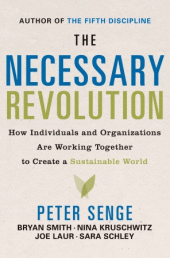
So, one of the reasons I wanted to read Senge’s book was to answer the question: why has sustainability and “going green” become such a hot topic in business today? A second reason was, since Mr. Senge is a purveyor of what you might call “business management philosophy,” I wanted to know where he sits on the question of global climate change and its causes; a controversial and highly charged topic.

On the first question, Senge provides an explanation of the source of the drive toward sustainability in the corporate world. As one would expect, with Peter Senge (and his co-authors Bryan Smith, Nina Kruschwitz, Joe Laur and Sara Schleyt), who wrote the acclaimed large volume The Fifth Discipline about “learning organizations,” there is no easy answer to the question. In The Necessary Revolution Senge and his collaborators attribute the transformation in business philosophy toward sustainability to a set of objective historical circumstances. They say that the sustainability revolution is not a fad or passing fancy but a new way of doing things in a world that is vastly different from the one that existed in 1950. This change is primarily driven, they say, by the global interdependence of nations and regions of the world and the realization that the side effects of the industrialization of the previous century and a half are unsustainable going forward.

The following passage from the opening chapter gives a good summary of this concept: “There are many types of revolutions. History talks mostly of political revolutions, dramatic events that all too often represent little real change over the long term: The cast of players in power shifts and new political philosophies come into vogue, but when it comes to the daily realities of most people, little changes. But occasionally something different happens, a collective awakening to new possibilities that changes everything over time – how people see the world, what they value, how society defines progress and organizes itself, and how institutions operate. The Renaissance was such a shift, as was the Industrial Revolution. So, too, is what is starting to happen around the world today.”

According to the authors of The Necessary Revolution, we are now at the beginning of the new post-industrial stage of society which mandates that we alter our view of the world and our use of its resources. In their view, this is the foundational source of the new policies and practices that are being adopted throughout the world toward preservation and establishing renewable sources of energy, air, water and food.

On the second question, Mr. Senge places climate change squarely at the feet of the growth of CO2 in the atmosphere. He writes, “Although science rarely provides absolute certainty, a consensus has emerged among scientists, and among a small but growing cadre of influential leaders, the the changes needed to avert extreme and possibly uncontrollable climate change will be greater and must happen far more quickly than we imagined even a few years ago. In this sense, climate change is a particular sort of gift, a time clock telling us how fast the Industrial Age is ending.” And further on he write, “Unlike so many other global social and environmental problems, in one sense climate change is simple — because its primary dimensions are measurable. Scientists now have extensive evidence of how rapidly CO2 and other greenhouse gasses are accumulating in the atmosphere, and how that compares with historical levels.”
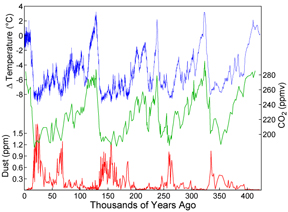
The authors then go on to explain the connection in the historical data between CO2 in the atmosphere and temperature, a fact that has been established through analysis of ice core drillings that preserved these characteristics going back 650,000 years.

While Peter Senge is not climate scientist, he is a social scientist and has done a considerable amount of his own research on human organization. The Necessary Revolution is devoted primarily to establishing a theoretical view of the new forms of activity that have emerged recently around sustainable practices in business, government and education. While I don’t subscribe to all of the ideas in his new book, I think that Mr. Senge and his co-authors should be credited with their honest portrayal of the scientific basis of the climate change crisis and pointing to the potentially catastrophic consequences of the resistance to dealing with this worldwide dilemma.

KD
July 12, 2008
Reflections on Düsseldorf

I’ve been back home now for nearly two weeks and have had an opportunity to reflect upon my experience in Düsseldorf, Germany during DRUPA 2008. While it didn’t take very long for me to settle back into the world of customers, printing projects, sales and marketing, I couldn’t help thinking and rethinking about what I saw there and the people I’d met. It was gratifying for me to find that many people at Grand River Printing & Imaging had been reading the blog and found it interesting. I also had numerous opportunities to tell others about the blog upon my return and send them a link to it. Many were glad to know that I started this project while I was away and appreciated the effort … So, here I go again.

The things that I learned about the technological progress of our printing and paper industries are significant. We are clearly at a transition in the economics of print media. There is now so much information available in electronic form and the myriad ways in which this can be enhanced and supported by paper-based (or some might say off-line) media opportunities. It really makes one stop and think about where to place resources and what would be the most effective investment going forward.

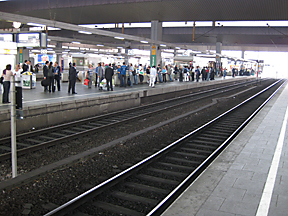
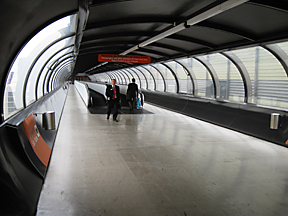
But enough about printing devices (digital or otherwise) and software. What I thought I should write about is some of the things about Germany that, I guess, are what you would call “lifestyle” issues. This would be things that one might take note of only  because it is different from the way things are done in the US. For example, I saw an interesting contrast in certain types of behavior. No one seemed to pay to ride the trains. Now, for DRUPA attendees the transit fare was included in the price of the entry ticket. This is clearly explained in the DRUPA literature. However, even though there is a place for travelers to insert their tickets, no one seemed to be using them. Of course, unlike cities in the US like NYC where a turnstile blocks unpaid entry onto the subway platform, access to the platforms are not impeded.

On the other hand, when on the surface streets, pedestrian crossings were strictly observed. When the “little green man” was lit up, then everyone walked. When the “big red hand” was lit, no one walked. It didn’t matter if there were any cars or not. Green, walk … red, stop. This is, of course, at odds with the pedestrian behavior in the US where everyone walks when the traffic is clear regardless of green, red, flashing, not flashing.

Something that takes some getting used to is the fact that there are attendants in every pubic restroom. These places, labelled with the letters “WC,” were very clean. Now this takes no getting used to. But, the attendant or custodian of the public men’s room was in most cases … a female. These ladies were the most polite and always graciously accepted tips. Correct me if I am wrong … this is something that you would never see in America!!

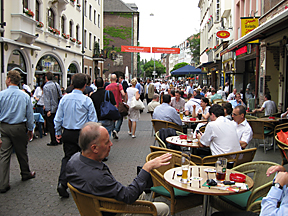
Another thing I want to mention is a commonly held conception that Americans have about Germany and this has to do with none other than … beer. It is true that beer is very popular in Germany and it is consumed at all hours of the day. It was not uncommon for me to arrive at the DRUPA exhibition in the morning and find people sitting at tables and chatting with bottles of beer in front of them. It seemed to always be available. Indeed, you could get beer served at any exhibitor booth any time of day of you being met with by one of the sales people. Meanwhile, every day at 5:00 pm many exhibitor booths would serve either Alt or Pils from the tap in little plastic 8 oz. cups.

Take a look at this video and count the number of people walking past the oom-pah band with large steins of beer in their hands (some have two) … and this was at 2:00 in the afternoon!!

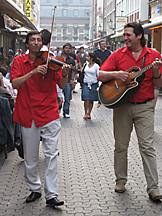
The last night that i was in Düsseldorf I had the pleasurable opportunity to visit the Altstadt (Old Town) or the place where everyone goes in the evening after the days events at DRUPA. As its name says, this is the part of town which is oldest and it has cobblestone streets with cafés and pubs with outdoor tables and chairs to sit on. This place was very lively until the wee hours of the morning and, of course, there was a fair amount of beer and spirits being enjoyed. There were also roving musicians playing different kinds of instruments and genres of music.


One of the strangest sights I saw in Altstadt was a lifesize wooden figure that popped out of a large chiming clock on the side of a building I was walking past. I wasn’t sure what this human-like creature was supposed and searched on the web to find the following description:

“SCHNEIDER WIBBEL
Chiming Clock with Mechanical Figures
Five times a day (at 11a, 1p, 3p, 6p & 9p), locals and tourists gather in front of the carillon to marvel at the glockenspiel, a chiming clock with mechanical figures which re-enact the story of ‘Schneider Wibbel’. Wibbel was a dressmaker who insulted Napoleon and was sent to prison. Instead of going to prison himself, Wibbel sent his apprentice, who died in jail, leading everyone to believe Wibbel was dead, while in reality, he was alive. Over the centuries, Wibbel has come to represent the typical, ‘clever Rhinelander’. Schneider-Wibbel-Gasse, a small street in the centre of the Old Town is also named after the cunning dressmaker.”

Perhaps Mr. Wibbel was quite clever, but what about the poor unnamed apprentice … a kind of garish story with an equally garish mechanical figure to go with it … enough said about that.

KRD
June 19, 2008 

Day 7: Last day at DRUPA

On my final day at the printing expo in Düsseldorf, I made sure to get an early start as I had an appointment with a manufacturer of color measurement equipment. I still had a few things to cover at DRUPA and one day can go by very quickly. The show starts daily at 10:00am and I wanted to be there when the doors opened. Since I am staying in Essen, it takes three trains (two underground and one regional train) to get there. On a good day this can take as little as 45 minutes. Today, was a good day and I was there promptly at 10:00.

I made my appointment and then set out to cover the two remaining topics on my agenda: publishing workflow systems and MIS systems. What is meant by publishing workflow systems is technologies that enable the process of bringing documents through the content creation and design stages up to prepress production. There were numerous technologies on display that handle these needs including the two most prominent desktop publishing applications: Adobe InDesign and QuarkXpress.

As you may know, a trend is developing in computer technology away from the desktop toward Internet-browser based applications and remote servers. The most well-known example of this is the Google Docs software. Without charge, this software can be accessed through your browser and you can create, edit and save word processing, spreadsheet and presentation files. The files are saved remotely (unless you elect to download them to your hard drive) and there are collaborative features that let you share the files with others easily. If you elect to download the files, they are compatible with Microsoft Office applications and can be opened and edited with these applications. As you can imagine, these browser-based applications have the traditional desktop software industry concerned.

This includes the companies that have dominated the desktop landscape in what might be called “professional” print design. These companies are now heavily involved in the development of Internet-based collaborative and cross-media solutions, that enable everyone in the publishing workflow to search content, access files, edit and update documents.

One workflow solution that I had an opportunity to review is called Helios software. This company has been developing Mac and Windows client/server technologies for the prepress and printing industries since the 1980s. They are now offering a browser-based solution that allows content creators to share projects over the Internet. Color management, PDF proofing and production and other aspects of the workflow are combined together into one system.

Another system that I saw was Exprem which is actually a web-2-print solution. However, within this system was a browser-based creative application that enabled users to create documents from scratch. The tool set that this application contained were every bit as sophisticated as those in InDesign or QuarkXpress including transparency and blending features.

Finally, I had a chance to look at some of the MIS (management information systems) at DRUPA. There are 37 of these systems on display at the show. I was able to look into three of these: HiFlex, DimS and Prism. All of these solutions offer a comprehensive information infrastructure for printing companies from customer interaction through production and invoicing. As with the workflow tools, these applications now feature browser-based interfaces and have automated communication solutions that send email at various stages of the process.

As I was getting ready to leave DRUPA I decided to make a short video farewell message which you can watch below:

KRD
June 6, 2008