Day 6: Back to DRUPA

I returned to DRUPA today to resume my review of the latest and most important technologies in the print media industry. The DRUPA directory divides the categories of our business into six distinct subgroups. These sections are:
1. Prepress and premedia
2. Printing
3. Bookbinding, print finishing
4. Paper converting (including packaging production)
5. Materials and consumables
6. Services

This is a good breakdown — and it should be since they’ve been doing this for decades — of all the aspects of the print media industry. If you overlay the six items I set out to investigate on my trip onto this list, you will see that my categories of interest only intersect with three of the DRUPA categories. This is how it looks:

1. Prepress and premedia=color management, publishing workflow solutions, web2print solutions
2. Printing= digital printing equipment & web offset press equipment
3. Services=MIS systems

Since I’ve already written about digital printing, color management and web2print, I now only now need to complete my review of publishing workflow solutions, MIS systems and web offset press equipment … sounds easy doesn’t it. But not so fast … there are a few other things I need to write about.
As you can tell, I’ve used this blog to talk about a lot more than just technology. This is because I believe the most interesting discussions about technology require some idea of the history of the things we are talking about; where did they come from, why are we doing it this way and what is likely to happen to it in the future. This is not a guessing game. It is possible to anticipate what will become of one technological innovation when you have a grasp of the things that have come before it and see the parallels that it has with the past. No technology completely repeats the path of the ones that have come before it; however, there are important similarities.

For example, the replacement of letterpress technology (metal type and relief printing methods) came into existence with Gutenberg’s invention of 1450 (as discussed my Day 4 blog). Letterpress, in turn, was replaced (eventually) by a combination of offset (1909) lithography (1793) and photoypesetting (1949). Although these technical achievements came together in the first half of the twentieth century, they did not overtake letterpress in terms of the total volume of printed matter until sometime in the 1970s after magazines and newspapers adopted the offset method of printing.

With offset lithography dominating the printing landscape for the last quarter century and more, the question is: what will replace it and when will this happen. Although we cannot predict these things with certainty, DRUPA 2008 provides — fortunately for us — a guideline to the answers to these questions.
Some experts in our industry predict that digital printing, in some form or fashion, will displace offset lithography as the dominant printing technology by the year 2020. This bold assertion has been made by Frank Romano and a group of students at RIT in a report sponsored by Canon entitled: The Insight Report: Digital Printing Directions, Trends & Opportunities.

This conclusion is derived not only from a depth of historical knowledge of our industry technologies, but also from interviews with 619 current print producers, industry observers and others. I would highly recommend that readers of this blog download and read a copy of this study: 

http://www.canon-europe.com/Images/Digital%20Printing%20Directions_v4_tcm13-514221.pdf
While digital printing’s cost is coming down and quality is coming up, offset printing will continue to be the most cost effective and highest quality printing method available. And even after digital becomes dominant, offset will continue to exist side by side with it. The traditional press manufacturers know this and they are continuing to put huge investments into offset printing technologies.

This is very evident in the web offset arena. The DRUPA directory lists 41 exhibitors of what they call “offset presses, web fed.” Of course, I could not possibly visit all of the suppliers, so I picked out a few. The market for this type of equipment is has been expanding rapidly in recent years, especially in Asia. 

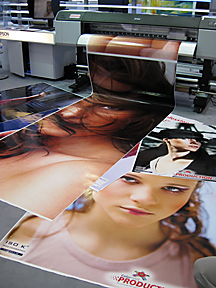
There were at least four web presses running live on the show floor. I was able to see three of these presses. One was a 16-page newspaper press from a Russian manufacturer called Litex. The Litex model was called POG2-84 series press and it contained one roll stand, one four high unit and a combination folder. It was running at a speed of 35,000 per hour. The second was a four unit Komori commercial heatset web. Komori was running the System 38S press at speeds up to 60,000 per hour. The third was a four unit commercial web from Goss International called the M600 Folia press. This press is designed to compete with high volume sheetfed as it prints from a roll to a specially designed sheeter at speeds up to 30,000 per hour, without an oven and with sheetfed inks.

You can see brief clips of of these three presses in the video below:

In the case of the Komori press, there were several important technical developments that point the direction in which offset lithographic presses are moving. This press ran 3 separate jobs requiring startup, makeready, and saving 1,500 good copies. The third of these projects also included a folder changeover. This sequence was done in under 14 minutes after the operator pressed one button on the console. Automatic plate changers, optical scanning of the press sheet for approval of good copies, automated speed up and slow down of the press and automatic folder setup were used to achieve this result.

One of the challenges facing the offset market is the cost and waste associated with the makeready. Since digital printing has no makeready (the first copy is, at least in theory, as good as every other copy), the makeready cost and process goes away. Many of the new technologies being developed are aimed at reducing the makeready cost and waste down to its absolute physical minimum. Another example of this is a new sheetfed press technology from Heidelberg that claims good copy within 5 impressions.

KRD
June 5, 2008 
Day 5: Ruhr valley transformation

There are many similarities between Detroit and the part of Germany where I am staying. I am referring to what is known as the Ruhr industrial valley where modern German manufacturing was born. The Ruhr River runs east to west and links up with Rhine (south to north) just above Düsseldorf. The cities in the Ruhr industrial area are: Duisburg, Essen, Bochum and Dortmund. All of these cities have an importance in the history of German industry. However, like in Chicago, Detroit, Cleveland and Pittsburgh, this area of Germany has experienced a significant decline in the recent past.

Today I had the opportunity to take a tour of this area and I did not want to pass it up, so I will get back to the DRUPA exhibition tomorrow.

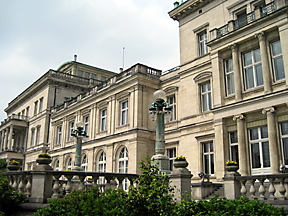
My first stop was the Krupp family mansion in Essen which is called Villa Hügel. Like Ford Motor Company in Detroit, Rockefeller’s Standard Oil in Cleveland and Carnegie’s US Steel in Pittsburgh, several generations of the Krupp family took the small business founded by Freidrich Krupp in 1811 and turned it into a major international steel corporation that dominated the city of Essen. A couple of the important industrial developments made by Krupp were the invention of seamless train wheels in 1851 and stainless steel around 1912.


For some strange reason the mansion at Villa Hügel is called Small House … but I can’t think of anything that would make this house look small. Like similar residences of the barons of US industry from this period, the house — built in 1873 — has very high ceilings, many rooms — including a ballroom — and is located on a large estate with gardens, winding walkways, green lawns, etc. Unfortunately, none of the displays in the historical museum were in English so it was difficult for me to follow along. However, for a fee of € .50 I was able to buy a brochure in English that explained the information in the exhibit.

At the height of the company’s success the Krupp steel company employed over 200,000 people in Essen. In order to foster company loyalty, Krupp built a garden city of housing for their employees nearby. The name of this area is still known as “Margarehten-Höhe,” so-named after the wife of Friedrich Alfred Krupp, Margarethe, who designed the village.


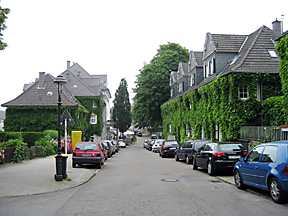
I toured this neighborhood with street after street of two and three multi-flat homes that were covered with ivy. It seems like a very nice place to live with a few shops and restaurants as well as Kindergartens. In its heyday Krupp owned 70,000 flats in Essen. However, none of the Krupp steelworkers are still living here … there’ll be more on that in a moment.

But first, as you probably already know, I need to mention that the Krupp family came into disrepute and revulsion when Gustav Krupp von Bohlen und Halbach and his son Alfried both supported Hitler and the rearmament of Germany during World War II. They even set up forced-labor production facilities with prisoners of war. The Allies bombed the massive Krupp steelworks destroying large sections of it and then Alfried was tried and convicted at Nuremberg. However, after serving only 2 and a half years Alfried Krupp was released form prison, on the order of American occupation authorities, and resumed control of the firm in 1953.

The last of Krupp family gave up their control of the company in the 1960s and transformed their shares into a foundation. The company was merged with Hoesch in the 1980s and then Thyssen in the 1990s. It is now known as global industrial conglomerate ThyssenKrupp.

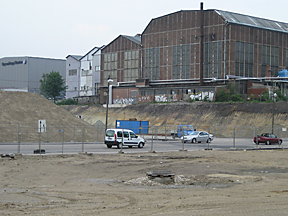
As I said, like Detroit and other US cities, the cities of the Ruhr valley have undergone a transformation in the last several decades with plant closures, layoffs and generally difficult economic times. Today, most of the Krupp steelworks complex has been demolished or redeveloped and turned into shopping areas and educational facilities. Driving around this semi-barren area of Essen, the only functioning factory that I saw was a ThyssenKrupp titanium plant. This is the modern looking building on the left in the photo above. The building on the right is part of the former steelworks and is now a web offset printing company called WestEnd.

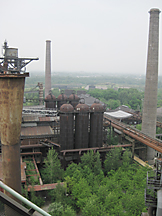
At my next stop in Duisburg, I learned how some people in Germany have tried to respond to the economic transition. Duisburg still has functioning steel production, but most of it has been closed down. One of the closed steel mills has been turned into a park with a museum. One of the blast furnaces was open to the public and I walked up to the top of it and took some pictures of the area at about 300 feet up. If you look in the foreground of the picture below, you can see how the trees have started to grow right inside the remains of the industrial complex.

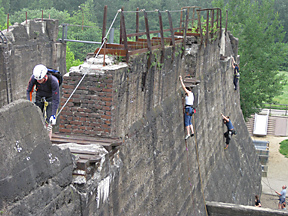
Meanwhile some of this old steel manufacturing machinery has been converted into different types of recreational facilities. Believe it or not, one of the large tanks has been converted into a scuba diving training tank. There is even an Alpine mountain climbing club that uses the area where coal and iron ore train cars used to come through a training facility area. I am not kidding … look at the picture and watch the video to see for yourself!!

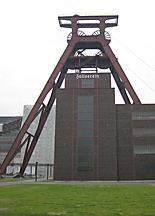
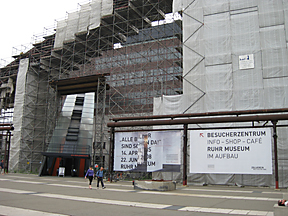
Back in Essen, I also toured a shut coal mining complex called Zollverein which is being converted into a cultural center. On the grounds of the coal mine, there are many different buildings that were part of the production process that have been converted into arts educational facilities. There is a program for visual arts, dance, modern design. The Zollverein complex also hosts concerts and other large cultural events. Each area of the complex is being reconstructed to host different aspects of the arts. There are two mine shafts and one coking plant that are being converted.


With much of the work already completed, the efforts at Zollverein are one of the reasons why the Ruhr has delcared itself the European Capital of Culture. A large international celebration is planned for 2010 … this sounds to me like a good reason to come back in two years.

KRD
June 4, 2008 

Day 4: Trip to Mainz

After I posted Sunday’s blog, I began thinking that I should take advantage of my trip to do something I’ve wanted to do for about 20 years: go to Mainz, Germany and visit the Gutenberg Museum … and that’s exactly what I did today. After three days at DRUPA I felt like I needed a break from the intensity of the crowds and the exhausting exhibition floor work.

The trip was about two and a half hours on the train from the Essen Hauptbahnhof (main railway station) near where I am staying to the Mainz Hauptbahnhof. The speedy train stopped only a few times while going through Düsseldorf, Köln, Bonn and Koblenz. Importantly, the train tracks follow the path of the Rhine and there are many fantastic scenes along the river. The cathedral at Köln is one that is especially memorable with its towering steeples. The trip would probably be a lot shorter if it did not follow the river; there are many bends and curves the Rhine. This also adds to the beauty of the view, however. 

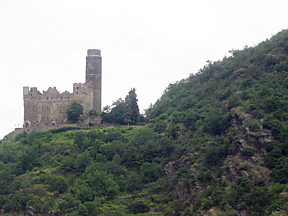
Without a doubt, one of the most spectacular sites along the Rhine River are the castles. I don’t believe I’ve actually ever seen a Medieval castle before. Perhaps it was just the cloudy day, but they seemed mysterious and threatening. After all, many of them hang over the edge of the steep crags above the river because they were built by the Kings and Dukes as a means of defending their property. I must have seen a dozen of them without looking very hard … they stand out quite nicely from the landscape around them.

Then my mind began to wander when I realized that there are so many castles that there must be a real estate market in these historic properties. As I drifted further, I thought that if these castles were in America there would be a show on HGTV called Castle Hunting and there would be this extremely wealthy couple meeting with an exasperated real estate agent and saying things like, “We really would like to see something mid-1300-ish. I hear the hardwood floors are to die for” or “Could you show us one that’s been modernized, we really need to have granite counter tops in the kitchen?” or “Does this one have a finished dungeon?” But I’m getting off the subject …

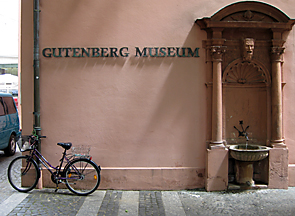
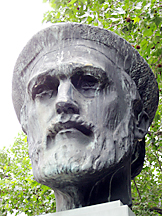
I arrived in Mainz with my map in hand and set out from the Hauptbahnhof to find the Gutenberg Museum. It was about one mile from the station through some winding streets. When I finally located it and went inside, I was struck by two things: there were very few people in the museum and the facility itself was very modest. Now, there are some monumental museums that recognize some people in history who haven’t made one tenth the contribution that Gutenberg made (I won’t mention any names), so the size of the building or the statue or whatever form of recognition is not really the issue. I was surprised most of all I guess by the way the museum seemed hidden away and not really boasted about by the entire city. It was as if this was just another among the many things in Mainz like the cafés and the shops and the other museums. It’s as if they’re conflicted about Gutenberg somehow … I really don’t know what more I can say about this.

The city of Mainz held a celebration in the year 2000 on the 600th anniversary of Gutenberg’s birth. There were exhibitions, multimedia projects, public festivals, cultural events and concerts. The city also published a book entitled: Gutenberg, Man of the Millenium. I believe this to be a true statement and as I’ve read and learned more about Gutenberg, I’ve become more convinced that it’s true.

First of all, people or individuals don’t select the times that they are born in. This is an obvious point. But what is less obvious, in my view, is that the times we live in sometimes have a way of picking up the things we do and take them on a journey that we perhaps never intended or could have intended.

The known details of Johannes Gutenberg’s life are few and far between. With documentary evidence quite meager after 600 years, there are many gaps in his biography. Due to the lack of information, a mythology has been built up about Gutenberg that (1) his ideas about printing came to him “like a ray of light,” (2) that he was a failed businessman and (3) he died in poverty. None of this is true.

What is known is that Gutenberg left Mainz in 1430 due to political conflicts between the patricians and the guilds. Gutenburg, himself a patrician with an inclination toward the guild members, was owed considerable sums by the local government. It is likely that Gutenberg began his project in 1439 while living in Strasbourg. Far from it coming to him in an instant, Gutenberg worked on what he called his “secret enterprise” for some ten years before it was complete and ready for commercial production. The processes involved in the technique were complex and expensive and would have required numerous approaches and attempts. Among them were:
1.) Typeface design
2.) Engraving of patrices
3.) Manufacture of matrices
4.) Creation of the manual metal typecaster
5.) Composition of metal alloys
6.) Ink formulation
7.) Experiments with paper and parchment
8.) The construction of the wooden press machinery

By far the most significant of these, was (4) the invention of the handheld mold for casting metal type. While I was at the museum, I asked if any of the original casting devices were existent and was told that none had been preserved; the ones that were in the museum were recreations from information available about how they were constructed. This information did not include any drawings or schematics. Below is a video of a demonstration given by the museum on Gutenberg’s invention.

It is believed that Gutenberg returned to Mainz in 1448 and it was around this time that the process was finalized and live projects could be produced with his invention. In 1449-50, Gutenberg secured an investment from Johannes Fust and the two became partners, opening the first commercial printing establishment in the world. A rented facility was located, new presses were built, a staff was hired and trained, materials were procured and stored for the purpose of producing the 42-line Bibles that are well-known.

In 1455, there was a business dispute between the two men and Fust sued Gutenberg in court on charges of refusal to pay interest on his loan and embezzlement. In a complex ruling, the court issued an order for Gutenberg to pay a portion of what Fust demanded and the two parted company. The legal dispute with Fust certainly set Gutenberg back as he was unable to pay immediately. Fust kept the Bible inventory, opened up his own printing facility and took the most skilled employee of the firm (Peter Schöffer) with him. However, Gutenberg was not ruined and he continued to work energetically on the development of his technique … he just had a competitor down the road, another first in the industry.

It is believed that Gutenberg continued to produce Bibles and other products such as calendars and letters of indulgence. In 1465, the archbishop of Mainz, Adolf von Nassau, appointed Gutenberg as “gentleman of the court” in recognition for his achievements which he enjoyed until his death in 1468. His invention spread rapidly throughout Europe, led to an tremendous expansion of literacy and is considered a key element in the Renaissance.

KRD
June 3, 2008