Day 3: Unified global color standards

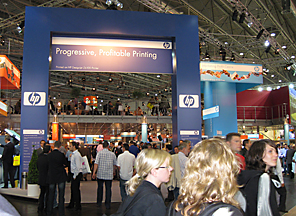
One feature of DRUPA that was started in 2004 and is now expanded in 2008 is called Drupa Innovation Parc (DIP). This is a hall dedicated to smaller and innovative companies that offer new solutions to printing and publishing related issues. Since I had spent most of my second day walking through the halls with heavy machinery, I wanted some time to focus in on software and related technologies.

Most of my career has been in prepress and premedia. While I am truly impressed with the mechanical element of the print process and have learned as much as I can about it, I am much more at home at the front end of production, i.e. the world of computers, creative workflows, content management, e-commerce and the like. This what the DIP is all about. There are seven division with the DIP:
1. Print buyer integration
2. Print + publishing
3. PDF + XML production
4. Creative production
5. JDF experience
6. Document management
7. Online communications 
There are more than 100 exhibitors in the DIP and I decided to just wade right in. The first thing I looked at was web2print or web-to-print solutions in the online communications section. These are technologies that enable a printer to host an online storefront where clients can specify, upload files — and in some cases even design documents and pages — for print media products and then purchase them electronically. Most of these systems are aimed at the short run and digital print market. However, I could see how a high-volume and primarily lithographic printing firm could have a web2print store front solution that would enable clients to purchase products online. The key competitive issues here would be price, turnaround and shipping costs … what’s so innovative about that.

After speaking with a few companies about web2print, my next stop was to talk about color management at the Alwan Color Expertise booth in the Print + production section of the DIP. Here I was presented with software that manages the conversion of customer or internal color data for printing companies so that they can more easily meet the customers’ color expectations. Alwan, a company that was founded in France in 1997, is also a big proponent of color standards for the graphic arts.

The following appears on the company web site:

“The globalisation of the industry has resulted in many new challenges to producing consistent quality print,” says Elie Khoury (founder of Alwan). “It is not unusual for the origination for a job to be created in one place, while the customer checking proofs is in another and the final output of the work is carried out in several countries. … If you can control color at every stage by standardising incoming files, produced proofs and the final print, you will significantly improve productivity and profitability”

This global perspective is not just sales jargon. During my discussion with the Alwan representative, I found out that there was a meeting being held that same day in a conference room in the DRUPA complex at 4:00pm. The meeting had been called by a group called “Printing Across Borders” whose aim was to unify the European and American color standards initiatives. This sounded like something that was in keeping with the theme of DRUPA: One World – One DRUPA, so I said that I would be interested in attending.

I finished up my visit to the DIP with a few more vendors and then decided to make my way over the Printing Across Borders meeting. In addition to the exhibition halls, the grounds of Messe Dusseldorf also include something called Congress Center Dusseldorf. The meeting was being held in CCD Room 7.
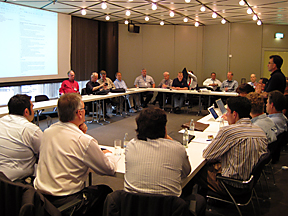
When I arrived I found a group of no more than 40 people around a conference table getting ready to begin their discussion. The chair of the meeting was none other than Elie Khoury of Alwan. I was also pleased to find among those in the room was Bill Birkett and Chuck Spontelli from Doppleganger, LLC a Michigan-based color consulting company. Others in attendance included technical representatives of printing equipment manufacturers, prepress companies, color measurement companies, technical consultants and printers from a dozen or so countries. 

The topic under discussion was trying to find a means to unify the European color standards (under the designation of ISO 12647) with the standards work done in the US (under the designation GRACoL7). For reasons beyond the control of most of those in attendance, these two standards initiatives evolved independently of each other. Some of this problem has to do with lack of communication between the two groups and some of it is related to an important technical legacy. Prior to the development of computer-to-plate and spectrophotometric color measurement technologies, the Europeans used positive film and negative plates (generally) and the Americans used negative film and positive plates. This led to slight differences in the appearance of printed color. This difference has been carried over into the world of ICC profiles and DeltaE color differences.

Fortunately, the actual color that each of these standards represents is by-and-large very similar. The consensus of those in the meeting was that these difference needed to be and could be resolved. If things were only so easy! There were three or four presentations that were given by representatives of each side and the specific technical details of the differences between the standards were discussed. These presentations were followed by discussion and the moderator ask each of the people in the room to express their opinion.

When he got to me, I said, “As a representative of a US printing firm, I am pleased to be able to participate in the meeting to discuss this important topic. Establishing one unified international color standard is important for all of our businesses to be able to successfully meet our customers’ needs. Getting the differences between the standards resolved is something that needs to be done quickly as we are discussing — for the most part — the lithographic reproduction of color in halftones. As everyone knows, at DRUPA we are seeing the rise of digital printing technologies and there are predictions being made here that digital printing will overtake lithography by the year 2020. That’s twelve years from now. GRACoL was founded in 1996 and that’s twelve years ago, so we don’t have a lot of time.”

KRD
June 2, 2008 

 

Day 2: A vast industry

One of the first things you notice when traveling to Germany from Detroit is the availability of public transportation. The closest thing Detroit ever had to a public rail system was the streetcar and the last of those stopped running in 1956. The trains here have very comfortable seats, ride very smoothly and are quiet when they pull into the station. Most, if not all, of the passengers on the trains I’ve been riding are either attending or working at DRUPA. It has been very easy to get help to make sure that I am going and coming on the right train even though I am not able to speak German.

  The last of the Detroit street cars stopped running in 1956

After spending the first day at DRUPA walking through three buildings where digital presses were located, I decided to venture out and get the “lay of the land.” Even though the maps, signs on the buildings and the directional information is well organized and easy to follow, it still takes a little while to figure out where everything is located on the grounds of the Messe.

The last time I was at DRUPA was 1995 and I  remember how overwhelming the exhibition was. Nothing can really prepare you for the magnitude of what is going on here. At that time, the big new technology was computer-to-plate devices and there more than 30 suppliers who were demonstrating their systems. Today there are less than a handful of manufacturers of computer to plate devices.

After walking around on the second floor of Hall 7 where many of the paper companies are located, I wandered down a tube-like bridge that had the longest moving walkway I have ever seen. This took me toward Halls 1-6. When I arrived at the end of the walkway and exited the tunnel, I entered Hall 1 which was entirely devoted to Heidelberg and it’s enormous product portfolio of commercial and packaging printing presses and finishing equipment … then I noticed that Heidelberg also occupied Hall 2!


What I was hoping to do was find someone to ask why Heidelberg does not have an inkjet printing press on display at DRUPA. But the hall was so packed with people and machinery that I decided to just move through the exhibit and into the next part of the show.

When I entered Hall 3 and started looking around at all of the companies that manufacture different pieces of machinery or materials for the industry I was reminded how enormous the print media industry is. We have packaging, foil stamping, all kinds of special coatings, papers and synthetic substrates, book binding, flexography, gravure, embossing and … you get the idea. There is no one person who can get their head around this entire industry; it is just too vast.

This is understandable when you think about the fact that printing (in its modern manufacturing form) has been around for 558 years. Think about it … printing was invented a half-century before Columbus crossed the Atlantic. When Johannes Gutenberg developed the first mechanized system for the mass production of movable metal type in 1450, he was starting the printing industry that we know today. A businessman, Gutenberg is well known for having printed 180 copies of the 42-line bible with his new invention. However, as is the case with most printed matter, nowhere does Gutenberg’s name or that of his firm appear on these earliest products of our industry.

KRD
June 1, 2008 


Day 1: Thermal inkjet press takes center stage

My plane touched down at 11:30am in Düsseldorf and I decided that I felt good enough to go straight to Messe Düsseldorf (this is the name of the exposition center where DRUPA is held) despite the fact that I had almost no sleep and it was actually 5:30am for me … I was feeling a second wind coming on. Once I got my bags I went about finding my way to the show.

There was a DRUPA information booth in the airport and the attendant was very helpful in directing me to the underground railway to the Messe. After a cup of coffee (a good one, too) I was on the platform and shortly thereafter arrived at DRUPA at about 12:30pm. Wow, the place was mobbed with people on a Saturday afternoon!

I selected digital printing as the first order of business because I knew from the pre-DRUPA literature I had been receiving that this was an important area of development. According to the directory there are 55 exhibitors with digital printing presses. The term “press” is being used very loosely here. In fact, that is one of the problems with technological development, printing or otherwise: the advancements are stressing the concepts and words that we have used historically.

Broadly, I would define digital printing presses as printing machines that are capable of (1) accepting a digital file directly into the system and (2) producing full color pages. These systems can be categorized into three groups:
1. Offset lithographic presses that digitally image plates on press
2. Toner-based printing presses (similar to office color laser printers)
3. Inkjet-based printing presses (similar to desktop inkjet printers)

I decided to focus on the last of these as this is the technology that is the newest and is showing significant advancements … I must say I wasn’t disappointed. The DRUPA directory lists 57 exhibitors of what they categorize as “ink jet printing systems.” This didn’t really help me very much, so I went looking and I found what I would call inkjet printing presses at the following booths:
1. Hewlett-Packard
2. Agfa
3. Kodak
4. FujiFilm
5. Screen USA

The most striking thing about this list is that the latest and most exciting area of development in the process of putting ink-on-paper does not include any of the traditional manufacturers of lithographic press equipment. Where is Heidelberg, KBA, Komori, Mitsubishi, etc.? I don’t have an answer to this question yet … but I will find out.

By far, the most important piece of equipment at DRUPA is HP’s Inkjet Web Press. This is a thermal inkjet device that, according to the product literature, “enables fast, four-color double-sided printing at 600 dpi with speeds of up to 400 feet per minute and inline process control. With roll-to-roll production at widths of up to 30 inches you can get high speed, high volume color print production in quantities up to 70 million per month.”

Now this is something entirely new. This machine is capable of a continuous stream of variable copy in a web press-like configuration. The implications of this machine for printing and publishing are significant. According to Andy Tribute, an industry expert: “The HP Inkjet Web Press is a ‘transition press.’ By that I mean it is a press that will be a major agent for change within the industry. It will be the first digital press that really will challenge offset color printing in areas other than short run color printing. … I think it can have the same level of market impact on offset printing as desktop publishing had on changing the structure of the prepress business in the 1980s and 1990s.”

The device is aimed at the following markets: direct mail, transaction printing, books and newspapers. Some may say that the quality isn’t there yet, that 600 dpi is not sufficient to compete with lithography. I remember a time when some said desktop publishing software couldn’t compete with phototypesetting because it lacked kerning of type. Well, desktop software is kerning type now and phototypesetting doesn’t exist any more.

May 31, 2008
KRD