Benjamin Franklin, Printer: 1706 – 1790

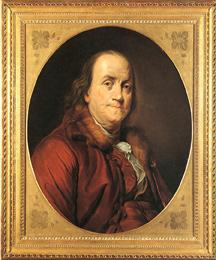
At the time of his death in 1790, Benjamin Franklin was world-famous as a philosopher, scientist, inventor and diplomat. His significant contributions to the American Enlightenment and as a leading figure of the Revolution of 1776 are far too numerous and important to be appropriately dealt with in this short space. However, his work as a printer deserves special appreciation.

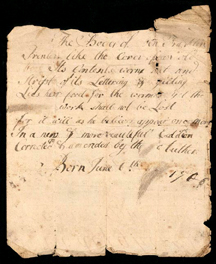
In 1728, when he was 22 years old, Benjamin Franklin wrote the following humorous epitaph for himself:

The body of
B. Franklin, Printer
(Like the Cover of an Old Book
Its Contents torn Out
And Stript of its Lettering and Gilding)
Lies Here, Food for Worms.
But the Work shall not be Lost;
For it will (as he Believ’d) Appear once More
In a New and More Elegant Edition
Revised and Corrected
By the Author.
In his last will and testament of 1788, Franklin amended his plan for the inscription on his gravestone to bear just the names of himself and his wife—Deborah Read Franklin—who preceded him in death by 15 years. In his will, however, he identified himself thus: “I, Benjamin Franklin, of Philadelphia, printer …”

Born in Boston, Massachusetts, Benjamin Franklin was the last of his father’s seventeen children. Franklin began his printing career when he was apprenticed to his brother, James Franklin, at age twelve. After he was denied his wish to be published in James’ newspaper, the young Ben began submitting letters to The New-England Courant under the pseudonym “Mrs. Silence Dogood.” The correspondence became very popular in the local community.

At age 17, Benjamin left his apprenticeship without permission, ran away to Philadelphia to start out on his own. After building his reputation as a skilled craftsmen—as both a type compositor and pressmen—and disciplined worker, Franklin had the opportunity to set up a printing house in partnership with Hugh Meredith in 1728. The following year he became publisher of The Pennsylvania Gazette, one of two newspapers in the colonies.

In his Philadelphia printing shop, Franklin produced his newspaper, government printing projects and he took on a considerable volume of print for hire such as forms, lottery tickets, handbills and bookwork. Beginning in 1730, Franklin was printer of all paper money issued by Pennsylvania, New Jersey and Delaware.

Perhaps one of his most recognized projects was “Poor Richards’s Almanack,” which Franklin wrote under the pseudonym Richard Saunders and printed for 25 years beginning in 1732. As Franklin explained in his Autobiography, “I endeavor’d to make it both entertaining and useful, and it accordingly came to be in such Demand that I reap’d considerable Profit from it, vending annually near ten Thousand. . . . I consider’d it as a proper Vehicle for conveying Instruction among the common People, who bought scarcely any other Books.”

Although Franklin was not the author of the many clever aphorisms contained the Almanack, it can be argued that these sayings have been passed down and are part of our speech today because of his work. Here are a few of them:

–       Early to bed and early to rise, makes a man healthy wealthy and wise. (1735)
–       The rotten apple spoils his companion. (1736)
–       No gains without pains. (1745)
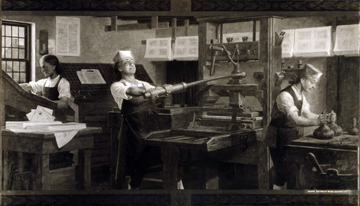
During his printing career, Ben Franklin made important contributions to the technology and practice of printing. He made major improvements to printing press design and helped to set up paper mills in the south. He established in 1778 the first printers’ association in America (later named the Franklin Society), established the first public library, is credited with the idea for the first American magazine and was appointed the first Postmaster by the Second Continental Congress in 1775. Benjamin Franklin created a franchise business model that launched two-dozen printing establishments up and down the Atlantic Coast.

In his “Apology for Printers,” Franklin elaborated a philosophy for the role of the printer in modern society: “Printers are educated in the Belief, that when Men differ in Opinion, both Sides ought equally to have the Advantage of being heard by the Publick; and that when Truth and Error have fair Play, the former is always an overmatch for the latter.” If printers printed only what they believed, “the World would afterwards have nothing to read but what happen’d to be the Opinions of Printers.”

We look back and appreciate the work of Benjamin Franklin with pride; he was one of our own.

Alois Senefelder: 1771 – 1834

By some estimates, offset lithography represents approximately two-thirds of all print today. Even with the rapid growth of digital printing, the oil and water based process, that also transfers the image to the paper with rubber blankets, is still by far the most dominant form of print media production.

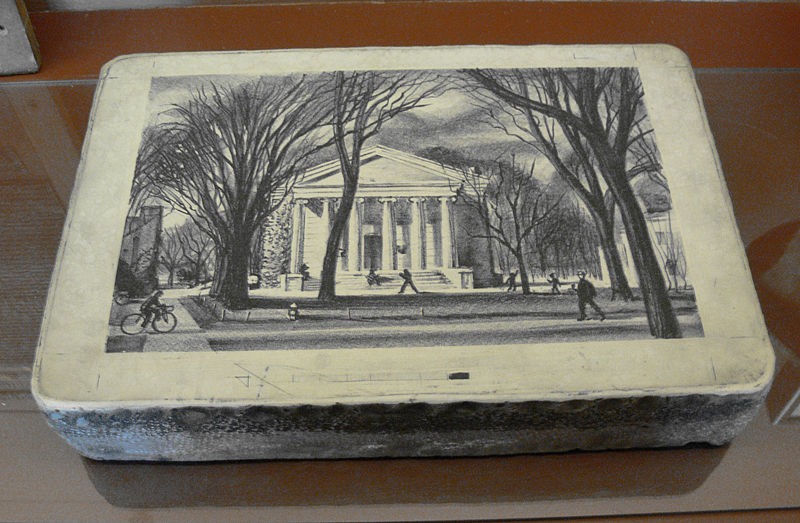
When separated from its offset component, lithography (which means stone printing) has been in existence for 213 years and counting. It is distinct from its relief, gravure, screen, xerographic and ink jet cousins in that the ink-carrying print image area is chemically separated from the non-image area. It is this quality—both the positive and negative image are on the same flat surface—that places lithography in a category of printing technology called planography.

Although offset lithography is print’s premiere technology (in terms of versatility and volume), it has only occupied this position since 1950 or just over 60 years. The previous dominant technology—letterpress—held that position for 500 years. Gutenberg invented the molten metal type casting and mechanical relief printing process in 1450.

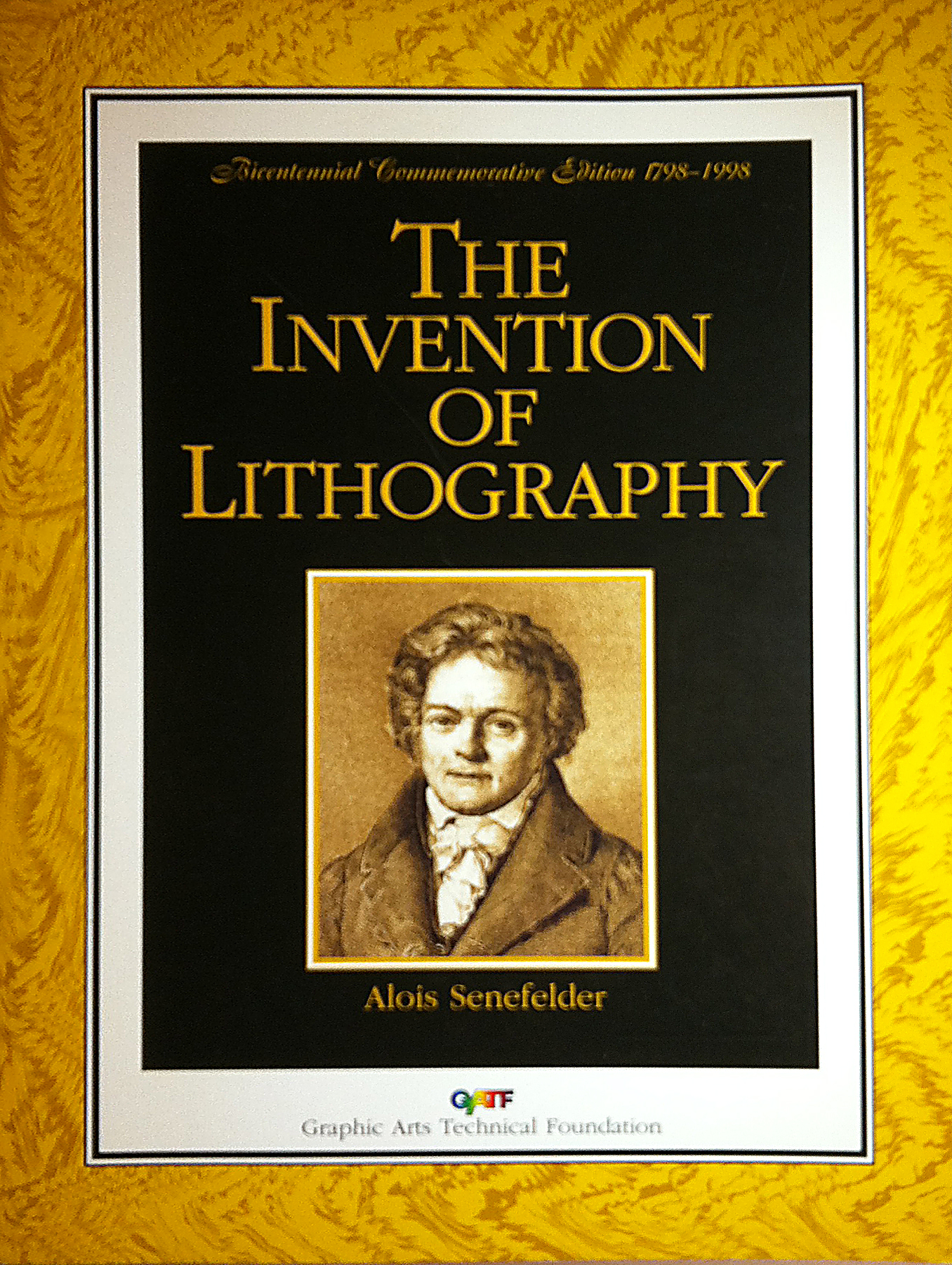
We are fortunate that the inventor of lithography, Alois Senefelder, left behind a book with many details of his life, an explanation of how his discovery was made and the methods for its effective use. The original translation of this volume, “The Invention of Lithography,” into English was made in 1911 and the Graphic Arts Technical Foundation reprinted it on the bicentennial of Senefelder’s accomplishment.

Alois Senefelder was born on November 6, 1771 in Prague where his actor father was appearing on stage at the time. The family lived in Munich and this is where the young Alois attended school. He later won a scholarship to study law in the Bavarian city of Ingolstadt.

At the age of twenty, Senefelder’s father died and the young man left his studies at law school to support his mother and eight siblings. His interest in the theater and acting led him to writing plays as a way of earning money. Several plays that he had written as a teenager had received popular response.

Initially, Alois went to a local printer with his manuscripts to get his work published. He quickly learned that his supplier had difficulty meeting deadlines and he decided to move the work elsewhere. By the time his copies were available and bought by a bookseller, Senefelder discovered that his costs were barely covered.

Being ambitious, Senefelder decided, “I found that it would not be hard for me to learn, and could not withstand the desire to own a small printing establishment myself.” Lacking the resources to buy a printing press, the types and paper, Senefelder engaged in various experiments with different etching and stereotype casting techniques.

When he was a student Senefelder had studied chemistry. He was deliberate in his experimentation and tried many different methods of engraving using turpentine, wax and tallow soap as well as copper and zinc surfaces. He also worked with different ink formulas to get his image transferred effectively onto the paper.

Although it is a popular myth that Senefelder invented lithography by chance, he explained, “I have told these things fully in order to prove to the reader that I did not invent stone-printing by happy accident, but that I arrived at it by a way pointed out by industrious thought.”

He began working with stone initially for the purpose of “rubbing down my colors on it” and later to practice writing. Most of the methods he was experimenting with required that writing be done in reverse. It was at this time in 1796 that his discovery was made when he wrote a laundry list on a stone that he had prepared and found that the image could be inked and transferred to paper.

By 1798, the full process had been perfected and, on September 3, 1799, Senefelder was granted an exclusive license for it. He joined with the André family of music publishers and refined both the chemical processes and the special form of printing press required for using the lithographic stones. Senefelder called it “stone printing” or “chemical printing,” but the French name lithography became more widely adopted.

Senefelder was recognized by King Maximilian Joseph of Bavaria and provided with a pension.  A statue of Senefelder stands in the town of Solnhofen, where lithographic stone is still quarried.

Alois Senefelder’s contribution to printing was significant in that it was a process that was more affordable and could be more widely used. Although letterpress remained the dominant form of printing text, lithography became the preferred technique for art and graphic image reproduction. It would be much later, after the offset printing technique was added to the process, that lithography would come to dominate in the field of newspaper, book and magazine publishing and numerous types of commercial print.

Chester Carlson: 1906 – 1968

20110816-065411.jpg
Chester Carlson invented xerography in 1938. Here he is demonstrating a prototype of the technology.

At age 20, I worked in the basement copy center of the NYU Law School as a college work-study employee. I learned to operate the systems used to duplicate legal documents for law professors and their students. For example, I ran the Xerox 9600; it had a document feeder, image zoom, two-sided copying, a 50-copy sorter, an electronic control panel and a series of sensors to detect paper jams.

I suppose there is significance to the fact that I remember far more about those copiers than I do about the legal documents being copied. I spent most of my free time experimenting, copying my own stuff and pushing those machines to their limits.

20110816-065643.jpg
Xerox 9500 with sorter; I worked on a system very similar to this in the copy center at New York University Law School in 1979-80.

Like most people, I took “xeroxing” for granted; I thought it was a fact of life and didn’t understanding where it came from. Only years later did I learn that xerography was a modern form of print technology; it was revolutionary when it was invented and its significance has continued to expand since then. As I think about it now, I am struck that the same distance of time (31 yeas) stands between today and my days at the NYU copy center in 1980 as between that time and the date of the first commercially available Xerox copier in 1949.

* * * * *

Chester Carlson, the inventor of xerography, was born on February 8, 1906 in Seattle, Washington. His early years were filled with hardship. His family was poor and his father suffered from multiple illnesses. Chester began working to support his family at the age of eight. When his mother died of TB, Chester was just 17. He would later say, “That is the worst thing that ever happened to me. I so wanted to be able to give her a few things in life.”

Chester developed an early interest in printing. He started a newspaper called This and That at the age of ten and circulated it among his friends. He used a Simplex Typewriter to set type one character at a time. He said of this experience, “I was impressed with the tremendous amount of labor involved with getting something into print … and I got to thinking about duplicating methods.”

Chester excelled in math and science and was encouraged by teachers to continue on after high school. He attended Riverside Junior College and then Caltech, graduating with a BS in Physics in 1930. Chester took his first job with Bell Labs in New York City as a research engineer. He would later transfer to the patent department as an assistant and turned his attention to document management. Chester recalled, “The need for a quick, satisfactory copying machine that could be used right in the office seemed very apparent to me … So I set out to think of how one could be made.”

Chester’s work on an office copier began in the mid-1930s. He conducted experiments with the help of Austrian physicist Otto Kornei and their first major breakthrough was achieved on October 22, 1938. They successfully transferred an image from a microscope slide to a sheet of wax paper using an electrostatic charge and some organic powder. Initially calling the process electron photography, Chester later commented, “The powder image was adhering to the plate by virtue of relatively small, but nevertheless real, electrostatic forces.”

20110816-065353.jpg
The first xerographic image produced by Chester Carlson and Otto Kornei.

With the help of a law degree obtained from the New York Law School in 1939, Chester successfully patented electrophotography in 1942. He tried to sell the concept to companies he thought might be interested in its commercial development. He wrote to more than 20 companies—including GE, IBM, AB Dick and RCA—none of which took him up. He described their response as “an enthusiastic lack of interest.”

In 1946, with the assistance of Battelle Memorial Institute of Columbus, Ohio, Chester finally convinced researchers and executives at The Haloid Company of Rochester, New York to sign a $10,000 contract to license electrophotography. Marketing concerns turned Haloid to search for a better product name and xerography was suggested; the combination of the Greek words xeros (dry) and graphein (writing).

The Haloid Company brought the Xerox Model A Copier to market in 1949, eleven years after Chester Carlson’s discovery. However, it was not a commercial success. It would take another eleven years (and many technological developments) before the fully automated Xerox 914 would become a huge hit as the first plain paper office copier. By 1962, ten thousand units had been sold and by 1968, revenues for Haloid Xerox had reached $500 million.

By 1965 Chester Carlson was worth several hundred million dollars from royalties on his patents, making him one of wealthiest people in America. However, Chester spent years quietly giving away most of his fortune to charities. He died of a heart attack at the age of 62 on September 19, 1968.

Chester Carlson’s invention—which took two decades to convert into a viable product—is used today in tens of millions of photocopying machines and laser printers as well as digital printing systems such as the Xerox iGen and Xeikon press. Along with digital ink jet printing devices, xerographic systems are slowly unseating traditional offset lithography as the dominant technologies of the printing industry.