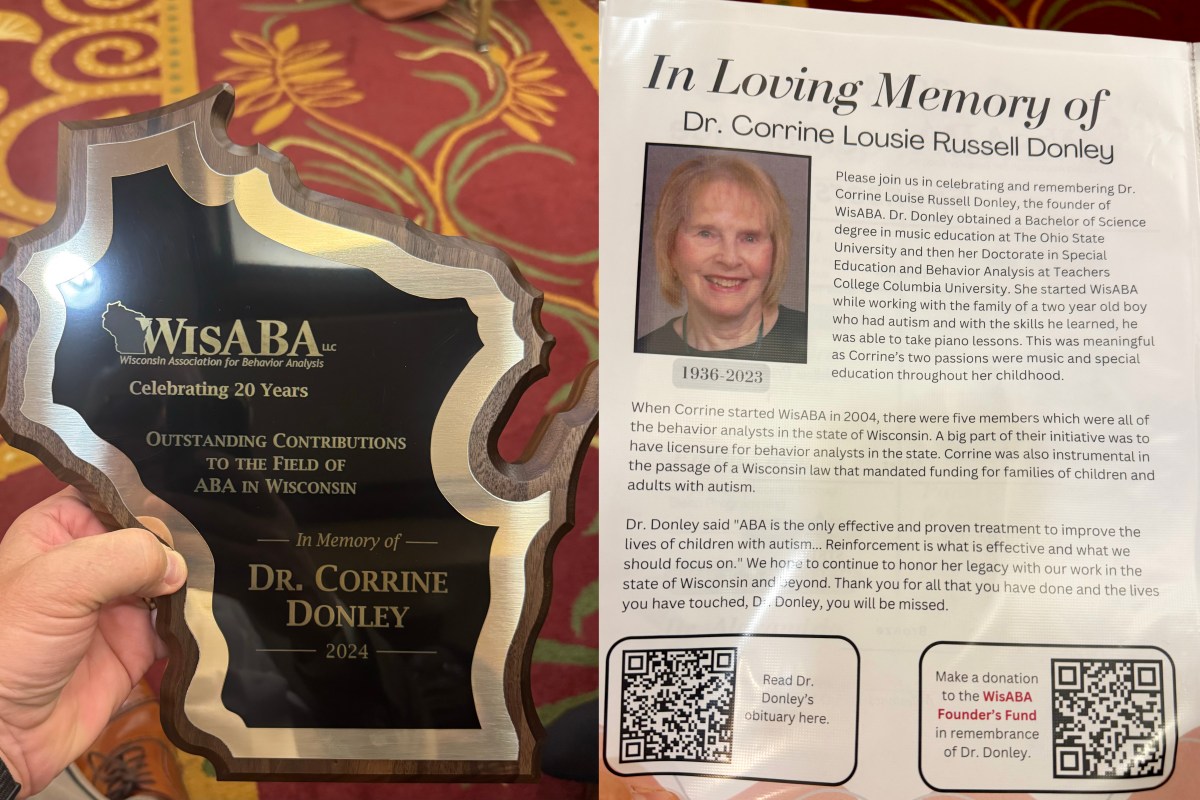
Award presented in memory of Dr. Corrine Russell Donley for Outstanding Contributions to the Field of ABA in Wisconsinon Saturday, October 5, 2024.
Good morning everyone,
I am really pleased to be here and very proud, of course, to accept this award from the Wisconsin Association for Behavior Analysis on behalf of my late mother, Dr. Corrine Russell Donley.
I first wanted to say that I am here this morning with my beautiful wife Sally and my wonderful granddaughter Aliyah. We arrived from Michigan late last night and we are pleased to join you this morning and be a part of this program.
We are here actually also to represent the extended Donley family. My mom was a mother, grand mother, great grand mother and great-great grand mother, so we have a very large family.
Some of you in attendance today may have known her and I would suspect, after 20 years of this organization, that perhaps many of you did not have a chance to meet her.
So, I wanted to say a few words about the person you would have referred to as Corrine or Dr. Donley. She always insisted upon being referred to professionally as Dr. Donley. She was very proud of her academic accomplishments.
I just want to say her life contains many, many lessons for all of us regardless of what field you work in or what profession you have pursued.
Before arriving here in Wisconsin in the 1990s, she worked for 25 years in the public school system in New Jersey, which is where my three siblings and I were raised. She was a special education teacher in the Howell school district.
She was a pioneer in that field in bringing the students who had special needs into the school environment and allowing all of the other students to interact with them. She had a special classroom with all of the appliances of a standard kitchen and also a washing machine. She taught life skills to a broad range of ages of children and they would go shopping and so forth.
I had the opportunity on several occasions to go to school with her and I met many of these students and became familiar with what it was like to be around people with special needs.
As Megan Sellers was explaining, from her earliest days my mother developed a love for music. She was an accomplished pianist. She played violin in The Ohio State University symphony and it was there that she met my dad, Loren Donley.
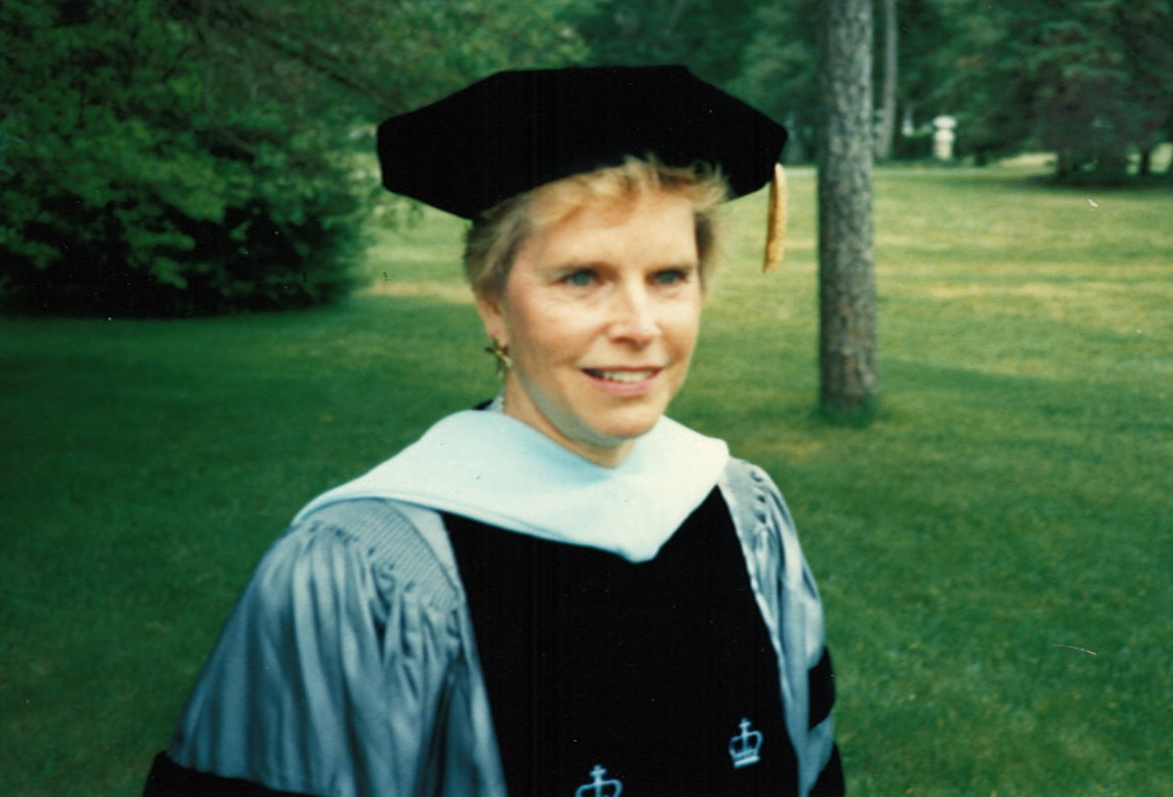
Now, after she finished and retired from the public schools in New Jersey at the age of 50, she decided to pursue a higher degree and received two masters and then her doctorate at Columbia. It was after this that she relocated here to Wisconsin to work at the University of Wisconsin at Oshkosh.
I would say throughout her life, whatever she was doing, she was always thinking of others and helping those in need. This took many forms, I cannot really go into it, I now receive all of her mail [laughter] and there were many, many organizations that she donated to and supported.
As I said, as I was growing up, I had many opportunities to both meet the students that she worked with and also the families and I saw the impact of her efforts on those families, which were life changing.
No matter what the difficulties were, no matter what the challenges, she was determined and always sought to find solutions, even if they were the smallest things, as you know, like learning how to speak. It was through those accomplishments that she found success in her professional work.
I also want to mention that she said to me many times later on that if she had learned about Applied Behavior Analysis earlier she would have raised us quite differently. There were many spankings, [laughter] I will say that and I do not think that this would have been done if she had known back then what she learned later on.
She passed a deep sense of social responsibility onto all of her children. I believe that if this world today were run by people like my mom and all of you, that we would have a society which would be much more equal.
So, from the bottom of my heart and on behalf of the Donley family, I want to thank you for keeping the memory of my mother alive and presenting us with this award today.
Tribute to my mother delivered at the memorial and celebration of her life on May 18, 2024 at Point Pleasant Presbyterian Church in Point Pleasant, New Jersey.
My name is Kevin Reed Donley and I am the second son of Corrine Louise Russell Donley. I was raised here in Point Pleasant, NJ along with my three siblings, Mark, Dana and Cheryl, and I am very proud to speak today on behalf of our family at this memorial and celebration of life for our late mother, who passed away last December 19 at the age of 87.
It is truly wonderful to see our friends and family at this event today and I want to thank all of you for being part of this celebration. I also want to thank those who are participating remotely through the live Zoom video stream.
As was her way of doing things, our mother is entirely responsible for organizing this event. For those of you who knew her, you will not be surprised to learn that she left us a very detailed plan for this service down to the selection of the scripture readings, the hymns and the anthems to be sung by the choir. She even specifically requested our organist today, Sarah Hoey, and we are thrilled that she is part of this celebration.
I also want to thank Point Pleasant Presbyterian Church, Reverend Molly Ramsey and the choir for hosting our service. It is indeed an emotional moment for the Donley family to return here. We grew up in this church community in the 1960s, 70s and 80s. We have many memories of our days attending Sunday school and church service here on Sundays. Since our parents were co-directors of the church choir during those decades, we attended many services wearing choir robes and singing from the choir loft. Throughout our childhood and teen years, Thursday evenings every week were reserved for choir rehearsals.
I would now like to turn to my tribute and begin by referring to the quotation our mother selected for this service. It is from the well-known 1915 poem by the American poet Robert Frost entitled, “The Road Not Taken.” The quotation reads as follows:
Two roads diverged in a wood, and I — I took the one less traveled by, and that has made all the difference.
For our mother, “the road less traveled” was without a doubt a metaphor for her life. She started out with meager beginnings and yet she accomplished so many extraordinary things. She was a loving wife and mother, grandmother, great grandmother and great-great grandmother. She was also an accomplished musician, an exceptional teacher, a pioneer in public school special education, a published academic researcher and, in the end, she established a private practice as a counselor for children and adults with autism.
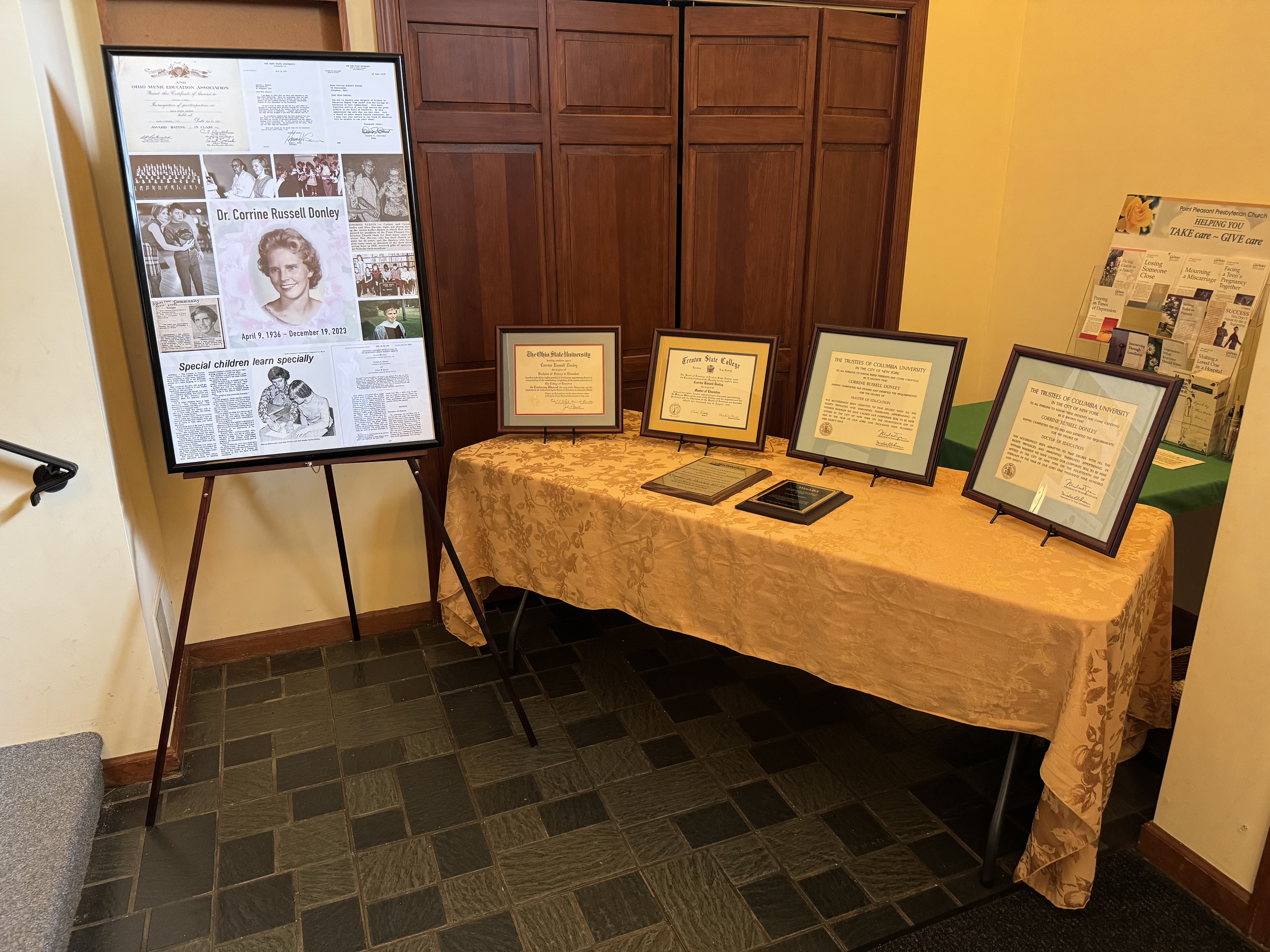
The academic accomplishments of our mother included an undergraduate degree in music education from The Ohio State University (1958), a masters degree in music therapy from Trenton State College (1981), a masters degree in music education from Columbia University (1989) and a doctoral degree in special education from Columbia University (1990).
She was the founder of the Wisconsin Association of Behavior Analysis (known as WisABA) and became its first president. There is today, a graduate student fellowship in her name at Marquette University in Milwaukee which is awarded each year to a student wishing to pursue a degree in Applied Behavior Analysis.
Our mother lived a life of enormous compassion and empathy for others, both within the family and, especially, for those with intellectual disabilities. Through decades of dedicated and often very difficult work, she had a transformative impact on many, many lives.
These are among the many important lessons of life that our mother taught us: the importance of strong family ties, the cultural significance of art and music, our responsibility to each other in society, especially for those in need, and the necessity to set goals that extend beyond ourselves. In possessing and living these principles and instilling them in others, our mother truly walked “the less traveled road” in her life.
At the same time, however, I believe there is another meaning in Robert Frost’s poem that has significance for our mother’s life; one that is perhaps more important and applies to all us of here today. This is because Frost’s poem is not only about the road that has been chosen, the one that appears as the “one less traveled by,” but, as the title says, it is also about “The Road Not Taken.” It asks us to question the road we have selected and think about “what might have been?” It points to the irony in the situation and asks, “what if I had taken the other road?” It is in this context that I think one of the most important lessons of our mother’s life truly emerges.
Corrine Louise Russell was born into a working class family in East Liverpool, Ohio on April 9, 1936, during the Great Depression. As she and the Russell family struggled through the many challenges of those early years, my mother found her two passions in life—music and special education—at a very young age.
Her exceptional musical talent was evident as a child. After first teaching herself to play the piano, a teacher noticed her desire to learn and, knowing that the family could not afford the fees, agreed to charge next to nothing for lessons in the morning before school.
By middle school, she was playing both piano and violin. In eighth grade, she was awarded a Level I rating by the Ohio Music Education Association for her violin playing. She graduated from East Liverpool High School in 1954.
After high school she was accepted as a student at The Ohio State University and was the first member of her family to attend college. She was awarded academic scholarships and she worked throughout her college years to pay for her education. She brought her musical talents to the university and studied for a degree in music education. She sang in the OSU Symphonic Choir and the Women’s Glee Club, for which she was piano accompanist, and she also played violin in the OSU Symphony.
She developed her interest in special education at OSU where, in 1955, she visited the Ohio State Institution for the Mentally Retarded in Columbus, Ohio. One year later, she pursued her interest in music therapy by directing a choir of patients at the Augusta State Mental Hospital in Augusta, Maine while also working as an attendant at the institution. It was following this experience that she was given an opportunity to transfer to Florida State University and pursue the field of music therapy.
However, by this time, Corrine Louise Russell had met our father Loren Duane Donley—who was a graduate student in music education at OSU—and the couple fell in love and decided to be married one year later, in December 1957, and start a family. At the age of 20, our mother made the decision to stay in Columbus and finish her degree in music education. She did not pursue music therapy and transfer to Florida State University.
And this brings me to the exceptional character and central point I would like to make about our mother and this something that I greatly admired in her. While she chose to pursue the road of marriage and start a family, she never forgot about her “road not taken.”
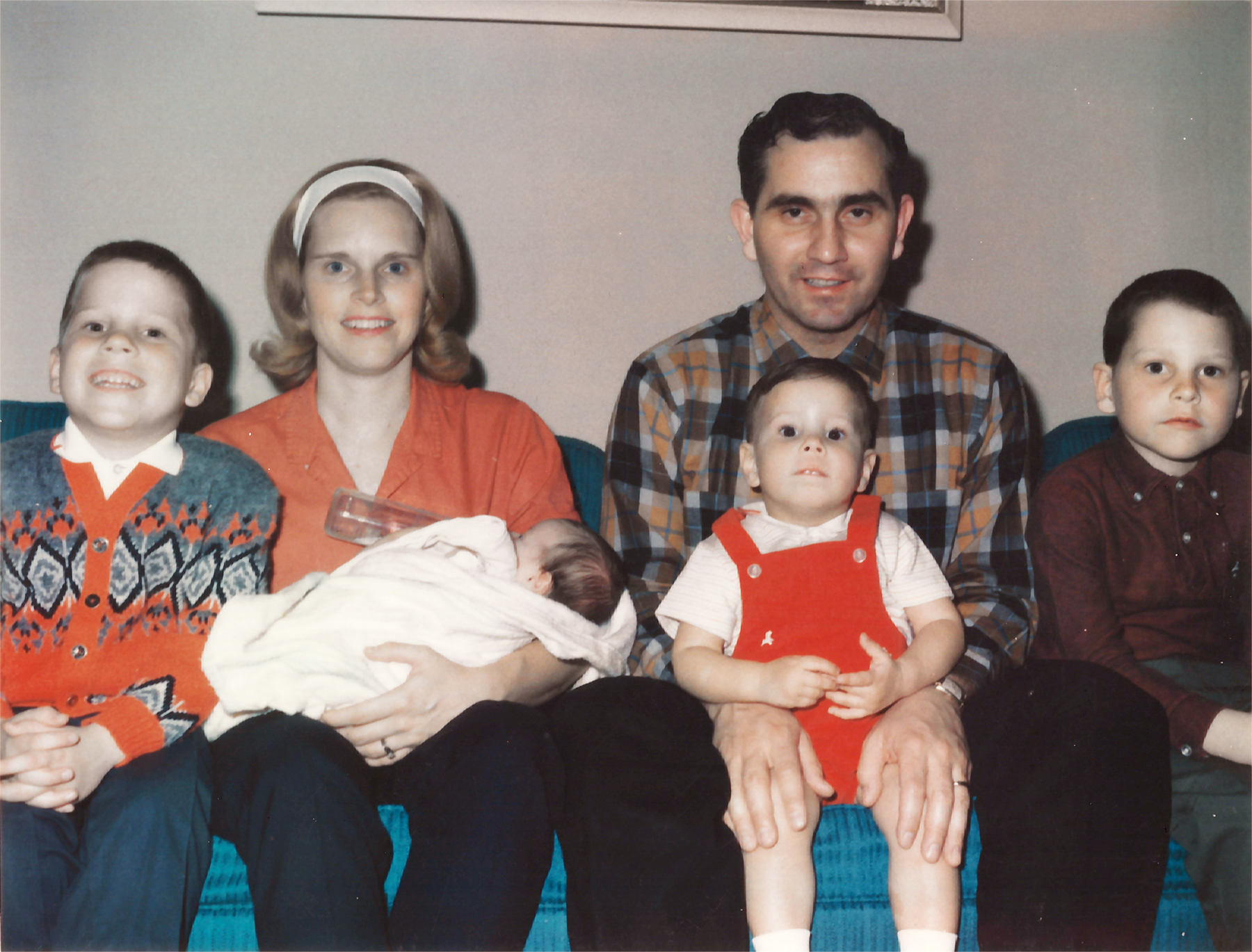
The Donley family in 1966 after the birth of my sister Cheryl
Our parents arrived in Point Pleasant in 1958, after our dad was discharged from the US Army at Fort Dix and accepted a position as the first music teacher in the Point Pleasant Borough school district.
My siblings and I were born between 1958 and 1966 and we were raised in what might be called a traditional family for that time. As the wife and mother with responsibility for most of the child rearing and household duties—a situation that was not at all uncommon during those years—our mother also continued to work toward her professional goals.
After the birth of my brother Mark and me, she became a kindergarten teacher for two years. Then she stopped working while she had my brother Dana and my sister Cheryl. She then returned to the classroom, but this time in the capacity of a special education teacher at what was known as The Little Carpenter School in Point Pleasant Borough.
Several years later, in 1969, she took a position as a special education teacher in the Howell School District. Working at the Aldrich School, she helped introduce a classroom where special needs students learned life skills such as how to prepare a meal or how to do the laundry. These students were also able to interact with the rest of the school community. This was a novel approach since, up to that time, students and adults with intellectual disabilities were kept segregated, out of sight and often institutionalized.
Feature newspaper story in the Central Jersey News Transcript in 1981 about Corrine Donley’s special education classroom at Aldrich School in Howell, NJ
During those years, she was awarded numerous accolades, including Teacher of the Year recognition from the ARC, a non-profit association that serves people with intellectual and developmental disabilities. While teaching at Aldrich School, she achieved her first master’s degree at Trenton State College and her thesis project was on music therapy for the handicapped. She was 45 years old at the time.
After twenty years at Aldrich, she could have gone into retirement, but she did not. She continued to pursue her “road not taken,” went back to school again and achieved her second master’s degree, this time in special education at Columbia University. Then, at the age of 55, she earned her doctorate from Columbia University in the field of Applied Behavior Analysis and specializing in speech therapy for autistic children.
In 1989, our mother became an assistant professor of special education, first at Georgian Court College and then at the University of Wisconsin in Oshkosh, Wisconsin. She left university teaching in 2002 to pursue her private practice until her retirement in 2011.
So, I would like to close this tribute with what I think is the best way for us to celebrate and honor the life of our mother. We are all challenged to find our own “road not taken,” whether young, old or in our prime. With the right combination of compassion and determination, it is never too late to accomplish the goals we set for ourselves, especially those that involve a contribution to the needs of others that make a real difference on the world.
My mother, Dr. Corrine Louise Russell Donley, would have been 88 years-old last Tuesday. Her birthday fell exactly sixteen weeks after I learned that she had died peacefully in her sleep sometime in the early morning hours of December 19, 2023.
I consider myself extremely fortunate to have seen her for the last time one month earlier on my own birthday. It was on a Saturday, and I planned a trip from Southfield, Michigan to her retirement community in Stow, Ohio and spent the day with her.
It was a memorable visit because we went to the Cleveland Museum of Art to see an impressionist exhibit that was especially important to her. We also went out for dinner and had a long talk. That experience on my 64th birthday is special to me because it is a memory that highlighted my mother’s most enduring qualities and, looking back on it now, reminded me of who she really was.
In thinking about my mother’s life, I can tell you she was a beautiful blond with piercing blue eyes and that she was an exceptionally talented and gifted musician and pianist. I can also tell you she was a dedicated homemaker and loving mother who, along with her husband of 29 years and my father, Loren D. Donley, raised me and my three siblings, Mark, Dana and Cheryl.
I will tell you my mother was an organizer of people and things, and she maintained an At-A-Glance day planner her entire life. She was meticulous with money, and, because of that, we were able to take long trips during the summers while my parents were off from school and their teaching jobs.
My mother loved to knit and, when we were kids growing up, it was not uncommon for her to knit clothes for us or to see her sitting at the sewing machine making things for us to wear, even though, when we were old enough to know the difference, we didn’t want to wear them in the first place.
Finally, I will share that she was an outstanding public school elementary and special education teacher who went on in academia to receive her doctorate and excel both nationally and internationally in the specialized field of applied behavior analysis.
All these things are true. However, it is also true that these attributes and accomplishments, as important as they are, only partially tell the story of who my mother was and why she came to have such drive and seemingly endless compassion and empathy for others.
Corrine Louise Russell was born in East Liverpool, Ohio on April 9, 1936, to Mildred Louise Shenton Russell and John Louis Russell. My grandparents were very young when they started their family, and my mother was their first child. She was born during the Great Depression and the conditions of life in East Liverpool—a small industrial town on the Ohio River across from the northern-most point of the West Virginia panhandle—were harsh.
East Liverpool was founded in the late 18thcentury by Irish settlers who named it after Liverpool, England. During its glory days in the late 19th century, East Liverpool was known as “Crockery City,” because more than 100 pottery factories were in and around the town, some of which were across the river in West Virginia and others further east in Pennsylvania.
The Thompson Pottery on the Ohio River in East Liverpool, 1910
The pottery industry settled into this region of The Upper Ohio Valley because there was a plentiful supply of clay in the area that was suitable for making dishes. By the late 19th and early 20th centuries, the pottery businesses became so successful that people of Irish, English, German, Italian, Greek, Jewish and African-American descent came to East Liverpool for work.
For example, my great-great grandfather, Samuel Shenton, was a potter who had emigrated from England to East Liverpool in 1869. Samuel began working as a dish-maker in his native town of Stoke-on-Trent, Staffordshire at age 9 and, along with many of his fellow workingmen, decided to make the trip across the Atlantic to seek a better life in America. When he arrived at age twenty-nine, Samuel was already an expert dish-maker and one of the first white-dish makers of East Liverpool.
Samuel became a Master Workman and member of the Knights of Labor. He was a highly respected member of the East Liverpool potter’s community because of his activity during the strikes and lockouts of 1884. This was before the establishment of the 8-hour workday and the conflict between the potters and the employers was centered on how machines were being used to eliminate jobs. Samuel was blacklisted by the employers in East Liverpool and forced to relocate for 18 years in another town in Ohio where they did not know who he was.
Obituary of Samuel Shenton, July 24, 1840–February 9, 1917.
All four of Samuel’s sons became potters and dish-makers, including Byron Shenton, my mother’s grandfather, who lived in Kittanning, Pennsylvania, a pottery town along the Allegheny River where my grandmother Mildred Louise was born.
In 1942, after the US entered World War II, Mildred Louise and John Russell had difficulty finding work and they decided to pack up my mother and her sister, my Aunt Joan, and move the family to Cleveland. It was there that John took a job as an electrician in a military aircraft factory and Mildred became a taxi driver.
When the war ended, the Russell family moved back to East Liverpool. However, the pottery industry was by this time decimated by the Great Depression and overseas dishware competition. The local economy never returned to that of its prewar years. Due in part to these circumstances, Mildred Louis and John divorced and there were times when my mother was sent to live with grandparents or aunts and uncles and did not see her parents for long stretches of time.
The hardship associated with the economic decline of East Liverpool impacted many families during those years. My mother told me that President Roosevelt’s New Deal programs—which brought jobs, Social Security and other government aid to the area—was so popular among the people of East Liverpool that a classmate of hers was given the name “Welcome FDR,” when he was born. They called him Welkie.
Corrine Louise Russell at age 12
As a child, my mother was precocious, and she developed a remarkable determination to overcome the poverty she was growing up in. She described to me some of the homes of East Liverpool residents which were essentially shacks made with random boards covered with tin can shingles and with dirt floors. She spoke compassionately about how some local people suffered from illiteracy and a lack of health care and dental care and from tobacco and alcohol abuse.
She told me about the house on Morton Street that the Russell family had moved into when she was 12. The home was nearly at the top of the hillside on which East Liverpool stood and you had to drive up extremely steep streets to get to it. The home initially had an outhouse and, when a bathroom was finally added, it was a box on stilts that was attached to the outside of the upper level. When entering the bathroom, she told me, she could see the ground below through a gap in the floor between the two structures.
Meanwhile, life in East Liverpool was fraught with many difficulties and obstacles for a young girl. She told me many times that, when speaking to others about her plans to do great things with her life, she was told more than once, “You won’t amount to anything. You’ll be barefoot and pregnant by the time you’re 16.” She also told me about abuses she suffered as a girl which were unfortunately common and the result of the poverty and backwardness that existed in the community.
While her experience was by no means entirely unique, the memories of what life was like in her childhood stayed with my mother. However, she never let those things keep her from educating herself and pursuing her goals. She did not allow the negative aspects of her upbringing to become a justification for what she could not do or to live a life of bitterness about how she was mistreated or how she never received the support she deserved as a child growing up.
Instead, these challenges and disappointments became her springboard; they became a source of energy and determination to set high expectations and strive to overcome all obstacles to meet them. She also used them to dedicate herself to helping others overcome their disadvantages and disabilities.
My mother was part of a generation of young women who, in the post-war years, benefited from access to public education and the expanding role of women in the workplace and society. Meanwhile, as part of that generation, my mother had a deep-going social awareness and concern for those less fortunate than her. She wanted to make a difference in the lives of others and this led her into special education, where she became a pioneer in the classroom and one of the first in the field to use music therapy for the handicapped and people with intellectual disabilities.
And this is what brings me back to our trip to the Cleveland Museum of Art on my birthday last November. One of the most important experiences I had growing up as the son of Corrine Louise Russell Donley was that she taught me and helped me learn about fine art. I recall when going on trips with the family during the summer that we would make stops to visit art galleries and exhibits.
At the time, like many children, I did not understand what she was doing. I would complain about having to go to the galleries and ask, “Mom, do I have to go with you to the museum?,” and she would always say, “Yes, you do.” She never let up on this.
By the time I was in high school, I knew about the paintings of modern artists like as Jackson Pollack, Paul Klee and Pablo Picasso. I was also familiar with the works of American painters like Andrew Wyeth, Winslow Homer, Grant Wood and Norman Rockwell. Today, my wife Denise and I have my parents’ print of Winslow Homer’s “The Country School” hanging on the wall in our living room. That painting was positioned for decades over the piano in the living room of the Donley household in Point Pleasant, New Jersey.
The Country School, Winslow Homer, 1871
Anyway, I developed an appreciation for the periods and methods of the artists and, by the time I was ready to leave home for college, I had formulated my own interest in fine art painting and, it turns out, this was a factor in my decision to pursue graphic arts as a career choice. I have my mother to thank for this.
The important exhibit she wanted to see in Cleveland was called “Degas and the Laundress: Women, Work and Impressionism.” It was the first exhibition to feature the impressionist Degas’ paintings and sketches of Parisian laundresses which he had made over his long career beginning in 1850. The exhibition also included paintings of laundresses by other artists, such as Picasso, Renoir, Toulouse-Lautrec and Daumier, who were inspired by Degas and his focus on these Parisian women.
Degas, who is most well-known for paintings of ballet dancers, horse races and upper middle class life in Paris, was drawn to the laundresses. A perpetual and visible presence in the city, the women could be seen at all times of the day washing clothes in the river, carrying heavy baskets of laundry or ironing in the many shops that were open to the street.
The laundresses were among the most marginalized, poorly paid and exploited people in Paris. Their job was arduous and dangerous, as they carried out strenuous and repetitive work while being exposed to chemicals and diseases. A remarkable aspect of Degas’ paintings of the laundresses of Paris is that he concentrated on images of these women while they were at work.
Woman Ironing, Edgar Degas, 1869
The Cleveland Museum of Art was not especially busy on my birthday, and we were able to find the special Degas exhibit easily. When my mother and I came upon the featured and most famous painting in Degas’ laundress series, we stopped there for a long time to observe it. The painting, entitled Woman Ironing, was painted by Degas in 1869 and the subject is based on a model named Emma Dobigny whom the artist had befriended.
The painting is remarkable because it has additional lines drawn of Dobigny’s arms as if they are in motion while she irons a gray muslin dress on the table. The expression on her face is one of exhaustion but also, as she stares straight at the artist, she seems to be saying, “Yes, this is difficult work, but I am strong, and I will not stop until it is complete.”
As I think about what we saw in that painting, I am now realizing what was going through my mother’s mind in that moment. Corrine Louise Russell Donley was nearing the end of her life. She had suffered several serious heath events that forced her to use a walker, and, in this instance, I was pushing her through the museum in a wheelchair. What my mother saw, as we looked at the Paris laundress, was someone with whom she identified.
Although she did not and could not have known on that day she would be gone in one month, my mother was determined, and I know she was thinking about all the things she had yet to do and how much more she had to give to the world. She was thinking, “I have come through many challenges, had a long life and accomplished important things. However, my work is not done yet.”




 MULTIMEDIAMAN