From craft to industry (1): Friedrich Koenig

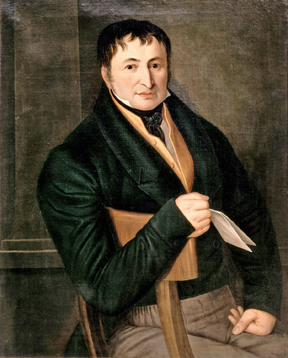
Friedrich Koenig, 1817

Some readers are likely wondering: why take so much time and space reviewing the work of individuals in the history of print media? What does this have to do with the printing business and the challenges we face right now, especially with media technology in transition and in a difficult economy? These are valid questions.

Although the effort requires bookwork and more than a casual reading of Wikipedia entries, it is not an academic exercise or something of interest only to print technophiles. Appreciation for the major transformations of the past provides a guide for navigating contemporary problems; it also assists in charting a path to the uncertain future.

Business decisions are influenced by multiple and complex factors. Availability of financial and human resources, technology development, market trends, customer needs, competition and risk-reward calculations all shape judgments about what should or should not be done. Knowledge of the rich history of the printing industry reveals the rhythmic relationship between the present and the past. Thereby, it is an indispensable tool for business thinking and planning.

The period of printing history under review is perhaps more resonant with our own time than at any other in the 570 years since Gutenberg. At the turn of the nineteenth century, a fundamental transition began: press technology went from wood and hand power to iron and steam power; during the years 1800-1814 all of the basic elements for the transformation of print from a craft to an industry were in place.

A measure of the magnitude of this revolution is the ten-fold increase in press productivity in the first two decades of the nineteenth century:

                              Up to 1800           1800                  1818
Press technology     Gutenberg              Stanhope             Koenig
Sheets per hour      240                        480                     2400

While the Stanhope press is identified with the introduction of iron in press manufacture, it was based on the same hand operated screw technique invented by Gutenberg in 1440. Alongside iron, the key advancements in the industrialization of print were the cylinder and steam power. Patent and business records of the period identify the first press that had all these features with Friedrich Koenig.

Koenig was born on April 17, 1774 in the town of Eisleben, Saxony. As manufacturing society was emerging, the bookseller and printer shared with others the desire to mechanize the hand press. Koenig’s first invention arrived 1803 with what was known as the Suhl press, a steam powered system that had inking rollers. Due to the difficult economic conditions of early 1800s Germany—including lack of a functioning patent system—Koenig moved to London in 1806 to pursue his ambition as an inventor.
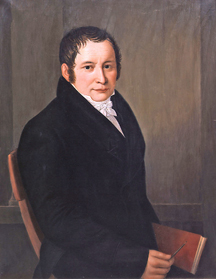
Andreas Bauer

The Fleet Street printer Thomas Bensley, along with several other English investors, were convinced of Koenig’s genius and agreed to finance his press experiments. Fellow countryman and engineer Andreas Bauer (1783–1860), joined Koenig in London and they developed two new platen designs for which they achieved patents in 1810 and 1811.

The significant breakthrough came in 1812 with the invention of a steam-driven cylinder machine. Koenig wrote about it in The Times, “Impressions produced by means of cylinders, which had likewise been already attempted by others, without the desired effect, were again tried by me upon a new plan, namely, to place the sheet round the cylinder, thereby making it, as it were, part of the periphery.”

Koenig’s solution of the problem of effectively transferring a letterpress image to paper by means of a cylinder won him recognition. His method was first used in book production and later, after John Walter II of The Times joined the partnership with Bensley, in newspaper printing. At Walter’s request, Koenig and Bauer built a double machine—being fed with sheets of paper from both ends—and obtained a patent for this device on June 23, 1813. The first issue of The Times printed with this technology was on November 29, 1814.

Double cylinder press designed and built by Koenig and Bauer for John Walter II and used to print The Times of London on November 20, 1814.

Walter wrote in The Times on that day, “Our journal of this day presents to the public the practical result of the greatest improvement connected with printing, since the discovery of the art itself. … A system of machinery almost organic has been devised and arranged, which, while it relieves all human frame of its most laborious efforts in printing, far exceeds all human powers in rapidity and dispatch. … Of the person who made this discovery, we have little to add. … It must suffice to say farther, that he is a Saxon by birth; that his name is Koenig; and that the invention has been executed under the direction of his friend and countryman Bauer.”

In 1816, Koenig and Bauer developed a perfecting cylinder press that was installed at Bensley’s business. This system produced up to 1,000 perfected sheets an hour. By this time, the two inventors wanted to sell their systems to the trade but Bensley refused. Koenig and Bauer decided to return to Germany to manufacture presses under their own name and, on August 9, 1817, they founded their own firm in Oberzell near Würzburg, Germany.

Their company continued to play a significant role in the industrial evolution of printing machines as steam power gave way to electric motors and also after the death of Friedrich Koenig on January 17, 1833. The company of Koenig and Bauer exists to this day (as KBA) at the same location and is the oldest printing press manufacturer in the world.

While European (both English and German) inventors dominated the early period of powered cylinder presses, the center of gravity for printing technology shifted to America around mid-century and especially following the Civil War. The significant expansion of the US market and the emergence of conditions for experiment and manufacturing made it the ideal environment for further strides in printing press development. This will be the subject of the next two parts of this review.
The new frontier of print management services

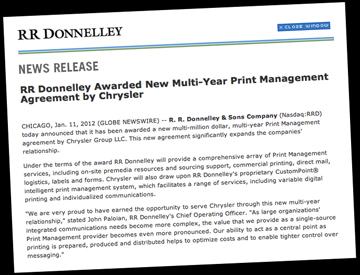
I read with interest the January 11, 2012 announcement from RR Donnelley that the $2 billion company had penned a multi-year, multimillion dollar agreement with Chrysler to “provide a comprehensive array of Print Management services, including on-site premedia resources and sourcing support, commercial printing, direct mail, logistics, labels and forms.”

While this is undoubtedly good news for Donnelley, it is more than likely troubling news for incumbent suppliers of Chrysler. Everyone is probably thinking the same thing: how do printers compete for Chrysler’s business when a huge competitor is managing the sourcing process?

Clearly, the growth of print management services over the past decade is an important and significant development. According to Ronnie Davis, Chief Economist of Printing Industries of America, print management services is one of the key emerging market tendencies within the printing industry.

In his book Competing for Print’s Thriving Future, Davis writes, “Print management services are typically defined as the practice of a customer outsourcing the management of their print and print logistics operation to a commercial printer.” Davis reports that the total value of these services to the printing industry is estimated to be as high as $5 billion or 6% of total industry value.

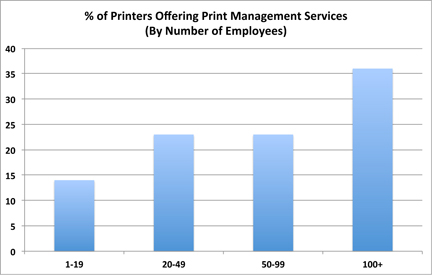
Davis reports that more than one in five printers is offering these services today; firms with more than one hundred employees are more than twice as likely to offer the services as firms with less than 20 employees.

But printing companies offering print management services is only part of the story. A larger sector of this market is made up of firms that have no printing equipment and do none of the production or distribution of printed materials. These firms are either outsourcing everything to companies on their supplier list or they are making the sourcing decisions and handing the management of the projects back to their corporate partner and/or its agencies.

Brought on by the drive for corporate cost cutting, excess capacity in the print supply base and the growth of online procurement solutions (e-commerce), the companies that specialize in print management services—also known as print procurement outsourcing—typically enter into corporate contracts. These agreements offer significant reductions in print spend as well as more efficient management and control of print-related marketing and communications materials.

For example, a well-known company of this type is InnerWorkings, a publicly traded firm (INWK) with a market value of $500 million. On their website, InnerWorkings describes themselves as “a partner in maximizing budgets and providing brand oversight in every corner of the globe.”

In a white paper entitled, “Top 6 Challenges to Managing Your Multi-Million Dollar Print Spend,” another provider of these services explains that corporate cost reduction efforts have, up to this point, used in-house resources and delivered minimal results. They write, “Many organizations are now choosing to work with a strategic partner who can bring additional spend, tools and resources … they are experiencing savings in the range of 10% – 40%.”

These changes are impacting every aspect of the traditional print supplier and corporate print buyer relationship. Corporate purchasing departments no longer need highly educated and informed print buyers since these skills are provided by experts within the firms hired to perform these functions.

Meanwhile, the nearly one hundred-year dominance by advertising agency print producers over the print sourcing process is being disrupted and, in some cases, completely eliminated. In instances where the only point of contact between the print supplier and the corporate end-user is through the medium of the print procurement firm, agencies play no role in sourcing decisions whatsoever.

For printing companies that participate as subcontractors in these arrangements this has meant a two-fold change: 1) loss of direct contact with corporate end-users and; 2) significant reduction in the prices that can be charged for print products and services.

Print management services and print procurement outsourcing are growing features of the print markets in the brave new world of 21st century corporate cost reduction. These firms and relationships have emerged alongside of the migration of marketing and communications dollars away from traditional print media to digital and social media alternatives.

As an industry, we need to understand these changing dynamics and develop strategies to adapt; we need to see that within every threat is also contained an opportunity. Rather than complaining about the difficulties of the environment, printing companies must develop a relationship with the print management services market that either leverages existing capabilities or competes directly for the business. As Ronnie Davis puts it, “printers can create their own positive future by understanding and taking advantage of emerging changes in print’s driving forces—those changes that are shaping the printing industry of today and tomorrow.”

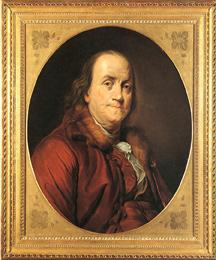
Benjamin Franklin, Printer: 1706 – 1790

At the time of his death in 1790, Benjamin Franklin was world-famous as a philosopher, scientist, inventor and diplomat. His significant contributions to the American Enlightenment and as a leading figure of the Revolution of 1776 are far too numerous and important to be appropriately dealt with in this short space. However, his work as a printer deserves special appreciation.

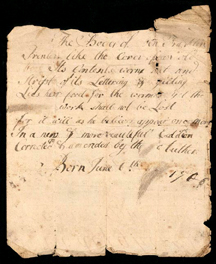
In 1728, when he was 22 years old, Benjamin Franklin wrote the following humorous epitaph for himself:

The body of
B. Franklin, Printer
(Like the Cover of an Old Book
Its Contents torn Out
And Stript of its Lettering and Gilding)
Lies Here, Food for Worms.
But the Work shall not be Lost;
For it will (as he Believ’d) Appear once More
In a New and More Elegant Edition
Revised and Corrected
By the Author.

In his last will and testament of 1788, Franklin amended his plan for the inscription on his gravestone to bear just the names of himself and his wife—Deborah Read Franklin—who preceded him in death by 15 years. In his will, however, he identified himself thus: “I, Benjamin Franklin, of Philadelphia, printer …”

Born in Boston, Massachusetts, Benjamin Franklin was the last of his father’s seventeen children. Franklin began his printing career when he was apprenticed to his brother, James Franklin, at age twelve. After he was denied his wish to be published in James’ newspaper, the young Ben began submitting letters to The New-England Courant under the pseudonym “Mrs. Silence Dogood.” The correspondence became very popular in the local community.

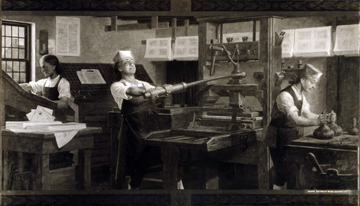
At age 17, Benjamin left his apprenticeship without permission, ran away to Philadelphia to start out on his own. After building his reputation as a skilled craftsmen—as both a type compositor and pressmen—and disciplined worker, Franklin had the opportunity to set up a printing house in partnership with Hugh Meredith in 1728. The following year he became publisher of The Pennsylvania Gazette, one of two newspapers in the colonies.

In his Philadelphia printing shop, Franklin produced his newspaper, government printing projects and he took on a considerable volume of print for hire such as forms, lottery tickets, handbills and bookwork. Beginning in 1730, Franklin was printer of all paper money issued by Pennsylvania, New Jersey and Delaware.

Perhaps one of his most recognized projects was “Poor Richards’s Almanack,” which Franklin wrote under the pseudonym Richard Saunders and printed for 25 years beginning in 1732. As Franklin explained in his Autobiography, “I endeavor’d to make it both entertaining and useful, and it accordingly came to be in such Demand that I reap’d considerable Profit from it, vending annually near ten Thousand. . . . I consider’d it as a proper Vehicle for conveying Instruction among the common People, who bought scarcely any other Books.”

Although Franklin was not the author of the many clever aphorisms contained the Almanack, it can be argued that these sayings have been passed down and are part of our speech today because of his work. Here are a few of them:

–       Early to bed and early to rise, makes a man healthy wealthy and wise. (1735)
–       The rotten apple spoils his companion. (1736)
–       No gains without pains. (1745)

During his printing career, Ben Franklin made important contributions to the technology and practice of printing. He made major improvements to printing press design and helped to set up paper mills in the south. He established in 1778 the first printers’ association in America (later named the Franklin Society), established the first public library, is credited with the idea for the first American magazine and was appointed the first Postmaster by the Second Continental Congress in 1775. Benjamin Franklin created a franchise business model that launched two-dozen printing establishments up and down the Atlantic Coast.

In his “Apology for Printers,” Franklin elaborated a philosophy for the role of the printer in modern society: “Printers are educated in the Belief, that when Men differ in Opinion, both Sides ought equally to have the Advantage of being heard by the Publick; and that when Truth and Error have fair Play, the former is always an overmatch for the latter.” If printers printed only what they believed, “the World would afterwards have nothing to read but what happen’d to be the Opinions of Printers.”

We look back and appreciate the work of Benjamin Franklin with pride; he was one of our own.