Frederic Eugene Ives: 1856 – 1937

Frederick Eugene Ives Frederic Eugene Ives

Frederic Eugene Ives is a central figure in the history of the graphic arts. His inventions and discoveries in the field of visual communications technology—the development of the first halftone reproduction process being the most significant—span six decades and are among the greatest contributions by an individual to the industry.

The son of a farmer-turned-country storekeeper from a small town in rural Connecticut, Ives developed an interest in printing when he found a small hand press in his fathers’ shop. He left school before the age of 12 to find a job and earn a living after the early death of his father from pulmonary consumption. More than a year later, young Frederic obtained an apprenticeship in the printing offices of the Litchfield Enquirer where he earned the state-wide reputation among newspaper printers as “the natural printer.” This was by virtue of the superb quality of his work.

Lacking any formal education, Ives developed a passion for investigation and experimentation in photography and engraving while working late into the night in the attic of a building directly across the village green from the Enquirer office. After completing his apprenticeship at the age of seventeen, he became a journeyman job printer for a printing establishment in Ithaca, New York, some two hundred miles away from his hometown. This was followed a year later with an application for a job running the photographic laboratory at Cornell University. After initially being declared too young and inexperienced for the position, Ives was selected by the university administration for employment on a “trial basis.”

While Ives’ tenure at Cornell lasted just four years, it was during this time that he would go on to develop some of his most important ideas; ideas that would transform the world of printing.

His invention of the halftone photoengraving process in 1881 and later the crossline screen for direct photographic halftone reproduction stand out as a transition period in the history of printing and publishing. Ives had created for the first time the technology and method for reproducing with ink-on-paper printing processes all of the tonal values and richness of detail from an original photographic image. Prior to this discovery, imagery in print was confined to the highly skilled and time-consuming efforts of handicraft wood engravers and resembled works of art more than an actual scene as perceived by the human eye.

In its essential features, the halftone process remains in use today as the most common method for photographic reproduction in print. It is safe to say that the offset lithographic process, the predominant printing technology of the past half-century, could not exist without Ives’ invention. Each day millions upon millions of printed products — newspapers, books, magazines, brochures, calendars, wrapping paper, greeting cards, packaging materials, billboards, to name only a few — are produced by machinery that utilizes what was once known as the “Ives process.”

Simply put, the halftone is an optical illusion: small dots of various sizes that are equidistant from each other create the appearance—at an appropriate viewing distance—of continuous gradations of tone. Due to the fact that many printing processes, can only transfer a solid film of ink to a sheet of paper (or other substrate), the halftone is the most effective method for reliably simulating a continuous tone image such as a photograph. Measured in lines per inch, the halftone screen is the essential building block of the printed page upon which everything else depends.

Ives also made major contributions to the development of color photography and microscopy. Among his 70 patents were the photochromoscope camera, the chromogram and the single-objective binocular microscope. In his later years, when asked how he came to devote himself to the field of optics without what was considered the requisite mathematics and physics training, Ives quoted Robert Louis Stevenson’s remark about his father, the lighthouse engineer, who he said had a “sentiment for optics.”

An unusually gifted man, Ives wrote about himself in his “Autobiography of an Amateur Inventor,”: “… the writer belongs to a period when some of the most revolutionary inventions were made by men not specially trained for such work, but were impelled to undertake it by the possession of what Sir William Abney once termed ‘instinctive genius.’ To this class of men I would apply the term ‘amateur inventors.’ … Some men are as naturally inventors as others are poets, fiction writers, statesmen or merchants and the typical amateur inventor will pursue his course through any amount of poverty and hardship and indifference, thinking much more about his work than about any material reward which it might bring.”

Frederic Eugene Ives is without question one of the great — albeit often unappreciated and rarely recognized — pioneers of graphic and print communications technology.
Thoughts on the newspaper

Much has been written and spoken recently about the fate of the newspaper. As with the rest of the print media industry, newspaper publishing is being altered by a dual reality: 1.) the economic downturn is devastating advertising revenues necessary to maintain financial viability; 2.) the transition of information and news distribution to alternative media such as TV, radio and, most importantly, the Internet.

Major metropolitan daily newspapers are closing or significantly cutting back frequency (The Rocky Mountain News suspended daily print publication on February 26, 2009, just 55 days short of its 150th birthday). Reported quarterly losses at some of the most prestigious publications are dire (The Boston Globe reported a first quarter 2009 loss of $74.5 million).

Clearly, falling readership is a key factor that guides the decision of advertisers to pay for ad space in newspapers. According to the Pew Research Center Biennial News Consumption Survey conducted in 2008:

For more than a decade, the audiences for most traditional news sources have steadily declined, as the number of people getting news online had surged.

While the causes and specifics of this phenomenon are complex, the trend is undeniable: newspapers are a declining source of news for growing numbers of people.

Another factor impacting newspaper revenue is the loss of money from classified advertising caused by eBay, Craigslist and other online services that provide similar services. These online resources are often less expensive (or free) and are more effective at selling or finding the product or service being bought or sold.

I think the future of newspapers is dependent upon form, content and cost. I am a weekday subscriber to The New York Times. The paper is delivered to my home at around 5:00 am each day. I can and occasionally do read the NYT online, however, I find the physical qualities (size, weight, portability, disposability) of the printed paper advantageous. This costs me about $25 per month.

I have considered purchasing a Kindle (which offers automatic daily download of the NYT). Besides the size of the upfront cost ($349 for the device and $99 for an annual subscription to the paper), I am hesitant to give up the other attributes of the printed paper (I don’t count ink smudged fingers and the occasional rain-soaked copy in the front yard among them).

There is one more important consideration: environmental impact of the printed newspaper vs. an electronic edition. I do not have the data to back up this assertion, but I would suggest that an electronic subscription to the daily newspaper (device production and delivery, publication content production, electronic delivery to the device, power to operate the device) would result in a net decrease in carbon impact versus the same for the print edition (publication content production, print production, newspaper delivery).

Newspapers will continue to exist well into the future, albeit in altered state of being. Their future is not guaranteed. When a genuine electronic “paper” is developed (the Kindle is about as close as it comes today), I believe the newspaper and other kinds of print publishing will be displaced The key to the continued existence of newspapers is finding the appropriate relationship between the use-function-cost of their print and online editions. What do you think?

Why are we “going green”?

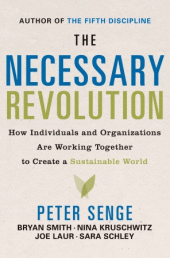
As previously mentioned, I bought the book by Peter Senge, The Necessary Revolution: How Individuals and Organizations Are Working Together to Create a Sustainable World. I wanted to read it because the green and sustainability movements have been impacting the printing and publishing industries over the past year. I am interested in a broader perspective on the subject. Indeed, our company – Grand River Printing & Imaging – has embarked upon its own green initiative and we held a highly successful educational event in Detroit on Earth Day (April 22) to provide a platform for our customers to learn about print media and sustainability.

Much of the recent development in this arena has been focused on paper and the wood fiber sources that are used to make it. The Forest Stewardship Council (FSC) is an independent organization dedicated to the responsible management of the world’s forests. This organization has established a chain of custody program in which all parties involved in the production of wood- and timber-based products, i.e. paper, furniture, building materials, etc., can become FSC certified. In doing so, these companies can demonstrate that the materials used to make the products that are ultimately bought and used by consumers have their sources in responsibly managed forests and woodlands. Products meeting the certification criteria can have the FSC logo imprinted upon them so that the public is aware of the green practices contained therein.

The FSC was founded in the early 1990s and has certified a significant portion of the world’s forests to date. Meanwhile, the number of companies achieving the FSC chain of custody certification has been growing exponentially as corporations, government and educational institutions have adopted the concept of using responsibly harvested wood-based products. Some organizations see this as a strategic goal and are using the FSC label along with other types of green programs to highlight their concern for the environment and willingness to contribute practically to the preservation of our natural resources.

Actually, the paper and printing industries have been involved in ecological efforts for many decades. Among the first industries to be impacted by laws passed in the 1970s by the EPA, the paper industry has been under particular anti-pollution scrutiny. As a major consumer of water and power resources, the paper manufacturers have been altering their practices over the past three decades. For print companies, who are major users of gas and electric power as well as the chemicals involved in the graphic arts process, government policies have regulated plant emissions and chemical waste disposal during the same three decades.

So, one of the reasons I wanted to read Senge’s book was to answer the question: why has sustainability and “going green” become such a hot topic in business today? A second reason was, since Mr. Senge is a purveyor of what you might call “business management philosophy,” I wanted to know where he sits on the question of global climate change and its causes; a controversial and highly charged topic.

On the first question, Senge provides an explanation of the source of the drive toward sustainability in the corporate world. As one would expect, with Peter Senge (and his co-authors Bryan Smith, Nina Kruschwitz, Joe Laur and Sara Schleyt), who wrote the acclaimed large volume The Fifth Discipline about “learning organizations,” there is no easy answer to the question. In The Necessary Revolution Senge and his collaborators attribute the transformation in business philosophy toward sustainability to a set of objective historical circumstances. They say that the sustainability revolution is not a fad or passing fancy but a new way of doing things in a world that is vastly different from the one that existed in 1950. This change is primarily driven, they say, by the global interdependence of nations and regions of the world and the realization that the side effects of the industrialization of the previous century and a half are unsustainable going forward.

The following passage from the opening chapter gives a good summary of this concept: “There are many types of revolutions. History talks mostly of political revolutions, dramatic events that all too often represent little real change over the long term: The cast of players in power shifts and new political philosophies come into vogue, but when it comes to the daily realities of most people, little changes. But occasionally something different happens, a collective awakening to new possibilities that changes everything over time – how people see the world, what they value, how society defines progress and organizes itself, and how institutions operate. The Renaissance was such a shift, as was the Industrial Revolution. So, too, is what is starting to happen around the world today.”

According to the authors of The Necessary Revolution, we are now at the beginning of the new post-industrial stage of society which mandates that we alter our view of the world and our use of its resources. In their view, this is the foundational source of the new policies and practices that are being adopted throughout the world toward preservation and establishing renewable sources of energy, air, water and food.

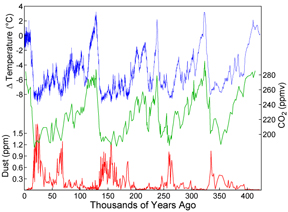
On the second question, Mr. Senge places climate change squarely at the feet of the growth of CO2 in the atmosphere. He writes, “Although science rarely provides absolute certainty, a consensus has emerged among scientists, and among a small but growing cadre of influential leaders, the the changes needed to avert extreme and possibly uncontrollable climate change will be greater and must happen far more quickly than we imagined even a few years ago. In this sense, climate change is a particular sort of gift, a time clock telling us how fast the Industrial Age is ending.” And further on he write, “Unlike so many other global social and environmental problems, in one sense climate change is simple — because its primary dimensions are measurable. Scientists now have extensive evidence of how rapidly CO2 and other greenhouse gasses are accumulating in the atmosphere, and how that compares with historical levels.”

The authors then go on to explain the connection in the historical data between CO2 in the atmosphere and temperature, a fact that has been established through analysis of ice core drillings that preserved these characteristics going back 650,000 years.

While Peter Senge is not climate scientist, he is a social scientist and has done a considerable amount of his own research on human organization. The Necessary Revolution is devoted primarily to establishing a theoretical view of the new forms of activity that have emerged recently around sustainable practices in business, government and education. While I don’t subscribe to all of the ideas in his new book, I think that Mr. Senge and his co-authors should be credited with their honest portrayal of the scientific basis of the climate change crisis and pointing to the potentially catastrophic consequences of the resistance to dealing with this worldwide dilemma.

KD
July 12, 2008