The book called “The Book”

The American Association of Publishers recently reported that year-over-year e-book sales had fallen by nearly 5% through mid-2013. The “flattening” of e-book sales has been underway for several years and the latest figures come as no surprise. The exponential growth rates of the e-book market that began in 2008—peaking at 254% in the first quarter of 2010—could not be sustained indefinitely. As Harper-Collins CEO Brian Murray noted last November to Publishers Weekly, “Nothing grows by triple digits for too long.”

The Book: A Global History published by Oxford University Press

There are dynamic and complex reasons for the e-book market slowdown: the popularity of individual titles, sales of dedicated e-reader devices vs. tablets, recognition by readers and publishers of titles that fit one format vs. another, etc. Meanwhile, one byproduct of these changes is that the decline in printed book sales—particularly hard cover books—has also begun to slow. It seems that some kind of equilibrium is being achieved between printed books and their digital cousins. Industry experts say that this is a repetition of the pattern of development that occurred when paperbacks (1930s) and audio books (1970s) first came into use.

The following is a summary of the recent AAP book sales figures by format:

Format               Jan-Jun 2013           Jan-Jun 2012            Change
Hardcover            $978.1 million            $1,063.8 million           -8.0%
Paperback            $953.5 million            $1,023.3 million           -6.8%
E-book                 $766.8 million           $805.3 million              -4.8%
Total                   $2,698.4 million      $2,892.4 million        -6.7%

One important aspect to note is that within an overall environment of declining book sales, e-book sales as a percent of the total is continuing to grow (from 27.8% in 2012 to 28.4% in 2013).

The inflection point in the e-book market is an appropriate moment to take note of the publication earlier this year of the volume The Book: A Global History by Oxford University Press. Edited by Michael F. Suarez and H.R. Woudhuysen, The Book contains 54 essays in two sections: Thematic Studies (21 essays) that deal with the origins of written communications, the ancient history of books and the technologies of book production and Regional and National Histories of the Book (33 essays) that cover book history in many countries in Europe, Asia, Australia and the Americas.

Oxford Companion to the BookThe new volume is a concise edition of the highly acclaimed Oxford Companion to the Book published in 2010. That work by the same editors is 1,327 pages, comes in two vivid burgundy bound volumes with gold lettering, costs $325 and is clearly library reference material.

As Suarez and Woudhuysen state in the introduction to the new smaller volume, “Encouraged by the commercial and critical fortunes of The Oxford Companion to the Book (2010), its General Editors were nonetheless chastened by the fact that its costliness prevented many from purchasing the two-volume work of 1.1 million words. … It is our hope that the publication of this volume will make a valuable collection of bibliographical and book-historical scholarship—ambitious in its scope and innovative in its reach—accessible to a broad audience of general readers and advanced specialists alike.”

One can tell from these two sentences that this is not a book to be read for entertainment. In any case, The Book: A Global History—in spite of its pedanticism and academic erudition—is an important resource. The research and scholarship enable those in modern day print communications to gain a deeper understanding of their profession and its social, technical and economic origins and development over many centuries.

For example, in a significant point in the introduction, the editors describe the term “book” as a synecdoche, i.e. a figure of speech that represents all other textual communications forms. They write, “Naturally, the use of the term ‘book’ in our title in no way excludes newspapers, prints, sheet music, maps or manuscripts … in every European language the word for ‘book’ is traceable to the word for ‘bark,’ we might profitably think of ‘book’ as originally signifying the surface on which any text is written and, hence, as fitting shorthand for all recorded texts.”

It is of course not possible to summarize the entirety of the new volume here, so below are a few highlights followed by some concluding thoughts:

  • Writing Systems
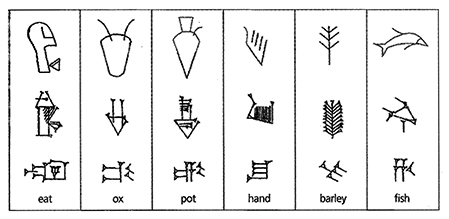
The evolution of early writing systems.

The very first essay by Andrew Robinson is about the origin of human writing systems. It should come as no surprise that the birth of writing is thought to have taken place in what is now known as the “cradle of civilization” in Mesopotamia sometime in the late 4th millennium BC. The impulse for the first writing system was the need for record keeping associated with trade. As Andrews writes, “the complexity of trade and administration had reached a point where it outstripped the power of memory among the governing elite. To record transactions in an indisputable, permanent form became essential.” One theory holds that the system began with the exchange of clay tokens and that this was later substituted with two-dimensional symbols written in clay. Of course, another origin of writing is the Ice Age symbols found in caves in southern France that date back 20,000 years. These images, however, are considered “proto-writing” because they do not conform to the scientific definition of writing provided by the noted Sinologist John DeFrancis as a “system of graphic symbols that can be used to convey any and all thought.”

  • The Book as Symbol

In essay number 7, Brian Cummings treats the book as an object within different historical contexts. He writes, “A book is a physical object, yet it also signifies something abstract, the words and the meanings collected within it. Thus, a book is both less and more than its contents alone.” During ancient times, books were considered sacred and access was restricted to a priestly class. Writing was itself considered a spiritual power and consumption of the written words also a mystical act. Later, Plato posited that writing was inferior and untrustworthy in comparison to the knowledge within the mind. In biblical times, “the scrolls” (Torah), “the tablets” (Ten Commandments) and “the scriptures” (The Bible) emerged as those writings that embodied divine power, law and ordinance. Cummings writes, “The incorporation of the holy book into ritual—the raising of the book, or carrying of it in procession, or kissing of the book or kneeling before it—is only the most obvious example of this.” These practices exist today in the courtroom or inaugural “swearing-in” and “taking the oath” of witnesses and officials who place their hand upon the Bible. Another more modern and historically significant treatment of books was the infamous Nazi burning of “degenerate” books in Berlin’s Opernplatz in 1933.

  • The Electronic Book
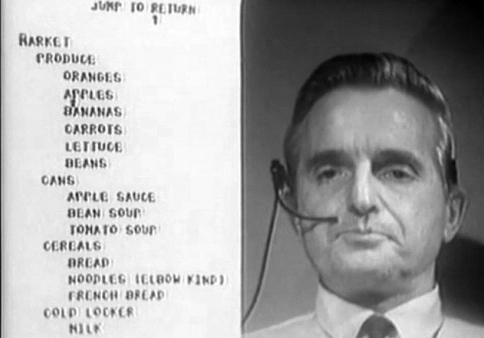
Engelbart Demonstrating NLS
Douglas Engelbart demonstrating the NLS on December 9, 1968

The essay by Eileen Gardiner and Ronald G. Musto on the e-book was revised and expanded from the Oxford Companion to the Book of 2010 and this fact expresses the rapid development of the new form. Of particular note is the essay’s summary of the background to present-day e-books. In 1945, Vannevar Bush provided the earliest documented vision for proto electronic books in what he called the Memex. This hypothetical system would store the entire contents of scientific literature and had pages, page-turners, annotation capability, internal and external links, storage, retrieval and transmission of documents. But, while Bush conceived of the Memex on microfilm, the first truly electronic book concept came in 1965 with the “hyperlinking,” “hypertext” and “hypermedia” vision of Ted Nelson. Nelson’s idea was first demonstrated—now famously referred to as “The Mother of All Demos”— by Douglas Engelbart. The system was called NLS (for oNLine System) and was developed by the Stanford Research Institute. Engelbart demonstrated in combination for the first time anywhere on December 9, 1968 the following: email, teleconferencing, video-conferencing and the mouse. The future of hypertext from this point forward merges directly with the emergence of the personal computer and later the World Wide Web, i.e. Apple HyperCard by Bill Atkinson in 1987, the emergence of CD-ROM books in 1992, online and searchable texts accessible with the Mosaic/Netscape web browser in 1993.

As mentioned earlier, The Book: A Global History is an important resource for bibliophiles and anyone seeking thorough knowledge of the history of print communications. Going through the volume, readers gain a better understanding world history. It seems that books, both their antecedents and descendants, are intermingled with the history of all civilization from the end of human pre-history to the present.

With the development and adoption of e-books—combined with wireless and mobile communications—it is possible to envision a future where print-on-paper books are recognized as relics of a distant past. But such an eventuality would also require a development well beyond the present e-book reader and mobile media experience along with solving many other complex problems. While great strides have been made, we are still at the very beginning of the transition from the completely analog world of books to the completely digital world of instantaneous and infinite access to all information, knowledge and culture.
Surveys show preference for print media

Several recent surveys and reports substantiate the fact that print is both a highly successful choice for advertisers as well as a preferred marketing media for consumers. Interestingly, according to these studies, even among young people and the affluent—where one might expect a higher rate of loyalty to electronic and social media alternatives—print is still a favored source of offers, promotions, information and news.

Millennial shoppers

On September 11, Valassis—a leader in intelligent media delivery and printed coupon advertising—announced the results of its Sixth Annual RedPlum Purse String Survey of over 5,000 shoppers taken in June and July of this year. The results provided insights into the shopping behavior of millennials: the generation of young people born between 1982 and 2004.

The Purse String Survey showed that the millennial generation relies heavily on newspaper advertising print coupons and offers in the same way that all other age groups and income levels do. The top print sources for the millennials are:

  • 33 percent from the mail
  • 21 percent from retail circulars
  • 20 percent from coupon books

While the younger generation is, of course, very active with digital advertising, they are getting their promotions to a larger degree from these sources than the rest of the population. But according to Lisa Reynolds, Valassis VP of Consumer Engagement, “The RedPlum Purse String Survey results are somewhat counter intuitive from what you might expect based on what we know about millennials … While they are heavy digital users, this group also embraces tried and true methods for savings, as much as any other age group. Promotion sensitive, they are a true testament to the use of savings from both print and digital sources.”

Millennials Share Coupons

When it comes to sharing promotions and deals with others, millennials are the most active:

  • 90% of millennials share deals with others
  • 45% of millennials share deals through social media, compared to 29% among everyone
  • 30% of millennials share deals through text, compared to 19% among everyone
  • 71% of millennials share deals through word of mouth, compared to 56% among everyone
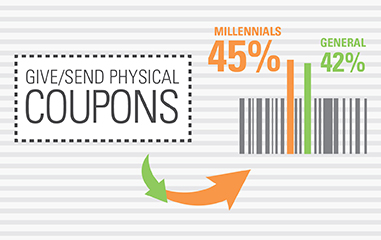
  • 45% of millennials share or send physical coupons compared with 42% among everyone

Affluent readers

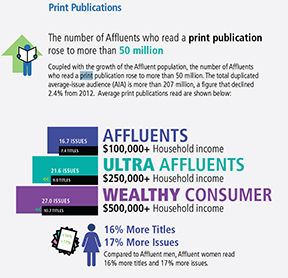
On September 19, the 2013 Ipsos Affluent Survey USA reported that affluent adults (households with and annual income of $100,000 or more) “continue to be enthusiastic consumers of traditional media,” even as their use of digital media continues to grow sharply.

The study projected that there are 62.5 million affluent adults in the US, which is up more than 6% over the past two year and represents approximately 20% of the total US population.

Affluent Adults Read Print MediaThe Ipsos survey found that 81% of affluent adults regularly read at least one of the 142 measured and reported print publications (135 magazines and 7 national newspapers).

The survey results on print readership is in contrast to the fact that affluent adults are also increasing the amount of time that they spend online each week. And they are increasing their use of smartphones, tablets and downloads of digital newspapers and magazines.

Direct mail vs. email marketing

An analysis of all Internet traffic in 2012 published by Pingdom reported that there were 144 billion email messages sent each day and that 68.8% of this was spam. Additionally, the data showed that 61% of all email was considered nonessential. Another report by HubSpot showed that three quarters of all email remains unopened and “click through” rates are below 5%.

This is in contrast to information published by the USPS in the Household Diary Study. This data from 2011 showed that the advertising mail represented 61% of all household mail or 85.1 billion pieces of print advertising entering homes in the US.

The survey showed that 78% of households either read or scan their advertising mail and only 21% say that they do not usually read their advertising mail. The USPS diary results also showed that 62% of households say they read or scan catalogs received in the home, with 13% setting them aside for later reading and only 17% discarding them without reading.

Additionally, the survey showed that households with Internet access receive more advertising mail than those without access.

Challenges to print

There continues to be a steady push by advertisers and marketers to move the behavior of the consumer away from print media to online alternatives, primarily because the cost of delivery is far lower.

A campaign recently launched by the CVS drugstore chain called “What’s your deal?” utilizes the integration of print, TV, mobile and social media channels to promote personalized offers based on previous consumer buying. The campaign offers customers who belong to the CVS ExtraCare loyalty program a personalized version of the weekly print circulars distributed through newspapers and in stores to an estimated 45 million people.

Users of the program will be able to build digital shopping lists that can be personalized based on the CVS location where they shop including the layout of the store and where they can find each product on the shelf.

According to a representative of the agency that developed the “What’s your deal?” program, “We’re trying to get people to change their behavior by going online for a much more personalized experience” rather than checking weekly circulars. “The print circular is going to be around for a while, but eventually it’s going to go away,” he added. “We have to prepare for the future.”

In the meantime, the above surveys on consumer and household behavior show that print media continues to be a preferred media for advertising, offers, information and news among the population. They also show that where print is integrated with digital and social media campaigns, its value in increased.

3-D printing: The next desktop revolution

I suspect there are more than a few readers who remember how printing and publishing changed dramatically in the 1980s as desktop computers and print-ready files displaced phototypesetters and camera-ready artwork. Many of us went from the hazards of darkroom chemistry to that of workstation ergonomics; I remember being unceremoniously lifted from the comfort of my paste-up boards, horizontal camera and film processor and dropped into the world of SyQuest disks, Apple system “bombs” and PostScript (infinite-loop) errors.

Steve Jobs Press Conference January 23 1985
Steve Jobs at the press conference where the first desktop publishing system was announced on January 23, 1985.

Actually, the birth of desktop publishing (a term coined by Paul Brainerd of Aldus Corporation) and its disruptive impact can be traced to a specific date. On January 23, 1985, at a press conference following an annual stockholder’s meeting of Apple Computer, Steve Jobs announced the first desktop publishing system. It consisted of the following component technologies:

  • Personal computer (Apple Macintosh)
  • Page layout software (Aldus PageMaker)
  • Laser printer (Canon/Apple LaserWriter)
  • Page description language (Adobe PostScript)

It is safe to say that few understood the meaning of what happened that day. For the first time, text and graphics were placed on a page simultaneously and imaged on paper as reproduction “copy” or as a final printed sheet. The breakthrough of desktop publishing was that it was possible for just about anyone—with a modest investment—to become a publisher. The full impact of desktop publishing would be realized over the next decade as it transformed several industries and was a significant element in the evolution of the World Wide Web.

Chris Anderson MakersWith the benefit of hindsight, Chris Anderson (author of The Long Tail and former editor of Wired magazine) discusses the long-term implications of the desktop phenomenon in his book Makers: The New Industrial Revolution. “Remember, at that time publishing used to mean manufacturing in every sense of the word, from the railways that brought huge rolls of paper and barrels of ink to the printing plant … Taking publishing out of the factories liberated it. But the real impact of this was not in paper, but in the idea of ‘publishing’ online. Once people were given the power of the press, they wanted to do more than print out newsletters. So, when the web arrived, ‘publishing’ became ‘posting’ and they could reach the world.”

Today Anderson believes that we are living through a similar paradigm shift. But this time it is in the world of physical objects and the making of things. Today’s Maker Movement—the design and manufacture of things by individuals instead of industrial corporations—is with personal computers, CAD software and desktop 3-D printers and other equipment like laser cutters and CNC machines.

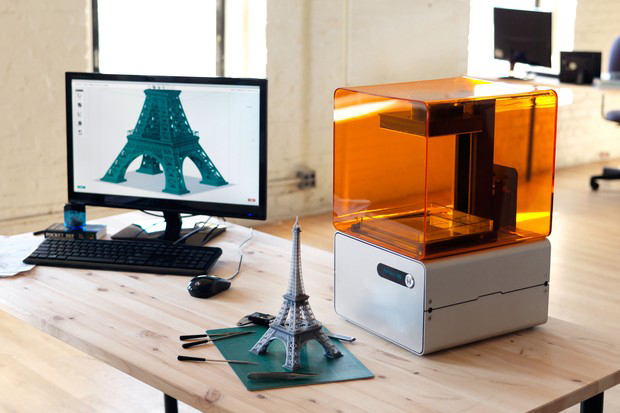
Form 1 desktop 3-D printer
Desktop 3-D printers take geometric data from CAD software and fabricate objects out of liquid plastic or resin

Distinct from the desktop printers that produce 2-D black and white or full color images on sheets of paper, a 3-D printer uses electronic geometries and turns them into objects that you can pick up and hold in your hand. Desktop 3-D printers usually extrude molten plastic in layers of liquid or powder resin. They can typically put down plastic material in thin layers (.33 of a millimeter) in processes like fusion deposition modeling (FDM), stereo lithography (SLA) or selective laser sintering (SLS).

3-D printers are an “additive” manufacturing technology; they build up objects from nothing, layer by layer. This is distinct from older industrial techniques—like “subtractive” routers and mills—in which spinning raw material is cut or ground away to reveal the object. Although they are newer and undergoing rapid development, additive 3-D printers have the advantage of producing little or no waste in the production process.

3D Print Sales Chart
Market size by 3-D printing sector application in US$ million

According to a recent report by IDTechEx, large-scale 3-D printing surpassed revenues of $1 billion in 2012 and growth is expected to quadruple by 2025. Industries that are heavy users of 3-D printing technologies are medical and dental, automotive and aerospace. The promise of the 3-D print is that it opens up inexpensive variability and complexity to the mass manufacturing process. For example, 3-D print used in the manufacture of prosthetics and orthopedic implants makes possible mass customization based on patient CT or MRI scan data.

Some believe—including Chris Anderson—that the digital Do-It-Yourself (DIY) and Maker Movement are generating a much bigger market than that of the large-scale commercial applications. The aggregate value of the design and manufacture of entirely custom products in medium to small (or even single) quantities is potentially greater than the manufacture of mass consumer products where each item is identical.

This is a business concept that everyone in the printing industry is very familiar with. We have been dealing with the economics of the digital print for two decades and understand very well that the cost per unit of a digital print product (custom) versus conventional offset printing (mass production). The cost per unit in digital print is “flat,” i.e. it do not rise or fall based upon a decrease or increase in quantity or a change in complexity, whereas the cost of the setup (make-ready) of a traditional offset print project is amortized across the entire print run.

chrischarts.indd
The relationship between the cost per unit and the quantity of mass manufacturing (injection molding) versus digital fabrication (3-D printing).

Anderson explains it this way, “Digital fabrication inverts the economics of traditional manufacturing. In mass production, most of the costs are in up-front tooling, and the more complicated the product is and the more changes you make, the more it costs. But with digital fabrication, it’s the reverse: the things that are expensive in traditional manufacturing become free.”

We can rightfully question Chris Anderson’s assertion that digital desktop fabrication heralds the beginning of new industrial revolution on the magnitude of that which occurred in the nineteenth century. However, there is no doubting his commitment. Anderson recently left his position after more than ten years as editor of Wired magazine to become full-time CEO of the firm he founded called 3D Robotics that manufactures unmanned aerial vehicles (UAVs).

As we think about the meaning of 3-D printing technology today, it is important to reflect back upon the desktop revolution of the 1980s. We should recall that many in the publishing industry viewed the nascent desktop system—inspired by Steve Jobs of Apple, Paul Brainerd of Aldus and Chuck Geschke and John Warnock of Adobe—as not measuring up to the professional requirements of the day. Many who initially dismissed desktop publishing as a fad and resisted the transition away from mechanical graphic arts technologies would later live to regret that perception.

The promise of 3-D printing is significant. Perhaps Chris Anderson will not be alone in the migration from the printing and publishing industries to that of digital fabrication, DIY manufacturing and the Maker Movement.