DRUPA 2012: A report from afar

Like most people in our graphic arts community, I was unable to attend the international printing and paper expo—DRUPA 2012—in Düsseldorf, Germany this year. The trade show, which is held every four years, took place May 3-16 at the Düsseldorf Fair Grounds. DRUPA—a contraction of the German words for printing (druck) and paper (papier)—is by far the biggest and most important printing industry event in the world. This year the exhibits covered 1.7 million square feet of floor space and were on display in a total of 17 halls.

Having attended the expo twice in the past, I was very keen to follow the industry news reports—primarily from WhatTheyThink.com—and official DRUPA press releases as they came in each day. However, this year it was also possible for the first time to follow the event from social media streams. Through numerous YouTube and Twitter posts—from exhibiting firms as well as by attendees—it was possible to get a real-time view of what was happening.

Among the most important news from the show came after it was over. DRUPA 2012 saw 314,500 experts from more than 130 countries attend; this was 75,550 less than 2008. “This drop does not come as a surprise for us and the sector as a whole. In Germany alone the printing industry lost some 3,900 operations with over 61,000 employees between 2000 and 2011. In the USA over the same period more than 7,700 printing operations closed,” explained Werner Matthias Dornscheidt, President & CEO of Messe Düsseldorf.

There were other international dynamics in evidence at DRUPA, as the final press release from the show explained. “With more than 190,000 foreign visitors the international focus of DRUPA continues at a very high level. What is striking here is the high number of trade visitors from India, which, now reaching some 15,000, ranks as the second largest visitor nation after Germany (123,000 visitors). Following behind these two in the country ranking is: Belgium, France, the Netherlands, Great Britain, the USA, Switzerland and Italy. It is particularly gratifying to see the rising proportion of visitors from South and Central America (8.8% in 2012 compared to 7% in 2008)—and more specifically from Brazil.”

You can read the DRUPA 2012 Final Press Release here, http://ilnk.me/10708

Moving on to the technology of the show, you can find a summary of all the DRUPA news reports from WTT.com both before and after the show here, http://ilnk.me/1072b

The major developments were clearly in digital printing with various inkjet-printing devices taking center stage.  And the biggest news from DRUPA was the launch by Landa Corporation of a new category of printing called nanography. Benny Landa, the founder and CEO of Landa Corp., is the godfather of the digital printing revolution. After he invented the Indigo press—the first full-color variable data printing device—in 1993, Landa then sold this technology to Hewlett-Packard in 2003.

Landa’s new nanographic technology is distinct from other forms of digital presses in that it does not begin from the business proposition associated with variable data printing. Previous digital printing devices have attempted to compete for marketing and communications dollars based upon the value of personalized content. Nanography, while it offers this capability, more importantly makes a business claim on a substantial spectrum of static print media currently dominated by the offset method.

The DRUPA standing room only crowd at the Landa Nano exhibit

The basic ideas of Landa’s new solution are found in the following excepts from his DRUPA presentation:

“Everything that can become digital will become digital and that includes printing. Since 1993 when we launched it, digital printing has exploded. … And yet, digital printing barely nibbles around the edges of mainstream printing. Only 2% of printed pages are printed digitally. This is why we have invented nanography; for the other 98% …

“I bet there is not one person in this hall that believes that 200 years from now man will communicate by smearing pigment onto crushed trees. The question on everyone’s mind is when will printed media be replaced by digital media. … It will take many decades before printed media is replaced by whatever it will be … many decades is way over the horizon for us and our children. We are concerned about the coming decades and there the question we must ask ourselves is: ‘How can my business prosper as the printing industry transitions from mechanical printing to digital printing to whatever comes next?’ …

“Its all about the other 98%. And where is this 98%? You are already doing it. The trouble is, you can’t make any money from it. … There is no digital printing on the horizon or the foreseeable future that is going replace offset. Offset will be here for as long as we can imagine. … Digital printing was invented to be profitable at a run length of one, but the problem is that digital printing is also unprofitable as run lengths become longer and longer. That has created an enormous gap where neither offset is profitable nor digital is profitable. But that gap is where your customers need to be; short and medium run lengths and they can’t get it with you doing it profitably and that is why we invented nanography.”

The unique proposition of nanography is that it puts down elements of pigment onto any substrate in ultra small particles that measure in nanometers, one billionth of a meter, thus reducing the cost of basic elements of the printed image. The Landa Nano technology has been so impressive that agreements have been signed to license the printing method by Komori, Man Roland and Heidelberg. A summary of the technical and business issues in nanography can be found at the Landa website here: http://ilnk.me/10735

If you have time, you can watch a 47 minute video of the entire Landa presentation, which was standing room only at DRUPA 2012, courtesy of Yair Zafrany, here: http://ilnk.me/1072d

In addition to the excitement around the Landa launch, there were also impressive digital printing presentations made by HP, Xerox and a number of other manufacturers. A summing up of these developments can be found in a YouTube video by industry expert Frank Romano published by Mohawk Fine Paper here: http://ilnk.me/10736

As has been the case in the past, the most important thing about DRUPA is that it is more about where our industry is going than about where it is today. So DRUPA is a kind of time machine that lets us look ahead a bit. It is my hope that the information reported here will at least provide an indication of what to expect this fall at GraphExpo 2012 on October 7-12 in Chicago. Hopefully, more of us will be able to attend that show and then we can compare notes. See you there!
From craft to industry (3): William Bullock

As mentioned previously, a significant driving force behind the industrial transformation of printing was the expansion of newspaper publishing. In 1840 there were 1,300 newspapers in America; by 1850 this number had doubled and most big cities had multiple daily papers. New York had fifteen dailies, Boston twelve, and Philadelphia and New Orleans each had ten.

By 1860, the telegraph and transatlantic cable increased the speed of news delivery and the largest circulation paper in the world—New York Herald—was distributing 77,000 copies daily. When the Civil War began on April 12, 1861, the New York Herald’s circulation shot up to 107,000 and did not fall below 100,000 until after the war. By this time, there were about 3,700 newspapers in the US and 387 of them were daily papers.

This was the beginning of the era of enormous publishing empires and major investments were being made in press technology development. The limitations of previous generation powered rotary presses had to be overcome in order to satisfy America’s population growth and the exploding demand for news in printed form.

In 1835, the English inventor and pioneer of the modern postal system, Sir Rowland Hill, suggested printing on both sides of a roll of paper. However, as has been the case with many previous printing press ideas, it is one thing to make a suggestion and quite another to execute it practically.

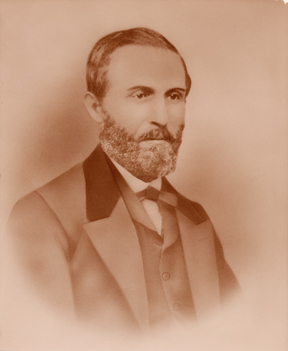
William Bullock, 1813-1867

There were several important technical issues involved in the first successful rotary web printing press. The most important of these was the rapid cutting off and delivery of the paper either before or after it was printed.

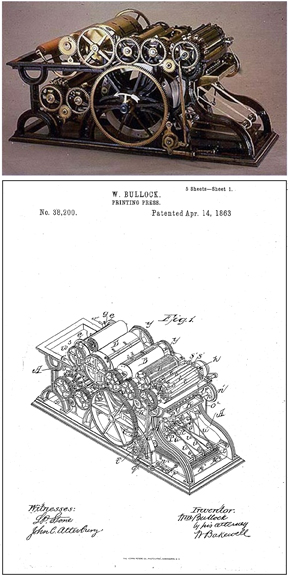
The solution to the problem of web cutoff is widely recognized as being made by the inventor William Bullock in Pittsburgh, Pennsylvania beginning around 1861. In the patent granted to Bullock on April 14, 1863, the inventor describes the significance of his achievement: “My improved machine for printing from moving type or stereotype-plates belongs to that class of power printing-presses in which the paper is furnished to the machine in a continuous web or roll, and by which the sheets are severed from the web, printed on both sides, and delivered from the machines thus ‘perfected.’ … In my machine, however, there is but one delivery apparatus, which is simple in construction and works as rapidly as the machine can be driven and the sheets printed, so that by my invention the great obstacle to the rapid operation of the printing press is successfully overcome.”

The prototype of Bullock’s breakthrough system was installed at the Cincinnati Times in 1863 and the Philadelphia Inquirer acquired the first fully functioning model in 1865. The essential components of Bullock’s rotary web cutoff technology remain in use to this day in web presses all over the world.

William Bullock’s biography is one of a harsh life and, ultimately, tragic death. Born in 1813 in Greenville, NY and orphaned shortly thereafter, Bullock was apprenticed at the age of eight to a foundry man and machinist by his brother. By the age of 21, William had his own shop and was working diligently as an inventor.

He moved to Savannah, GA in the late 1830s after inventing a shingle-cutting machine and where he also built hay and cotton presses. He returned to New York and made artificial legs and invented a grain drill, seed planter and a lath-cutting machine. In 1849 he won second prize by the Franklin Institute for his grain drill.

Bullock’s interest in printing presses began in the 1850s. He was editor of The American Eagle in Catskill, NY in 1853 and then moved to New York City to work as a mechanical engineer. He ended up building a high-speed press for the nationally circulated Leslie’s Weekly in 1860.

William Bullock moved to Pittsburgh in 1861 and it seems he had aspirations of becoming a patent attorney having considerable experience with patent filings. It was around this time that he changed his listing in a Pittsburgh business directory to “manufacturer of printing presses.”

The original design of the Bullock Press and the front page of US Patent 38,200 dated April 14, 1863.

The original Bullock press design cut the paper off before printing on it. Later models of his machine cut the web after it had been printed upon, just as it is done today in the majority of web fed presses. Later, a folder invented by Walter Scott and multiple webs were added to the system further improving press productivity.

William Bullock did not live to see these additions to his invention. On April 12, 1867, he died from injuries sustained when his leg became entangled in the drive mechanism of a press he was installing at the Philadelphia Public Ledger. Bullock is buried in Union Dale Cemetery on Pittsburgh’s North Side. He was belatedly recognized in 1964 as one of the city’s geniuses with a bronze memorial marker that reads: “His invention of the rotary web press (1863) made the modern newspaper possible.”

The industrial development of printing—much like our present digital, Internet and social media era—transformed the landscape of information and news publishing and distribution. Those who studied and understood the form and content of the successive waves of technology revolution were able to take advantage of the opportunities that presented themselves. Individuals like Friedrich Koenig, Richard March Hoe and William Bullock exemplified the best of their respective generations as printing passed through a transformative period during the nineteenth century.

From craft to industry (2): Richard March Hoe

The transformation of printing from handcraft to an industry began in 1812. Koenig and Bauer—through the application of iron, steam power and, above all, the cylinder—replaced the wood construction, hand power and screw mechanism of the Gutenberg press that had existed for the previous 370 years.

While these changes dramatically increased productivity, the industrialization of print machinery remained incomplete. Mechanical limitations, the consistency of paper manufacture and print quality issues prevented the cylinder press from reaching speeds greater than a few thousand sheets per hour.

Richard March Hoe,
September 12, 1812 – June 7, 1886

By mid-century, the demands of publishers for faster and larger print production volumes required another technological leap. In 1847, Richard March Hoe provided the solution with his invention of the first rotary printing press.

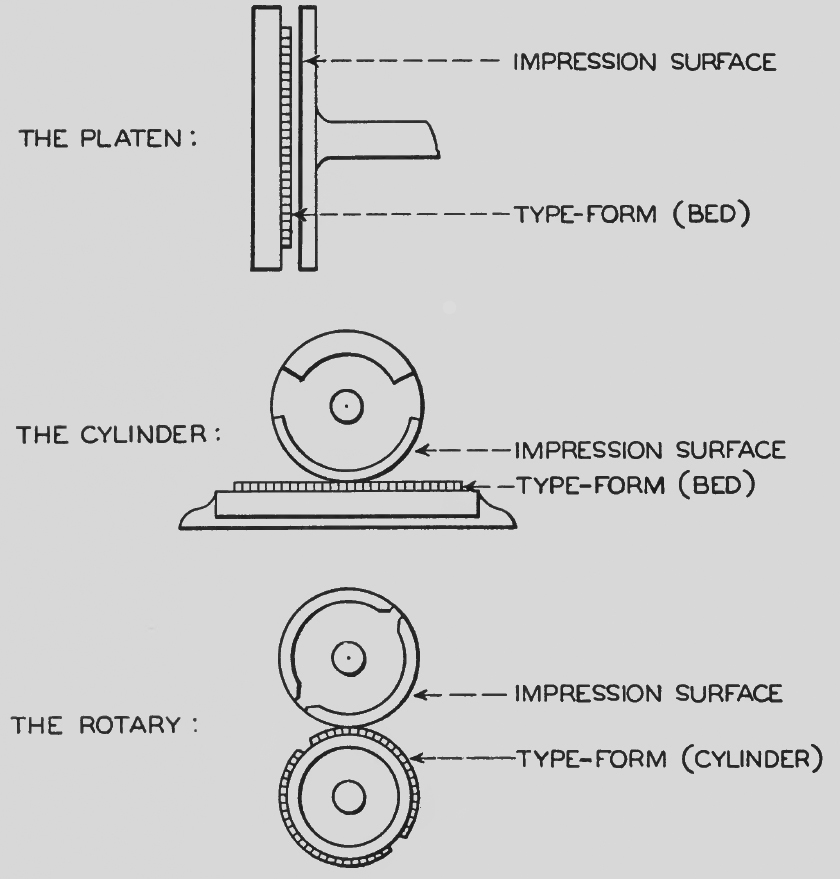
When reviewing the evolution of the press, an understanding of print fundamentals is important. With the exception of modern-day digital systems—where an infinitely variable image is rendered directly to the substrate by print heads—all previous printing machinery had an important common feature: an image carrier. The image carrier is the surface from which ink is transferred to paper or other print material.

In letterpress printing, the image carrier is the raised metal type form. The letterpress process also requires an impression surface where pressure is applied tp transfer the ink to paper. During the industrialization of printing, both the image carrier and the impression surface were converted from a flat platen shape to a curved rotary shape.

The illustration below shows how the cylinder press was a transitional or hybrid development between the platen press and the rotary press. With the cylinder press, the image carrier remained flat, while the impression surface was curved. The ink was applied to the paper as it rode on the bed underneath the impression cylinder.

It took another 35 years of experience and experimentation before the type forms could be mounted on a curved surface and the paper could move on its own between the impression and the “revolving-type” cylinders. This is the core achievement of the rotary press identified with Richard March Hoe.

There were many individuals and companies that worked on creating a rotary printing machine that did away with the platen type form bed. As far back as 1790, an Englishman name William Nicholson took out a patent for a system that designed letter forms around a cylinder. However, the idea was never delivered practically.

The story of the first commercially successful rotary press is the story of the Hoe family. Robert Hoe (1784-1833) was born in Leicestershire, England. With skills as a carpenter, he emigrated to the United States at age eighteen. He later formed with his brothers-in-law Peter and Matthew Smith a wooden press-manufacturing firm in New York City. In 1823, he gained sole ownership and the R. Hoe & Company was founded and it became the first company to build an iron and steam driven cylinder press in America based upon the designs of Koenig and Bauer.

After Robert Hoe’s death in 1833, his sons Richard March Hoe and Robert Hoe II took over the business. More than any other firm, the R. Hoe & Company expressed the fact that, during the two decades between 1830 and 1850, the center of printing technology development had shifted from Europe to America.

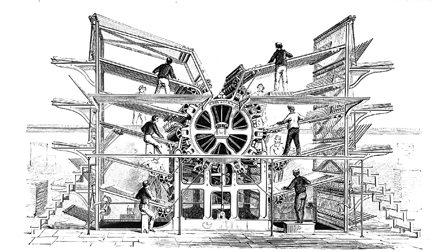
With Richard March Hoe at the helm, and driven by the demand for the mass circulation and daily newspaper, the company developed an innovative technique for mechanically feeding sheets of paper into a press. Later, with its most significant invention, the company designed and built the “Hoe Type-Revolving Machine,” the first functioning rotary press. This system was so successful and productive that it became known as the “Lightning Press.”

Working on this press in 1845-46—Richard March Hoe obtained patents for it in 1847—the problem of mounting type forms onto the curved surface of a cylinder was solved. According to an account published in 1902 by Robert Hoe III, the grandson of the founder, “The basis of these inventions consisted in an apparatus for securely fastening the forms of type on a central cylinder placed in a horizontal position. This was accomplished by the construction of cast-iron beds, one for each page of the newspaper. The column rules were made ‘V’ shaped; i.e. tapering toward the feet of the type. It was found that, with proper arrangement for locking up or securing the type upon these beds, it could be held firmly in position, the surface form a true circle, and the cylinder revolved at any speed without danger of the type falling out.”

Robert Hoe III also noted the importance of these developments, “As the demands of the newspapers increased, more impression cylinders were added, until these machines were made with as many as ten grouped around the central cylinder, giving an aggregate speed of about 20,000 papers per hour printed upon one side.  A revolution in newspaper printing took place.”

Ten cylinder Hoe Type-Revolving Press

With its six-and-a-half foot diameter central revolving type cylinder, these new machines were rapidly adopted across the US and also in Britain. In 1858, The Times of London ordered two ten cylinder presses to replace the Applegath vertical press that had previously been in use. R. Hoe & Company also built two, four, six and eight cylinder systems to accommodate the different needs of newspaper publishers.

The challenges that remained to be solved were developing a rotary press capable of printing on both sides (perfecting) and from a roll (web) of paper. These issues would be conquered after the Civil War and R. Hoe & Company would play a role—along with other important figures—in their development. This will be the subject of the third and final part of this series.