The book called “The Book”

The American Association of Publishers recently reported that year-over-year e-book sales had fallen by nearly 5% through mid-2013. The “flattening” of e-book sales has been underway for several years and the latest figures come as no surprise. The exponential growth rates of the e-book market that began in 2008—peaking at 254% in the first quarter of 2010—could not be sustained indefinitely. As Harper-Collins CEO Brian Murray noted last November to Publishers Weekly, “Nothing grows by triple digits for too long.”

The Book: A Global History published by Oxford University Press

There are dynamic and complex reasons for the e-book market slowdown: the popularity of individual titles, sales of dedicated e-reader devices vs. tablets, recognition by readers and publishers of titles that fit one format vs. another, etc. Meanwhile, one byproduct of these changes is that the decline in printed book sales—particularly hard cover books—has also begun to slow. It seems that some kind of equilibrium is being achieved between printed books and their digital cousins. Industry experts say that this is a repetition of the pattern of development that occurred when paperbacks (1930s) and audio books (1970s) first came into use.

The following is a summary of the recent AAP book sales figures by format:

Format               Jan-Jun 2013           Jan-Jun 2012            Change
Hardcover            $978.1 million            $1,063.8 million           -8.0%
Paperback            $953.5 million            $1,023.3 million           -6.8%
E-book                 $766.8 million           $805.3 million              -4.8%
Total                   $2,698.4 million      $2,892.4 million        -6.7%

One important aspect to note is that within an overall environment of declining book sales, e-book sales as a percent of the total is continuing to grow (from 27.8% in 2012 to 28.4% in 2013).

The inflection point in the e-book market is an appropriate moment to take note of the publication earlier this year of the volume The Book: A Global History by Oxford University Press. Edited by Michael F. Suarez and H.R. Woudhuysen, The Book contains 54 essays in two sections: Thematic Studies (21 essays) that deal with the origins of written communications, the ancient history of books and the technologies of book production and Regional and National Histories of the Book (33 essays) that cover book history in many countries in Europe, Asia, Australia and the Americas.

Oxford Companion to the BookThe new volume is a concise edition of the highly acclaimed Oxford Companion to the Book published in 2010. That work by the same editors is 1,327 pages, comes in two vivid burgundy bound volumes with gold lettering, costs $325 and is clearly library reference material.

As Suarez and Woudhuysen state in the introduction to the new smaller volume, “Encouraged by the commercial and critical fortunes of The Oxford Companion to the Book (2010), its General Editors were nonetheless chastened by the fact that its costliness prevented many from purchasing the two-volume work of 1.1 million words. … It is our hope that the publication of this volume will make a valuable collection of bibliographical and book-historical scholarship—ambitious in its scope and innovative in its reach—accessible to a broad audience of general readers and advanced specialists alike.”

One can tell from these two sentences that this is not a book to be read for entertainment. In any case, The Book: A Global History—in spite of its pedanticism and academic erudition—is an important resource. The research and scholarship enable those in modern day print communications to gain a deeper understanding of their profession and its social, technical and economic origins and development over many centuries.

For example, in a significant point in the introduction, the editors describe the term “book” as a synecdoche, i.e. a figure of speech that represents all other textual communications forms. They write, “Naturally, the use of the term ‘book’ in our title in no way excludes newspapers, prints, sheet music, maps or manuscripts … in every European language the word for ‘book’ is traceable to the word for ‘bark,’ we might profitably think of ‘book’ as originally signifying the surface on which any text is written and, hence, as fitting shorthand for all recorded texts.”

It is of course not possible to summarize the entirety of the new volume here, so below are a few highlights followed by some concluding thoughts:

  • Writing Systems
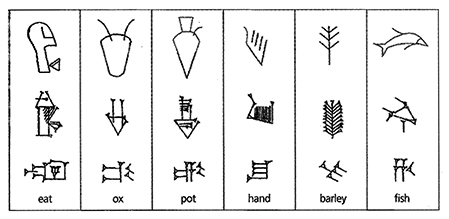
The evolution of early writing systems.

The very first essay by Andrew Robinson is about the origin of human writing systems. It should come as no surprise that the birth of writing is thought to have taken place in what is now known as the “cradle of civilization” in Mesopotamia sometime in the late 4th millennium BC. The impulse for the first writing system was the need for record keeping associated with trade. As Andrews writes, “the complexity of trade and administration had reached a point where it outstripped the power of memory among the governing elite. To record transactions in an indisputable, permanent form became essential.” One theory holds that the system began with the exchange of clay tokens and that this was later substituted with two-dimensional symbols written in clay. Of course, another origin of writing is the Ice Age symbols found in caves in southern France that date back 20,000 years. These images, however, are considered “proto-writing” because they do not conform to the scientific definition of writing provided by the noted Sinologist John DeFrancis as a “system of graphic symbols that can be used to convey any and all thought.”

  • The Book as Symbol

In essay number 7, Brian Cummings treats the book as an object within different historical contexts. He writes, “A book is a physical object, yet it also signifies something abstract, the words and the meanings collected within it. Thus, a book is both less and more than its contents alone.” During ancient times, books were considered sacred and access was restricted to a priestly class. Writing was itself considered a spiritual power and consumption of the written words also a mystical act. Later, Plato posited that writing was inferior and untrustworthy in comparison to the knowledge within the mind. In biblical times, “the scrolls” (Torah), “the tablets” (Ten Commandments) and “the scriptures” (The Bible) emerged as those writings that embodied divine power, law and ordinance. Cummings writes, “The incorporation of the holy book into ritual—the raising of the book, or carrying of it in procession, or kissing of the book or kneeling before it—is only the most obvious example of this.” These practices exist today in the courtroom or inaugural “swearing-in” and “taking the oath” of witnesses and officials who place their hand upon the Bible. Another more modern and historically significant treatment of books was the infamous Nazi burning of “degenerate” books in Berlin’s Opernplatz in 1933.

  • The Electronic Book
Engelbart Demonstrating NLS
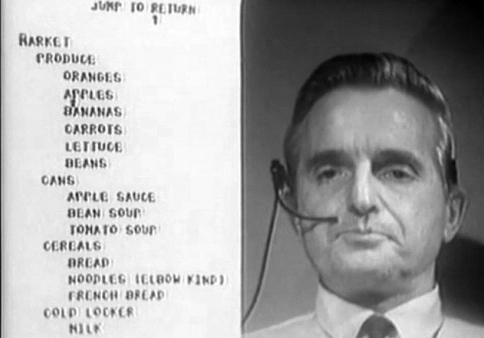
Douglas Engelbart demonstrating the NLS on December 9, 1968

The essay by Eileen Gardiner and Ronald G. Musto on the e-book was revised and expanded from the Oxford Companion to the Book of 2010 and this fact expresses the rapid development of the new form. Of particular note is the essay’s summary of the background to present-day e-books. In 1945, Vannevar Bush provided the earliest documented vision for proto electronic books in what he called the Memex. This hypothetical system would store the entire contents of scientific literature and had pages, page-turners, annotation capability, internal and external links, storage, retrieval and transmission of documents. But, while Bush conceived of the Memex on microfilm, the first truly electronic book concept came in 1965 with the “hyperlinking,” “hypertext” and “hypermedia” vision of Ted Nelson. Nelson’s idea was first demonstrated—now famously referred to as “The Mother of All Demos”— by Douglas Engelbart. The system was called NLS (for oNLine System) and was developed by the Stanford Research Institute. Engelbart demonstrated in combination for the first time anywhere on December 9, 1968 the following: email, teleconferencing, video-conferencing and the mouse. The future of hypertext from this point forward merges directly with the emergence of the personal computer and later the World Wide Web, i.e. Apple HyperCard by Bill Atkinson in 1987, the emergence of CD-ROM books in 1992, online and searchable texts accessible with the Mosaic/Netscape web browser in 1993.

As mentioned earlier, The Book: A Global History is an important resource for bibliophiles and anyone seeking thorough knowledge of the history of print communications. Going through the volume, readers gain a better understanding world history. It seems that books, both their antecedents and descendants, are intermingled with the history of all civilization from the end of human pre-history to the present.

With the development and adoption of e-books—combined with wireless and mobile communications—it is possible to envision a future where print-on-paper books are recognized as relics of a distant past. But such an eventuality would also require a development well beyond the present e-book reader and mobile media experience along with solving many other complex problems. While great strides have been made, we are still at the very beginning of the transition from the completely analog world of books to the completely digital world of instantaneous and infinite access to all information, knowledge and culture.

William Morris: 1834 – 1896

WilliamMorrisAge43
William Morris before his 43rd birthday

A polymath is a person with extraordinary expertise in multiple disciplines. The most remarkable polymath of all time was Leonardo da Vinci, the Italian Renaissance painter, sculptor, inventor, engineer, musician, astronomer, anatomist, biologist, geologist, cartographer, physicist and architect. In addition to painting the Mona Lisa and The Last Supper, Leonardo also conceptualized a flying machine, adding machine, solar power and plate tectonics among many other innovations … in the 16th century.

Any list of polymaths in world history would include:

  • Nicolaus Copernicus: astronomer, lawyer, physician, politician and economist
  • Isaac Newton: mathematician, physicist, theologian, astronomer and philosopher
  • Benjamin Franklin: author, printer, scientist, inventor and statesman
  • Thomas Jefferson: architect, paleontologist, inventor, horticulturalist and politician

It goes without saying that people with such a range of talents are extremely rare. Among the distinguishing attributes of a polymath are boundless curiosity and a facility for encyclopedic knowledge. Additionally, because they have the ability to acquire extensive practical experience in overlapping fields, polymaths are often responsible for inventions, discoveries, breakthroughs and noteworthy creative works.

While it would be an exaggeration to place William Morris—a significant figure of the late 19th century—in the company of the above-mentioned geniuses of human achievement, he was nonetheless a polymath. During his lifetime, William Morris made major contributions to architecture, textile design, decorative arts, poetry, literary fiction, politics, typography and printing.

Early years 

William Morris was born on March 24, 1834 in Walthamstow. He was the third child and oldest son of William Morris and Emma Morris Shelton. His father, who had moved to London from Worcester in the 1820s, became a partner in a stock brokerage firm in the city. His mother was the daughter of Joseph Shelton, a music teacher in Worcester.

In the early 1840s, the elder William Morris became very wealthy from an investment in a copper mining business. The family then moved into a 150-acre estate in Woodford with its own brewery, bakery and buttery and a Governess and housekeeping staff.

Little William Morris was a precocious child and learned to read very early. By the age of four—it is said—he was reading books and familiarizing himself with the Waverly novels. At Woodford, William spent time exploring the outdoors, going fishing and rabbit hunting and he developed a life-long appreciation for animal nature. After William Morris senior died at age 50 in 1847, the Morris family moved back to Walthamstow along with a considerable fortune.

One year later, William Morris was enrolled at Marlborough College where he attended for three years. In a recollection of his experience at Marlborough, Morris said it was “a new and very rough school. As far as my school instruction went, I think I may fairly say I learned next to nothing there, for indeed next to nothing was being taught.” Despite this negative memory, Morris spent time in the school library and developed an interest in archaeology and gothic architecture. He also took long walks in the countryside amid the Neolithic and Bronze Age monuments, stone circles and burial mounds.

Following a rebellion and four-day strike in 1851 by students against the conditions at Marlborough, the Morris family removed William from the college. Determined to prepare him for entry into Oxford, the family arranged a private classical tutor for the seventeen-year-old William. In 1852, William was admitted as a non-resident and unable to dine or sleep in the company of his fellow students, he entered Exeter College, Oxford.

The Brotherhood

It was at Exeter that William made the acquaintance of a student from Birmingham, Edward Burne-Jones, who would become a lifelong friend and collaborator. While the two students had entered the school with the intention of joining the priesthood, they both decided to dedicate themselves to the arts following a trip and tour of the great Gothic cathedrals in Northern France.

William then joined Edward—along with several other undergraduates and friends of Burne-Jones from Birmingham—in a group of intellectuals that called itself “The Brotherhood.” This club, which historians sometimes call the Birmingham Set, began meeting regularly to read theological tracts. This gave way to Shakespeare, the poetry of Tennyson and Browning, the novels of Dickens and then to a secular study of the art and architecture of the middle ages.

John Ruskin in the 1850s

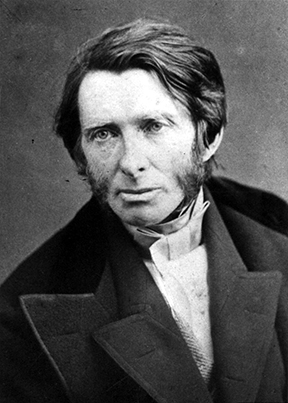
By 1855, the young men were influenced greatly by the views of John Ruskin and the Pre-Raphaelites who wanted to counter the influence of the industrial revolution upon artistic and cultural expression. Ruskin and his followers believed that art had to be returned to the hand-craftsmanship that had been abandoned beginning with the works of Raphael. Ruskin taught that the separation of the intellectual work of the designer from the manual work of physical construction—a significant feature of mass industrial economy—was socially and esthetically damaging.

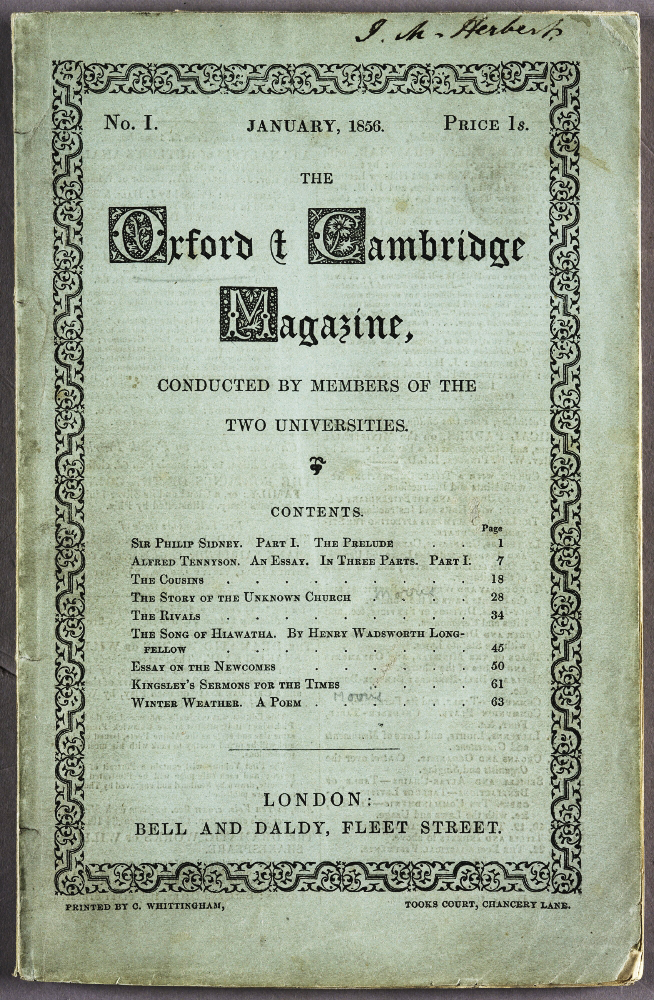
The first issue of the “Oxford and Cambridge Magazine”

Returning to medieval artistic forms and techniques—and rebelling against what was considered the “barbarity” of contemporary industrial culture—would become a recurring theme of the subsequent works of William Morris. He developed the firm conviction that “without dignified, creative human occupation people became disconnected from life.” Alongside these cultural ideas, Morris and “The Brotherhood” advocated social reform aimed at improving the conditions of misery among the industrial workingmen of Victorian England.

In 1856, the members of “The Brotherhood” published twelve monthly issues of the Oxford and Cambridge Magazine—financed by Morris—which espoused the views of the group. It was out of these ideas, that William Morris, Edward Burne-Jones, Charles Faulkner, Dante Gabriel Rossetti and others would establish what later became known as the Arts and Crafts Movement that spread throughout the world in the late 19th and early 20th centuries.

Morris’s accomplishments

It is not possible to deal in detail with the many significant accomplishments made by William Morris in so many fields over the next four decades. The following is a brief listing:

Red House where William Morris lived with his wife Jane from 1860 to 1865. It is owned today by the National Trust and is open to the public.

–       Architecture:

  • He transformed domestic architecture and construction with the Red House built in Kent for Morris and his wife in 1859 with designs by Philip Webb. The house is made of red brick with a steep tiled roof, utilizing all natural materials.
  • Morris founded the Society for the Protection of Ancient Buildings (SPAB) in 1877 dedicated to the repair and preservation of England’s ancient buildings. The society still exists with 8,500 members and operates according to Morris’s original manifesto.

–       Decorative Arts:

  • Founded in 1861 Morris, Marshall, Faulkner & Co. for the creation of woodcarvings, stained glass, metalwork, paper hangings, printed fabrics and carpets.
  • To this day, the textile designs of William Morris—for furniture, embroidery and wallpaper—remain among the most popular choices for home decor.

–       Literature:

  • Morris wrote several novels—News From Nowhere (1890), The Wood Beyond the World (1894) and The Well at the World’s End (1896)that were the first works of science fiction fantasy. Morris influenced both C.S. Lewis (The Chronicles of Narnia) and J. R. R. Tolkien (The Lord of the Rings).
  • In 1869, after learning Old Norse language and together with Eirikr Magnusson, Morris published translations of Icelandic mythology and folklore into English. The project eventually became a six-volume library of 9th century Icelandic sagas.

–       Politics:

  • In 1883, Morris became an active member of the Social Democratic Federation and played a prominent role in its political work.
  • Morris was the financier, editor and writer from 1885-1890 for Commonweal an influential English left political magazine.

Kelmscott Press

Toward the end of his life, William Morris turned to the craft of printing and publishing. In 1891, he founded Kelmscott Press along with William Bowden near his home in Hammersmith, London. As with his previous artistic ventures, Morris wanted to shift book design and production back to that of medieval times.

At Kelmscott Press, Morris set out to produce books with traditional methods as much as possible. This meant first of all redesigning typefaces to reflect the look of the fifteenth century and simultaneously eschewing the use of lithographic printing systems. Morris believed strongly that contemporary book production was inferior to that which could be achieved by the craftsmen’s handwork based on strict adherence to fifteenth century techniques.

The typefaces Golden and Troy designed by William Morris for Kelmscott Press

For all 53 books produced by Kelmscott Press, special hand-woven paper was made entirely of linen, natural materials were used for custom-made inks and Morris himself designed the typefaces. Based upon the 1470 type of Nicholas Jenson, Morris developed his Golden type in 1891. Later that year he also designed the gothic Troy font based upon the black letter type printed by Gutenberg in 1450.

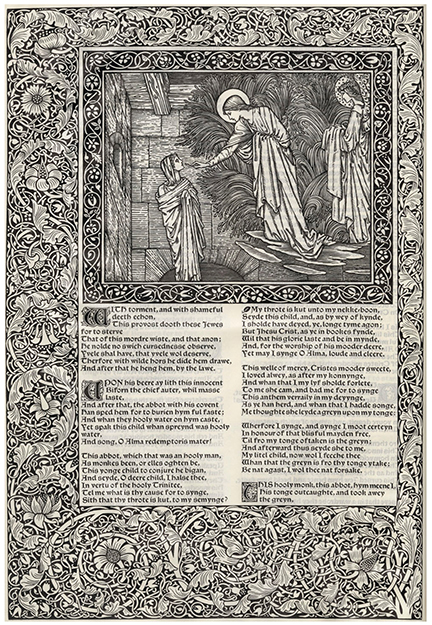
Page 60 of “The Works of Geoffrey Chaucer” published by Kelmscott Press in 1896

Perhaps Morris’s greatest printing accomplishment was The Works of Geoffrey Chaucer published by Kelmscott in 1896. The magnificent volume established a new standard for book design at the end of the 19th century. Adorned with 87 illustrations and many decorative black borders of acanthus and vine—all designed and produced by Morris’s friend Burne-Jones—there were approximately 425 copies printed.

Morris’s contribution to book design was summed up in a talk that he delivered to the Bibliographic Society in 1893 called “The Ideal Book.” In his presentation, Morris exhibited his considerable knowledge of the technology of book printing as well as the esthetics of typographic design. In poetic style, Morris said,

First, the pages must be clear & easy to read; which
they can hardly be unless,

Secondly, the type is well designed; and

Thirdly, whether the margins be small or big, they
must be in due proportion to the page of letter.

William Morris—the polymath designer, author, social theorist and printer—died on October 3, 1896 at the age of 62. A major figure of the late 19th century and during a time of great technological change, Morris sought solutions to the dilemmas of his time in medieval styles and methods. While one may rightfully question his romanticism and identification of industrial progress with “barbarity,” the positive influence of William Morris lives on today in many more ways than is popularly appreciated or understood.

NAPL report: What is happening to the printing industry?

State of the IndustryLast September, NAPL (National Association for Printing Leadership) published a valuable eleventh edition of a report called “State of the Industry.” The report provides a multi-faceted and insightful look into the condition of the printing industry—the changes, challenges and opportunities faced by printing firms today—based upon a survey of executives and owners from more than 300 companies.

The report is the work of Andrew Paparozzi, NAPL Chief Economist, and Joseph Vincenzino, NAPL Senior Economist. The NAPL economists overlay the survey results upon other general information to develop a depth of understanding about the dynamic forces impacting the industry. A copy of the report is available for NAPL members at no charge and non-members can purchase it on the NAPL web site for $149.95. http://members.napl.org/store_product.asp?prodid=369

A central theme of the survey results and analysis—both quantitative and qualitative—is that print is undergoing a transformation of historic magnitude. The difficulties created by the Great Recession of 2008-2009 that caused business volumes to fall dramatically—and they still remain today some 21% below pre-recession highs—are but one side of the problems created by rapidly evolving print markets.

The report begins with the following: “Business remains a tough grind, with little opportunity for organic growth.” This means that firms competing for “new” business are struggling over a traditional print market pie that is getting smaller; and yet market redistribution is also underway because of the second side of the changing business climate: the fundamental adjustments brought on by digital communications technologies and methods.

As Paparozzi and Vincenzino explain in the Executive Summary, “Getting and staying on the right side of market redistribution is the most significant challenge for everyone in our industry. Market redistribution is structural, not just cyclical. So much of what’s happening in our industry is the result of digitization, the Internet, and profound change in how people communicate, not GDP. Consequently, we have fewer printers but more competition—we’re in a constant battle for market share.”

The NAPL analysis is more than a review and commentary on the condition of the industry (Chapters: “Where We Are” and “Where We Are Headed”); the report also contains an assessment of those firms that are doing well in the current environment. It brings together generalizations (Chapters: “What We Have to Do” and “We May Need to Look Elsewhere”) about the correct way to approach the printing business today (Chapters: “Leaders: A Diverse Group” and “Ideas for Action”). At the same time, the report cautions against any kind of formulaic or “cookie-cutter” solution for every company or situation.

As the Executive Summary concludes: “It isn’t enough to know what’s happening and what’s ahead. We have to act on what we know—a game plan for action—taking steps to make the upheaval redefining our industry an opportunity rather than a threat. This report provides several ‘ideas for action’ to do just that.” These actions are summarized as “Hear the voice of our clients more clearly; execute more efficiently and successfully; communicate company direction to employees more effectively; and cultivate new skills across our organization.”

Macro trends

One interesting point that is made deals with the contraction of the industry. It is well know that the number of printing establishments has been declining for the last two decades; since 1992 there were 16,000 fewer companies in the industry (41,012 down to 25,242) by 2012. However, as the report analyses, not only are companies dying off, but there are also new firms being born each year.

Printing Company Births and Deaths

What kind of companies are these businesses? NAPL answers thus: “These companies are coming in with a clean slate—i.e. without legacy equipment, work habits and mindsets that limit flexibility or the troublesome issue of long-term, loyal employees whose skills don’t match the direction in which the company is embarking. Rather they are hiring the skills they at the start, creating a workforce with talents more relevant to our new industry. That they tend to be smaller companies shouldn’t create a false sense of security: Smaller companies grow—and the good ones grow rapidly.”

Another important point the report makes about the overall situation is that a boost in overall economic activity as reflected in GDP is not going to produce a “recovery” in printing. In any event, the very modest economic growth remains lackluster because of “headwinds” such as government cutbacks and the implications of the Affordable Care Act.

NAPL predicts that US printing industry sales will rise .5%-1.5% in 2013 and as much as 1.0%-3.0% in 2014 following an increase of .6% in 2012. While these figures are very modest, the report shows that these results are not projected to be even across all regions of the country. While some regions, such as South Central, have experienced double-digit growth since 2007, others like the Southeast and North Central have seen an overall decline of -.5%.

Print business priorities

The NAPL survey results reveal what company owners and executives consider the most important areas of focus and how they approach them. The following are the business topics and the top responses to the survey:

  • Hearing the Voice of the Customer
    Meeting more frequently on an owner-to-owner/executive-to-executive basis (64%)
  • Client Education
    We offer client education programs and materials (56.4%)
  • Employee Communications
    One-on-one or small group meetings (77%)
  • Execution issues
    Poor follow through. Start off well, but lose focus (39.8%)
  • Strategic Shifts
    We will no longer carry unproductive employees (48.3%)
  • Critical Skills
    Sales (71.3%)
  • What We’d Most Like to Upgrade
    Web-to-print, web storefront, ecommerce (51%)

Sales Industry Leaders

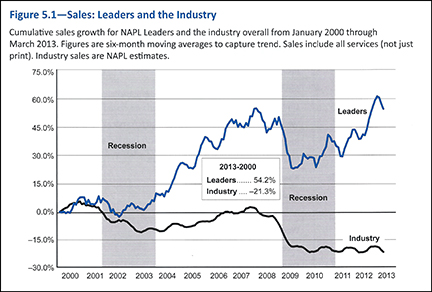
One of the striking results of the survey is that there is an expanding divergence between industry leaders and the rest of the industry. This comes out most obviously on the sales front. It is clear from the foregoing data that understanding customer needs, business development and sales are a top priorities for printing company owners and executives.

In an environment of intense competition, differentiation is key to winning and retaining clients. In order to survive and grow, those companies that have been most successful have absorbed the meaning of the fundamental changes taking place and are offering a complex array of products and services beyond ink on paper. As summed up in the comment of one survey participant, “Successful printers recognize they are part of the communications industry, not the printing industry.”

Where does offset lithography fit?

An important aspect of the NAPL report deals with the state of traditional offset printing. In fact, the report contains a page following the executive summary called, “What About Lithography?” which makes some highly valuable comments about the relationship between the old and the new of the industry.

Offset lithography is still the single biggest source of revenue in the printing industry. At between $40 and $45 billion, this market breaks down as follows:

  • Advertising print: $10.2 billion
  • Magazine/periodical print: $4.9 billion
  • Catalog/directory print: $3.2 billion
  • Miscellaneous other print: $20 billion

Printing Company Revenue Sources

Eighty-eight percent of NAPL survey respondents reported that they get one quarter of their revenue from offset lithography and 70% report that it accounts for at least half. Printing companies cannot afford to “walk away” from this dominant yet traditional source of revenue. “Put simply, once we won by being the best lithographer. Now we win by being the best at putting lithography and every other service that we offer—it’s print-and, not print-or—to work for our clients.” This is a very good summary of where we are as an industry: one foot in the old and one foot in the new era of communications.