Digital trends: Where’s your camera?

In June 1994, I bought my first digital camera: an Apple QuickTake 100. It was the first consumer-level digital camera and cost about $695. Developed jointly by Apple and Kodak, it was a fascinating breakthrough device.

On the day I bought the camera, I connected it via serial cable to my Mac, installed the QuickTake 1.0 software (from a floppy disk) and downloaded the first digital photos I had ever taken. I brought the pictures into Photoshop and started editing them; these were images that did not come from film and did not require scanning. Wow, I thought, how much time am I going to save with this nifty little camera.

Well, not so fast. The images had a resolution of 640×480 pixels (about one third of a megapixel in today’s terms) and were not very useful for print reproduction. But they were perfect for standard definition video display and I could see how they could be used in presentations and slide shows.

Over the next few years, while I was fiddling around with the novelty of digital photography, I continued using my Canon 35mm SLR to shoot film negatives and transparencies. I’d shoot rolls of film and drop them off at the local camera store for processing and print making and continued to do this for many more years. It wasn’t until 2000 that I made the transition permanently to digital photography.

Fast forward to 2012 … Last weekend, for the first time I deposited a check into my bank account using the mobile banking app on my iPhone. I also shot a video and took photos of a family picnic in my back yard and posted the photos and video to my Facebook page immediately. I was even able to assemble and edit my video clips using the iMovie app on my iPhone.

And, on the same weekend, I saw someone using an iPad to shoot video of a football scrimmage … they were using the iPad screen as a viewfinder as they followed the players down the football field.

Needless to say, in the 18 years between these different experiences, camera technology has undergone a transformation. The last two decades have seen the replacement of conventional film photography with digital photos, but also more recently, the displacement of single purpose digital cameras (both video and still) by smartphones.

The pace and magnitude of these dual transformations are seen clearly in the answers to the following questions:

When did digital photography eclipse film photography?
In 1990 100% of photography was analog/film based. Ten years later, in 2000, just 99% of photography was still analog while 1% was digital. The big change took place over the past decade. By 2011, 99% of photography was digital and 1% film.

How many photos are being taken?
It has been estimated (by 1000memories blog) that since photography was first invented in 1838, there have been 3.5 trillion pictures taken. Today, every two minutes, we snap as many photos as were taken by all of humanity in the entire 19th century. In 1990 there were 57 billion photos taken, in 2000 there were 86 billion taken and in 2011 there were 380 billion taken.

Are mobile and smartphones replacing cameras and camcorders?
It has been estimated (by NPD Group) that in 2010 camera phones accounted for 17% of all images while point and shoot and camcorders accounted for 52%. In just one year, these numbers changed to 27% by camera phones and 44% by point and shoot and camcorders. The balance of the imagery is still dominated by higher end digital photographic and video equipment.

Where are all the digital photos being stored?
The biggest library of online photos is Facebook. It has been estimated (by pixable blog) that over 100 billion photos have been uploaded into Facebook its by users. The following is a list of the top photo sharing sites and their image volumes:

  • Photobucket: 10 billion photos
  • Picasa: 7 billion photos
  • Flickr: 6 billion photos
  • Instagram: 400 million

Instagram is the fastest growing online photo sharing technology and it was purchased by Facebook earlier this year for $1 billion.

The ubiquity and ease of use of cameras on smartphones—capable of shooting high quality color photos and video—combined with social networking and photo sharing have led to an explosion in digital photography. Almost anyone can capture a scene at any time and people are doing it, all the time.

As with other developments in our digital world, a transformation of one kind—the replacement of film by digital photography—is not fully completed when a transformation of another kind—the replacement of digital point-and-shoot cameras and camcorders by camera and smart phones—accelerates the entire process and evolves in an unanticipated direction.

It is these sudden and unexpected twists that make navigating the business environment such a complex task. The challenges facing Kodak, which filed for bankruptcy reorganization last January, is an expression of the way these rapid changes can impact companies and entire industries. Once the king of analog photographic equipment and supplies as well as an originator of the digital camera revolution, Kodak announced on August 23 that it was selling off its film division.

The ability to see and understand the convergence and successive waves of digital transformation, and the way these impact the behavior of our customers, is the only way to keep pace in our rapidly changing world and make plans for the future.

William Blake: 1757 – 1827

20120726-181057.jpg
William Blake, November 28, 1757–August 12, 1827

William Blake is well known as an English poet and painter. During his lifetime he was not recognized for his genius; but today Blake is viewed as a significant and early figure of the Romantic period of European culture. He was one of the most brilliant representatives of the creative movement in the late 18th and early 19th centuries that emphasized the free expression of the feelings of the artist in his works.

William Blake was born on November 28, 1757 in the Soho district of London. He was the third of seven children, two of whom died in infancy. His father was James Blake, a London hosier, and his mother was Catherine Wright Armitage Blake. Since William exhibited a love of art at an early age, his parents enrolled him in drawing classes and elected to educate him on other subjects at home.

At age 14, William was apprenticed to the engraver James Basire of London for a seven-year term. At the end of this training, Blake emerged as a skilled engraver but he chose to enroll as an art student at the Royal Academy instead of pursuing a professional career at this time.

In his years at the Academy, William Blake developed his particular creative style in opposition to the trends of the time, especially the popular extravagance of the Baroque works of Peter Paul Rubens. Blake was drawn to the Classical period and the style and precision of Michelangelo and Raphael. Some of Blake’s early paintings were exhibited at the Royal Academy between 1780 and 1808.

William’s gift of verse was also evident in his youth. A volume of his first poetry called “Poetical Sketches,” published by friends in 1783, contains lines that he had written as early as 1768 when William was only 10 or 11 years old.

Throughout his life, beginning at age 4, William claimed to have experienced visions. These apparitions were often of a spiritual and religious nature and formed the basis of his literary and visual creations. It was this mystical behavior that earned him a reputation of being an unstable man among his contemporaries. In fact, the noted poet William Wordsworth is quoted in a biography of Blake as having said, “There is something in the madness of this man which interests me more then the sanity of Lord Byron and Walter Scott.”

William Blake was married to Catherine Boucher in 1782 in St. Mary’s Church, Battersea. Although Catherine was illiterate—she signed their wedding contract with an “X”—William taught her to read and write and later trained her as an engraver. Catherine remained with William to the day of his death and she proved to be invaluable to him, helping to print his illuminated works and maintaining his spirits through a number of crises.

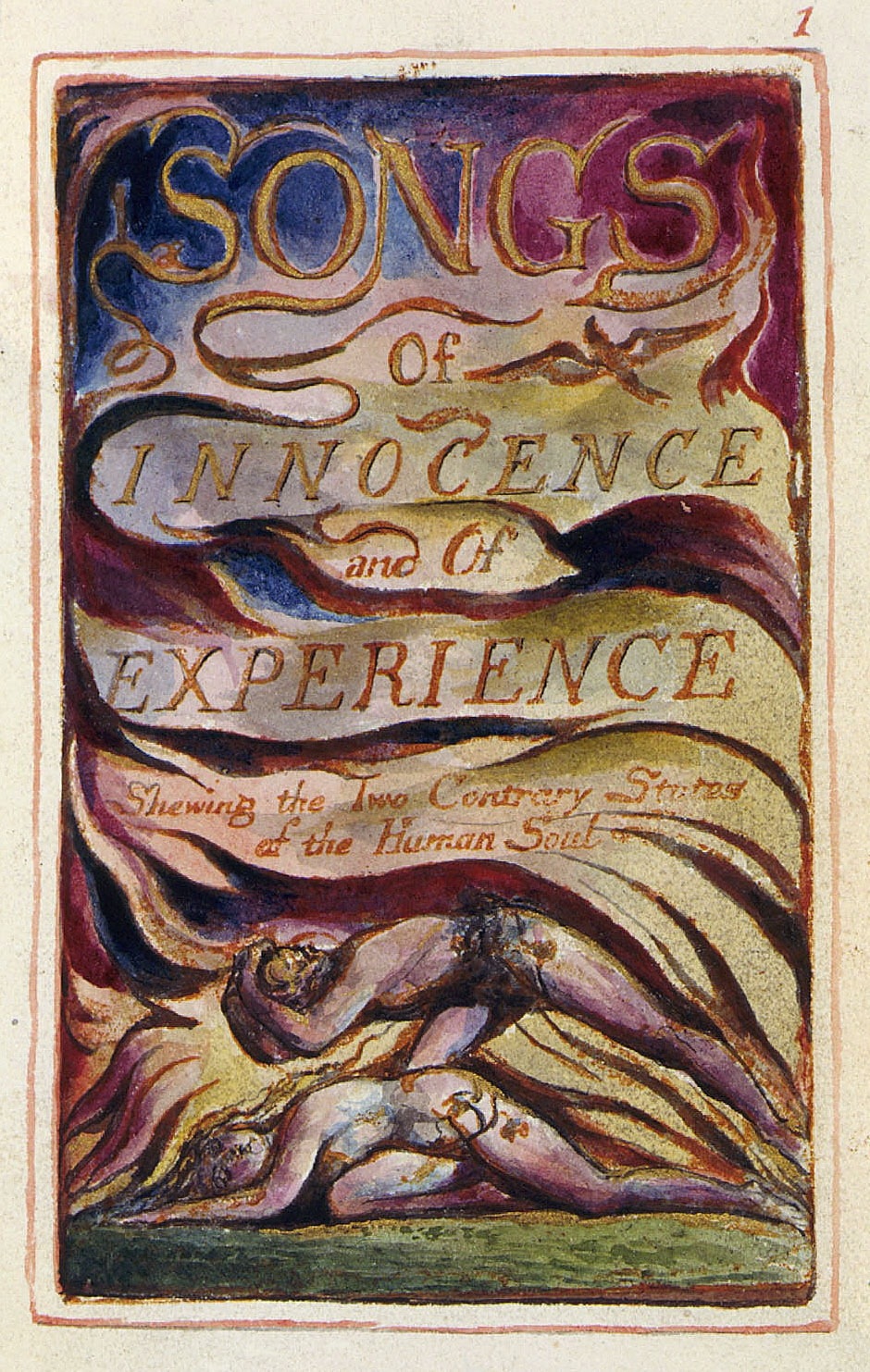
The frontispiece of William Blake’s “Songs of Innocence & of Experience” published in 1826.

Due to his posthumous acclaim in the literary and visual arts, Blake is not as well known for his work as an engraver and, in particular, his innovative contributions to the graphic arts. Aside from the spectacular beauty of his print work—his hand-illustrated series of epic and lyrical poems “Songs of Innocence” (1789) and “Songs of Experience” (1794) being among the most original and stunning prints ever produced—William invented the technique known as relief etching. This is the method that is associated with the illuminated printing of his most important work.

The previous method of engraving exposed the images and text to acid and, therefore, the copper plate was recessed in those areas and the transfer of ink to paper took place with the intaglio method. Beginning in 1788, at the age of 31, Blake began his experiments with relief etching where the text of the poems was applied to copper plates with pens and brushes using an acid-resistant medium. He then etched the plates, dissolving the untreated copper and leaving the design to stand in relief. The pages printed from these plates were hand painted in water colors and then stitched together to finish the book.

Due to the lack of popularity of his own creative output during his lifetime, Blake took to commercial work to make a living. Some of the books that he illustrated are: “Night Thoughts” by Edward Young, “The Grave” by Robert Blair, “Paradise Lost” by John Milton, “The Book of Job,” “The Pilgrim’s Progress” by John Bunyon and “The Divine Comedy” by Dante. The last two of these remained unfinished when Blake died in 1827.

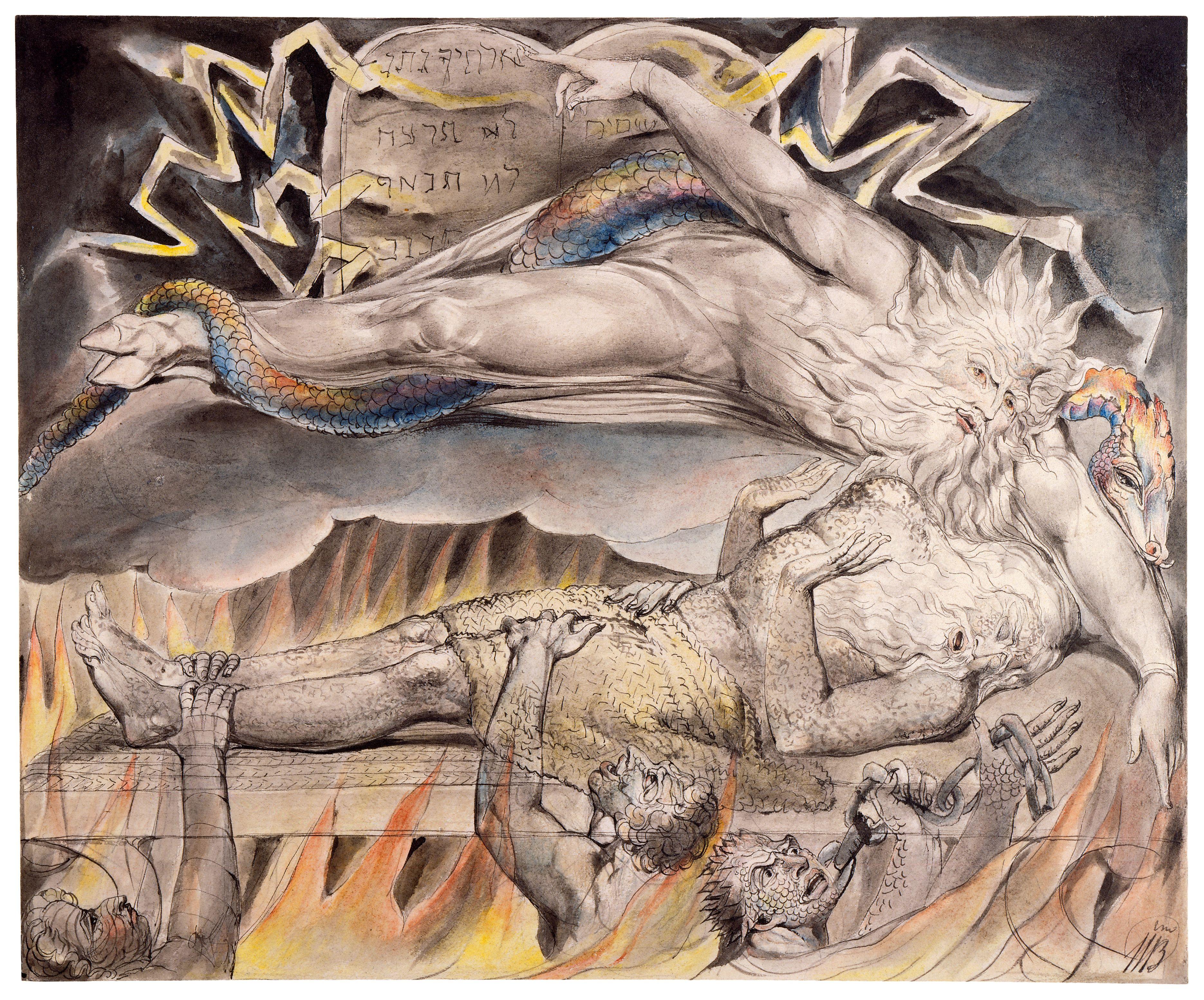
“Job’s Evil Dreams” from William Blake’s illustrations of The Book of Job.

Among his original works, some of the more popular titles are “The Marriage of Heaven and Hell,” “Visions of the Daughters of Albion,” “The First Book of Urizen,” “Milton, a Poem” and “Jerusalem, The Emanation of the Giant Albion.” The preface to the last of these contains the well known verse “And did those feet in ancient time … ” that was later composed as a hymn called “Jerusalem” and became a British national anthem.

William Blake died in his house on August 12, 1827 at age 69 in the midst of his work. Living in near poverty, Catherine borrowed the money needed for the funeral of her loving husband. The service was attended by a small group of his closest friends. Today, a monument marks the approximate location of the remains of William Blake and his wife—Catherine died four years later—at Bunhill Fields in London.

William Blake lived at a time of great transformation in society; the beginnings of the Industrial Revolution. To some extent his work reflects a deep emotional reaction to the coldness of those times and a longing for a simpler and more humanitarian world. However, despite his justified anger toward the socially negative impact of science and technology at the turn of the nineteenth century, Blake made a colossal contribution to art in its literary, visual and, some would say, musical forms.

Had Blake lived in our day, he would no doubt have found in the technology of the personal computer an outlet for his visionary, mythical and humanistic creative expression. As it happened, William Blake was one of the first and most important multimedia artists that ever lived.

DRUPA 2012: A report from afar

Like most people in our graphic arts community, I was unable to attend the international printing and paper expo—DRUPA 2012—in Düsseldorf, Germany this year. The trade show, which is held every four years, took place May 3-16 at the Düsseldorf Fair Grounds. DRUPA—a contraction of the German words for printing (druck) and paper (papier)—is by far the biggest and most important printing industry event in the world. This year the exhibits covered 1.7 million square feet of floor space and were on display in a total of 17 halls.

Having attended the expo twice in the past, I was very keen to follow the industry news reports—primarily from WhatTheyThink.com—and official DRUPA press releases as they came in each day. However, this year it was also possible for the first time to follow the event from social media streams. Through numerous YouTube and Twitter posts—from exhibiting firms as well as by attendees—it was possible to get a real-time view of what was happening.

Among the most important news from the show came after it was over. DRUPA 2012 saw 314,500 experts from more than 130 countries attend; this was 75,550 less than 2008. “This drop does not come as a surprise for us and the sector as a whole. In Germany alone the printing industry lost some 3,900 operations with over 61,000 employees between 2000 and 2011. In the USA over the same period more than 7,700 printing operations closed,” explained Werner Matthias Dornscheidt, President & CEO of Messe Düsseldorf.

There were other international dynamics in evidence at DRUPA, as the final press release from the show explained. “With more than 190,000 foreign visitors the international focus of DRUPA continues at a very high level. What is striking here is the high number of trade visitors from India, which, now reaching some 15,000, ranks as the second largest visitor nation after Germany (123,000 visitors). Following behind these two in the country ranking is: Belgium, France, the Netherlands, Great Britain, the USA, Switzerland and Italy. It is particularly gratifying to see the rising proportion of visitors from South and Central America (8.8% in 2012 compared to 7% in 2008)—and more specifically from Brazil.”

You can read the DRUPA 2012 Final Press Release here, http://ilnk.me/10708

Moving on to the technology of the show, you can find a summary of all the DRUPA news reports from WTT.com both before and after the show here, http://ilnk.me/1072b

The major developments were clearly in digital printing with various inkjet-printing devices taking center stage.  And the biggest news from DRUPA was the launch by Landa Corporation of a new category of printing called nanography. Benny Landa, the founder and CEO of Landa Corp., is the godfather of the digital printing revolution. After he invented the Indigo press—the first full-color variable data printing device—in 1993, Landa then sold this technology to Hewlett-Packard in 2003.

Landa’s new nanographic technology is distinct from other forms of digital presses in that it does not begin from the business proposition associated with variable data printing. Previous digital printing devices have attempted to compete for marketing and communications dollars based upon the value of personalized content. Nanography, while it offers this capability, more importantly makes a business claim on a substantial spectrum of static print media currently dominated by the offset method.

The DRUPA standing room only crowd at the Landa Nano exhibit

The basic ideas of Landa’s new solution are found in the following excepts from his DRUPA presentation:

“Everything that can become digital will become digital and that includes printing. Since 1993 when we launched it, digital printing has exploded. … And yet, digital printing barely nibbles around the edges of mainstream printing. Only 2% of printed pages are printed digitally. This is why we have invented nanography; for the other 98% …

“I bet there is not one person in this hall that believes that 200 years from now man will communicate by smearing pigment onto crushed trees. The question on everyone’s mind is when will printed media be replaced by digital media. … It will take many decades before printed media is replaced by whatever it will be … many decades is way over the horizon for us and our children. We are concerned about the coming decades and there the question we must ask ourselves is: ‘How can my business prosper as the printing industry transitions from mechanical printing to digital printing to whatever comes next?’ …

“Its all about the other 98%. And where is this 98%? You are already doing it. The trouble is, you can’t make any money from it. … There is no digital printing on the horizon or the foreseeable future that is going replace offset. Offset will be here for as long as we can imagine. … Digital printing was invented to be profitable at a run length of one, but the problem is that digital printing is also unprofitable as run lengths become longer and longer. That has created an enormous gap where neither offset is profitable nor digital is profitable. But that gap is where your customers need to be; short and medium run lengths and they can’t get it with you doing it profitably and that is why we invented nanography.”

The unique proposition of nanography is that it puts down elements of pigment onto any substrate in ultra small particles that measure in nanometers, one billionth of a meter, thus reducing the cost of basic elements of the printed image. The Landa Nano technology has been so impressive that agreements have been signed to license the printing method by Komori, Man Roland and Heidelberg. A summary of the technical and business issues in nanography can be found at the Landa website here: http://ilnk.me/10735

If you have time, you can watch a 47 minute video of the entire Landa presentation, which was standing room only at DRUPA 2012, courtesy of Yair Zafrany, here: http://ilnk.me/1072d

In addition to the excitement around the Landa launch, there were also impressive digital printing presentations made by HP, Xerox and a number of other manufacturers. A summing up of these developments can be found in a YouTube video by industry expert Frank Romano published by Mohawk Fine Paper here: http://ilnk.me/10736

As has been the case in the past, the most important thing about DRUPA is that it is more about where our industry is going than about where it is today. So DRUPA is a kind of time machine that lets us look ahead a bit. It is my hope that the information reported here will at least provide an indication of what to expect this fall at GraphExpo 2012 on October 7-12 in Chicago. Hopefully, more of us will be able to attend that show and then we can compare notes. See you there!