From craft to industry (2): Richard March Hoe

The transformation of printing from handcraft to an industry began in 1812. Koenig and Bauer—through the application of iron, steam power and, above all, the cylinder—replaced the wood construction, hand power and screw mechanism of the Gutenberg press that had existed for the previous 370 years.

While these changes dramatically increased productivity, the industrialization of print machinery remained incomplete. Mechanical limitations, the consistency of paper manufacture and print quality issues prevented the cylinder press from reaching speeds greater than a few thousand sheets per hour.

Richard March Hoe,
September 12, 1812 – June 7, 1886

By mid-century, the demands of publishers for faster and larger print production volumes required another technological leap. In 1847, Richard March Hoe provided the solution with his invention of the first rotary printing press.

When reviewing the evolution of the press, an understanding of print fundamentals is important. With the exception of modern-day digital systems—where an infinitely variable image is rendered directly to the substrate by print heads—all previous printing machinery had an important common feature: an image carrier. The image carrier is the surface from which ink is transferred to paper or other print material.

In letterpress printing, the image carrier is the raised metal type form. The letterpress process also requires an impression surface where pressure is applied tp transfer the ink to paper. During the industrialization of printing, both the image carrier and the impression surface were converted from a flat platen shape to a curved rotary shape.

The illustration below shows how the cylinder press was a transitional or hybrid development between the platen press and the rotary press. With the cylinder press, the image carrier remained flat, while the impression surface was curved. The ink was applied to the paper as it rode on the bed underneath the impression cylinder.
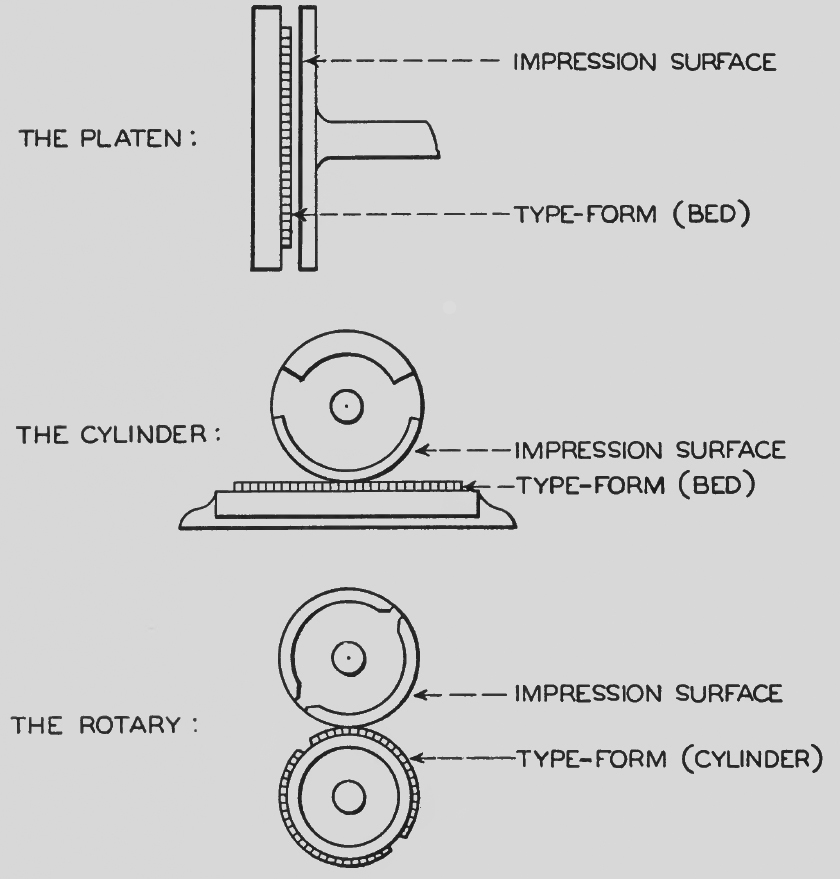
It took another 35 years of experience and experimentation before the type forms could be mounted on a curved surface and the paper could move on its own between the impression and the “revolving-type” cylinders. This is the core achievement of the rotary press identified with Richard March Hoe.

There were many individuals and companies that worked on creating a rotary printing machine that did away with the platen type form bed. As far back as 1790, an Englishman name William Nicholson took out a patent for a system that designed letter forms around a cylinder. However, the idea was never delivered practically.

The story of the first commercially successful rotary press is the story of the Hoe family. Robert Hoe (1784-1833) was born in Leicestershire, England. With skills as a carpenter, he emigrated to the United States at age eighteen. He later formed with his brothers-in-law Peter and Matthew Smith a wooden press-manufacturing firm in New York City. In 1823, he gained sole ownership and the R. Hoe & Company was founded and it became the first company to build an iron and steam driven cylinder press in America based upon the designs of Koenig and Bauer.

After Robert Hoe’s death in 1833, his sons Richard March Hoe and Robert Hoe II took over the business. More than any other firm, the R. Hoe & Company expressed the fact that, during the two decades between 1830 and 1850, the center of printing technology development had shifted from Europe to America.

With Richard March Hoe at the helm, and driven by the demand for the mass circulation and daily newspaper, the company developed an innovative technique for mechanically feeding sheets of paper into a press. Later, with its most significant invention, the company designed and built the “Hoe Type-Revolving Machine,” the first functioning rotary press. This system was so successful and productive that it became known as the “Lightning Press.”

Working on this press in 1845-46—Richard March Hoe obtained patents for it in 1847—the problem of mounting type forms onto the curved surface of a cylinder was solved. According to an account published in 1902 by Robert Hoe III, the grandson of the founder, “The basis of these inventions consisted in an apparatus for securely fastening the forms of type on a central cylinder placed in a horizontal position. This was accomplished by the construction of cast-iron beds, one for each page of the newspaper. The column rules were made ‘V’ shaped; i.e. tapering toward the feet of the type. It was found that, with proper arrangement for locking up or securing the type upon these beds, it could be held firmly in position, the surface form a true circle, and the cylinder revolved at any speed without danger of the type falling out.”

Robert Hoe III also noted the importance of these developments, “As the demands of the newspapers increased, more impression cylinders were added, until these machines were made with as many as ten grouped around the central cylinder, giving an aggregate speed of about 20,000 papers per hour printed upon one side.  A revolution in newspaper printing took place.”
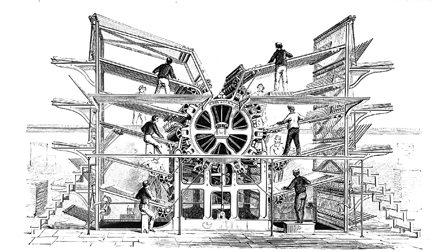
Ten cylinder Hoe Type-Revolving Press

With its six-and-a-half foot diameter central revolving type cylinder, these new machines were rapidly adopted across the US and also in Britain. In 1858, The Times of London ordered two ten cylinder presses to replace the Applegath vertical press that had previously been in use. R. Hoe & Company also built two, four, six and eight cylinder systems to accommodate the different needs of newspaper publishers.

The challenges that remained to be solved were developing a rotary press capable of printing on both sides (perfecting) and from a roll (web) of paper. These issues would be conquered after the Civil War and R. Hoe & Company would play a role—along with other important figures—in their development. This will be the subject of the third and final part of this series.
From craft to industry (1): Friedrich Koenig

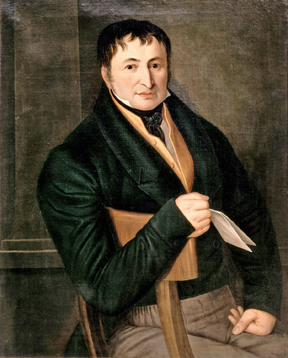
Friedrich Koenig, 1817

Some readers are likely wondering: why take so much time and space reviewing the work of individuals in the history of print media? What does this have to do with the printing business and the challenges we face right now, especially with media technology in transition and in a difficult economy? These are valid questions.

Although the effort requires bookwork and more than a casual reading of Wikipedia entries, it is not an academic exercise or something of interest only to print technophiles. Appreciation for the major transformations of the past provides a guide for navigating contemporary problems; it also assists in charting a path to the uncertain future.

Business decisions are influenced by multiple and complex factors. Availability of financial and human resources, technology development, market trends, customer needs, competition and risk-reward calculations all shape judgments about what should or should not be done. Knowledge of the rich history of the printing industry reveals the rhythmic relationship between the present and the past. Thereby, it is an indispensable tool for business thinking and planning.

The period of printing history under review is perhaps more resonant with our own time than at any other in the 570 years since Gutenberg. At the turn of the nineteenth century, a fundamental transition began: press technology went from wood and hand power to iron and steam power; during the years 1800-1814 all of the basic elements for the transformation of print from a craft to an industry were in place.

A measure of the magnitude of this revolution is the ten-fold increase in press productivity in the first two decades of the nineteenth century:

                              Up to 1800           1800                  1818
Press technology     Gutenberg              Stanhope             Koenig
Sheets per hour      240                        480                     2400

While the Stanhope press is identified with the introduction of iron in press manufacture, it was based on the same hand operated screw technique invented by Gutenberg in 1440. Alongside iron, the key advancements in the industrialization of print were the cylinder and steam power. Patent and business records of the period identify the first press that had all these features with Friedrich Koenig.

Koenig was born on April 17, 1774 in the town of Eisleben, Saxony. As manufacturing society was emerging, the bookseller and printer shared with others the desire to mechanize the hand press. Koenig’s first invention arrived 1803 with what was known as the Suhl press, a steam powered system that had inking rollers. Due to the difficult economic conditions of early 1800s Germany—including lack of a functioning patent system—Koenig moved to London in 1806 to pursue his ambition as an inventor.

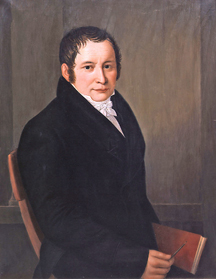
Andreas Bauer

The Fleet Street printer Thomas Bensley, along with several other English investors, were convinced of Koenig’s genius and agreed to finance his press experiments. Fellow countryman and engineer Andreas Bauer (1783–1860), joined Koenig in London and they developed two new platen designs for which they achieved patents in 1810 and 1811.

The significant breakthrough came in 1812 with the invention of a steam-driven cylinder machine. Koenig wrote about it in The Times, “Impressions produced by means of cylinders, which had likewise been already attempted by others, without the desired effect, were again tried by me upon a new plan, namely, to place the sheet round the cylinder, thereby making it, as it were, part of the periphery.”

Koenig’s solution of the problem of effectively transferring a letterpress image to paper by means of a cylinder won him recognition. His method was first used in book production and later, after John Walter II of The Times joined the partnership with Bensley, in newspaper printing. At Walter’s request, Koenig and Bauer built a double machine—being fed with sheets of paper from both ends—and obtained a patent for this device on June 23, 1813. The first issue of The Times printed with this technology was on November 29, 1814.

Double cylinder press designed and built by Koenig and Bauer for John Walter II and used to print The Times of London on November 20, 1814.

Walter wrote in The Times on that day, “Our journal of this day presents to the public the practical result of the greatest improvement connected with printing, since the discovery of the art itself. … A system of machinery almost organic has been devised and arranged, which, while it relieves all human frame of its most laborious efforts in printing, far exceeds all human powers in rapidity and dispatch. … Of the person who made this discovery, we have little to add. … It must suffice to say farther, that he is a Saxon by birth; that his name is Koenig; and that the invention has been executed under the direction of his friend and countryman Bauer.”

In 1816, Koenig and Bauer developed a perfecting cylinder press that was installed at Bensley’s business. This system produced up to 1,000 perfected sheets an hour. By this time, the two inventors wanted to sell their systems to the trade but Bensley refused. Koenig and Bauer decided to return to Germany to manufacture presses under their own name and, on August 9, 1817, they founded their own firm in Oberzell near Würzburg, Germany.

Their company continued to play a significant role in the industrial evolution of printing machines as steam power gave way to electric motors and also after the death of Friedrich Koenig on January 17, 1833. The company of Koenig and Bauer exists to this day (as KBA) at the same location and is the oldest printing press manufacturer in the world.

While European (both English and German) inventors dominated the early period of powered cylinder presses, the center of gravity for printing technology shifted to America around mid-century and especially following the Civil War. The significant expansion of the US market and the emergence of conditions for experiment and manufacturing made it the ideal environment for further strides in printing press development. This will be the subject of the next two parts of this review.

Going mobile

Pete Townsend, Roger Daltrey, Keith Moon and John Entwistle of The Who in 1971

Readers may recognize “Going Mobile” as the title of a song by the rock band The Who (from their 1971 album Who’s Next). Guitarist and vocalist Pete Townsend was writing about the joys of traveling the open road in his RV:

Out in the woods
Or in the city
It’s all the same to me
When I’m driving free, the world’s my home
When I’m mobile

At the time, Townsend could not have known that forty years later the song would take on a completely new meaning. Today, the world is indeed going mobile.

According to recent data from Canalys—a leading provider of computing technology analysis—the year 2011 was the year of the smartphone. For the first time ever, worldwide smartphone sales (488 million units) surpassed PC sales (415 million units).

“Smartphone shipments overtaking those of client PCs should be seen as a significant milestone,” a Canalys analyst said. “In the space of a few years, smartphones have grown from being a niche product segment at the high-end of the mobile phone market to becoming a truly mass-market proposition.”

Some have referred to this transition as the beginning of the “post-PC” era of computing. Indeed, the expansion of smartphones beyond desktop and notebook computers signals a major shift. With their increased processing power, advanced touch user interface, availability of wireless broadband service—not to mention high resolution cameras, HD video and GPS navigation capabilities— smartphones are dramatically changing the way people interact with computer technology, access the online world and communicate with each other.

This sudden change has important implications for consumer marketing and advertising planning and media buying. And this is not only impacting traditional media such as TV, radio and print. The mobile revolution is affecting social media and online advertising models developed more recently.

A recent article in The New York Times, “Facebook’s Mobility Challenge,” revealed how the social media giant is struggling to come up with an effective solution to advertising to its expanding number of mobile-only users. “We do not currently directly generate any meaningful revenue from the use of Facebook mobile products, and our ability to do so successfully is unproven,” the company said in its review of the threats it faces.

This is particularly problematic for companies like Facebook where much of their user growth (worldwide Facebook users are now at 845 million) is taking place in countries like Chile, Turkey, Venezuela and Brazil where many people have never had a broadband connection to the Internet other than through their smartphones.

The transition to a mobile dominated world is being taken note of by major advertisers. They are looking for opportunities to deliver messages in unique new ways and also drive mobile commerce. A recent report by Forrester Research forecasts that interactive advertising in the US will reach $76.6 billion by 2016 and be equal to TV ad spending. As significant as that projection is, the truly interesting part of this report is found in the details.

Forrester breaks down interactive marketing into five subcategories:
• social media
• email marketing
• mobile marketing
• display advertising
• search marketing.

Of these, mobile marketing is projected to quintuple in size to $8.2 billion between now and 2016! This is a compound annual growth rate of 38% and far faster than any of the four other categories. The report also shows that mobile marketing overtook both email marketing and social media marketing in 2011.

It might seem impossible, but the media landscape is once again shifting dramatically under our feet. Companies such as Google, which went public just 8 years ago on the basis of the latest in search advertising revenue, are now being challenged by mobile alternatives. To its credit, Google is making a huge play into the smartphone and tablet markets with the development of the Android operating system.

But every aspect of marketing and communications should be reconsidered in light of the rapidly expanding mobile universe. For print media companies, this means developing capabilities to assist clients in converting their content into “mobilized” experiences; it means partnering with firms that specialize in all forms of interactive advertising and recognizing that “going mobile” is now on the agenda.

Those that ignore the changes underway, or bury themselves in nostalgia about the good old days of traditional media, do so at their own risk. They may wind up singing another great track from the Who’s Next album: “The Song is Over.”