Going mobile

Pete Townsend, Roger Daltrey, Keith Moon and John Entwistle of The Who in 1971

Readers may recognize “Going Mobile” as the title of a song by the rock band The Who (from their 1971 album Who’s Next). Guitarist and vocalist Pete Townsend was writing about the joys of traveling the open road in his RV:

Out in the woods
Or in the city
It’s all the same to me
When I’m driving free, the world’s my home
When I’m mobile

At the time, Townsend could not have known that forty years later the song would take on a completely new meaning. Today, the world is indeed going mobile.

According to recent data from Canalys—a leading provider of computing technology analysis—the year 2011 was the year of the smartphone. For the first time ever, worldwide smartphone sales (488 million units) surpassed PC sales (415 million units).

“Smartphone shipments overtaking those of client PCs should be seen as a significant milestone,” a Canalys analyst said. “In the space of a few years, smartphones have grown from being a niche product segment at the high-end of the mobile phone market to becoming a truly mass-market proposition.”

Some have referred to this transition as the beginning of the “post-PC” era of computing. Indeed, the expansion of smartphones beyond desktop and notebook computers signals a major shift. With their increased processing power, advanced touch user interface, availability of wireless broadband service—not to mention high resolution cameras, HD video and GPS navigation capabilities— smartphones are dramatically changing the way people interact with computer technology, access the online world and communicate with each other.

This sudden change has important implications for consumer marketing and advertising planning and media buying. And this is not only impacting traditional media such as TV, radio and print. The mobile revolution is affecting social media and online advertising models developed more recently.

A recent article in The New York Times, “Facebook’s Mobility Challenge,” revealed how the social media giant is struggling to come up with an effective solution to advertising to its expanding number of mobile-only users. “We do not currently directly generate any meaningful revenue from the use of Facebook mobile products, and our ability to do so successfully is unproven,” the company said in its review of the threats it faces.

This is particularly problematic for companies like Facebook where much of their user growth (worldwide Facebook users are now at 845 million) is taking place in countries like Chile, Turkey, Venezuela and Brazil where many people have never had a broadband connection to the Internet other than through their smartphones.

The transition to a mobile dominated world is being taken note of by major advertisers. They are looking for opportunities to deliver messages in unique new ways and also drive mobile commerce. A recent report by Forrester Research forecasts that interactive advertising in the US will reach $76.6 billion by 2016 and be equal to TV ad spending. As significant as that projection is, the truly interesting part of this report is found in the details.

Forrester breaks down interactive marketing into five subcategories:
• social media
• email marketing
• mobile marketing
• display advertising
• search marketing.

Of these, mobile marketing is projected to quintuple in size to $8.2 billion between now and 2016! This is a compound annual growth rate of 38% and far faster than any of the four other categories. The report also shows that mobile marketing overtook both email marketing and social media marketing in 2011.

It might seem impossible, but the media landscape is once again shifting dramatically under our feet. Companies such as Google, which went public just 8 years ago on the basis of the latest in search advertising revenue, are now being challenged by mobile alternatives. To its credit, Google is making a huge play into the smartphone and tablet markets with the development of the Android operating system.

But every aspect of marketing and communications should be reconsidered in light of the rapidly expanding mobile universe. For print media companies, this means developing capabilities to assist clients in converting their content into “mobilized” experiences; it means partnering with firms that specialize in all forms of interactive advertising and recognizing that “going mobile” is now on the agenda.

Those that ignore the changes underway, or bury themselves in nostalgia about the good old days of traditional media, do so at their own risk. They may wind up singing another great track from the Who’s Next album: “The Song is Over.”
The new frontier of print management services

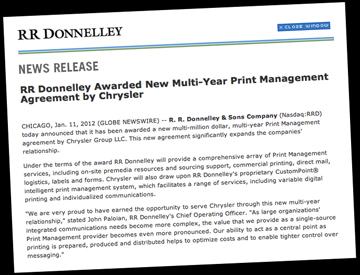
I read with interest the January 11, 2012 announcement from RR Donnelley that the $2 billion company had penned a multi-year, multimillion dollar agreement with Chrysler to “provide a comprehensive array of Print Management services, including on-site premedia resources and sourcing support, commercial printing, direct mail, logistics, labels and forms.”

While this is undoubtedly good news for Donnelley, it is more than likely troubling news for incumbent suppliers of Chrysler. Everyone is probably thinking the same thing: how do printers compete for Chrysler’s business when a huge competitor is managing the sourcing process?

Clearly, the growth of print management services over the past decade is an important and significant development. According to Ronnie Davis, Chief Economist of Printing Industries of America, print management services is one of the key emerging market tendencies within the printing industry.

In his book Competing for Print’s Thriving Future, Davis writes, “Print management services are typically defined as the practice of a customer outsourcing the management of their print and print logistics operation to a commercial printer.” Davis reports that the total value of these services to the printing industry is estimated to be as high as $5 billion or 6% of total industry value.

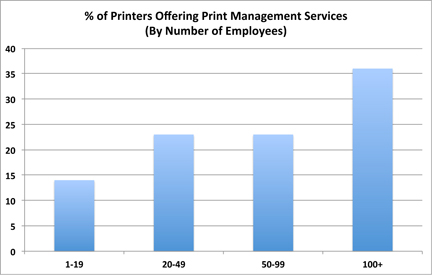
Davis reports that more than one in five printers is offering these services today; firms with more than one hundred employees are more than twice as likely to offer the services as firms with less than 20 employees.

But printing companies offering print management services is only part of the story. A larger sector of this market is made up of firms that have no printing equipment and do none of the production or distribution of printed materials. These firms are either outsourcing everything to companies on their supplier list or they are making the sourcing decisions and handing the management of the projects back to their corporate partner and/or its agencies.

Brought on by the drive for corporate cost cutting, excess capacity in the print supply base and the growth of online procurement solutions (e-commerce), the companies that specialize in print management services—also known as print procurement outsourcing—typically enter into corporate contracts. These agreements offer significant reductions in print spend as well as more efficient management and control of print-related marketing and communications materials.

For example, a well-known company of this type is InnerWorkings, a publicly traded firm (INWK) with a market value of $500 million. On their website, InnerWorkings describes themselves as “a partner in maximizing budgets and providing brand oversight in every corner of the globe.”

In a white paper entitled, “Top 6 Challenges to Managing Your Multi-Million Dollar Print Spend,” another provider of these services explains that corporate cost reduction efforts have, up to this point, used in-house resources and delivered minimal results. They write, “Many organizations are now choosing to work with a strategic partner who can bring additional spend, tools and resources … they are experiencing savings in the range of 10% – 40%.”

These changes are impacting every aspect of the traditional print supplier and corporate print buyer relationship. Corporate purchasing departments no longer need highly educated and informed print buyers since these skills are provided by experts within the firms hired to perform these functions.

Meanwhile, the nearly one hundred-year dominance by advertising agency print producers over the print sourcing process is being disrupted and, in some cases, completely eliminated. In instances where the only point of contact between the print supplier and the corporate end-user is through the medium of the print procurement firm, agencies play no role in sourcing decisions whatsoever.

For printing companies that participate as subcontractors in these arrangements this has meant a two-fold change: 1) loss of direct contact with corporate end-users and; 2) significant reduction in the prices that can be charged for print products and services.

Print management services and print procurement outsourcing are growing features of the print markets in the brave new world of 21st century corporate cost reduction. These firms and relationships have emerged alongside of the migration of marketing and communications dollars away from traditional print media to digital and social media alternatives.

As an industry, we need to understand these changing dynamics and develop strategies to adapt; we need to see that within every threat is also contained an opportunity. Rather than complaining about the difficulties of the environment, printing companies must develop a relationship with the print management services market that either leverages existing capabilities or competes directly for the business. As Ronnie Davis puts it, “printers can create their own positive future by understanding and taking advantage of emerging changes in print’s driving forces—those changes that are shaping the printing industry of today and tomorrow.”

Benjamin Franklin, Printer: 1706 – 1790

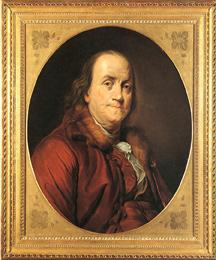
At the time of his death in 1790, Benjamin Franklin was world-famous as a philosopher, scientist, inventor and diplomat. His significant contributions to the American Enlightenment and as a leading figure of the Revolution of 1776 are far too numerous and important to be appropriately dealt with in this short space. However, his work as a printer deserves special appreciation.

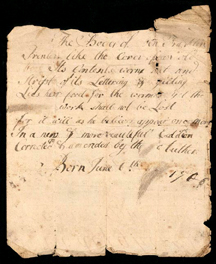
In 1728, when he was 22 years old, Benjamin Franklin wrote the following humorous epitaph for himself:

The body of
B. Franklin, Printer
(Like the Cover of an Old Book
Its Contents torn Out
And Stript of its Lettering and Gilding)
Lies Here, Food for Worms.
But the Work shall not be Lost;
For it will (as he Believ’d) Appear once More
In a New and More Elegant Edition
Revised and Corrected
By the Author.

In his last will and testament of 1788, Franklin amended his plan for the inscription on his gravestone to bear just the names of himself and his wife—Deborah Read Franklin—who preceded him in death by 15 years. In his will, however, he identified himself thus: “I, Benjamin Franklin, of Philadelphia, printer …”

Born in Boston, Massachusetts, Benjamin Franklin was the last of his father’s seventeen children. Franklin began his printing career when he was apprenticed to his brother, James Franklin, at age twelve. After he was denied his wish to be published in James’ newspaper, the young Ben began submitting letters to The New-England Courant under the pseudonym “Mrs. Silence Dogood.” The correspondence became very popular in the local community.

At age 17, Benjamin left his apprenticeship without permission, ran away to Philadelphia to start out on his own. After building his reputation as a skilled craftsmen—as both a type compositor and pressmen—and disciplined worker, Franklin had the opportunity to set up a printing house in partnership with Hugh Meredith in 1728. The following year he became publisher of The Pennsylvania Gazette, one of two newspapers in the colonies.

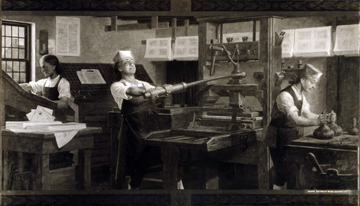
In his Philadelphia printing shop, Franklin produced his newspaper, government printing projects and he took on a considerable volume of print for hire such as forms, lottery tickets, handbills and bookwork. Beginning in 1730, Franklin was printer of all paper money issued by Pennsylvania, New Jersey and Delaware.

Perhaps one of his most recognized projects was “Poor Richards’s Almanack,” which Franklin wrote under the pseudonym Richard Saunders and printed for 25 years beginning in 1732. As Franklin explained in his Autobiography, “I endeavor’d to make it both entertaining and useful, and it accordingly came to be in such Demand that I reap’d considerable Profit from it, vending annually near ten Thousand. . . . I consider’d it as a proper Vehicle for conveying Instruction among the common People, who bought scarcely any other Books.”

Although Franklin was not the author of the many clever aphorisms contained the Almanack, it can be argued that these sayings have been passed down and are part of our speech today because of his work. Here are a few of them:

–       Early to bed and early to rise, makes a man healthy wealthy and wise. (1735)
–       The rotten apple spoils his companion. (1736)
–       No gains without pains. (1745)

During his printing career, Ben Franklin made important contributions to the technology and practice of printing. He made major improvements to printing press design and helped to set up paper mills in the south. He established in 1778 the first printers’ association in America (later named the Franklin Society), established the first public library, is credited with the idea for the first American magazine and was appointed the first Postmaster by the Second Continental Congress in 1775. Benjamin Franklin created a franchise business model that launched two-dozen printing establishments up and down the Atlantic Coast.

In his “Apology for Printers,” Franklin elaborated a philosophy for the role of the printer in modern society: “Printers are educated in the Belief, that when Men differ in Opinion, both Sides ought equally to have the Advantage of being heard by the Publick; and that when Truth and Error have fair Play, the former is always an overmatch for the latter.” If printers printed only what they believed, “the World would afterwards have nothing to read but what happen’d to be the Opinions of Printers.”

We look back and appreciate the work of Benjamin Franklin with pride; he was one of our own.