The holidays & product logistics print

The holiday season is the time of year to think about the people in your life; your family and friends as well as those with whom you do business. After all, where would you be without the people who are most important to you, those who have helped to make you into the person that you are and those that have helped to make your company what it is; your customers, your suppliers and your staff.

For all of us in the graphic arts and printing business, the holidays are also a time to take note of just how expansive our industry is. You will understand what I mean if, as you go about your gift giving this year, you take a moment to notice how much the holidays are permeated by print.

Aside from all of the direct mail, advertising and promotional print products for Black Friday, etc, the holidays are a great time to recognize perhaps the unsung heroes of our industry: the packaging printers. If you leave aside for the moment all of the gift wrapping paper and the little cards that say: From Santa, it is hard to think of any gift that you will give this holiday that doesn’t contain, isn’t contained by or isn’t accompanied by some kind of printed material.

In the broadest sense, I am talking about what the Printing Industries of America (PIA) calls product logistics printing; i.e., print that supports manufactured products with logistics materials such as packaging, labels, wrappers and product user manuals.

Aside from the consumer product items typically associated with gift giving, when you consider the full dimension of product logistics print, the variety is enormous: food, personal care, health care, household items. All of these require some kind of printed carton or container, labeling or information sheet.

The concept of product logistics print is explained in the recent PIA book entitled, “Competing for Print’s Thriving Future,” by Ronnie H. Davis, Ph.D. According to 2009 data from PIA—while marketing, promotion and communications printing are dominant functional segments of our industry—product logistics print represented 20% of total print volume or about $28 billion.

As opposed to the other segments, which have all seen a steady downward divergence from the general economic activity over the past decade, product logistics “should continue to grow at rates similar to overall gross domestic product and underpin overall printing shipments.”

The reason for this seemingly contradictory good news story in an otherwise declining volume of print materials is that product logistics print is the least likely segment to compete with or face elimination by digital media alternatives. With the exception of product user manuals, which can be put online or in other digital formats, product logistics print “has a protected competitive position.”

As is widely known today, print products such as forms, books, magazines, newspapers, brochures and technical documentation are for the most part “unprotected” from digital and online alternatives.

Product logistics print processes are also unique in our industry in that all of the different printing technologies are employed: offset lithography, flexography, gravure, screen print, xerography and inkjet. Meanwhile, the types of materials being printed upon also vary greatly: coated and uncoated paper, paperboard, containerboard, metal, glass, plastic and other synthetic substrates.

Color reproduction requirements for product logistics are huge, given that brand and corporate identity is key to consumer choice. In many cases, product packaging is printed in process color, but it is also common for flexographic systems to print in up to 12 colors to achieve precise color requirements.

One especially important category of product logistics print is label manufacturing. There has been steady growth over the past five years in nearly every area of label production. According to research by Fredonia Group, label production is expected to reach $20 billion by 2015 with pressure sensitive products accounting for 70% of the category. Along with product identity labeling, barcode and smart labels are also in rapid growth mode.

So, as you review the year 2011 and think about plans for 2012, take a few moments to appreciate the work of our friends and colleagues in the packaging print business. They represent the one segment of print media that, as long as physical items are being packaged for sale—especially to the consumer—will always be around; including long after promotional and informational print has been largely displaced by digital media.

Alois Senefelder: 1771 – 1834

By some estimates, offset lithography represents approximately two-thirds of all print today. Even with the rapid growth of digital printing, the oil and water based process, that also transfers the image to the paper with rubber blankets, is still by far the most dominant form of print media production.

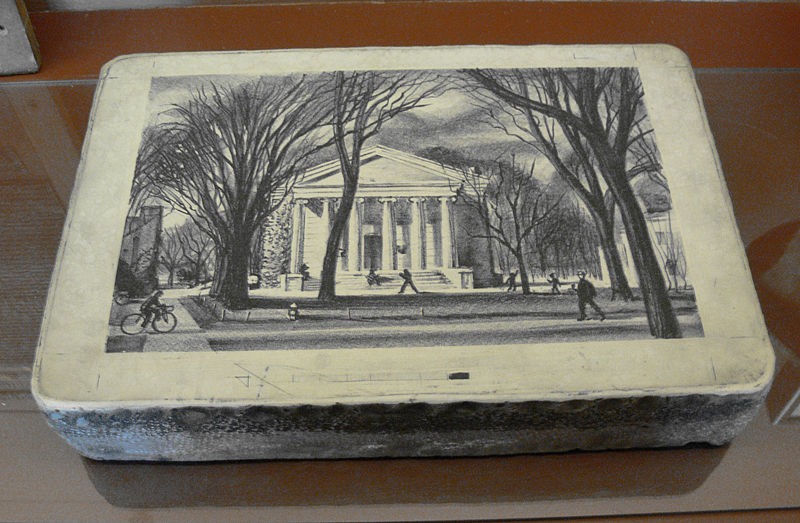
When separated from its offset component, lithography (which means stone printing) has been in existence for 213 years and counting. It is distinct from its relief, gravure, screen, xerographic and ink jet cousins in that the ink-carrying print image area is chemically separated from the non-image area. It is this quality—both the positive and negative image are on the same flat surface—that places lithography in a category of printing technology called planography.

Although offset lithography is print’s premiere technology (in terms of versatility and volume), it has only occupied this position since 1950 or just over 60 years. The previous dominant technology—letterpress—held that position for 500 years. Gutenberg invented the molten metal type casting and mechanical relief printing process in 1450.

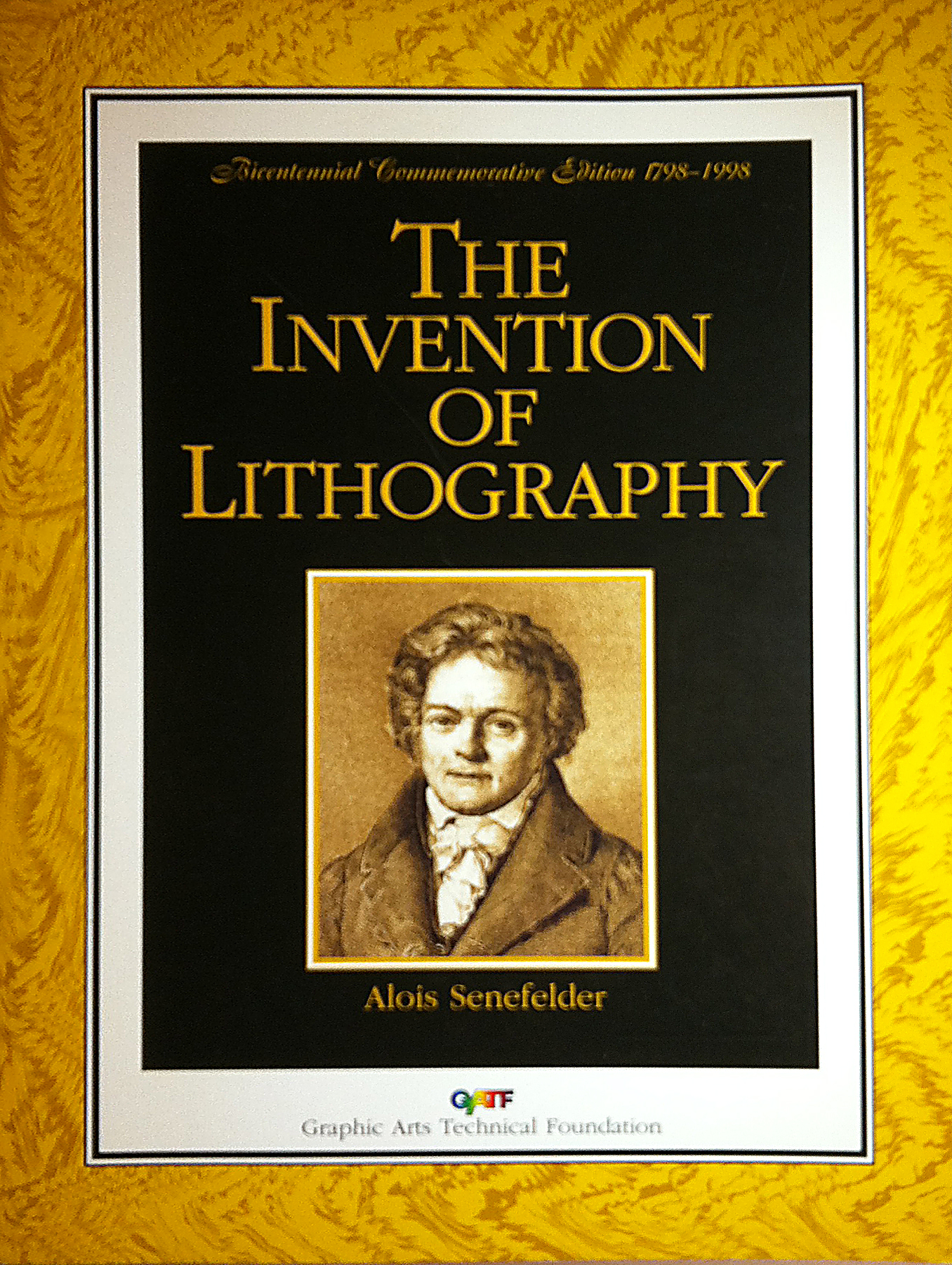
We are fortunate that the inventor of lithography, Alois Senefelder, left behind a book with many details of his life, an explanation of how his discovery was made and the methods for its effective use. The original translation of this volume, “The Invention of Lithography,” into English was made in 1911 and the Graphic Arts Technical Foundation reprinted it on the bicentennial of Senefelder’s accomplishment.

Alois Senefelder was born on November 6, 1771 in Prague where his actor father was appearing on stage at the time. The family lived in Munich and this is where the young Alois attended school. He later won a scholarship to study law in the Bavarian city of Ingolstadt.

At the age of twenty, Senefelder’s father died and the young man left his studies at law school to support his mother and eight siblings. His interest in the theater and acting led him to writing plays as a way of earning money. Several plays that he had written as a teenager had received popular response.

Initially, Alois went to a local printer with his manuscripts to get his work published. He quickly learned that his supplier had difficulty meeting deadlines and he decided to move the work elsewhere. By the time his copies were available and bought by a bookseller, Senefelder discovered that his costs were barely covered.

Being ambitious, Senefelder decided, “I found that it would not be hard for me to learn, and could not withstand the desire to own a small printing establishment myself.” Lacking the resources to buy a printing press, the types and paper, Senefelder engaged in various experiments with different etching and stereotype casting techniques.

When he was a student Senefelder had studied chemistry. He was deliberate in his experimentation and tried many different methods of engraving using turpentine, wax and tallow soap as well as copper and zinc surfaces. He also worked with different ink formulas to get his image transferred effectively onto the paper.

Although it is a popular myth that Senefelder invented lithography by chance, he explained, “I have told these things fully in order to prove to the reader that I did not invent stone-printing by happy accident, but that I arrived at it by a way pointed out by industrious thought.”

He began working with stone initially for the purpose of “rubbing down my colors on it” and later to practice writing. Most of the methods he was experimenting with required that writing be done in reverse. It was at this time in 1796 that his discovery was made when he wrote a laundry list on a stone that he had prepared and found that the image could be inked and transferred to paper.

By 1798, the full process had been perfected and, on September 3, 1799, Senefelder was granted an exclusive license for it. He joined with the André family of music publishers and refined both the chemical processes and the special form of printing press required for using the lithographic stones. Senefelder called it “stone printing” or “chemical printing,” but the French name lithography became more widely adopted.

Senefelder was recognized by King Maximilian Joseph of Bavaria and provided with a pension.  A statue of Senefelder stands in the town of Solnhofen, where lithographic stone is still quarried.

Alois Senefelder’s contribution to printing was significant in that it was a process that was more affordable and could be more widely used. Although letterpress remained the dominant form of printing text, lithography became the preferred technique for art and graphic image reproduction. It would be much later, after the offset printing technique was added to the process, that lithography would come to dominate in the field of newspaper, book and magazine publishing and numerous types of commercial print.

Beyond “tweets” and “friends”: the meaning of social media

I was not surprised when I learned that the term “retweet” was added to the 12th Edition of the Oxford English Dictionary. New words born of the social media revolution are everywhere. It’s an odd fact of our social media world that you can be “unfriended” on Facebook and not even know it. If you’re interested, you can read a discourse on the politics of unfriending here: http://www.facebook.com/topic.php?uid=4647588319&topic=4080

Treatises on the significance of social media are abundant. A search of Amazon’s book listings for “social media” turned up 102,071 paperback titles, 46,597 hardcover titles, 1,461 Kindle edition titles and 24 audio editions. The majority of these are how-to books for business: marketing and branding advice, tips on moneymaking and metrics for measuring success. Apparently, one can create a business out of social media by writing a book on the subject!

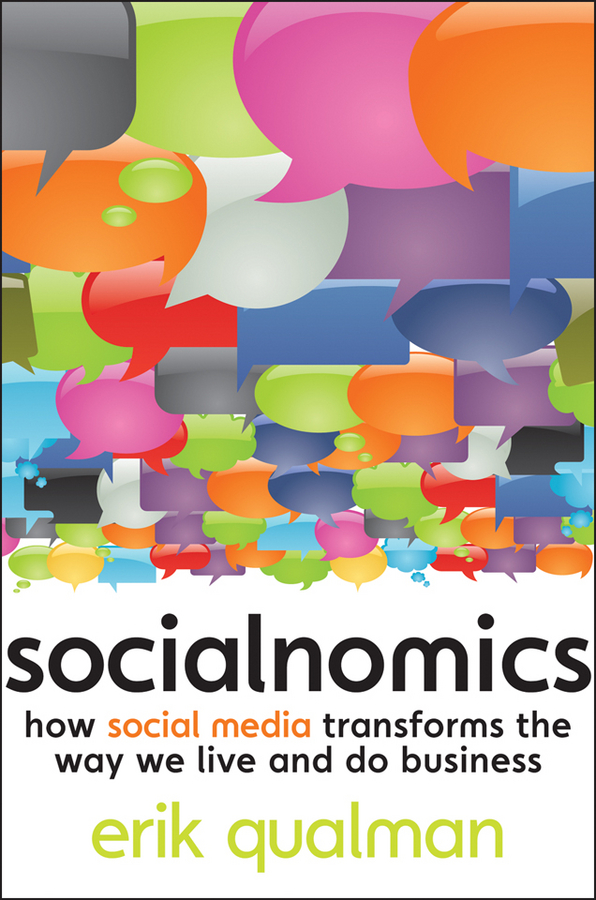
I won’t offer a how-to on the business opportunities present in social media; you should be pursuing this on your own already. What interests me is the broader implications of the social media; how is it different than previous media, how is it impacting our lives and where is it going? That’s what brought me to the book by Erik Qualman, “Socialnomics: how social media transforms the way we live and do business.”

Qualman, a marketing executive at EF Education and an MBA professor at Hult International Business School, sets himself a high bar with his title. However, I’m not sure he reaches his goal, even in the revised and updated edition.

Let me start with the positive. The core of Qualman’s theory of social media is found in the introduction where he states: “Socialnomics is the value created and shared via social media and its efficient influence on outcomes (economic, political and relational, etc.). Or more simply put, it’s Word of Mouth on digital steroids.”

I think his idea is basically correct, although the term “socialnomics” and the “value created” assertion should be debated. Social media transforms activities previously associated with word-of-mouth communications (exchanges between people that multiply) and accelerates them exponentially beyond anything previously possible. What we are living through is the evolution from simple verbal contact between individuals in one location to (potentially) a worldwide exchange between all individuals in all locations.

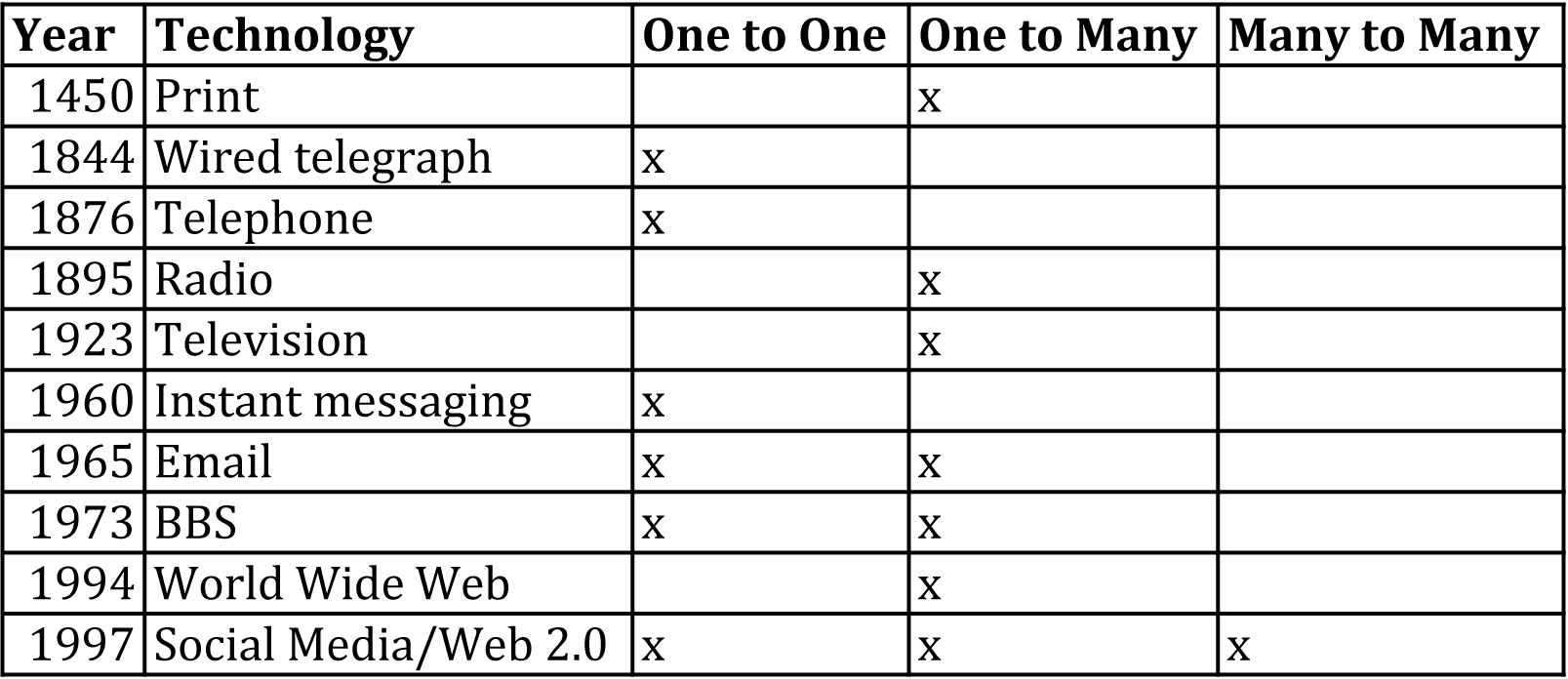
To illustrate this point, let us look at communications technology from the time of Gutenberg up to the present. When comparing the creator/recipient spectrum of social media to all previous technologies (dates subject to review), the transformation becomes apparent:

Social media, originating with what we know as Web 2.0 (online user-generated content, the Wiki phenomenon or web-as-participant-platform), has changed forever communications between people. We are no longer restricted to information from establishment sources or individual contact between our limited circle of friends and family; everyone can now simultaneously consume and create in the worldwide media-scape.

What Qualman does next is review, through case studies, the ways that this alteration in communications has been used, especially in business. He gives positive and negative examples. He examines the use of social media in the 2008 presidential campaign of Barack Obama. Many of these stories are interesting.

But this is also where the book falls down. His case studies are anecdotal and poorly researched. His conclusions are platitudinous and silly. Qualman has written an entire chapter called, “Social Media=Braggadocian Behavior” to explain that people use social media to compete for “who’s doing the coolest thing.” In my opinion, this only serves to reinforce negative perceptions of social media as a medium to post mundane daily activities. Of course, this is happening; much the same as it does with letter writing or telephone calls. This fact does little to reveal the underlying significance of what is happening.

YouTube, LinkedIn, Facebook and Twitter are the names of the services most associated with social media. In just a few short years, hundreds of millions (even billions in aggregate) worldwide are using these technologies to communicate in entirely new ways. We need to understand social media in the context of the breakthroughs and limitations of its predecessors in order to take advantage of the opportunities that it represents.