Ira W. Rubel: 1860 – 1908

Illustrator and painter Robert Thom’s depiction of the invention of the offset printing press by Ira W. Rubel and his assistants in Nutley, NJ in 1903.
Ira Washington Rubel

Walter E. Soderstrom, the noted authority on print technology, wrote in the Photo-Lithographer’s Manual of 1937: “The origin of the offset press is one of the least discussed subjects in the literature of printing.”

In preparing this brief sketch of the life of Ira Rubel and his invention of the offset printing press—an extraordinarily important event in the history of modern print technology—it is evident that nothing much has changed since Soderstrom’s time. To this day, there is little accessible and authoritative information about Ira Washington Rubel: his work or his life. In fact, most of what is easily found either trivializes Rubel’s contribution—as bumbling or happenstance rather than the work of an earnest inventor—or glosses over its historic significance. There is currently no biographical Wikipedia entry on the man and his accomplishment; photos of Ira Rubel are very hard to find.

Ira Washington Rubel was born in Chicago on August 27, 1860. He attended Hayes and Division West High Schools in Chicago. He graduated from the University of Chicago in 1881. Rubel then attended Northwestern University in Evanston where he was a classmate of William Jennings Bryan and graduated with a Bachelor of Law in 1883. He litigated cases as a practicing attorney for a short time in Chicago.

The printing firm Rubel Brothers—which Ira founded along with his brother Charles in 1881—is listed in the Lakeside Annual Directory of the City of Chicago of 1887. During the 1880s, Ira became known for having been a pioneer in the manufacture of loose-leaf systems. Promoting the systems for the maintenance of business transactions records, the Rubel Loose Leaf Mfg. Co. was established on Superior Street in Chicago.

Advertising by the Rubel Company in a Chicago business publication.

By 1899, the Rubel brothers’ firm acquired both a six story building on Wabash Street in Chicago as well as a paper mill. At some point, Ira Rubel and his three brothers expanded to the east coast and established an office on Broadway in New York City. They also opened a lithographic printing and paper mill facility in Nutley, New Jersey.

By 1901, the Rubel Brothers Paper & Manufacturing Co. on Kingsland Street in Nutley, NJ experienced significant growth and expanded its facilities. It was at this plant that Ira would conduct his experiments, discover the offset printing method and build the first offset lithographic printing press.

Offset printing is also known as “indirect” printing, i.e. the printed image is not applied directly to paper from the printing plate or inked image carrier, but is first transferred to a rubber blanket and then to paper. Although indirect ink transfer had already proven its importance for at least 25 years in tinplate (canned goods) printing, the concept was not obvious in paper-based lithographic printing due to the dominance at the time of the letterpress technique especially in typographic reproduction.

Perhaps one of the reasons for the lack of literature on Rubel’s discovery is the fact that the offset method was the result of more than fifty years of seemingly disconnected technological developments in both typographic and pictorial reproduction. In 1875, Robert Barclay of Barclay & Fry obtained an English patent for the very first offset press that transferred the printed image from the lithographic stone to a cardboard surface and then to sheet metal (used in making biscuit tins). The discovery of halftone photographic and process color reproduction in the 1880s was also a factor that motivated the invention of offset.

In 1903 and 1904 Rubel experimented at the Nutley facility with photo reproductions transferred onto lithographic stone through a screen. Although the testing did not yield significant results, Rubel’s work on a stop cylinder press led inadvertently to an important breakthrough. When his assistant miss fed a sheet and the rubber impression roller came into contact with the lithographic stone, the reversed image was transferred this roller. When the next sheet was fed, it had an image on both sides: one that was product of the direct contact with the stone image carrier as intended and the other with a wrong-reading image from the “indirect” rubber roller.

Once the “indirect” image was found to be superior in quality to the direct one, Rubel and his collaborators expanded their testing along these lines and perfected the technique. This included a complete redesign of the press based upon the offset principle.
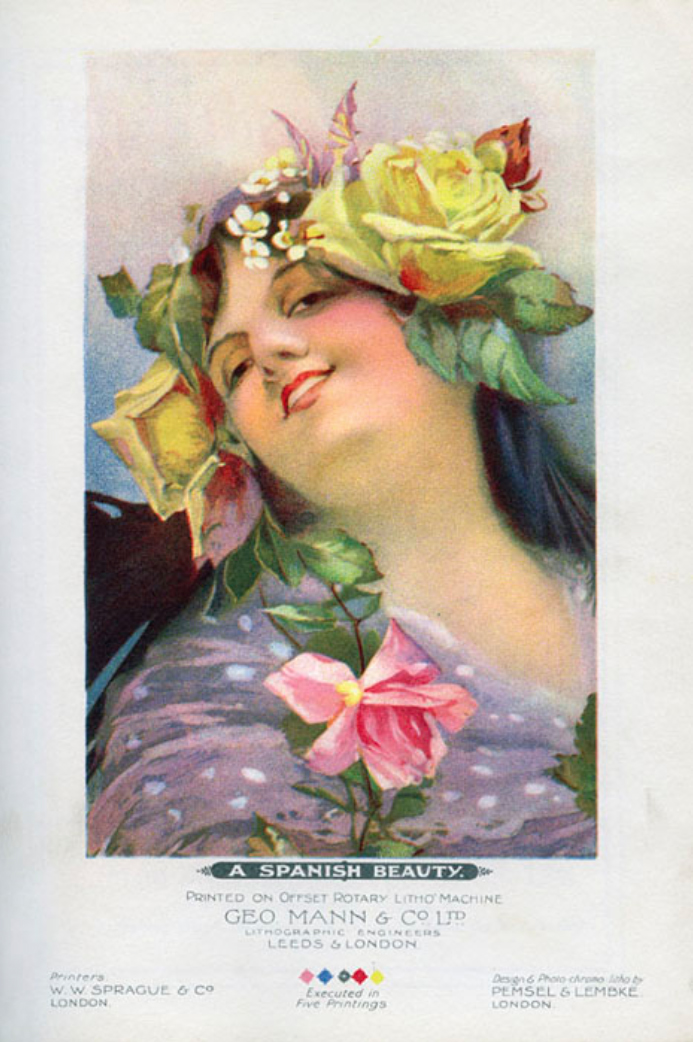
One of the first process color prints produced on an offset press. It appeared in Penrose’s Annual Pictorial in 1910.

As Ira was convinced of the importance of his discovery, he returned to Chicago to seek the technical assistance of lithographer Alexander B. Sherwood. The two also enlisted the financial support of Andrew Kellogg of New York as a venture partner. Although the arrangement did not last, three presses were built and each man took one of them as their share of the achievement.

Court rulings made it impossible for Rubel to obtain a US patent for his discovery because the pre-existing use of the offset method by tinplate printers was legally invoked. Therefore, each of the partners—Rubel, Sherwood and Kellogg— went their separate ways with the new invention. The Kellogg Offset Press was built in New Hampshire, Sherwood joined the Potter Printing Press Company of Plainfield, NJ and Ira Rubel took his idea to England where he thought he might obtain a patent for it. In 1906, Rubel met the New Zealander Frederick Sears and together they launched what became known as the Sears “Highlight” process.

Rubel and his family never realized any fortune from his invention. He died of a stroke at the age of 48 while at the Derby Hotel, Bury, Lancashire, according to relatives, from “the worry and work occasioned in seeking to protect his patents and marketing his inventions in Europe and America.”

An obituary published in the September 19, 1908 edition of The American Stationer reported, “Ira W. Rubel, pioneer manufacturer of loose leaf systems and inventor of the offset printing press which did much in the progress of lithographic development, died suddenly in London of apoplexy. Mr. Rubel was formerly connected with the Rubel Brothers’ Company, which was succeeded by the Rubel Manufacturing Company. Mr. Rubel left Chicago ten years ago, and took up his residence in New York. His remains will be buried in Chicago in Graceland cemetery, by the side of his wife.”

There is no doubt that Ira Rubel’s invention—and the independent and concurrent work of Charles and Alfred Harris of Niles, IL—came to transform the printing industry worldwide. The offset lithographic process was greeted initially within the industry with mixtures of enthusiasm, skepticism and opposition. As with many previous and future breakthroughs in the graphic arts, there were those who could see offset’s potential and those who were advocates of the dominant letterpress of the previous technology generation.

It would take fifty years before the superior quality, speed and economics of offset overtook letterpress as the dominant printing method internationally. By 1960, the majority of printed matter was being produced on offset equipment. Today, with digital printing systems advancing rapidly in recent decades, offset still represents more than half of the $800 billion of worldwide annual printing shipments. More than a century after Ira Rubel’s invention, the dominance of offset printing will continue for many years—some even say decades—to come.

Between papyrus & flexible e-paper displays: Two millennia of paper

We often take paper for granted. When searching for a dollar bill, filling up a fountain drink cup or moving a leaf bag to the curb, do we think about paper? Probably not. We are focused on the useful purpose of these daily items and don’t have time to stop and think about how they are made or what they are made of.

Christian religious text written on papyrus

Paper in all its different forms, qualities and applications has been around for a very long time. Most commonly, paper is thought of as a medium for the written or printed word. This is natural since paper—the word is derived from the Latin term papyrus—was developed as a writing surface 1,800 years ago by the Chinese to replace wood and bamboo scrolls.

The papermaking process—basically unchanged since Ts’ai Lun invented it in 105 AD—is a marvel of human ingenuity. Distinct from the papyrus of ancient Egypt, where thinly cut plant stalks were woven and laminated together, paper is the reduction of a raw material to individual fibers and their liquid suspension onto a mat or sheet.

With today’s instant global communications and world travel, it might seem strange that it took 500 years for papermaking to leave China and arrive in Japan and nearly 1,000 years for it to reach Europe. Nonetheless, paper’s global growth and development is an important chapter of world history.

  • In the seventh century, the Japanese were the first to recycle and repulp paper. In 750 AD, after a battle between the Chinese and the Muslims in what is now Uzbekistan, a group of Chinese prisoners revealed their secrets to their Middle Eastern captors. Once the Muslims began making paper, they went on to develop water powered stamping/hammer mills for the pulping process.
  • Papermaking entered Europe through the Muslim Moors of southern Spain in about 1100 AD. At that time, most European documents were recorded on parchment, a writing surface of sheepskin or vellum from calfskin. Since Europe was majority Christian and it was the time of the Crusades, the papermaking techniques of the Moors were not discovered by Europeans until after the military campaigns were concluded in the south. Once the Vatican was exposed to the wonders of papermaking, Italy emerged as the primary producer of paper in Europe.
  • In the thirteenth and fourteenth centuries the center of papermaking moved from Italy to France when the craft was encouraged by the monarchy. Just as demand for handwritten documents was on the rise, metallurgist Johann Gutenberg invented the mechanical methods of type setting and printing in Mainz, Germany in 1450. As the printing press spread throughout Europe, the volumes of paper being produced by the mills in France and Italy grew exponentially.
  • By the eighteenth century, papermaking had moved largely to Germany and Holland due to the social and political instability in France. Meanwhile, the technology of the paper industry was undergoing a transformation brought on by the emergence of manufacturing throughout Europe. These are the same industrial developments that impacted printing presses; iron in place of wood; steam in place of manpower or other natural forces such as wind and water.
The Fourdrinier paper machine and portrait of Nicholas-Louis Robert
  • In 1800, a Frenchman named Nicholas-Louis Robert patented an invention that converted papermaking into a mass production industry. Robert’s paper machine had a continuous wire screen upon which the slurry was poured so that the excess water would pass straight through it. The paper in formation was progressively dried by a series of felt rollers until it was solid enough to be wound onto a roll. Thus, paper no longer needed to made in individual sheets.
  • Several years later, Robert’s invention was sold to the Fourdrinier brothers of London where they constructed a much larger version of it. In 1812, the first Fourdrinier—the name associated with Robert’s invention and remains the primary method for papermaking to this day—machine was started up in a mill near Two Waters, England. Later, cylinders for pulp transport, drums for drying and techniques to prevent ink absorption into the fibers of the paper (sizing) would modify the Fourdrinier system.
  • By the mid nineteenth century, the center of papermaking moved to America and played an important role in the growth of newspaper publishing around the time of the Civil War. Up to this point, the fiber for papermaking—especially in Europe—came from the fabric in rags. But with the vast forests of North America, wood fiber quickly became the source of paper pulp and groundwood the essential raw material for the newsprint industry.
  • In the twentieth century, as printing technology moved from black and white letterpress to full color offset lithography, coated papers were developed. The papermaking process evolved from offline to inline coating systems. Today, the pulp and paper industries worldwide are going through a transformation born of the global economy and the shifting of paper consumption from west to east. According to industry data, paper consumption in the advanced world is falling rapidly—brought on by electronic media and recycling practices—while paper consumption in the developing world is rising even more rapidly. In 2009, for example, paper consumption in China surpassed that of the United States for the first time.
Text displayed on Gyricon e-paper and Nick Sheridon

While paper remains the number one media for publishing, electronic and online alternatives have been in development and grown rapidly over the last several decades. In the 1970s, Nick Sheridon at Xerox’s Palo Alto Research Center (PARC) developed the world’s first electronic paper, called Gyricon. It consisted of microscopic polyethylene spheres with black on one side and white on the other embedded in a silicon sheet. With the appropriate electronic charge this e-paper could be used over and over again to display an unlimited number of different images much like a computer monitor.

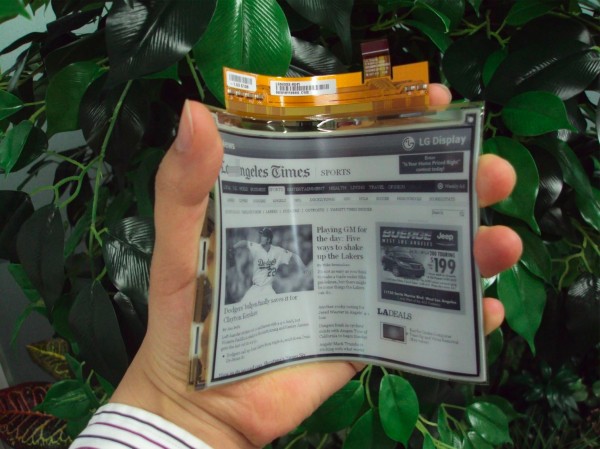
LG’s six inch flexible e-paper display

In 2007, Amazon began marketing the Kindle e-book reader based on a principle similar to Sheridon’s invention. The Kindle emulates the visual characteristics of book paper because it relies upon reflective light as opposed to the transmissive backlighting of computer displays. Although these technologies lack the surface flexibility of paper, there are developments underway that will soon bring that attribute to electronic publishing. For example, in March of this year, LG unveiled the world’s first commercially available six-inch e-paper display that can be bent at an angle of up to 40 degrees.

While good old-fashioned paper will be around for a long time—ensured by its utility, durability, recyclability and cost—the one sector where we can now visualize its decline and disappearance is in the publication of books, magazines and newspapers. Perhaps by that time we will better appreciate the miracle of paper and no longer take it for granted.

William Blake: 1757 – 1827

20120726-181057.jpg
William Blake, November 28, 1757–August 12, 1827

William Blake is well known as an English poet and painter. During his lifetime he was not recognized for his genius; but today Blake is viewed as a significant and early figure of the Romantic period of European culture. He was one of the most brilliant representatives of the creative movement in the late 18th and early 19th centuries that emphasized the free expression of the feelings of the artist in his works.

William Blake was born on November 28, 1757 in the Soho district of London. He was the third of seven children, two of whom died in infancy. His father was James Blake, a London hosier, and his mother was Catherine Wright Armitage Blake. Since William exhibited a love of art at an early age, his parents enrolled him in drawing classes and elected to educate him on other subjects at home.

At age 14, William was apprenticed to the engraver James Basire of London for a seven-year term. At the end of this training, Blake emerged as a skilled engraver but he chose to enroll as an art student at the Royal Academy instead of pursuing a professional career at this time.

In his years at the Academy, William Blake developed his particular creative style in opposition to the trends of the time, especially the popular extravagance of the Baroque works of Peter Paul Rubens. Blake was drawn to the Classical period and the style and precision of Michelangelo and Raphael. Some of Blake’s early paintings were exhibited at the Royal Academy between 1780 and 1808.

William’s gift of verse was also evident in his youth. A volume of his first poetry called “Poetical Sketches,” published by friends in 1783, contains lines that he had written as early as 1768 when William was only 10 or 11 years old.

Throughout his life, beginning at age 4, William claimed to have experienced visions. These apparitions were often of a spiritual and religious nature and formed the basis of his literary and visual creations. It was this mystical behavior that earned him a reputation of being an unstable man among his contemporaries. In fact, the noted poet William Wordsworth is quoted in a biography of Blake as having said, “There is something in the madness of this man which interests me more then the sanity of Lord Byron and Walter Scott.”

William Blake was married to Catherine Boucher in 1782 in St. Mary’s Church, Battersea. Although Catherine was illiterate—she signed their wedding contract with an “X”—William taught her to read and write and later trained her as an engraver. Catherine remained with William to the day of his death and she proved to be invaluable to him, helping to print his illuminated works and maintaining his spirits through a number of crises.

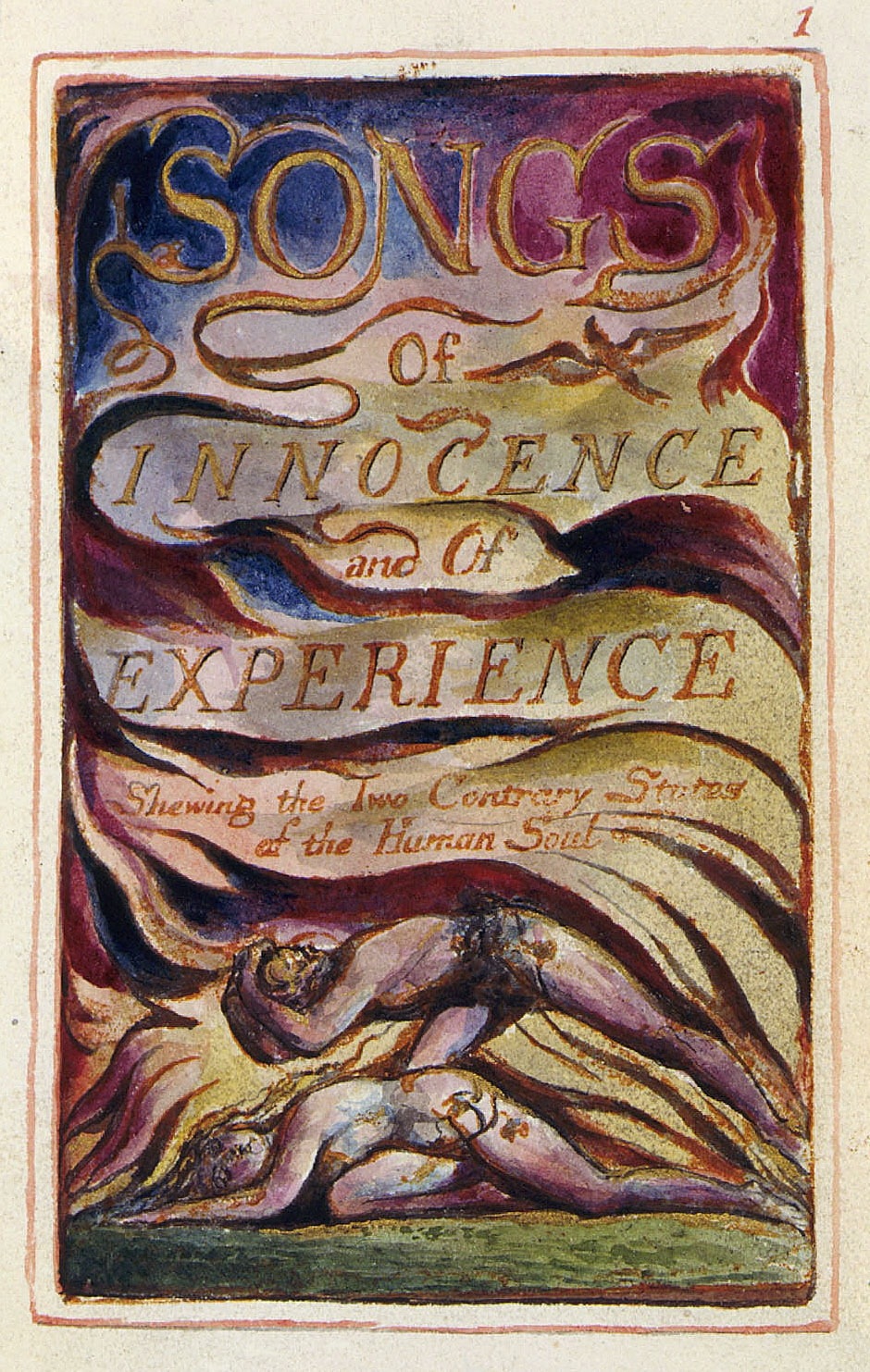
The frontispiece of William Blake’s “Songs of Innocence & of Experience” published in 1826.

Due to his posthumous acclaim in the literary and visual arts, Blake is not as well known for his work as an engraver and, in particular, his innovative contributions to the graphic arts. Aside from the spectacular beauty of his print work—his hand-illustrated series of epic and lyrical poems “Songs of Innocence” (1789) and “Songs of Experience” (1794) being among the most original and stunning prints ever produced—William invented the technique known as relief etching. This is the method that is associated with the illuminated printing of his most important work.

The previous method of engraving exposed the images and text to acid and, therefore, the copper plate was recessed in those areas and the transfer of ink to paper took place with the intaglio method. Beginning in 1788, at the age of 31, Blake began his experiments with relief etching where the text of the poems was applied to copper plates with pens and brushes using an acid-resistant medium. He then etched the plates, dissolving the untreated copper and leaving the design to stand in relief. The pages printed from these plates were hand painted in water colors and then stitched together to finish the book.

Due to the lack of popularity of his own creative output during his lifetime, Blake took to commercial work to make a living. Some of the books that he illustrated are: “Night Thoughts” by Edward Young, “The Grave” by Robert Blair, “Paradise Lost” by John Milton, “The Book of Job,” “The Pilgrim’s Progress” by John Bunyon and “The Divine Comedy” by Dante. The last two of these remained unfinished when Blake died in 1827.

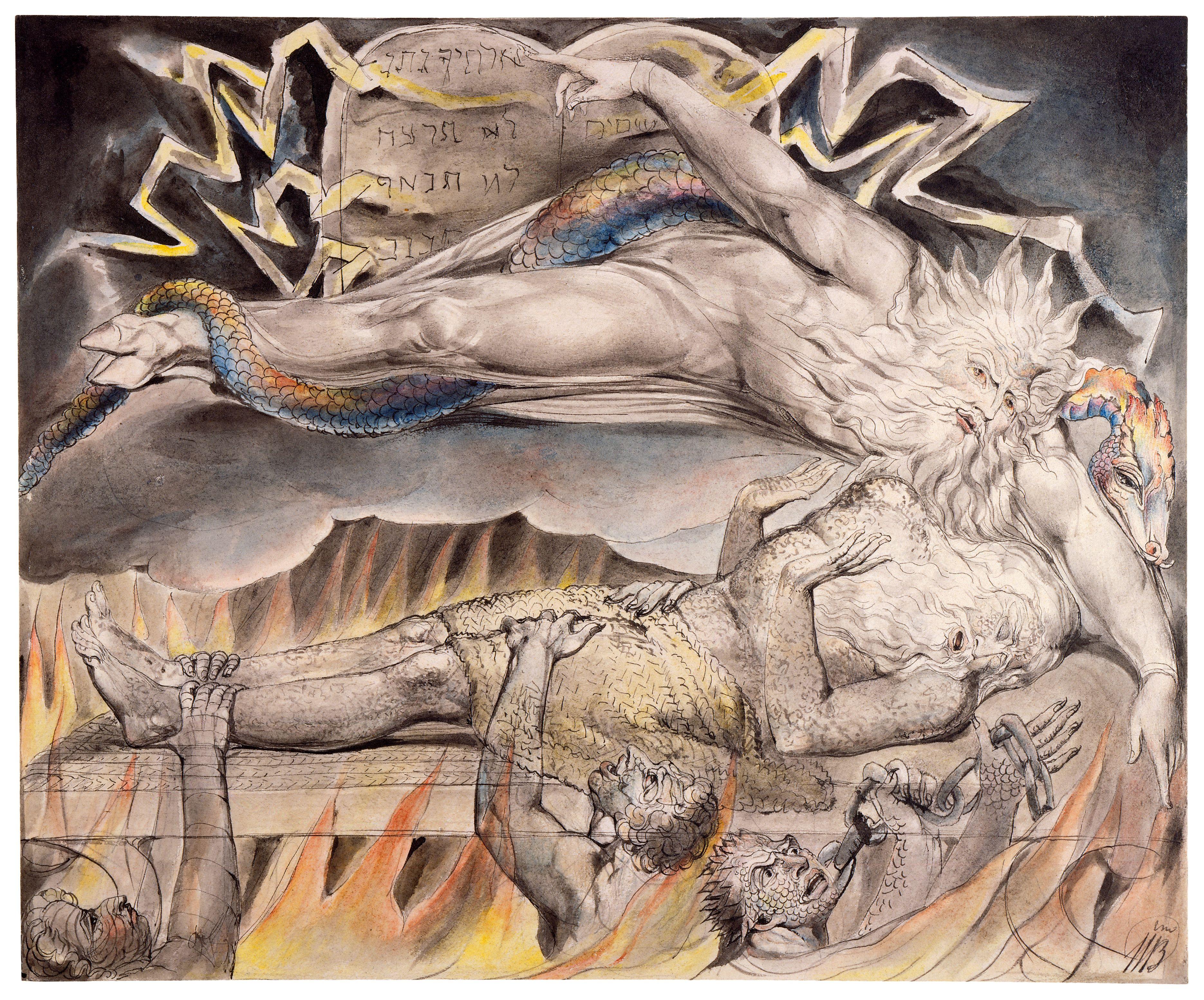
“Job’s Evil Dreams” from William Blake’s illustrations of The Book of Job.

Among his original works, some of the more popular titles are “The Marriage of Heaven and Hell,” “Visions of the Daughters of Albion,” “The First Book of Urizen,” “Milton, a Poem” and “Jerusalem, The Emanation of the Giant Albion.” The preface to the last of these contains the well known verse “And did those feet in ancient time … ” that was later composed as a hymn called “Jerusalem” and became a British national anthem.

William Blake died in his house on August 12, 1827 at age 69 in the midst of his work. Living in near poverty, Catherine borrowed the money needed for the funeral of her loving husband. The service was attended by a small group of his closest friends. Today, a monument marks the approximate location of the remains of William Blake and his wife—Catherine died four years later—at Bunhill Fields in London.

William Blake lived at a time of great transformation in society; the beginnings of the Industrial Revolution. To some extent his work reflects a deep emotional reaction to the coldness of those times and a longing for a simpler and more humanitarian world. However, despite his justified anger toward the socially negative impact of science and technology at the turn of the nineteenth century, Blake made a colossal contribution to art in its literary, visual and, some would say, musical forms.

Had Blake lived in our day, he would no doubt have found in the technology of the personal computer an outlet for his visionary, mythical and humanistic creative expression. As it happened, William Blake was one of the first and most important multimedia artists that ever lived.