Marshall McLuhan: 1911 – 1980

Marshall McLuhan, the Canadian educator and communications scholar, was born 100 years ago on July 21, 1911. McLuhan became a celebrity in the 1960s for his controversial media studies and peculiar perspective on television and its societal impact.

While you are likely familiar with McLuhan’s aphorism “the medium is the message,” you might not know that he was an expert on printing. Much of his writing deals with print media technology, its history and significance as a cultural form, especially the book. One of his most important titles, The Gutenberg Galaxy: The Making of Typographic Man (1962), examines prints’ contribution to the transformation of mankind’s self-image and consciousness during the Renaissance.

McLuhan was among the first to foresee the coming of electronic media. He had a prophetic view of the information age, one that anticipated the World Wide Web and digital publishing. His relevance to modern media studies is shown by the conferences being held worldwide on the centenary of his birth: http://marshallmcluhan.com/.

Herbert Marshall McLuhan was born in Edmonton, Alberta. His family moved to Winnipeg, Manitoba after World War I. In 1928, Marshall entered the University of Manitoba where earned an MA in English. He went on to the University of Cambridge where he earned a Ph.D. in 1943. Marshall married Corrine Lewis in 1939 and they had six children.

McLuhan and his family moved to Toronto in 1946 where he joined the faculty of St. Michael’s College of the University of Toronto. In the 1950s he began the Communication and Culture seminars, gaining a reputation as a media expert and, in 1963, the university created with him the Centre for Culture and Technology.
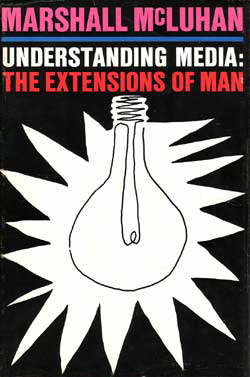
McLuhan became internationally known with the publication of Understanding Media: The Extensions of Man (1964). He advanced the profound idea that “the ‘message’ of any medium or technology is the change of scale or pace or pattern that it introduces into human affairs.” He examined many forms of media: the written word, the printed word, the photograph, the telegraph, the typewriter, the telephone, the phonograph, movies, radio and television and showed how the content of one media is always another media form.

Marshall McLuhan suffered a stroke in 1979 that affected his speech. The University of Toronto attempted to close his research center shortly thereafter but was prevented by protests, most notably by Woody Allen. McLuhan never recovered and died on December 31, 1980.

Marshall McLuhan on the Today Show in September 1976.

Since McLuhan’s theoretical concepts are difficult to explain, I will let him do it himself. Below are quotations taken from TV interviews that can be viewed online.

On “hot” and “cold” media, 1964

“It has to do with the slang phrase ‘the hot and the cool’ … ‘Cool’ in the slang form has come to mean involved, deeply participative, deeply engaged; everything that we had formerly meant by heated … Though the idea that ‘cool’ has reversed its meaning I think has some bearing on the fact that our culture has shifted its stress on the demand that we become more committed, more involved.” http://marshallmcluhanspeaks.com/?video=SAY_001

On the future of publishing, 1966

“Instead of going out and buying a book of which there have been 5,000 copies printed, you will go to the telephone and describe your interests, your needs, your problems … They will at once Xerox—with the help of computers from the libraries of the world—all the latest material just for you, personally, not as something to be put out on the bookshelf. They send you the package as a direct personal service.” http://marshallmcluhanspeaks.com/?video=PRO_004

On instantaneous, simultaneous information, 1976

“At the speed of light there is no sequence, everything happens at one instant … We live in a world where everything is supposed to be lineal, one thing at a time, connected and logical, goal oriented. We are now living in a world which pushes the right hemisphere (of the brain) way up … is making the old left hemisphere world—which is our educational establishment, our political establishment—look very foolish.” http://marshallmcluhanspeaks.com/?video=TEA_007

Admittedly, McLuhan’s academic style and references to historical and cultural artifacts make him difficult to read. However, McLuhan has made a unique contribution to an understanding of media and how they impact the cognitive functions and social organization of man. We should embrace and study Marshall McLuhan as the first philosopher of our multimedia world.

Ottmar Mergenthaler: 1854 – 1899

Ottmar Mergenthaler, the inventor of the Linotype machine, was born on May 11, 1854. While it may be difficult to appreciate in our era of digital innovation, Mergenthaler’s invention was a momentous achievement that transformed our industry 125 years ago.

Called the “eighth wonder of the world” by Thomas Edison, Mergenthaler’s machine automated and integrated the casting and assembly of type forms; the invention completed the advancement of printing from handcraft to industrial manufacturing.

In the early 19th century, industrial printing came into shape as iron replaced wood in press construction. Cylinders were developed and, with steam power, the rotary press was invented. Meanwhile, the 1800s saw papermaking industrialize and bookbinding convert from handiwork to mass production.

The industrial revolution increased the volume of printing and its output per hour. However, in contrast, there was one critical step that remained primitive, costly and in need of revolutionary change: typesetting.

For centuries, type composition methods remained static. Standing in front of the type case, the compositor manually picked up individually cast metal characters and placed them in sequence—including justification—onto an eight-inch composing stick. Manual typesetting required The New York Times, for example, to maintain a staff 100 compositors … to produce eight-page weekday editions and a twelve-pager on Sundays!

The search to replace the old process—which remained unchanged since Gutenberg’s time—spanned a century and went through more than 100 unsuccessful inventions. As one author wrote, “The story of the many inventors who failed, died broke or took to drink … only serves to dramatize this persistent urge of the human spirit” to leap over an important technological hurdle.

With expectations of a solution on the horizon, investors put up an estimated $10 million between 1865 and 1885 for various schemes. Among them was Mark Twain who sank $190,000 ($7 million in today’s money) into a failed contraption that had 18,000 moving parts.

It took the genius, clarity of vision and persistence of a young German emigrant to America to solve the riddle of mechanical typesetting. Arriving in Baltimore at the age of 18, Ottmar Mergenthaler was looking for an opportunity to pursue his interest in engineering.

In 1876, the young Mergenthaler—who was trained as a watchmaker— was asked to review the apparatus of another inventor. He said, “Even though I know almost nothing about printing, I have little faith that this is the machine to revolutionize an industry.” And with that, he embarked upon the project of his life. After ten years of work and at age 32, Mergenthaler demonstrated his machine publicly for the first time in the offices of The New York Tribune on July 3, 1886.

With his unique arrangement of keyboard, gears, wheels, belts, pulleys, tubes, cables, hoses, trays etc., Mergenthaler integrated a mind-boggling array of functions. At the core of his invention were: 1.) the casting of individual type forms from hot metal; 2.) the assembly of the characters into lines-of-type and; 3.) everything was done by a single operator. You can watch a Model 8 Linotype machine in action by visiting this YouTube link: http://www.youtube.com/watch?v=nf0hDWOrnWA

By 1895, there were 3,000 machines in use by publishers and printers worldwide. The fast, low cost typesetting led to an expansion of the printed word. In the US, newspapers increased pages, magazines grew in size and frequency, books were printed in greater quantities, libraries multiplied and the illiteracy rate was reduced.

Predictably, Mergenthaler—a technician, not a moneyman—was treated badly by the “publishers syndicate” that financed the development of the Linotype. Expecting rapid and large returns, they forced Ottmar to bring his invention to market before it was ready and manipulated the patent system for their own gain.

Along with other inventors of his generation, Ottmar Mergenthaler exhibited little interest in riches or personal glory. After twenty years of work and following a serious illness, he and his family took their first vacation. Traveling to his hometown in Wurttemberg, Ottmar was greeted with a hero’s welcome. Upon their return to America, however, Ottmar Mergenthaler was diagnosed with TB and, at the age of 45, he died on October 28, 1899.

Johannes Gutenberg: c. 1398 – 1468


Bust of Johannes Gutenberg outside the Gutenberg Museum in Mainz, Germany

The known details of Johannes Gutenberg’s life are few and far between. With documentary evidence quite meager after 600 years, there are many gaps in his biography. Due to the lack of information, a mythology has been built up about Gutenberg that (1) his ideas about printing came to him “like a ray of light,” (2) that he was a failed businessman and (3) he died in poverty. None of this is true.

What is known is that Gutenberg left Mainz in 1430 due to political conflicts between the patricians and the guilds. Gutenburg, himself a patrician with an inclination toward the guild members, was owed considerable sums by the local government. It is likely that Gutenberg began his project in 1439 while living in Strasbourg. Far from it coming to him in an instant, Gutenberg worked on what he called his “secret enterprise” for some ten years before it was complete and ready for commercial production. The processes involved in the technique were complex and expensive and would have required numerous approaches and attempts. Among them were:
1.) Typeface design
2.) Engraving of patrices
3.) Manufacture of matrices
4.) Creation of the manual metal typecaster
5.) Composition of metal alloys
6.) Ink formulation
7.) Experiments with paper and parchment
8.) The construction of the wooden press machinery

By far the most significant of these, was (4) the invention of the handheld mold for casting metal type. While I was at the Gutenberg Museum in Mainz, Germany in June 2008, I asked if any of the original casting devices were existent and was told that none had been preserved; the ones that were in the museum were recreations from information available about how they were constructed. This information did not include any drawings or schematics. Below is a video of a demonstration given by the museum on Gutenberg’s invention.

It is believed that Gutenberg returned to Mainz in 1448 and it was around this time that the process was finalized and live projects could be produced with his invention. In 1449-50, Gutenberg secured an investment from Johannes Fust and the two became partners, opening the first commercial printing establishment in the world. A rented facility was located, new presses were built, a staff was hired and trained, materials were procured and stored for the purpose of producing the 42-line Bibles that are well-known.

In 1455, there was a business dispute between the two men and Fust sued Gutenberg in court on charges of refusal to pay interest on his loan and embezzlement. In a complex ruling, the court issued an order for Gutenberg to pay a portion of what Fust demanded and the two parted company. The legal dispute with Fust certainly set Gutenberg back as he was unable to pay immediately. Fust kept the Bible inventory, opened up his own printing facility and took the most skilled employee of the firm (Peter Schöffer) with him. However, Gutenberg was not ruined and he continued to work energetically on the development of his technique … he just had a competitor down the road, another first in the industry.

It is believed that Gutenberg continued to produce Bibles and other products such as calendars and letters of indulgence. In 1465, the archbishop of Mainz, Adolf von Nassau, appointed Gutenberg as “gentleman of the court” in recognition for his achievements which he enjoyed until his death in 1468. His invention spread rapidly throughout Europe, led to an tremendous expansion of literacy and is considered a key element in the Renaissance.