Steve Case and “The Third Wave” of the Internet

Steve Case and The Third Wave

In 1980, Alvin Toffler published The Third Wave, a sequel to his 1970 best-seller Future Shock and an elaboration of his ideas about the information age and its stressful impact on society. In contrast to his first book, Toffler sought in The Third Wave to convince readers not to dread the future but instead to embrace the potential at the heart of the information revolution.

Alvin Toffler
Alvin Toffler

Actually, Alvin—and his co-author wife Heidi Toffler—were among the few writers to appreciate early on the transformative power of electronic communications. Long before the word “Internet” was used by anyone but a few engineers working for the US Department of Defense—and after reporting for Fortune magazine on foundational Third Wave companies like IBM, AT&T and Xerox—Toffler began to hypothesize about “information overload” and the disruptive force of networked data and communications upon manufacturing, business, government and the family.

"The Third Wave" (1980) by Alvin Toffler
“The Third Wave” (1980) by Alvin Toffler

For example, one can read in the The Third Wave, “Humanity faces a quantum leap forward. It faces the deepest social upheaval and creative restructuring of all time. Without clearly recognizing it, we are engaged in building a remarkable new civilization from the ground up. This is the meaning of the Third Wave.” Appearing today as a little excessive, these words would certainly have seemed in 1980 to be a wild exaggeration by two fanatical tech futurists.

But Alvin and Heidi were really onto something. More than 35 years later, who can deny the truth behind Toffler’s basic ideas about the global information revolution and its consequences? The Internet, networked PCs, the World Wide Web, wireless broadband, smartphones, social media and, ultimately, the Internet of Things have changed and are changing every aspect of society.

To his credit, Steve Case—who cofounded the early Internet company America Online—has written a new book called The Third Wave: An Entrepreneur’s Vision of the Future that borrows its title from Toffler’s pioneering work. As Case explains in the preface, he was motivated by Toffler’s theories as a college student because they “completely transformed the way I thought about the world—and what I imagined for the future.”

Steve Case’s The Third Wave

First Wave Internet companies

In Steve Case’s book, “The Third Wave” refers to three phases of Internet development as opposed to Toffler’s stages of civilization. For Case, the first wave was the construction of the “on ramps”—including AOL and others like Sprint, Apple and Microsoft—to the information superhighway. The second wave was about building on top of first wave infrastructure by companies like Google, Amazon, eBay, Facebook, Twitter and others that have developed “software as a service” (SAS).

Case’s Third Wave of the Internet is the promise of connecting everything to everything else, i.e. the rebuilding of entire sectors of the economy with “smart” technologies. While the ideas surrounding what he calls the Internet of Everything are not new—Case does not claim to have originated the concept—the new book does discuss important barriers to the realization of the Third Wave of Internet connectivity and how to overcome them.

Second Wave Internet companies

Case argues that Third Wave companies will require a new set of principles in order to be successful, that following the playbook of Second Wave companies will not do. He writes, “The playbook they need, instead, is one that worked during the First Wave, when the Internet was still young and skepticism was still high; when the barriers to entry were enormous, and when partnerships were a necessity to reaching your customers; when the regulatory system was coming to grips with a new reality and struggling to figure out the appropriate path forward.”

In much of the book, Case reviews his ideas about the transformation of the health care, education and food industries by applying the culture of innovation and ambition for change that is commonly found in Silicon Valley. However, he cautions that current Second Wave models of venture capital investment, views about the role of government and aversion to collaboration among entrepreneurs threaten to stall or kill Third Wave change before it can get started.

The story of AOL

In some ways, the most interesting aspects of Case’s book deal with the origin, growth and decline of America Online (AOL). Case gives a candid explication of the trials and tribulations of his innovative dial-up Internet company from 1983 to 2003. Case explains that prior to the achievement of significant consumer (27.6 million users by 2002) and Wall Street ($222 billion market cap by 1999) success, AOL and its precursors went through a series of near death experiences.

Steve Case in 1987 before the founding of America Online

For example, he tells the story of a deal that he signed with Apple in 1987 that was cancelled by the Cupertino-based company during implementation. Case had sold Apple customer service executives on a partnership with his then Quantum Computer Services to build an online support system called Apple Link Personal Edition that would be offered to customers as a software add-on. Disagreements between Apple and Quantum over how to sell the product to computer users ultimately killed the project.

Facing the termination of the investment funding that was tied to the $5 million agreement, Case and the other founders decided to sue Apple for breach of contract. Acknowledging their liability to Quantum, Apple agreed to pay $3 million to “tear up the contract.” Starting over with their new source of cash, Case and his partners restarted their company as America Online and they made an approach directly to consumers to sign up for their service.

This tale and others reinforces one of the key themes of Case’s book: Third Wave entrepreneurs will need to persevere through “the long slog” to success.

The January 24, 2000 cover of Time magazine with Steve Case and Jerry Levin announcing the AOL-Time Warner merger.

The end of Steve Case’s relationship with AOL is also a lesson in the leadership skills required for Third Wave success. In a chapter entitled “Matter of Trust” (the longest of the book), Steve Case relives the story of the merger/acquisition of Time Warner with/by AOL. It is a cautionary tale of both the excesses of Wall Street valuations during the dot com boom and the crisis of traditional media companies in the face of Third Wave innovation.

Case says that while the combination of AOL with Time Warner in 2000—the largest corporate merger in history up to that point—made sense at the time, two months later the dot com bubble burst and the company lost eighty percent of its value within a year. This was followed by a series of leadership battles that proved there were deep seated feelings of “personal mistrust and lingering resentments” among top Time Warner executives over the business potential of the Internet and the up-start start-up called AOL.

Steve Case writes that, although the dot com crash was certainly a factor, “It came down to emotions and egos and, ultimately, the culture itself. That something with the potential to be the first trillion-dollar company could end up losing $200 billion in value should tell you just how important the people factor is. It doesn’t really matter what the plan is if you can’t get your people aligned around achieving the same objectives.”

What now?

For those of us that were in the traditional media business—i.e. print, television and radio—the word “disruption” hardly describes the impact of the Internet over the past three decades. When companies like AOL were getting started with their modems and dial-up connections, most of us were looking pretty good. We had little time or interest in the tacky little AOL “You’ve Got Mail” audio message. As we reluctantly embraced IBM, Apple and Microsoft as partners in our front office and production operations, we were later making smug remarks about the absurdity of eBay and Amazon as legitimate business ideas.

Internet of Things
IoT is at the center of Case’s Third Wave of innovation.

Steve Case’s book represents a timely warning to the enterprises and business leaders of today who similarly dismiss the notions of IoT.  He points to Uber and Airbnb and shows that the hospitality and transportation industries are being right now turned on their sides by this new wave of information-enabled “sharing” businesses.

Actually, Case is an unlikely spokesman for the next wave of innovation having personally made out quite well (his net worth stands at $1.37 billion) despite the shipwreck that became AOL Time Warner. If he had been born twenty-five years later, Case could possibly have been another Mark Zuckerberg of Facebook and rode the Second Wave of the Internet (Zuckerberg got his start in coding by hacking AOL Instant Messenger) over the ruins of the dot com bust.

But that was then and this is now. Case has decided to commit himself to investment in present day entrepreneurships through his Revolution Growth venture capital fund. His book is kind of a roadmap for those who want to learn from his experience and bravely launch into the Third Wave of the Internet and build start-ups of a new kind. As Alvin Toffler wrote in Future Shock, “If we do not learn from history, we shall be compelled to relive it. True. But if we do not change the future, we shall be compelled to endure it. And that could be worse.”


Nicholas-Louis Robert (1761 – 1828): Papermaking machine

Engraving of Nicholas-Louis Robert: December 2, 1761–August 8, 1828

Industry experts say that there are more than twenty thousand uses of paper in the world today. Communication, currency, hygiene, manufacturing, packaging and construction are a few of the commercial applications of paper. Remarkably, even with the growth of electronic and digital alternatives, the worldwide production of paper and cardboard has continued to expand.

Paper is so ubiquitous in our lives that it would seem that the subject of its origins and development would be of interest to just about everyone. Yet the versatility and utility of paper are such that we barely notice it. As librarian and historian John Bidwell has said, “If you’re noticing paper, that probably means there’s something wrong with it.”

Throughout its history, paper has served as the vehicle upon which an image is presented; it is the medium that delivers the message. The more invisible its “negative” form, the more effective paper carries its “positive” content.

Perhaps this background role is at least partially responsible for the perception that paper is more effect than cause; that the development of paper has always been driven by the requirements of what is printed upon it. However, the truth is that the evolution of paper and the methods of its making have proceeded in reciprocal relation to print, as both its catalyst and consequence.

* * * * *

And so it was that paper was invented by Ts’ai Lun (Cai Lun) in China in 105 AD initially for the purpose of facilitating calligraphy. By the time Oriental wood block printing was developed a century later, the making of hand writing papers was an established craft. The new printing method was adapted to the lightweight Chinese stock and the soft impression of the wood block prints could only be effectively made upon one side of this paper.

Beginning with the papers made for Chinese calligraphy from around 100 AD, Chinese woodblock printing types (200 AD) and Gutenberg’s metal type characters (1440) were influenced by the paper that was available at the time of their invention.
Beginning with the papers made for Chinese calligraphy from around 100 AD, Chinese wood block printing types (200 AD) and Gutenberg’s metal type characters (1440) were influenced by the paper that was available at the time of their invention.

More than one thousand years later—after papermaking made its way across Asia and the Middle East and became established in Europe—a different kind of paper was being made. Crafted from macerated linen and cloth fibers, dipped in animal gelatin and dried to accommodate the quill pen, this paper was used by Gutenberg in the application of his movable metal printing types. The pressure of the inked metal type impression took to these hardened European papers in a manner that facilitated printing on both sides of the sheet.

Four-and-a-half centuries later, as print was being transformed from a craft to an industry, paper once again emerged as the driver of innovation. Many years before the application of metal construction, cylinders and steam power to printing machines, the technology of papermaking had undergone its own revolution.

The papermaking machine

In 1798, Frenchman Nicholas-Louis Robert began the industrialization of printing by inventing the papermaking machine. Although there were many technical hurdles to be overcome, the essential features of Robert’s first successful invention have remained standard in paper manufacturing to this day.

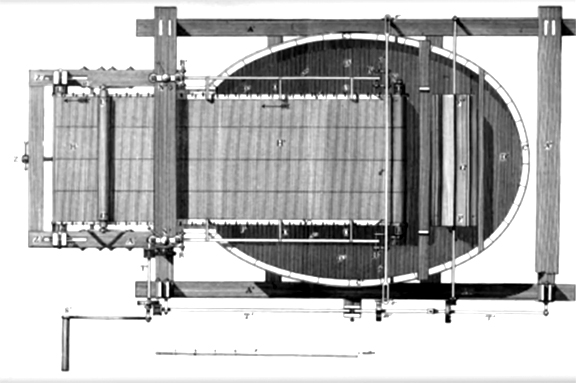
Robert’s technical innovation was the rotating cloth screen (wire) belt that received a continuous flow of fibers and delivered an unbroken sheet of wet paper to a pair of squeeze rollers. As the long strip of paper came off the machine, in Robert’s configuration it was hung by hand to dry on a series of bars or cables. This would later become a roll of paper.

Model of Robert’s original invention reconstructed from the drawings that accompanied his French patent application of 1798

Prior to the Robert’s invention, all paper was made by hand and consisted of dipping a framed mould with a porous surface into a vat of fibers suspended in water. Upon lifting the mould from the vat, a thin layer of fibers rested on top of the screen and was dried to form a sheet of paper. With this method, the mould could be used again only when the sheet had dried and been removed from it.

Aside from its important technical features, the key results of the papermaking machine were:

  • Productivity:
    The volume of paper that previously would have taken many hand papermakers and many hours could be produced by a single operator in far less time.
  • Paper Size:
    Sheet dimension was limited with handmade paper. It was not possible for a craftsman to adequately balance a large mould. With Robert’s machine, paper size was limited only by the width of the machine and the length was endless.

Nicholas-Louis Robert

Nicholas-Louis Robert was born in Paris in a small house on December 2, 1761. He had health problems as a child and was quite frail. Despite his condition, when he turned fifteen, the boy made an effort to join the French army because he was concerned that his aging parents could not afford to take care of him. The military did not allow him to join and Nicholas-Louis was returned to his parents’ home to continue his studies.

Four years later, following a period of severe mental anguish for having been a burden to the family, Nicholas-Louis again applied for military service. On April 23, 1780, he was admitted to the First Battalion of the Grenoble Artillery and was stationed in a garrison at Calais, a port city in Northern France across the English Channel from the clifftop town of Dover.

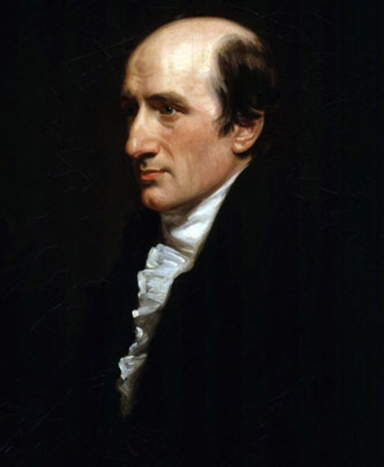
Portrait of Nicholas-Louis Robert from a watercolor painted by his sister

Robert’s military experience took a dramatic turn in 1781 when the young soldier was sent to war in the Caribbean during the American Revolution. The French Metz Artillery regiment sailed to Santo Domingo to fight an engagement against the British. Having won the battle, Nicholas-Louis returned home and shortly thereafter left the military at age 28 to seek an occupation in civilian life.

With a mechanical aptitude, Robert turned to the printing craft and landed a clerkship with the well-known printing, type founding and publishing company Didot in Paris. After working for several years in the office, Nicholas-Louis sought a new opportunity in related industries and came upon the paper mill operations of Francois Didot in Essones, a well-known papermaking center south of Paris.

The Didot papermaking operation was quite important as much of French paper currency was printed there. Nicholas-Louis initially obtained a position as mill personnel inspector. Having regular contact with the staff, Nicholas-Louis found that there many antagonisms among the hand paper making tradesmen and these problems frustrated him.

The invention

After working in the mill for months, it occurred to Robert that there was a more advanced method for making paper; that it might be possible to get around the constant quarrelling among the papermaking trades. While the discord among the employees of the mill may have been the impulse for Robert’s research—he was after all under the direction of the owner Didot—the fact is that his project led to a significant reduction in the cost and a more abundant supply of paper.

Robert’s initial attempts at a papermaking machine were failures and termed “feeble” by Didot. Nonetheless, Didot encouraged Nicholas-Louis to continue with his work. For a time, the young man gave up on his project and became involved in other areas of mill operations. But under the constant prodding of his boss, he returned to his research in mechanical papermaking.

Diagram of Robert’s original papermaking machine

Soon, with the help of others at the Didot establishment, Robert saw that the basic principles of his original concept were sound. His earlier work was revived and he proceeded with the construction of a device that was larger than the first machine. Finally, when trial sheets of paper had been effectively produced on the new machine, Didot encouraged Nicholas-Robert to file a patent for his invention.

On September 9, 1798, Robert and Didot traveled to Paris and presented a patent application to the French Minister of the Interior. In a letter that accompanied the application, Nicholas-Louis wrote, “It has been my dream to simplify the operation of making paper by forming it with infinite less expense, and, above all, in making sheets of an extraordinary length without the help of any worker, using only mechanical means. … The machine makes for economy of time and expense and extraordinary paper, being 12 to 15 meters (472 to 590 inches) in length, if one wishes.”

The patent was granted at a cost of 1,562 francs and dated January 18, 1799. Considering the fact that the maximum length of handmade paper was about 32 inches, Robert’s machine represented an enormous step forward. The French government recognized the significance of his invention and dispatched an engineer to the Didot mill to assist in the construction of an improved model.

The Bureau of Arts and Trades wrote of it, “this machine forms paper of great width and indefinite length. The machine makes paper of perfect quality in thickness and gives advantages that cannot be derived from ordinary methods of forming paper by hand, where each sheet is limited in size in comparison with those made on this machine.”

Further developments

Mention must be made of the fact that Robert’s papermaking machine was invented during the tumultuous years of the French Revolution (1789-1799). It is no accident that this technical breakthrough coincided with the spread of the ideas of “liberty, equality and fraternity” that depended greatly upon the printed word.

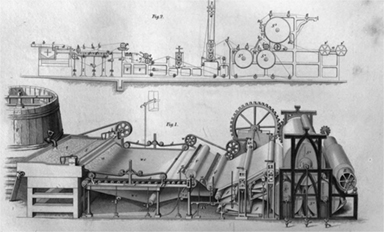
Mid-19th century drawing of a Fourdrinier papermaking machine

However, as the historian Dard Hunter described, the “disturbed conditions” of the period were such that very little progress was made by Didot and Robert beyond the initial invention. As Robert became preoccupied with the financial benefits of his accomplishment, he sold his patent to Didot for 25,000 francs, a modest sum considering the implications of the invention.

Didot immediately sought to move further development of the project out of France and into the more stable environment of England. Didot’s brother in law, John Gamble, was an English paper-mill owner and the two corresponded to have a much larger machine constructed. It was then that the London stationers Henry and Sealy Fourdrinier became involved in building papermaking machines.

A monument to the memory of Nicholas-Louis Robert was erected outside the church at Vernouillet, France in 1912.
A monument to the memory of Nicholas-Louis Robert in Vernouillet, France

Following several modifications to the wire, the Fourdrinier brothers invested 60,000 pounds in the construction of a large machine that could make paper on continuous rolls. This attempt was eventually proven successful and they were granted an English patent for it in 1806. However, the project was not commercially successful and it bankrupted the Fourdriniers. Nevertheless, to this day—although its basic design was invented by Nicholas-Louis Robert—the papermaking machine bears the Fourdrinier name.

While the Fourdrinier machine underwent rapid development in the nineteenth century, the ingenious Nicholas Louis was living quietly in France. When the first commercial papermaking machine was installed there in France in 1811, Robert was approaching fifty years of age and on his way out of the papermaking business. In 1812, he opened a small primary school in Vernouillet, northwest of Paris where he worked as a poorly paid teacher. Never realizing the financial benefit from his invention, Nicholas-Louis died broken and destitute on August 8, 1828. A monument to Robert’s memory was erected in 1912 outside the church at Vernouillet.

Charles Stanhope (1753–1816): Iron printing press

Charles Stanhope, 3rd Earl Stanhope: August 3, 1753–December 15, 1816

Historians generally agree that the first industrial revolution took place between 1760 and 1840. Among the features of the great economic and social transformation were: (1) the progression from predominantly rural to urban society, (2) the replacement of handicraft with machine production, (3) the introduction of iron and steel in place of wood and (4) the substitution of muscle power with new energy sources like coal-fired steam power.

A unique set of circumstances—a stable commercial environment, advances in iron making and an abundance of skilled mechanics—made Britain the birthplace of the industrial revolution. Beginning with new techniques in textile production, industrial innovations spread rapidly to other manufacturing sectors and then across national borders in Europe and around the globe. All aspects of life would be touched by industrialization: population, politics, trade and commerce, science and culture, education, transportation and communication.

It was during this era of remarkable change that the English aristocrat Charles Stanhope invented—sometime around 1800—the first printing press constructed wholly of iron. Prior to Stanhope’s achievement, the design and build of printing machines had not changed in the three and a half centuries since Gutenberg.

Previously, small adjustments had been made to the wooden press. These related to structural stability, increased sheet size and automation to reduce human muscle power. But, even with the inclusion of some iron parts, the basic design of printing presses remained as they were in 1450.

With the Stanhope hand press, both the design of the impression mechanism as well as the material from which the machine was built were transformed; Stanhope’s contribution was a crucial preliminary step in the industrial development of print communications.

Young Lord Stanhope

Charles Stanhope, third Earl Stanhope, was born on August 3, 1753, the younger of two sons of Philip Stanhope, second Earl Stanhope, and his wife Lady Grisel (Hamilton) Stanhope. As a member of the English peerage system—with titles like Duke, Earl and Baron—Charles is often referred to as Lord Stanhope or Earl Stanhope. Born into the English aristocracy, he was afforded a privileged upbringing and, at the age of nine, was enrolled by his parents at prestigious Eton boarding school.

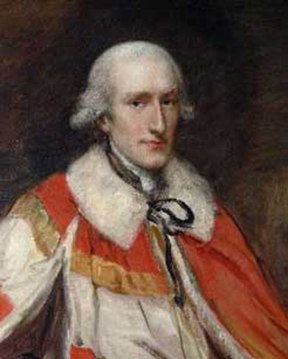
Portrait of the young Lord Stanhope

In 1763, following the death at age seventeen of his brother Philip from tuberculosis, Charles became family heir. His parents decided that Charles’ “health should not be exposed to the English climate, or the care of his mind to the capricious attention of the English schoolmaster” and the family relocated to Geneva, Switzerland. At age eleven, he was enrolled at the school in Geneva founded on the principles of John Calvin and there studied philosophy, science and math.

As a teenager, Charles was known to be a devoted cricket player, an exceptional equestrian and a well mannered young man who was admired by his peers. At age seventeen, Charles won a prize in a Swedish competition for the best essay, written in French, on the construction of a pendulum.

While Charles was accomplished academically in math and science, he was also known to have talents in drawing and painting. As a nobleman, Charles had obligations as a militia commander and he developed a passion for archery and musket shooting. At eighteen, he won a competition and was crowned the best shot and so-called “King of the Arquebusiers.”

By the time Charles completed his education in Switzerland, his parents decided to move the family back to England. According to a published account, as the family and its entourage left Geneva in 1774, “The young gentleman was obliged to come out again and again to his old friends and companions who pressed round the coach to bid him farewell, and expressed their sorrow for his departure and their wishes for his prosperity.”

Stanhope the inventor

During their five-month journey home to England from Switzerland, the family made a stop in Paris. Charles was welcomed and “esteemed by most of the learned educated men of the capital” over the prize he had won for his paper on pendulum design. He was developing an international reputation as an innovator.

Upon his return to England, Charles used his skills in mechanics to win election to London’s Royal Society, a world renowned club founded by King Charles in the 17th century to promote the benefits and accomplishments of science. At the age of 20, Charles embarked on a series of self-funded experiments and inventions and his interest in such matters continued throughout his life.

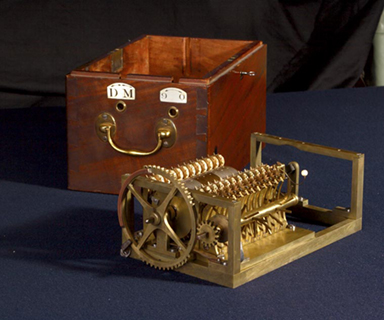
The first of two calculating machines invented by Charles Stanhope. His "arithmetical machines" have been recognized as precursors to the computer.
The first of two calculating machines invented by Charles Stanhope. His “arithmetical machines” have been recognized as precursors to the computer.

The most important of these were:

  • A method for preventing counterfeiting of gold currency (1775)
  • A system for fireproofing houses by starving a fire of air (1778)
  • Several mechanical “arithmetical machines” that could add, subtract, multiply and divide. These inventions were early forerunners of computers (1777 and 1780).
  • Experiments in steamboat navigation and ship construction which included the invention of the split pin, later known as the Cottier pin (1789).
  • A popular single lens microscope that became known as the Stanhope that was used in medical practice and for examination of transparent materials such as crystals and fluids (1806).
  • A monochord or a single string device, used for tuning musical instruments
  • Improvements in canal locks and inland navigation (1806)

Charles Stanhope became so well accomplished in international scientific circles that he was befriended by Benjamin Franklin. The two spent time together during Franklin’s visits to England prior to the American Revolution. They shared a mutual interest in electricity and, in 1779, Charles Stanhope published a volume entitled “Principles of Electricity” that corroborated through experimental evidence Franklin’s ideas about lighting rods.

The Stanhope press

By 1800, as has often happened in graphic arts history, the environment became ripe for a major step forward in printing methods. Charles Stanhope—who had the desire, know-how and resources to make it happen—stepped forward with a significant breakthrough.

Due to his many democratic political pursuits and scientific publishing activities—some of which concerned freedom of the press—Charles was very familiar with printing technology. Among his concerns were the cost of production, the accuracy of the content, the beauty of the print quality and the importance of books for the expansion of knowledge in society as a whole.

A drawing of the original Stanhope press design. None of these are known to exist today.

All letterpress technologies require a means to transfer ink from the surface of the metal type forms to the paper. This process requires the application of pressure, i.e. an impression, that mechanically drives the ink into the paper fibers. The pressure also creates a slight indentation in the shape of the letter forms in the surface of the paper.

Prior to 1800, press designs were based on the screw press that had been used for pressing grapes (wine) and olives (oil), cloth and paper going back to Roman times. The screw mechanism is a complex arrangement of the screw, nut, spindle and fixed bar that drives the platen—the flat plate that presses the paper against the type form—downward. There are many historical drawings and engravings that illustrate how physical strength is required to pull the bar and make a printing impression with the Gutenberg era press design.

Stanhope’s innovation, according to historian James Moran, was that “he retained the conventional screw but separated it from the spindle and bar, inserting a system of compound levers between them. The effect of several levers acting upon another is to multiply considerably the power applied.” The compound lever system was so successful that it became referred to as “Stanhope principles” and was incorporated into subsequent generations of hand press design in the nineteenth century (Columbian, Albion and Washington).

The second and more common design of the Stanhope hand press. Note the separation of the lever system from the screw and platen mechanism.

Other important Stanhope press changes were:

  • All iron construction including a massive frame formed in one piece
  • A double size platen
  • A regulator that controlled the intensity of the impression

The Stanhope press would undergo several important modifications, the most important of which was strengthening the frame in 1806 to prevent the iron from cracking under the stress of repeated impressions. The second design—with its characteristic rounded cheeks—is what today is commonly associated with the Stanhope press.

The Times of London immediately adopted the Stanhope press and it became successful across Europe and America in the first few decades of the 1800s. Meanwhile, further developments with all-iron hand presses would continue up to the end of the nineteenth century. However, driven by the rapid advancement of the industrial revolution, the next stage in the evolution of press design—the introduction of cylinders and steam power—would rapidly eclipse Stanhope’s accomplishments.

Stanhope the statesmen

Charles 3rd Earl Stanhope was an unusual man. In addition to his many inventions and scientific studies, he devoted himself to radical political causes that often controverted his aristocratic background. He often referred to himself as “Citizen” Stanhope. The origins of his democratic leanings were to be found in the influence of his father—who was a member of Parliament and an outspoken critic of the crown and proponent of Habeas Corpus—his education in the radical environment of Geneva and the Revolutions in America (1776) and France (1789).

Known publicly as Viscount Mahon at the time, Charles was elected to Parliament in 1780 and adopted positions that conflicted with the political elite. His demands for electoral and finance reform and religious tolerance of dissenters and Catholics did not sit well with the establishment. Charles was also known to have campaigned against slavery and was party to the abolition bill known as the Slave Trade Act of 1807.

Stanhope estate at Chevening, Kent. Charles died here on December 15, 1816.

Charles Stanhope was an opponent of the war against the thirteen colonies and a supporter of John Wilkes, a British sympathizer of the American rebels. Despite his efforts on behalf of the oppressed and downtrodden in society, Charles Stanhope’s personal eccentricities caused him, especially later in life, to be isolated from his family.

Always thinking of others before himself, he allowed his manse at Chevening, Kent to fall into disrepair and it is speculated that he had starved himself to death on a diet of soup and barley water. Charles Stanhope was interred “as a very poor man” in the family vault at Chevening Church one week after his death on December 15, 1816.