QR Codes & the future of offline media

By now you are familiar with QR Codes; those two dimensional bar codes scanned by mobile devices. They are popping up everywhere: billboards, catalogs, magazine ads, real estate signs, t-shirts, product packaging and business cards. One of the more creative uses of a QR Code is on the movie poster for Iron Man 2, where the code resolves to a mobile site with photos, trailers and information about the film.

You may also know that the US Postal Service is offering a 3% discount on mail that contains a QR Code through the end of August. You can find the USPS promotion here.

Quick Response (QR) Codes were first developed in 1994 by the Japanese firm Denso Wave to track parts in the vehicle manufacturing process at Toyota. The technology was unique because the codes could be read rapidly regardless of the orientation of the scanner. Also, while other two dimensional bar codes require a license for use, the QR Code is free and code generators can be easily found on the Web.

Japan is currently the largest user and QR Codes are the de facto standard for Japanese mobile phones. Generally speaking, the codes are used more widely in countries where mobile culture is highly developed. It is a peculiar fact of life that technological development is not repeated through the same stages in every country. Therefore, it should come as no surprise that some countries never experienced landline telephone technology and have jumped straight into our mobile world.

In the US, QR Codes are being used in growing numbers for marketing and communications campaigns.  A recent study of QR code adoption by 3GVision.com showed:

  • Worldwide QR Code use more than quadrupled between 2009 and 2010.
  • In Q4 2010, the US had the highest number of QR Code scans of any country  (except Japan, where data was not available for the study).
  • Canada, Hong Kong and Germany had exponential growth of QR Code scans.

As Philip Warbasse of Print2D.com—a company specializing in QR Code and mobile campaigns—explained, “Though we have a way to go before 2D codes completely go mainstream in the US, we are seeing a steady increase in their use in almost every industry. Thankfully, we are also beginning to see companies that have created QR Code campaigns in the past come to us for advice on how to better use them in the future. In reality, it’s not the code but, rather, the device that we focus on when we create mobile strategies at Print 2D.”

QR and 2D bar code campaigns are really only as good as the mobile content behind them, i.e. the success of a campaign is not only reflected in the novelty with which the QR Code itself is rendered; it is as much about the mobile content on the back end. The most successful QR Code/mobile campaigns follow these simple rules:

  • Mobilize the landing page
  • Use a short URL
  • Make the mobile content valuable

The expansion of QR Code use is part of the mobile revolution and the transformation of the way people all over the world consume information and media. Anyone doubting that mobile technologies will impact their business should consider the following (data from ITU):

  • There are more than 5.3 billion mobile subscriptions in the world today (77% of the world’s population)
  • 90% of the world now lives in a place with access to a mobile network

Meanwhile, explosion of mobile access worldwide—especially the adoption of smartphones—is being taken note of by marketers and advertisers. According to Gartner, the world’s leading information technology research company, worldwide mobile advertising spending will reach $3.3 billion this year and grow by a factor of more than six times to $20.6 billion by 2015. As with other forms of online advertising, the funds for these initiatives are being taken from budgets for traditional channels such as print and broadcast media.

Fortunately, the QR Code revolution is enhancing the value of print because it provides a link between offline media and that of the online, wireless world of mobile devices and instant information. The QR Code is one means print media has to maintain its relevance as a critical component of any integrated marketing and communications campaign.

Marshall McLuhan: 1911 – 1980

Marshall McLuhan, the Canadian educator and communications scholar, was born 100 years ago on July 21, 1911. McLuhan became a celebrity in the 1960s for his controversial media studies and peculiar perspective on television and its societal impact.

While you are likely familiar with McLuhan’s aphorism “the medium is the message,” you might not know that he was an expert on printing. Much of his writing deals with print media technology, its history and significance as a cultural form, especially the book. One of his most important titles, The Gutenberg Galaxy: The Making of Typographic Man (1962), examines prints’ contribution to the transformation of mankind’s self-image and consciousness during the Renaissance.

McLuhan was among the first to foresee the coming of electronic media. He had a prophetic view of the information age, one that anticipated the World Wide Web and digital publishing. His relevance to modern media studies is shown by the conferences being held worldwide on the centenary of his birth: http://marshallmcluhan.com/.

Herbert Marshall McLuhan was born in Edmonton, Alberta. His family moved to Winnipeg, Manitoba after World War I. In 1928, Marshall entered the University of Manitoba where earned an MA in English. He went on to the University of Cambridge where he earned a Ph.D. in 1943. Marshall married Corrine Lewis in 1939 and they had six children.

McLuhan and his family moved to Toronto in 1946 where he joined the faculty of St. Michael’s College of the University of Toronto. In the 1950s he began the Communication and Culture seminars, gaining a reputation as a media expert and, in 1963, the university created with him the Centre for Culture and Technology.

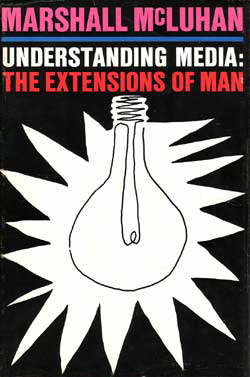
McLuhan became internationally known with the publication of Understanding Media: The Extensions of Man (1964). He advanced the profound idea that “the ‘message’ of any medium or technology is the change of scale or pace or pattern that it introduces into human affairs.” He examined many forms of media: the written word, the printed word, the photograph, the telegraph, the typewriter, the telephone, the phonograph, movies, radio and television and showed how the content of one media is always another media form.

Marshall McLuhan suffered a stroke in 1979 that affected his speech. The University of Toronto attempted to close his research center shortly thereafter but was prevented by protests, most notably by Woody Allen. McLuhan never recovered and died on December 31, 1980.

Marshall McLuhan on the Today Show in September 1976.

Since McLuhan’s theoretical concepts are difficult to explain, I will let him do it himself. Below are quotations taken from TV interviews that can be viewed online.

On “hot” and “cold” media, 1964

“It has to do with the slang phrase ‘the hot and the cool’ … ‘Cool’ in the slang form has come to mean involved, deeply participative, deeply engaged; everything that we had formerly meant by heated … Though the idea that ‘cool’ has reversed its meaning I think has some bearing on the fact that our culture has shifted its stress on the demand that we become more committed, more involved.” http://marshallmcluhanspeaks.com/?video=SAY_001

On the future of publishing, 1966

“Instead of going out and buying a book of which there have been 5,000 copies printed, you will go to the telephone and describe your interests, your needs, your problems … They will at once Xerox—with the help of computers from the libraries of the world—all the latest material just for you, personally, not as something to be put out on the bookshelf. They send you the package as a direct personal service.” http://marshallmcluhanspeaks.com/?video=PRO_004

On instantaneous, simultaneous information, 1976

“At the speed of light there is no sequence, everything happens at one instant … We live in a world where everything is supposed to be lineal, one thing at a time, connected and logical, goal oriented. We are now living in a world which pushes the right hemisphere (of the brain) way up … is making the old left hemisphere world—which is our educational establishment, our political establishment—look very foolish.” http://marshallmcluhanspeaks.com/?video=TEA_007

Admittedly, McLuhan’s academic style and references to historical and cultural artifacts make him difficult to read. However, McLuhan has made a unique contribution to an understanding of media and how they impact the cognitive functions and social organization of man. We should embrace and study Marshall McLuhan as the first philosopher of our multimedia world.

Debating the tipping point: When will digital printing transcend offset?

When I attended GraphExpo2010 in Chicago last fall, I noticed something had changed. For the first time, the largest exhibit spaces—in previous years occupied by offset lithographic presses—had been taken over by the latest digital printing systems.

This seemed to happen suddenly and I wondered: have we reached the tipping point already?

Since the digital printing revolution began in the early 1990s, much has been written and said about its impact on our industry and markets. Books and research studies have been published and conferences and surveys have been held, all to illustrate the transformative effect of the new technology. The opportunities and threats of the disruptive innovation brought by digital printing—personalized, variable, on-demand, data-driven and zero makeready—have been thoroughly discussed.

More recently, the commentary has turned to a debate over the transition point at which digital will displace offset. I have collected examples of this dialogue and focused on those who have been so bold as to prognosticate on the subject.

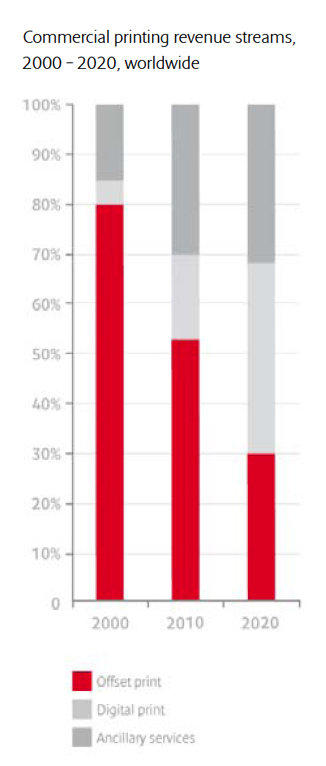
• In June 2008, Canon Europe published a report called “Digital Printing Directions.” Based on a survey of 619 industry representatives worldwide, the report says: “The global printing industry is at a crossroads. … Digital printing in 2008 is at the point where offset was in 1968.” Next to a graph the report says, “Through 2020, offset will remain a viable process, even as digital printing grows, but after 2020, new digital technology may affect offset the way that offset affected letterpress.”

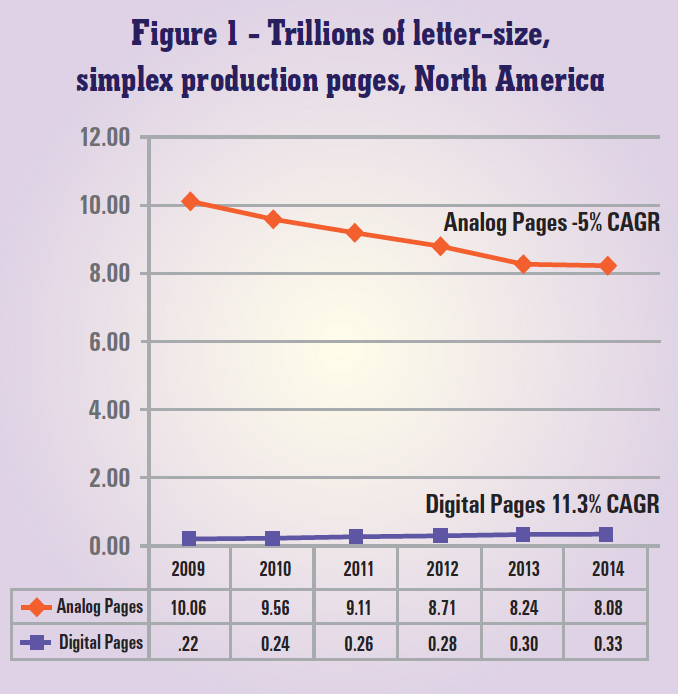
• In September 2010, NPES (the association for printing, publishing and converting technologies) published details of a study called “Megatrends in Digital Printing Applications.” The study surveyed 900 industry representatives and covered 12 applications: books, catalogs, direct mail, labels, magazines, manuals, marketing collateral, newspapers, packaging and specialty printing. The findings showed that few if any of the 12 applications will tip by 2020 but “the tipping point for most of the applications is decades away, if at all.” The NPES article contains a graph (Chart 2) showing how digital printing, while experiencing 11.3% growth from 2010 to 2014, remains a tiny fraction of total print volume.

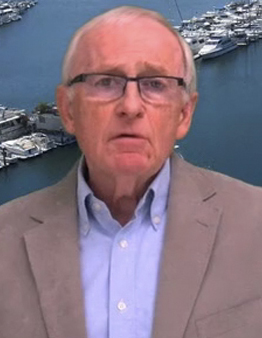
• On November 10, 2010, whattheythink.com’s Frank Romano made the following remark in a video entitled “Frank takes a look at when the tipping point for digital may be”: “Offset lithography dragged along for a hundred years and then all of a sudden it found a marketplace and within a decade letterpress was gone.  Now according to the (NPES) research, they say the tipping point for digital printing is decades away … I disagree with that … Now, I don’t think it’s going to take a decade for those two worlds to come very close together.”

Frank Romano
Andy Tribute

• On January 18, 2011, whattheythink.com’s Andy Tribute published a commentary entitled, “When Will Digital Printing Take Over from Offset Printing?” Tribute wrote, “Overall I find that many projections I see for digital printing growth are pretty wild … it will take a long time before the ‘tipping point’ is reached where digital becomes larger than analog printing.”

These are differing predictions on the tempo and scope of the replacement of offset by digital printing. Some say in a decade (or less) and others say it will take longer (two decades or more). Some say total eclipse and others say partial and only in some categories. However, they all agree that the transition is coming.

As we reflect upon the present and the letterpress-to-offset and phototypesetting-to-desktop experiences of our past, keep in mind these key attributes of disruptive innovation: 1.) likelihood of dominant players to fail; 2.) requirement of a new value proposition; 3.) short-term increase in cost per unit, 4.) short-term decrease in quality, and; 5.) long-term tendency toward complete replacement.

For printing companies, these are strategic problems. The relative weight and pace of offset-to-digital within the print markets is not uniform. Therefore, digital adoption rates must be calibrated to meet increasing customer demand while maintaining competitive in offset long enough to exhaust its potential. In other words, companies must plan their own offset-to-digital tipping point to avoid having it foisted upon them the way that offset printing and desktop publishing were adopted.