The mobile juggernaut

Mark Zuckerberg
Mark Zuckerberg

On August 27, Mark Zuckerberg posted the following message on his personal Facebook account, “We just passed an important milestone. For the first time ever, one billion people used Facebook in a single day. On Monday, 1 in 7 people on Earth used Facebook to connect with their friends and family.”

The Facebook one-billion-users-in-a-single-day accomplishment on August 24, 2015 is remarkable for the social network that was started by Zuckerberg and a group of college dormitory friends in 2004. With Facebook becoming available for public use less than ten years ago, the milestone illustrates the speed and extent to which social media has penetrated the daily lives of people all over the world.

While Facebook is very popular in the US and Canada, 83.1% of the 1 billion daily active users (DAUs) come from other parts of the world. Despite being barred in China—where there are 600 million internet users—Facebook has hundreds of millions of active users in India, Brazil, Indonesia, Mexico, UK, Turkey, Philippines, France and Germany.

Facebook's "Mobile Only" active users.
Facebook’s “Mobile Only” active users.

A major driver behind the global popularity and growth speed of Facebook is the mobile technology revolution. According to published data, Facebook reached an average of 844 million mobile active users during the month of June 2015 and industry experts are expecting this number to hit one billion in the very near future. Clearly, without smartphones, tablets and broadband wireless Internet access, Facebook could not have achieved the DAU milestone since many of the one billion people are either “mobile first” or “mobile only” users.

From mobile devices to wearables

When I last wrote about mobile technologies two-and-half years ago, the rapid rise of smartphones and tablets and the end of the PC era of computing was a dominant topic of discussion. Concerns were high that significant resources were being shifted toward mobile devices and advertising and away from older technologies and media platforms. The move from PCs and web browsers toward apps on smartphones and tablets was presenting even companies like Facebook and Google with a “mobility challenge.”

Today, while mobile device expansion has slowed and the dynamics within the mobile markets are becoming more complex, the overall trend of PC displacement continues. According to IDC, worldwide tablet market growth is falling, smartphone market growth is slowing and the PC market is shrinking. On the whole, however, smartphone sales represent more than 70% of total personal computing device shipments and, according to an IDC forecast, this will reach nearly 78% in 2019.

IDC's Worldwide Device Market 5 Year Forecast
IDC’s Worldwide Device Market 5 Year Forecast

According to IDC’s Tom Mainelli, “For more people in more places, the smartphone is the clear choice in terms of owning one connected device. Even as we expect slowing smartphone growth later in the forecast, it’s hard to overlook the dominant position smartphones play in the greater device ecosystem.”

While economic troubles in China and other market dynamics have led some analysts to the conclude that the smartphone boom has peaked, it is clear that consumers all over the world prefer the mobility, performance and accessibility of their smaller devices.

Ercisson's June 2015 Mobility Report projects 6.1 billion smartphone users by 2020.
Ercisson’s June 2015 Mobility Report projects 6.1 billion smartphone users by 2020.

According to the Ericsson Mobility Report, there will be 6.1 billion smartphone users by 2020. That is 70% of the world’s population.

Meanwhile, other technology experts are suggesting that wearables—smartwatches, fitness devices, smartclothing and the like—are expanding the mobile computing spectrum and making it more complex. Since many wearable electronic products integrate easily with smartphones, it is expected this new form will push mobile platforms into new areas of performance and power.

Despite the reserved consumer response to the Apple Watch and the failure of Google Glass, GfK predicts that 72 million wearables will be sold in 2015. Other industry analysts are also expecting wearables to become untethered from smartphones and usher in the dawn of “personalized” computing.

Five mobile trends to watch

With high expectations that mobile tech will continue to play a dominant role in the media and communications landscape, these are some major trends to keep an eye on:

Wireless Broadband: Long Term Evolution (LTE) connectivity reached 50% of the worldwide smartphone market by the end of 2014 and projections show this will likely be at 60% by the end of this year. A new generation of mobile data technology has appeared every ten years since 1G was introduced in 1981. The fourth generation (4G) LTE systems were first introduced in 2012. 5G development has been underway for several years now and it promises speeds of several tens of megabits per user with an expected commercial introduction sometime in the early 2020s.

Apple's A8 mobile processor is 50 times faster than the original iPhone processor.
Apple’s A8 mobile processor is 50 times faster than the original iPhone processor.

Mobile Application Processors: Mobile system-on-a-chip (SoC) development is one of the most intensely competitive sectors of computer chip technology today. Companies like Apple, Qualcomm and Samsung are all pushing the capabilities and speeds of their SoCs to get the maximum performance with the least energy consumption. Apple’s SoCs have set the benchmark in the industry for performance and the iPhone6 contains an A8 processor which is 40% more powerful than the previous A7 chip; and it is 50 times faster than the processor in the original iPhone. A new processor A9 will likely be be announced with the next generation iPhone in September 2015 and it is expected to bring a 29% performance boost over the A8.

Pressure Sensitive Screens: Called “force touch” by Apple, this new mobile display capability allows users to apply varying degrees of pressure to trigger specific functions on a device. Just like “touch” functionality—swiping, pinching, etc.—pressure sensitive interaction with a mobile device provides a new dimension to human-computer-interface. This feature was originally launched by Apple with the release of the Apple Watch which has a limited screen dimension on which to perform touch functions.

Customized Experiences: With mobile engagement platforms, smartphone users can receive highly targeted promotions and offers based upon their location within a retail establishment. Also known as proximity marketing, the technology uses mobile beacons with Bluetooth communications to send marketing text messages and other notifications to a mobile device that has been configured to receive them.

Mobile Apps: The mobile revolution has been a disruptive force for the traditional desktop software industry. Microsoft is now offering its Office Suite of applications to both iOS and Android users free of charge. In August, Adobe announced that it would be releasing a mobile and full-featured version of its iconic Photoshop software in October as a free download and as part of its Creative Cloud subscription.

With mobile devices, operating systems, applications and connectivity making huge strides and expanding across the globe by the billions it is obvious that every organization and business should be navigating its way behind this technology juggernaut. This begins with an internal review of your mobile practices:

  • Do you have a mobile communications and/or operations strategy?
  • Is your website optimized for a mobile viewing experience?
  • Are you encouraging the use of smartphones and tablets and building a mobile culture within your organization?
  • Are you using text messaging for any aspect of your daily work?
  • Are you using social media to communicate with your members, staff, prospects or clients?

If the answer to any of these questions is no, then it is time to act.

Efraim “Efi” Arazi (1937–2013): Color electronic prepress systems

Efraim “Efi” Arazi: April 14, 1937 – April 14, 2013

One of the most important achievements of personal computers and mobile wireless technologies is that they have made it possible for the general public to do things that could previously be done only by professionals.

Take video for example: according to YouTube statistics, 300 hours of digital video is uploaded every minute of every day by people all over the world. This remarkable volume of video is being generated because just about anyone can record, edit and upload a high-definition movie from their smartphone. According to a recent Pew Research study, about one third of online adults (ages 18-50) had posted digital video to a website by 2013.

It is easy to take for granted the video production functions that are performed routinely today on inexpensive and easy to use mobile devices. Less than ten years ago, the ability to capture and edit HD video would have cost tens of thousands of dollars in digital camera and production equipment and required extensive training to use it.

The same can be said for the ability to quickly create a document in a word processing program and insert high resolution graphics anywhere on the page, cropping and scaling as needed. Applying filters and adjusting image quality (contrast, brightness, sharpness) is also second nature as these functions are today available on every mobile device.

CEPS

Four decades ago, before the personal computer existed, electronic image editing, scaling and cropping could only be performed on very expensive prepress systems that cost more than $1 million. That was during the era of what was known as color electronic prepress systems (CEPS) that were built on state-of-the-art minicomputers with reel-to-reel magnetic tape for data storage.

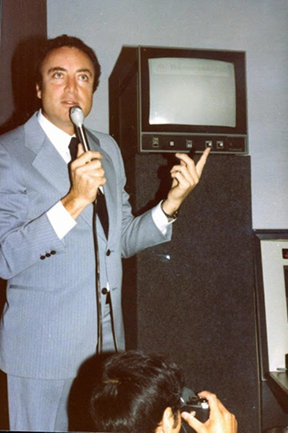
Arazi making a presentation of the Scitex  CEPS equipment in 1979
Arazi making a presentation of the Scitex CEPS equipment in 1979

During the 1960s and 1970s, as commercial offset lithography and film-based color reproduction were overtaking letterpress and single color work, high-end digital electronic production systems were acquired by the big printing companies and major publishers that could afford the investment.

By the 1960s—after analog electronic systems had been widely adopted in pressrooms and prepress and typesetting departments across both Europe and America—a race was on to develop a fully computerized page composing system. Companies like Hell, Crosfield, Dai Nippon Screen and other companies that had been part of the post-war electronics revolution jumped into the market to try and solve the problem of merging text and color photographs together electronically on a computer display.

However, it was a newcomer to the graphic arts industry from Israel called Scitex, founded by Efraim “Efi” Arazi in 1968, that made the highly anticipated breakthrough. Foreshadowing the impact of PC-based desktop publishing on graphic communications in the late 1980s, Scitex introduced digital files and computerization to the prepress production process and forever changed the printing industry.

Scitex

Efi Arazi (born in Jerusalem on April 14, 1937) entered the Israeli military when he was 16 and without graduating from high school. He made a name for himself as an exceptional electronics specialist while working on radar systems in the Israeli air force. Following his military service, with the assistance of the US embassy Arazi was admitted to the Massachusetts Institute of Technology in 1958 as an “extraordinary case” despite his lack of the normally requisite secondary school diploma.

While attending MIT, Arazi also worked at Harvard University’s observatory and digital photography lab. Under the direction of Harvard Professor Mario Grossi, Arazi petitioned NASA and was awarded funds to develop a camera system for scanning the surface of the moon on the unmanned lunar probes in 1966 and 1967. It has also been reported that Arazi’s invention was part of the equipment on the Apollo 11 mission that captured and transmitted video of Neil Armstrong’s first footsteps on the Moon on July 20, 1969.

After earning a bachelor degree in engineering at MIT, Arazi worked in the US for a short time for Itek corporation, a US defense contractor that specialized in spy satellite imagery. In 1967 he returned to Israel and one year later—along with several others who had been educated in the US—founded Scientific Technologies (later shortened to Scitex) with the aim of developing electro-optical devices for commercial purposes.

The Scitex Response 80 system and an example of a stitching designs from it
The Scitex Response 80 system and an example of a stitching design from it

Scitex’s first products were developed for the textile industry. The company sold nearly one hundred electronic systems that automated the process of creating knitting patterns. Since many colors were used in complex fabric designs such as the popular Jacquard pattern, Arazi and his Scitex team developed a scanner (Chroma-Scan) and image manipulation workstation (Response 80) that programmed electronic double-knit stitching looms.

These optical systems replaced manual and time consuming stitch-by-stitch drawings and punch cards that had been widely used in the textile industry up to that time. Scitex also later devised a system for imaging film for printing on textiles that included overprinting, trapping and repeating patterns.

Response 300

Recognizing the potential for new technologies in the growing international printing and publishing industries, Scitex began development in 1975 of a computerized color prepress system. Arazi stunned the graphic arts industry in the Fall of 1979 when he demonstrated the Response 300 system for the first time at the GEC expo in Milan, Italy.

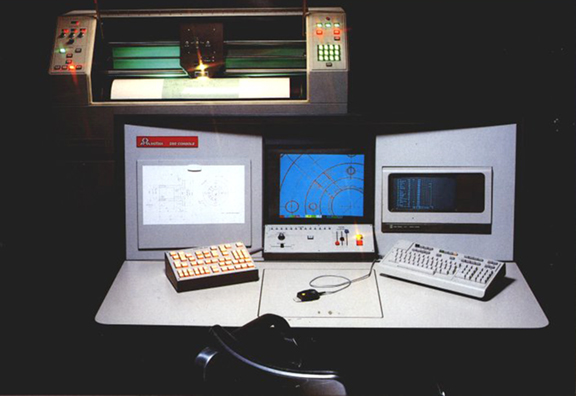
Response 300 included an integrated color drum scanner, image editing workstation and laser film plotter. Directly challenging the domination of high tech graphic arts equipment by Hell (Germany) and Crosfield (UK), Scitex was the first company in the world to combine color image retouching and page makeup onto a single console.

An early model Scitex Response workstation and console

Prior to the Response 300, the electronic color scanning process was based on an analog transfer of color separation information directly from a drum scanner to the film output device. The innovation of Arazi and Scitex was to place a minicomputer (at that time an HP1000) between the scanner and plotter such that the color separations were captured and stored in digital form. The proprietary image files could then be color corrected, retouched, scaled and cropped on screen prior to final output as film separations.

In describing the significance of the accomplishment, industry historian Andy Tribute later explained, “It allowed you to do in real-time on a terminal the sort of things we do in Photoshop now. … I remember watching Efi do a demo where he had a picture of a person with a Rolex watch on and he changed the date in real time on the Rolex. Today that may seem nothing but back then it blew my mind”

Within one year, Scitex had sold $100 million of the Response systems to printers and publishers. Through the mid-1980s, Arazi led Scitex as it developed a suite of products (Raystar, SmartScanner, Whipser, Prisma and Prismax Superstation to name a few) that brought the latest in minicomputer technologies to high-end prepress workflows. Scitex customers gladly paid the $1 million price tag for the flexibility and time savings that Scitex provided.

DTP & EFI

The first European installation of the Response 200 system for the textile industry in 1975

Scitex remained an innovator throughout the 1980s and 1990s as proprietary technologies and CEPS gave way to desktop publishing, industry standard file formats and PostScript workflows. Scitex was among the first prepress technology companies to embrace the introduction of Macintosh computers into graphic arts production.

In 1988, Scitex partnered with Quark technologies—developer of the most sophisticated desktop publishing software at the time—and made it possible for QuarkXPress users to build compound documents with high resolution full color images to be output for both commercial and publication printing.

In 1985, Arazi pushed the industry forward with the development of Handshake, a Scitex product that allowed a wide variety of systems including those of competitors to send and receive data from the Response line of products. Later Scitex was an advocate of Digital Data Exchange Standards along with Hell, Crosfield, Eikonix and others to smooth that transfer of data between all systems in the industry.

In June 1988, Arazi stepped down as President and CEO of Scitex. Six months later, when Mirror Group’s Robert Maxwell acquired a controlling stake in Scitex, Efi Arazi also resigned as chairman of the board. While the company had reached the height of its success with revenues approaching $1 billion and 4,000 employees, Arazi knew that personal computers were transforming the industry and it was time to move on to other business ventures.

After Arazi’s departure, Scitex continued to develop prepress workflow systems, laser imaging equipment, desktop scanners, digital color and soft proofing devices. The company participated in the transition from film-based workflows to the direct-to-plate revolution of the mid-1990s.

Along with all of its competitors, Scitex began to struggle financially and ended up selling its graphic arts group to Vancouver-based competitor Creo Products in 2000. The division of the company that went into digital printing called Scitex Vision was acquired along with the Scitex name by HP in 2005. The remainder of the business was renamed Scailex at that time.

In 1988 Efi Arazi founded Electronics for Imaging (EFI) at the age of 51. The new venture was no less successful then Scitex as EFI raster image processors were integrated in many high quality color laser and toner based printing devices. The EFI Fiery technology quickly became a standard in the graphic arts industry by the 1990s for low cost, high quality color proofs. The company—which bears the first name of its founder as an acronym—later expanded into ink jet printing devices, printing industry productivity software and print server and workflow software tools. Today EFI is one of the most important and successful technology companies in the rapidly changing printing industry. Efraim Arazi died on April 14, 2013 at age 76.

AI and the future of information

Amazon Echo intelligent home assistant

Last November, Amazon revealed its intelligent home assistant called Echo. The black cylinder-shaped device is always on and ready for your voice commands. It can play music, read audio books and it is connected to Alexa, Amazon’s cloud-based information service. Alexa can answer any number of questions regarding the weather, news, sports scores, traffic reports and your schedule in a human-like voice.

Echo has an array of seven microphones and it can hear—and also learn—your voice, speech pattern and vocabulary even from across the room. With additional plugins, Echo can control your automated home devices like lights, thermostat, kitchen appliances, security system and more with just the sound of your voice. This is certainly a major leap from “Clap on, Clap off” (watch “The Clapper” video from the mid-1980s here: https://www.youtube.com/watch?v=Ny8-G8EoWOw).

As many critics have pointed out, the Echo is Amazon’s response to Siri, Apple’s voice-activate intelligent personal assistant and knowledge navigator. Siri was launched as an integrated feature of the iPhone 4S in October 2011 and the iPad released in May 2012. Siri is also now part of the Apple Watch, a wearable device, that adds haptics—tactile feedback—and voice recognition along with a digital crown control knob to the human computer interface (HCI).

If you have tried to use any of these technologies, you know that they are far from perfect. As the New York Times reviewer, Farhad Manjoo explained, “If Alexa were a human assistant, you’d fire her, if not have her committed.” Often times, using any of the modern artificial intelligence (AI) systems can be an exercise in futility. However, it is important to recognize that computer interaction has come a long way since the transition from mainframe consoles and command line interfaces were replaced by the graphical, point and click interaction of the desktop.

What is artificial intelligence?

The pioneers of artificial intelligence theory: Alan Turing, John McCarthy, Marvin Minsky and Ray Kurzweil

Artificial intelligence is the simulation of the functions of the human brain—such as visual perception, speech recognition, decision-making, and translation between languages—by man-made machines, especially computers. The field was started by the noted computer scientist Alan Turing shortly after WWII and the term was coined in 1956 by John McCarthy, a cognitive and computer scientist and Stanford University professor. McCarthy developed one of the first programming languages called LISP in the late 1950s and is recognized for having been an early proponent of the idea that computer services should be provided as a utility.

McCarthy worked with Marvin Minsky at MIT in the late 1950s and early 1960s and together they founded what has become known as the MIT Computer Science and Artificial Intelligence Laboratory. Minsky, a leading AI theorist and cognitive scientist, put forward a range of ideas and theories to explain how language, memory, learning and consciousness work.

The core of Minsky’s theory—what he called the society of mind—is that human intelligence is a vast complex of very simple processes that can be individually replicated by computers. In his 1986 book The Society of Mind Minsky wrote, “What magical trick makes us intelligent? The trick is that there is no trick. The power of intelligence stems from our vast diversity, not from any single, perfect principle.”

The theory, science and technology of artificial intelligence have been advancing rapidly with the development of microprocessors and the personal computer. These advancements have also been aided by the growth in understanding of the functions of the human brain. The field of neuroscience has vastly expanded in recent decades our knowledge of the parts of the brain, especially the neocortex and its role in the transition from sensory perceptions to thought and reasoning.

Ray Kurzweil has been a leading theoretician of AI since the 1980s and has pioneered the development of devices for text-to-speech, speech recognition, optical character recognition and music synthesizers (Kurzweil K250). He sees the development of AI as a necessary outcome of computer technology and has written widely—The Age of Intelligent Machines (1990), The Age of Spiritual Machines (1999), The Singularity is Near (2005) and How to Create a Mind (2012)—that this is a natural extension of the biological capacities of the human mind.

Kurzweil, who corresponded as a New York City high school student with Marvin Minksy, has postulated that artificial intelligence can solve many of society’s problems. Kurzweil believes—based on the exponential growth rate of computing power, processor speed and memory capacity—that humanity is rapidly approaching a “singularity” in which machine intelligence will be infinitely more powerful than all human intelligence combined. He predicts that this transformation will occur in 2029; a moment in time when developments in computer technology, genetics, nanotechnology, robotics and artificial intelligence will transform the minds and bodies of humans in ways that cannot currently be comprehended.

Some fear that the ideas of Kurzweil and his fellow adherents of transhumanism represent an existential threat to society and mankind. These opponents—among them the physicist Stephen Hawking and the pioneer of electric cars and private spaceflight Elon Musk—argue that artificial intelligence will become the biggest “blow back” in history such as depicted in Kubrick’s film 2001: A Space Odyssey.

While much of this discussion remains speculative, anyone who watched in 2011 as the IBM supercomputer Watson defeated two very successful Jeopardy! champions (Ken Jennings and Brad Rutter) knows that AI has already advanced a long way. Unlike the human contestants, Watson was able to commit 200 million pages of structured and unstructured content, including the full text of Wikipedia, into four terabytes of its memory.

Media and interface obsolescence

Today, the advantages of artificial intelligence are available to great numbers of people in the form of personal assistants like Echo and Siri. Even with their limitations, these tools allow instant access to information almost anywhere and anytime with a series of simple voice commands. When combined with mobile, wearable and cloud computing, AI is making all previous forms of information access and retrieval—analog and digital alike—obsolete.

There was a time not that long ago when gathering important information required a trip—with pen and paper in hand—to the library or to the family encyclopedia in the den, living room or study. Can you think of the last time you picked up a printed dictionary? The last complete edition of the Oxford English Dictionary—all 20 volumes—was printed in 1989. Anyone born after 1993 is likely to have never seen an encyclopedia (the last edition of the Encyclopedia Britannica was printed in 2010). Further still, GPS technologies have driven most printed maps into bottom drawers and the library archives.

Instant messaging vs email communications
Among teenagers, instant messaging has overtaken email as the primary form of electronic communications

But that is not all.  The technology convergence embodied in artificial intelligence is making even more recent information and communication media forms relics of the past. Optical discs have all but disappeared from computers and the TV viewing experience as cloud storage and time-shifted streaming video have become dominant. Social media (especially photo apps) and instant messaging have also made email a legacy form of communication for an entire generation of young people.

Meanwhile, the advance of the touch/gesture interface is rapidly replacing the mouse and, with improvements in speech-to-text technology, is it not easy to visualize the disappearance of the QWERTY keyboard (a relic from the mechanical limitations of the 19th century typewriter)? Even the desktop computer display is in for replacement by cameras and projectors that can make any surface an interactive workspace.

In his epilogue to How to Create a Mind, Ray Kurzweil writes, “I already consider the devices I use and the cloud computing resources to which they are virtually connected as extensions of myself, and feel less than complete if I am cut off from these brain extenders.” While some degree of skepticism is justified toward Kurzweil’s transhumanist theories as a form of technological utopianism, there is no question that artificial intelligence is a reality and that it will be with us—increasingly integrated into us and as an extension of us—for now and evermore.