Streaming and the era of on-demand media

On January 6, Netflix went live with its video-streaming service in 130 new countries across the globe. The expansion—covering most of the world except for China—was announced by Netflix cofounder and CEO Reed Hastings during a keynote speech at the International Consumer Electronics Show in Las Vegas. Hastings said, “Today, right now, you are witnessing the birth of a global TV network.”

Reed Hastings, CEO of Netflix announcing the global expansion of the streaming video service on January 6

Prior to this latest announcement, Netflix had 40 million subscribers in the US and 20 million subscribers internationally in a total of 60 countries and available in 17 languages. According to Hastings, the company’s goal is to reach 200 countries by the end of 2016 and sign up 90 million US and 450 million worldwide subscribers.

The rapid expansion of Netflix is part of the transformation of TV program and movie viewing that has been underway for a decade or more. While “linear TV”— programming that is presented at specific times and on non-portable screens—is still popular, it is being rapidly overtaken by the new personalized, on-demand and mobile subscription services like Netflix.

According to Netflix, the growth of Internet TV is driven by (1) advancements in Internet reliability and performance, (2) time and place flexibility of on-demand viewing and (3) accelerating innovation of streaming video technology. A possible fourth driver of Netflix’s success is its subscription-based user model. Unlike previous on-demand solutions that often required consumers to purchase one at a time—or rent for a specified period of time—their own copies of movies and music, streaming media solutions like Netflix offer subscribers access to the entire content library without limitations for a monthly fee.

Streaming media

Popular video and music streaming services

Streaming media refers to video or audio content that is transmitted in a compressed digital form over the Internet and played immediately, rather than being downloaded onto a computer hard drive or other storage media for later playback. Therefore, users do not need to wait for the entire media file to be sent before playing it; the media file is delivered in a continuous stream and can be watched or listened to as soon as the playing process is able to begin.

Media streaming originated with “elevator music” known as Muzak in the early 1950s. It was a service that transmitted music over electrical lines in retail stores and building lobbies. The first efforts to stream music and video on computers and digital networks ran up against the limitations of CPU performance, network bandwidth and data stream interruptions associated with “buffering.”

Attempts in the 1990s by Microsoft (Windows Media Player), Apple (QuickTime) and RealNetworks (RealPlayer) to develop streaming technologies on desktop computers made important breakthroughs. However, each of these solutions required proprietary file formats and media players that resulted in an unworkable system for users.

By the early 2000s, the adoption of broadband internet and improvements in CPU and data throughput along with efforts to create a single, unified format led to the adoption of Adobe Flash as a de facto standard for streaming media. By 2005, when the social media and video sharing service YouTube was established, Flash became the dominant streaming technology on the Internet. More recently—especially since 2011—HTML5 has advanced as an international standard on computers and mobile devices and it will eventually supplant Flash.

Music industry streaming revenue is growing fast and download revenue is falling

Streaming media has been transforming the music industry along side of TV and movies. While digital downloads still represent the largest percentage of music sales in the US, they are falling. Meanwhile, streaming music services like Pandora, Spotify and Apple Music have already overtaken physical CD sales and represent about one third of the industry’s income. Some analysts expect revenue from music streaming to surpass that of digital downloads in the near future.

Consumers and content

Streaming media has fundamentally shifted the relationship between consumers and entertainment content. During the era of broadcast radio (1920s) and television (1950s), consumers needed a “set” to receive the analog programs of radio stations and TV channels. Meanwhile, audience members had to be on front of their radio or TV—with “rabbit ears” antenna adjusted optimally—on a schedule set by the broadcasters. The cost of programming was paid for by commercial advertising and corporate sponsors.

In the cable and satellite era (1970s), consumers began paying for content with subscription fees and programming was “commercial free.” Along with home recording devices—at first analog magnetic tape systems like VCRs (1970s) and digital recording devices like DVRs (late 1990s)—came an important shift in viewing behavior. Consumers could do what is now called “time shifted viewing,” i.e. they could choose when they wanted to experience the recorded content. 

Vinyl records, magnetic tapes and optical recording formats preceded downloading and streaming

At first, music publishers mass produced and marketed analog audio recordings—records (1950s) and then audio tapes (1970s)—and consumers purchased and owned a library of recordings. These records and tapes could be enjoyed at any time and place as long as there was an audio system with a stereo turntable or cassette player available.

The same was true of mass produced CD audio (1980s) and DVD video (2000s) optical discs. While these digital formats improved portability and their quality did not deteriorate from repeated play—the way that analog magnetic and vinyl did—they required a new generation of optical devices. Portable CD (1980s) and DVD players (late 1990s) addressed this issue, but consumers still had to maintain a library of purchased titles.

With digital downloading of music and video over the Internet, content could finally be played anywhere and at anytime on portable digital players like iPods (2001) and notebook PCs. However, consumers were still required to purchase the titles they wanted to enjoy. Instead of owning bookshelves and cabinets full of CD and DVD jewel cases, downloaded electronic files had to be maintained on MP3 players, computer hard drives and digital media servers.

When Internet-based media streaming arrived alongside of mobile and wireless computing the real potential of time and place independent content viewing became a reality. Add to these the subscription model—with (potentially) the entire back catalog of recorded music, TV shows and movies available for a relatively small monthly fee—and consumers began flocking in large numbers to services like Netflix and Spotify.

Streaming media trends to watch 2016

Media industry analysts have been following the impact of these streaming content and technologies and some of their recent insights and trend analyses are below:

Streaming media device adoption in US households
Streaming media device adoption in US households with broadband Internet
  • Streaming devices:
    • Linear TV content still dominates US households. However, there are signs that streaming media devices such as Roku, Apple TV, Chromecast and Amazon Fire are rapidly shifting things. The adoption of these devices went from about 17% in 2014 to about 28% of US households with broadband internet in 2015 [Park Associates]
Nielsen on demand music streams
On-demand music streaming includes music videos
  • Streaming vs. downloading:
    • Online music streams doubled from 164.5 billion to 317 billions songs
    • Digital song sales dropped 12.5% from 1.1 billion to 964.8 million downloads
    • Digital album sales dropped 2.9% from 106.5 million to 103.3 million downloads [Nielsen 2015 Music Report]
Cable TV subscriptions have been declining with the rise of "cord cutting" and streaming media
Cable TV subscriptions have been declining with the rise of “cord cutting” and streaming media
  • Cable TV:
    • The cord-cutting trend—households that are ending their cable TV service—is accelerating. Total households with cable subscriptions fell from 83% in 2014 to under 80% in 2015 [Pacific Crest].
    • Scheduled “linear” TV fell and recorded “linear” TV was flat (or even increased slightly) from 2014 to 2015, while streamed on-demand video increased [Ericsson ConsumerLab].

While streaming audio and video are growing rapidly, traditional radio and TV still represent by far the largest percentages of consumer activity. Obviously, some of the cultural and behavior changes involved in streaming media run up against audience demographics: some older consumers are less likely to shift their habits while some younger consumers have had fewer or no “linear” experiences.

As the Ericsson ConsumerLab study shows, teenagers spend less than 20% of their TV viewing time watching a TV screen; the other 80% is spent in front of desktop and laptop computers, tablets and smartphones. Despite these differences, streaming content use is soaring and the era of “linear” media is rapidly coming to an end. Just like the relationship between eBooks and print books, the electronic alternative is expanding rapidly while the analog form persists and, in some ways, is stronger than ever. Nonetheless, the new era of time and place independent on-demand media is fast approaching.
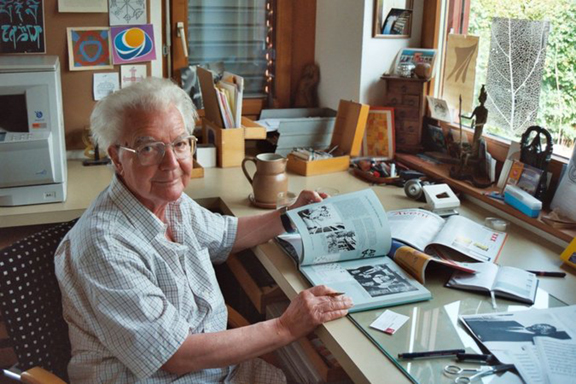

Adrian Frutiger (1928–2015): Univers and OCR-B

Adrian Frutiger: May 24, 1928 – September 10, 2015

Adrian Frutiger died on September 10, 2015 at the age of 87. He was one of the most important type designers of his generation, having created some 40 fonts, many of them still widely used today. He was also a teacher, author and specialist in the language of graphic expression and—since his career spanned metal, photomechanical and electronic type technologies—Frutiger became an important figure in the transition from the analog to the digital eras of print communications.

Frutiger was born on May 24, 1928 in the town of Interseen, near Interlaken and about 60 kilometers southeast of the city of Bern, Switzerland. His father was a weaver. As a youth, Adrian showed an interest in handwriting and lettering. He was encouraged by his family and secondary school teachers to pursue an apprenticeship rather than a fine arts career.

Adrian Frutiger around the time of his apprenticeship

At age 16, Adrian obtained a four-year apprenticeship as a metal type compositor with the printer Otto Schlaeffli in Interlaken. He also took classes in drawing and woodcuts at a business school in the vicinity of Bern. In 1949, Frutiger transferred to the School of Applied Arts in Zürich, where he concentrated on calligraphy. In 1951, he created a brochure for his dissertation entitled, “The Development of the Latin Alphabet” that was illustrated with his own woodcuts.

It was during his years in Zürich that Adrian worked on sketches for what would later become the typeface Univers, one of the most important contributions to post-war type design. In 1952, following his graduation, Frutiger moved to Paris and joined the foundry Deberny & Peignot as a type designer.

During his early work with the French type house, Frutiger was engaged in the conversion of existing metal type designs for the newly emerging phototypesetting technologies. He also designed several new typefaces— Président, Méridien, and Ondine—in the early 1950s.

San serif and Swiss typography

San serif type is a product of the twentieth century. Also known as grotesque (or grotesk), san serif fonts emerged with commercial advertising, especially signage. The original san serif designs (beginning in 1898) possessed qualities—lack of lower case letters, lack of italics, the inclusion of condensed or extended widths and equivalent cap and ascender heights—that seemingly violated the rules of typographic tradition. As such, these early san serif designs were often considered too clumsy and inelegant for the professional type houses and their clients.

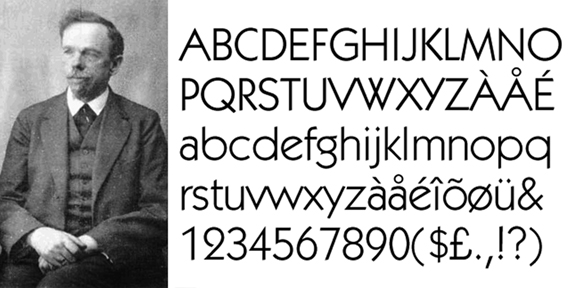
Rudolf Koch, Kabel, 1927
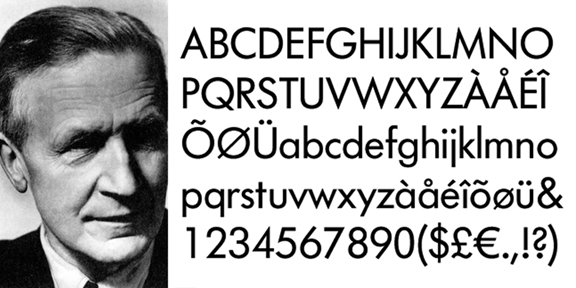
Paul Renner, Futura, 1927
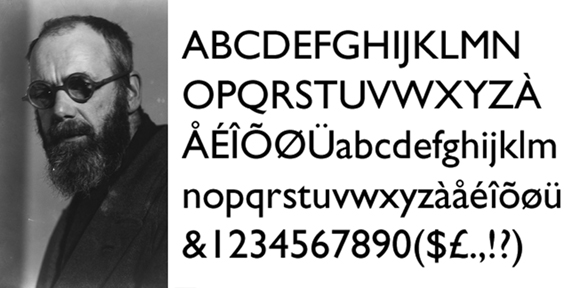
Eric Gill, Gill Sans, 1927

Along with the modern art and design movements of the early twentieth century, a reconsideration of the largely experimental work of the first generation of sans serif types began in the 1920s. Fonts such as Futura, Kabel and Gill Sans incorporated some of the theoretical concepts of the Bauhaus and DeStijl movements and pushed sans serif to new spheres of respectability.

However, these fonts—which are still used today—did not succeed in elevating san serif beyond headline usage and banner advertising and into broader application. Sans serif type remained something of an oddity and not yet accepted by the traditional foundry industry as viable in terms of either style or legibility.

In the 1930s, especially within the European countries that fell to dictatorship prior to and during World War II, there was a backlash against modernist conceptions. Sans serif type came under attack, was derided as “degenerate” and banned in some instances. Exceptions to this trend were in the US, where the use of grotesque types was increasing, and Switzerland, where the minimalist typographic ideas of the Bauhaus were brought by designers who had fled the countries ruled by the Nazis.

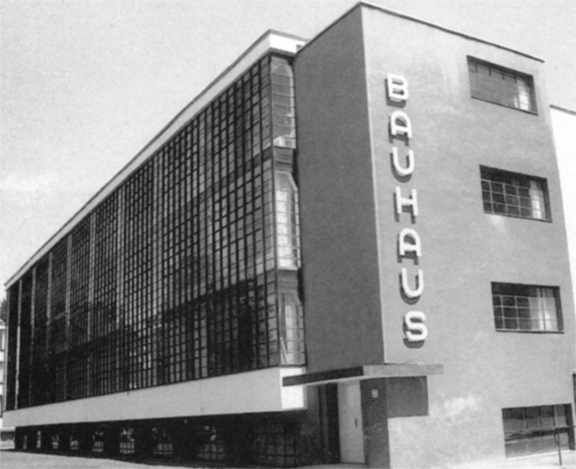
The Bauhaus School, founded in 1919 in Weimar, Germany, was dedicated to the expansion of the modernist esthetic

After the war, interest in sans serif type design was renewed as a symbol of modernism and a break from the first four decades of the century. By the late 1950s, the most successful period of san serif type opened up and the epicenter of this change emerged in Switzerland, signified by the creation of Helvetica (1957) by Eduard Hoffmann and Max Miedinger of the Haas Type Foundry in Münchenstein.

It was the nexus of the creative drive to design the definitively “modern” typeface and the possibilities opened up by the displacement of metal type with phototypesetting that brought san serif from a niche font into global preeminence.

Frutiger’s Univers

This was the cultural environment that influenced Adrian Frutiger as he set about his work on a new typeface as a Swiss trained type designer at a French foundry. As Frutiger explained in a 1999 interview with Eye Magazine, “When I came to Deberny & Peignot in Paris, Futura (though it was called Europe there) was the most important font in lead typesetting. Then one day the question was raised of a grotesque for the Lumitype-Photon [the first phototypesetting system]. …

“I asked him [Peignot] if I might offer an alternative. And within ten days I constructed an entire font system. When I was with Käch I had already designed a thin, normal, semi-bold and italic Grotesque with modulated stroke weights. This was the precursor of Univers. … When Peignot saw it he almost jumped in the air: ‘Good heavens, Adrian, that’s the future!’ ”

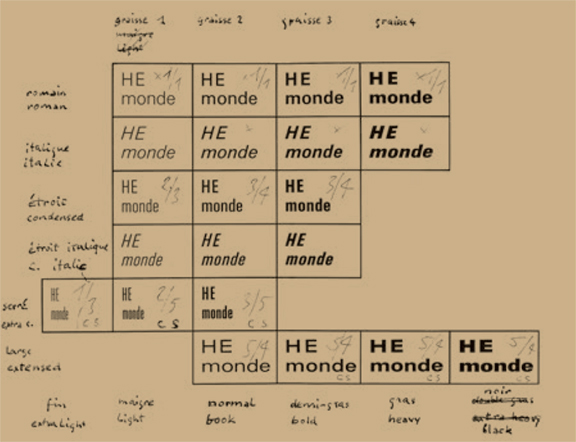
An early diagram of Frutiger’s Univers in 1955 shows the original name “Monde”
Final diagram of Frutiger’s 21 styles of Univers in 1955

Originally calling his type design “Monde” (French for “world”), Frutiger’s innovation was that he designed 21 variations of Univers from the beginning; for the first time in the history of typography a complete set of typefaces were planned precisely as a coherent system. He also gave the styles and weights a numbering scheme beginning with Univers 55. The different weights (extended, condensed, ultra condensed, etc.) were numbered in increments of ten, i.e. 45, 65, 75, 85 and styles with the same line thickness were numbered in single digit increments (italics were the even numbers), i.e. 53, 56, 57, 58, 59, etc.

Univers was released by Deberny & Peignot in 1957 and it was quickly embraced internationally for both text and display type purposes. Throughout the 1960s and 70s, like Helvetica, it was widely used for corporate identity (GE, Lufthansa, Deutsche Bank). It was the official promotional font of the 1972 Munich Olympic Games.

Frutiger explained the significance of his creation in the interview with Eye Magazine, “It happened to be the time when the big advertising agencies were being set up, they set their heart on having this diverse system. This is how the big bang occurred and Univers conquered the world. But I don’t want to claim the glory. It was simply the time, the surroundings, the country, the invention, the postwar period and my studies during the war. Everything led towards it. It could not have happened any other way.”

Computers and digital typography

Had Adrian Frutiger retired at the age of 29 after designing Univers, he would have already made an indelible contribution to the evolution of typography. However, his work was by no means complete. By 1962, Frutiger had established his own graphic design studio with Bruno Pfaffli and Andre Gurtler in Arcueil near Paris. This firm designed posters, catalogs and identity systems for major museums and corporations in France.

Throughout the 1960s, Frutiger continued to design new typefaces for the phototypesetting industry such as Lumitype, Monotype, Linotype and Stempel AG. Among his most well-known later san serif designs were Frutiger, Serifa and Avenir. Frutiger’s font systems can be seen to this day on the signage at Orly and Charles de Gaulle airports and the Paris Metro.

The penetration of computers and information systems into the printing and publishing process were well underway by the 1960s. In 1961, thirteen computer and typewriter manufacturers founded the European Computer Manufacturers Association (ECMA) based in Geneva. A top priority of the EMCA was to create an international standard for optical character recognition (OCR)—a system for capturing the image of printed information and numbers and converting them into electronic data—especially for the banking industry.

By 1968, OCR-A was developed in the US by American Type Founders—a trust of 23 American type foundries—and it was later adopted by the American National Standards Institute. This was the first practically adopted standard mono-spaced font that could be read by both machines and the human optical system.

However, in Europe the ECMA wanted a font that could be used as an international standard such that it accommodated the requirements of all typographic considerations and computerized scanning technologies all over the world. Among the issues, for example, were the treatment of the British pound symbol (£) and the Dutch IJ and French oe (œ) ligatures. Other technical considerations included the ability to integrate OCR standards with typewriter and letterpress fonts in addition to the latest phototypesetting systems.

Comparison of OCR-A (1968) with Frutiger’s OCR-B (1973)

In 1963, Adrian Frutiger was approached by representatives of the ECMA and asked to design OCR-B as an international standard with a non-stylized alphabet that was also esthetically pleasing to the human eye. Over the next five years, Frutiger showed the exceptional ability to learn the complicated technical requirements of the engineers: the grid systems of the different readers, the strict spacing requirements between characters and the special shapes needed to make one letter or number optically distinguishable from another.

In 1973, after multiple revisions and extensive testing, Adrian Frutiger’s OCR-B was adopted as an international standard. Today, the font can be most commonly found on UPC barcodes, ISBN barcodes, government issued ID cards and passports. Frutiger’s OCR-B font will no doubt live on into the distant future—alongside various 2D barcode systems—as one of the primary means of translating analog information into digital data and back again.

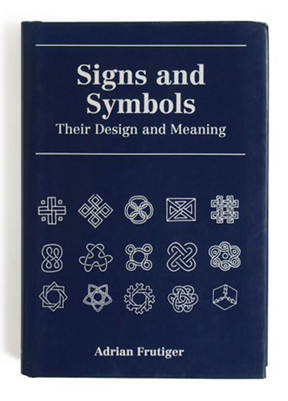
Frutigers Sign and Symbols 1989
Frutiger’s 1989 English translation of “Signs and Symbols: Their Design and Meaning”

Adrian Frutiger’s type design career extended well into the era of desktop publishing, PostScript fonts and the Internet age. In 1989, Frutiger published the English translation of Signs and Symbols: Their Design and Meaning a theoretical and retrospective study of the two-dimensional expression of graphic drawing with typography among its most advanced forms. For someone who spent his life working on the nearly imperceptible detail of type and graphic design, Frutiger exhibited an exceptional grasp of the historical and social sources of man’s urge toward pictographic representation and communication.

As an example, Frutiger wrote in the introduction to his book, “For twentieth century humans, it is difficult to imagine a void, a chaos, because they have learned that a kind of order appears to prevail in both the infinitely small and the infinitely large.  The understanding that there is no element of chance around or in us, but that all things, both mind and matter, follow an ordered pattern, supports the argument that even the simplest blot or scribble cannot exist by pure chance or without significance, but rather that the viewer does not clearly recognize the causes, origins, and occasion of such a ‘drawing’.”

Where is VR going and why you should follow it

Promotional image for Oculus Rift VR headset

On November 2, video game maker Activision Blizzard Entertainment announced a $5.9 billion purchase of King Digital Entertainment, maker of the mobile app game Candy Crush Saga. Activision Blizzard owns popular titles like Call of Duty, World of Warcraft and Guitar Hero—with tens of millions sold—for play on game consoles and PCs. By comparison, King has more than 500 million worldwide users playing Candy Crush on TVs, computers and (mostly) mobile devices.

While it is not the largest-ever acquisition of a game company—Activision bought Blizzard in 2008 for $19 billion—the purchase shows how much the traditional gaming industry believes that future success will be tied to mobile and social media. Other recent acquisitions indicate how the latest in gaming hardware and software have become strategically important for the largest tech companies:

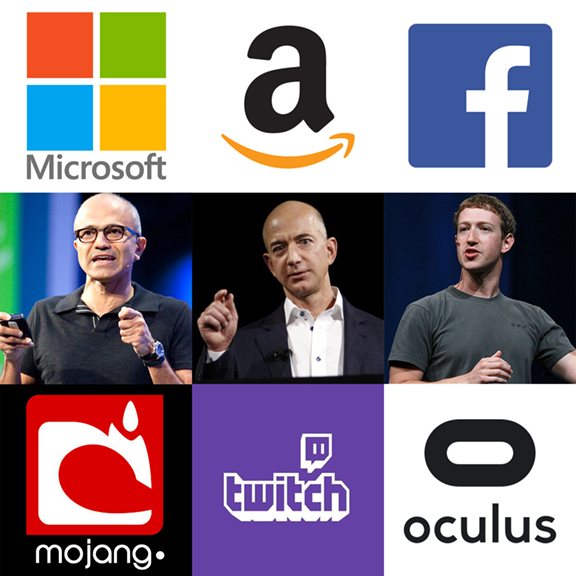
Major acquisitions of gaming companies by Microsoft, Amazon and Facebook took place in 2014
  • September 2014: Microsoft acquired Mojang for $2.5 billion
    Mojang’s Minecraft game has 10 million users worldwide and an active developer community. The Lego-like Minecraft is popular on both Microsoft’s Xbox game console and Windows desktop and notebook PCs. In making the purchase, Microsoft CEO Satya Nadella said, “Gaming is a top activity spanning devices, from PCs and consoles to tablets and mobile, with billions of hours spent each year.”
  • August 2104: Amazon acquired Twitch for $970 million
    The massive online retailer has offered online video since 2006 and the purchase of Twitch—the online and live streaming game service—adds 45 million users to Amazon’s millions of Prime Video subscribers and FireTV (stick and set top box) owners. Amazon’s CEO Jeff Bezos said of the acquisition, “Broadcasting and watching gameplay is a global phenomenon and Twitch has built a platform that brings together tens of millions of people who watch billions of minutes of games each month.”
  • March 2014: Facebook acquired Oculus for $2 billion
    Facebook users take up approximately 20% of all the time that people spend online each day. The Facebook acquisition of Oculus—maker of virtual reality headsets—is an anticipation that social media will soon soon include an immersive experience as opposed to scrolling through rectangular displays on PCs and mobile devices. According to Facebook CEO Mark Zuckerberg, “Mobile is the platform of today, and now we’re also getting ready for the platforms of tomorrow. Oculus has the chance to create the most social platform ever, and change the way we work, play and communicate.”

The integration of gaming companies into the world’s largest software, e-commerce and social media corporations is further proof that media and technology convergence is a powerful force drawing many different industries together. As is clear from the three CEO quotes above, a race is on to see which company can offer a mix of products and services sufficient to dominate the number of hours per day the public spends consuming information, news and entertainment on their devices.

What is VR?

Among the most important current trends is the rapid growth and widespread adoption of virtual reality (VR). Formerly of interest to hobbyists and gaming enthusiasts, VR technologies are now moving into mainstream daily use.

A short definition of VR is a computer-simulated artificial world. More broadly, VR is an immersive multisensory, multimedia experience that duplicates the real world and enables users to interact with the virtual environment and with each other. In the most comprehensive VR environments, the sight, sound, touch and smell of the real world are replicated.

Current and most commonly used VR technologies include a stereoscopic headset—which tracks the movement of a viewer’s head in 3 dimensions—and surround sound headphones that add a spatial audio experience. Other technologies such as wired gloves and omnidirectional treadmills can provide tactile and force feedback that enhance the recreation of the virtual environment.

New York Times VR promtion
The New York Times’ VR promotion included a Google Cardboard viewer that was sent along with the printed newspaper to 1 million subscribers

Recent events have demonstrated that VR use is becoming more practical and accessible to the general public:

  • On October 13, in a partnership between CNN and NextVR, the presidential debate was broadcast in VR as a live stream and stored for later on demand viewing. The CNN experience made it possible for every viewer to watch the event as though they were present, including the ability to see other people in attendance and observe elements of the debate that were not visible to the TV audience. NextVR and the NBA also employed the same technology to broadcast the October 27 season opener between the Golden State Warriors and New Orleans Pelicans, the first-ever live VR sporting event.
  • On November 5, The New York Times launched a VR news initiative that included the free distribution of Google Cardboard viewers—a folded up cardboard VR headset that holds a smartphone—to 1 million newspaper subscribers. The Times’ innovation required users to download the NYTvr app to their smartphone in order to watch a series of short news films in VR.

Origins of VR

Virtual reality is the product of the convergence of theater, camera, television, science fiction and digital media technologies. The basic ideas of virtual reality go back more than two hundred years and coincide with the desire of artists, performers and educators to recreate scenes and historical events. In the early days this meant painting panoramic views, constructing dioramas and staging theatrical productions where viewers had a 360˚ visual surround experience.

In the late 19th century, hundreds of cycloramas were built—many of them depicting major battles of the Civil War—where viewers sat in the center of a circular theater as the timeline of the historical event moved and was recreated around them in sequence. In 1899, a Broadway dramatization of the novel Ben Hur employed live horses galloping straight toward the audience on treadmills as a backdrop revolved in the opposite direction creating the illusion of high speed. Dust clouds were employed to provide additional sensory elements.

Kromscop viewer invented by Frederic Eugene Ives at the beginning of the 20th century
Frederic Eugene Ives’ Kromscop viewer

Contemporary ideas about virtual reality are associated with 3-D photography and motion pictures of the early twentieth century. Experimentation with color stereoscopic photography began in the late 1800s and the first widely distributed 3-D images were of the 1906 San Francisco earthquake and taken by Frederic Eugene Ives. As with present day VR, Ives’ images required both a special camera and viewing device called the Kromskop in order to see 3-D effect.

1950s-era 3-D View-Master with reels

3-D photography was expanded and won popular acceptance beginning in the late 1930s with the launch of the View-Master of Edwin Eugene Mayer. The virtual experience of the View-Master system was enhanced with the addition of sound in 1970. Mayer’s company was eventually purchased by toy maker Mattel and later by Fischer-Price and the product remained successful until the era of digital photography in the early 2000s.

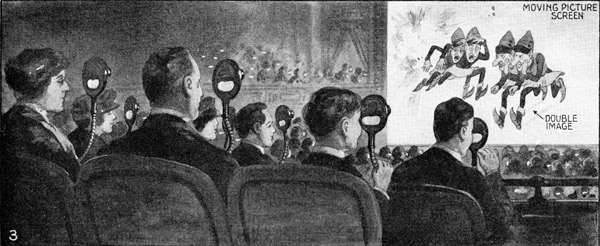
An illustration of the Teleview system that mounted a viewer containing a rotation mechanism in the armrest of theater seats

Experiments with stereoscopic motion pictures were conducted in the late 1800s. The first practical application of a 3-D movie took place in 1922 using the Teleview system of Laurens Hammond (inventor of the Hammond Organ) with a rotating shutter viewing device attached to the armrest of the theater seats.

Prefiguring the present-day inexpensive VR headset, the so-called “golden era” of 3-D film began in the 1950s and included cardboard 3-D glasses. Moviegoers got their first introduction to 3-D with stereophonic sound in 1953 with the film House of Wax starring Vincent Price. The popular enthusiasm for 3-D was eventually overtaken by the practical difficulties associated with the need to project two separate film reels in perfect synchronization.

1950s 3-D glasses and a movie audience wearing them

Subsequent waves of 3-D movies in the second half of the twentieth century—projected from a single film strip—were eventually displaced by the digital film and audio methods associated with the larger formats and Dolby Digital sound of Imax, Imax Dome, Omnimax and Imax 3D. Anyone who has experienced the latest in 3-D animated movies such as Avatar (2009) can attest to the mesmerizing impact of the immersive experience made possible by the latest in these movie theater techniques.

Computers and VR

Recent photo of Ivan Sutherland; he invented the first head-mounted display at MIT in 1966

It is widely acknowledged that the theoretical possibility of creating virtual experiences that “convince” all the senses of their “reality” began with the work of Ivan Sutherland at MIT in the 1960s. Sutherland invented in 1966 the first head-mounted display—nicknamed the “Sword of Damocles”—that was designed to immerse the viewer in a simulated 3-D environment. In a 1965 essay called “The Ultimate Display,” Sutherland wrote about how computers have the ability to construct a “mathematical wonderland” that “should serve as many senses as possible.”

With increases in the performance and memory capacity of computers along with the decrease in the size of microprocessors and display technologies, Sutherland’s vision began to take hold in the 1980s and 1990s. Advances in vector based CGI software, especially flight simulators created by government researchers for military aircraft and space exploration, brought the term “reality engine” into use. These systems, in turn, spawned notions of complete immersion in “cyberspace” where sight, sound and touch are dominated by computer system generated sensations.

The term “virtual reality” was popularized during these years by Jaron Lanier and his VPL Laboratory. With VR products such as the Data Glove, the Eye Phone and Audio Sphere, Lanier combined with game makers at Mattel to create the first virtual experiences with affordable consumer products, despite their still limited functionality.

By the end of the first decade of the new millennium, many of the core technologies of present-day VR systems were developed enough to make simulated experiences more convincing and easy to use. Computer animation technologies employed by Hollywood and video game companies pushed the creation of 3-D virtual worlds to new levels of “realness.”

An offshoot of VR, called augmented reality (AR), took advantage of high resolution camera technologies and allowed virtual objects to appear within the actual environment and enabled users to view and interact with them on computer desktop and mobile displays. AR solutions became popular with advertisers offering unique promotional opportunities that capitalized on the ubiquity of smartphones and tablets.

Expectations

Scene from the 2009 movie Avatar
A scene from the 2009 animated film “Avatar”

Aside from news, entertainment and advertising, there are big possibilities opening up for VR in many business disciplines. Some experts expect that VR will impact almost every industry in a manner similar to that of PCs and mobile devices. Entrepreneurs and investors are creating VR companies with the aim of exploiting the promise of the new technology in education, health care, real estate, transportation, tourism, engineering, architecture and corporate communications (to name just a few).

Like consumer-level artificial intelligence, i.e. Apple Siri and Amazon Echo, present-day virtual reality technologies tend to fall frustratingly short of expectations. However, with the rapid evolution of core technologies—processors, software, video displays, sound, miniaturization and haptic feedback systems—it is conceivable that VR is ripe for a significant leap in the near future.

In many ways, VR is the ultimate product of media convergence as it is the intersection of multiple and seemingly unrelated paths of scientific development. As pointed out by Howard Rheingold in his authoritative 1991 book Virtual Reality, “The convergent nature of VR technology is one reason why it has the potential to develop very quickly from a scientific oddity into a new way of life … there is a significant chance that the deep cultural changes suggested here could happen faster than anyone has predicted.”