What our doctors are telling us about the health of the printing industry

Two well-known Ph.D. economists recently published important reports on the condition of printing markets and printing businesses. Naturally, we should ask the question: what do our doctors have to say about the health of our industry?

Dr. Joe Webb, WhatTheyThink.com

Dr. Joe Webb, with a Ph.D. from the NYU Center for Graphic Communications Management, is director of WhatTheyThink.com’s Economic Research Center. Dr. Webb published a blog on February 4 on current quantitative indicators entitled, “2014 US Commercial Printing Rebounds from Poor First Half with Positive Third and Fourth Quarters.”

After a slow start in 2014, commercial printing shipments finished nearly even with 2013 and with most of the turnaround coming in December. “It was the first positive December since 2010. At that time, however, current shipments were more that $7 billion; December 2014 shipments were nearly $6.52 billion,” Webb wrote.

US Commercial Printing Shipments

He deduced that the strong December shipments were most likely the result of print that was generated by:

  1. The contentious mid-term local and regional election cycle
  2. A surge in local retail and holiday shopping promotions

However, Dr. Doom—as Joe Webb is sometimes called—had a warning against any false optimism that the December figures were part of a long-term growth trend. He wrote, “It is unlikely that this is a bottoming-out trend of industry shipments patterns, but a marked slowdown in the decline of real shipments. It is likely it is a sideways pause before another shift in media implementation.”

Media implementation refers to corporate marketing strategies that allocate budgets for the different communications channels, i.e. print, TV, radio, mobile, social, etc. There are contending opinions developing at the corporate marketing level regarding the effectiveness of digital approaches (computer, tablet and smartphone) versus tradition print such (direct mail, insert media, etc.).

Finally, Webb gave a warning, “Again, we remind readers that aggregate industry shipment data trends are not the certain destinies of all print businesses. Processes and product offerings are changing as market demands require. Getting ahead of those changes is essential.

“A slowdown in industry contraction, and even short-term increases, should be viewed as breathing room for thoughtful business re-configuration for the future.”

Dr. Ronnie H. Davis, Printing Industries of America

Dr. Ronnie H. Davis, Senior Vice President and Chief Economist at the Printing Industries of America Economic and Market Research Department published the second report called, “Industry Briefing: Competing in Print’s Dynamic Marketspace in 2015.” Dr. Davis’s report, although it also contains economic data, is a qualitative analysis of the major trends of the printing industry; it examines the overall economic environment, print sales volumes and profitability of the past decade. The report assesses the relative strengths and weaknesses of different forms of print media, different approaches to business strategy by printing companies and provides a forecast for each through the year 2021.

Recovery GapAfter explaining that the overall economy has still to “get out of second gear” following the recession of 2008-2009, Davis says that we should expect only “modest improvement” in the coming period. One of the impacts of the Great Recession is that the recovery is lagging behind previous recessionary cycles by about 4.8% or an average of about 1.2% growth per year. This “recovery gap” means that, at best, we will experience a leveling off or growth plateau that will remain between 2% and 3% into the near future.

GDP vs Nominal Print

In spite of this less than optimistic view of the economy as a whole, Dr. Davis makes an extremely important point about the relationship of print to GDP. For several years, industry analysts have been pointing to a divergence of printing industry annual growth numbers from the performance of the overall economy. But, according to the PIA report, “print still correlates with the economy.” This means that the impact of the Internet and digital alternatives may not have forced a detachment of print from general economic activity as had been previously thought. It may be the case that the responsiveness of print to GDP has lagged, but its ups and downs still correlate nonetheless.

As he has done in the past, Dr. Davis categorizes the functions of print into three groups:

  1. Inform and Communicate: Publications, Newspapers, Books, Legal Printing
  2. Product Logistics: Labels, Packaging Printing
  3. Market and Promote: Direct Mail, Signage

Print by Function

By far, the biggest drain on the printing industry is the first category; Inform and Communicate. The decline in magazine, newspaper and book printing—forms that are most susceptible to digital media alternatives and face dramatic declines in their revenue models—are pulling the rest of the industry down. According to Dr. Davis, this category—with a volume equal to one and a half times that of the other two categories combined—experienced a decline of 2% in 2014 and will see a drop of another 2.5% in 2015.

Meanwhile, Product Logistics—which represents somewhere around one tenth of the total volume of print—experienced an increase of 2.5% in 2014 and is expected to grow another 3% in 2015. According to Dr. Davis, the Market and Promote category is basically flat with a growth of 2% in 2014 and an expected growth of 1% in 2015.

The business trajectory of companies in the industry is another subject that PIA and Dr. Davis have been following for some years. Davis defines the product and service spectrum within the printing industry marketspace in the following four groups:

  1. Printed Products
  2. Ancillary and Adjacent Marketspace
  3. Communications Solutions
  4. Outsourced Print Management Services

As any given company moves from the top to the bottom of this list, they are migrating further and further away from the attributes of a “commercial printer” and into a more strategic partnership with their clients. Products and services that extend beyond and eliminate the competitive job-by-job bidding process make it possible for firms to develop relationships that add strategic value rather than low cost printing.

Additionally, Dr. Davis’s report contains information from a study of management approaches by printing industry companies that shows those that practice strategic planning have higher profit rates than those that do not.

PIA Long Term Print Forecast by Function

Finally, the PIA report considers a view of the industry six years out from now. Dr. Davis writes, “We project aggregate U.S. printing shipments to decline from $158.5 billion in 2015 to $143.6 billion in 2021—a reduction of around $15 billion or 9.4 percent. Although this is a fairly substantial decline, it is gradual (about 1.5 percent per year) and even at the end of the forecast period, print’s economic footprint remains large—over $143 billion, making it still one of the largest U.S. manufacturing industries. Additionally, two out of three print functions are expected to grow (print logistics and print marketing/promotion). Only print’s communication/inform function is projected to decline.”

It is clear from the reports published by both of our doctors that the health of the printing industry is improving, if only marginally. While much depends on the overall performance of the economy, print still remains a major manufacturing industry in the US with $155 billion in annual shipments, 45,000 establishments and nearly 1 million employees. As the industry continues to consolidate and shrink, business leaders must respond to the changes being made in customer markets, i.e. shifts in media implementation and segments that are most susceptible to digital alternatives.

Steve Jobs (1955 – 2011): Fonts and desktop publishing

Steven P. Jobs’ role in creating the first personal computer (along with his neighborhood friend Steve Wozniak), the founding of Apple Computer and his subsequent firing and return to the company have become part of tech industry lore. His later contributions to mobile, wireless and touch computing—embodied in the Apple iPod, iPhone and iPad—were no less transformative.

Steven P.  Jobs in 1984
Steven P. Jobs in 1984

Although Steve Jobs had extensive knowledge of computer hardware, operating systems and applications—he even worked for a short time in the early 1970s as a technician for Atari—his greatest skills were as technology visionary, marketer and salesman. Without the entrepreneurial drive, leadership charisma and design esthetic of Steve Jobs, Apple would never have emerged as the world’s largest publicly traded corporation; nor would it have the most loyal customers in the history of the consumer products industries.

Owing a great deal to the location and times of his upbringing, Steve Jobs expressed a broad cultural viewpoint and considered every project and product as an aspect of a larger creative purpose. Having developed an enthusiasm for the Bauhaus movement’s form and function philosophy, he identified design simplicity with products that were both beautiful and easy to use.

In his 2012 biography, Walter Isaacson quotes Steve Jobs from the early 1980s, “So that’s our approach. Very simple, and we’re really shooting for Museum of Modern Art quality. The way we’re running the company, the product design, the advertising, it all comes down to this: Let’s make it simple. Really simple.” Jobs rejected the boxy, bulky and dark industrial style of the earlier generation of computer design in favor of elegance and what he later called “taste.”

It was out of this unique blending of art with science and business that Steve Jobs made two significant contributions to typography and printing technology: the creation of computer fonts and the launching of desktop publishing. As with every innovation associated with his name, Jobs relied on the skills of others to realize his vision and then packaged and presented the accomplishments with great fanfare to investors and consumers alike.

Computer Fonts

Jobs’ esthetic sensibility had been formed a decade earlier while he was briefly a student at Reed College in Portland, Oregon in 1972. After dropping out of school, he enrolled in a calligraphy course at Reed taught by Father Robert Palladino. The course had a lasting impact on him.

As Jobs explained in a commencement address he delivered to Stanford University in 2005: “Reed College at that time offered perhaps the best calligraphy instruction in the country. … I learned about serif and san serif typefaces, about varying the amount of space between different letter combinations, about what makes great typography great. It was beautiful, historical, artistically subtle in a way that science can’t capture, and I found it fascinating.”

“None of this had even a hope of any practical application in my life. But ten years later, when we were designing the first Macintosh computer, it all came back to me. And we designed it all into the Mac. It was the first computer with beautiful typography.”

While working with the Macintosh design team, Jobs was involved in every detail of its size, shape and color as well as every icon, window and box of the graphical user interface. This involvement included the design of a group of fonts which he insisted be named for the great cities of the world: Cairo, Chicago, Geneva, London, Los Angeles, Monaco (monospaced system font), New York, San Francisco, Toronto and Venice.

Apple Macintosh font and desktop icon designer Susan Kare, developer Andy Hertzfeld and engineer Bill Atkinson

Prior to the work of Macintosh designer Susan Kare, developer Andy Hertzfeld and engineer Bill Atkinson on proportional fonts, computers were mostly limited to monospaced typefaces much like a typewriter with al alphanumeric characters and keystrokes the exact same width. Jobs could see that the bitmapped display of the Macintosh desktop was capable of rendering typefaces with a sophistication equal to that of letterpress hot metal type and cold phototypesetting.

Others at Apple Computer, due to their limited perspective on the utility of the personal computer, could not relate to Steve Jobs’ insistence on the font library; they considered it a distracting personal obsession. In his biography of Jobs, Walter Isaacson quotes Apple investor and partner Mark Markkula: “I kept saying, ‘Fonts?!? Don’t we have more important things to do?’ ”

The original Macintosh font library

When Steve Jobs launched the Macintosh on January 24, 1984 at the Flint Center in Cupertino, the font library was a critical part of the presentation of “the computer for the rest of us.” It was the first desktop system to offer not only the 9 city-named fonts listed above but also style choices—Plain, Bold, Italic, Bold Italic, Underline, Outline, Shadowed—for each.

While initially appearing somewhat primitive, bitmapped and lacking the finesse of professional typography, Jobs’ on-screen fonts were the beginning of a revolution in type technology. Firstly, fonts became something that everyone with a computer could use, not just professional graphic designers and printing specialists.

Secondly, the Macintosh font library encouraged professionals to push the limits of computer-generated typography and eventually transformed the field of typesetting altogether. Soon desktop fonts surpassed the quality and versatility of all previous type technologies and offered WYSIWYG (What You See Is What You Get) output; i.e. the image displayed on the computer screen is precisely what is printed onto a sheet of paper or other final output media.

Desktop Publishing

Steve Jobs understood the promise of WYSIWYG long before the phrase was widely used in the printing and publishing industries. Nearly one year to the day after unveiling the Macintosh, Jobs was back on stage in Cupertino at the annual Apple stockholders meeting on January 23, 1985 to launch the Apple LaserWriter and demonstrate the first ever desktop publishing system.

Desktop publishing signifies an integrated publishing system whereby pages containing both text and graphics are designed in layout software on a desktop computer and printed in individual or multiple copies on a desktop printer. Building on the accomplishments of the Macintosh, Steve Jobs worked throughout 1984 with partner companies and publishing industry experts to integrate the Apple Macintosh computer with other basic elements of desktop publishing: the Apple LaserWriter, Adobe PostScript and Aldus PageMaker.

The Apple LaserWriter, Apple project manager Bruce Blumberg and laser printer invertor Gary Starkweather
The Apple LaserWriter, Apple project manager Bruce Blumberg and laser printer invertor Gary Starkweather 

Apple LaserWriter: Gary Starkweather invented the core toner imaging technology of the laser printer at Xerox PARC in the early 1970s. Although Xerox never brought a desktop laser printer to market, HP and Canon developed systems independently of each other in the 1970s. The HP LaserJet, based on the Canon LBP-CX printing engine, was the first desktop laser printer and was released in 1984. The Apple LaserWriter, developed by a team led by project manager Bruce Blumberg, had two important differences with the HP device: it was networked (with AppleTalk) and could be shared and contained breakthrough PostScript software that enabled true WYSIWYG capability. The Apple LaserWriter was available for purchase in March 1985 and sold for $6,995.

PostScript Language Reference Manual. Steve Jobs talking with Chuck Geschke (left) and John Warnock of Adobe in January 1985.

Adobe Postscript: The software at the heart of the Apple LaserWriter was Adobe’s PostScript page description language. John Warnock and Chuck Geschke, who also came from Xerox PARC, founded Adobe Systems in 1982 with PostScript as their flagship product. Warnock and Geschke developed a state-of-the-art device independent print programming language that: 1.) captured all the elements—text, graphics, geometry, etc. —on the page of the desktop layout software during the “Print” function; 2.) interpreted the layout data as vector-based objects within the memory of the printer and; 3.) converted the PostScript objects into raster print data such that the page could to rendered onto a sheet of paper at a resolution of 300 dots per inch. The Adobe founders also signed a licensing agreement with Linotype that made 13 professional typefaces (four styles for each of the Helvetica, Times Roman and Courier families and a Symbol font) “resident” within the PostScript raster image processor (RIP) in the Apple LaserWriter.

Paul Brainerd and an early version of Aldus PageMaker on the Macintosh
Paul Brainerd and an early version of Aldus PageMaker on the Macintosh 

Aldus PageMaker: Paul Brainerd—the man who coined the phrase “desktop publishing”—founded Aldus Corporation in February 1984 in Seattle, WA. With a background in computerized newspaper publishing systems, Brainerd and a group of developers began working on layout software initially for newspapers. After getting some early peeks at the Apple Macintosh, Adobe PostScript and Apple LaserWriter, the Aldus team developed PageMaker as the first application capable of placing columns of text and images onto a virtual page and used a floating tool palette. The first commercially available version of PageMaker was released in July 1985 and sold for $495.

John W. Seybold
John W. Seybold

An important advisor to Steve Jobs throughout the process was John Seybold, a pioneer in computerized publishing systems and industry consultant. According to Paul Brainerd, “There were a couple of people that really were the glue that made all of this come together, and the most important was Jonathan Seybold. He was consulting to both Adobe and Apple. He and I knew each other for a long time going back … he told me some time during ’84, probably in the first quarter, that there was some confidential information that I needed to know. He got clearance from his clients to be able to share it with me.”

In an account published by Adobe in 2004, Jonathan Seybold reviewed the significance of the events that unfolded during the summer of 1984, “Steve wanted to see me urgently. He said they had a deal with Adobe, they were signing a deal with Linotype, they had real fonts. I went to Cupertino and walked into this tiny room, and there stood Jobs and Warnock with a Mac and a LaserWriter. He showed me what they were up to. I turned to Steve and said, ‘You’ve just turned publishing on its head. This is the watershed event.’ ”

Although they are less celebrated, Steve Jobs’ introduction of the Apple Macintosh font library and his pivotal role in launching the desktop publishing revolution in 1984-85 were watershed developments because they made designing and publishing accessible to anyone with a desktop computer and printer. The lasting impact of Jobs’ breakthrough continues to be felt today in the explosion of online and social media publishing by billions of people across the globe. Jobs’ death from cancer at age 56 on October 5, 2011 prematurely ended the life of one of the most important and unique figures of our times.

Open source software: where it came from and why it is important

The InnovatorsIn his new book The Innovators, Walter Isaacson reviews the impact of the intermingling of the Internet and the personal computer in the late 1980s and early 1990s. He writes, “This merger of the personal computer and the Internet allowed digital creativity, content sharing, community formation, and social networking to blossom on a mass scale.”

Indeed, in the ten years from 1984 to 1994 the convergence of these two previously separate technologies changed the world. The integration of the mouse driven and graphical desktop with web browsing and email communications was the beginning of a transformation in human activity on a mass scale that continues to this day. Without this accomplishment we would never have reached the wireless, mobile, touch and social world we now live in.

Isaacson’s book shows how the gifted and creative innovators that brought the digital revolution into being also collaborated with each other and across generations; their genius and creative accomplishments could not have been achieved without teamwork.

Isaacson explains the social and cultural environment of that time which nurtured the social element of the digital transformation, “For the birth of the digital age, this included a research ecosystem that was nurtured by government spending and managed by a military-industrial-academic collaboration. Intersecting with this was a loose alliance of community organizers, communal-minded hippies, do-it-yourself hobbyists, and homebrew hackers most of whom were suspicious of centralized authority.”

Most people are familiar with the contributions of men like Steve Jobs of Apple, Bill Gates of Microsoft and Marc Andreesen of Netscape during those early years of the convergence of the PC and the Internet. The competition and legal battles for domination of the new technology markets—with billions of dollars at stake—are now legendary chapters of American business history. As much as collaboration was an organizational prerequisite for the age digital innovation, the market also drove antagonisms that split people and firms apart from one another.

Apple, for example, famously launched (1988) and ultimately lost (1994) a lawsuit against Microsoft over the manner in which Windows 2.0 copied features—the “look and feel”—of the Macintosh desktop. Even something as universal as the Trash Can became a source of contention.

Later, the US government initiated (1998) and won (2000) an antitrust case against Microsoft—on behalf of competitors including Netscape—that forced the unbundling of Internet Explorer (which Microsoft was giving away free of charge at the time) from the Windows operating system. Just at the moment when the seamless integration of web browsing with the underlying operating system would be the next logical phase of development, competitive pressures drove these elements of the computing experience apart from one another.

Open source software

Although perhaps less legendary, there was another no less significant group of innovators who made major and lasting contributions to the digital age during the same ten-year span (1984-1994): the creators of open source software (OSS). Their approach to digital technology development was based entirely upon a collaborative model. Although competitive and strategic differences did emerge among them, the open source community today is a central and growing force in the computer software industry.

Open source software is computer software whose source code is available publicly by license from the copyright holder. As opposed to closed source software—where the source code is hidden and unavailable for modification by anyone but the copyright holder—open source software encourages users and the public as a whole to study, copy, modify and distribute the source code to anyone and for any purpose.

Open source software licensing maintains the copyright ownership of the original author and frequently has obligations for licensees. For example, an open source software license may require that modifications to the source code be distributed in open source form or an attribution of the original author must be included in the documentation or program being distributed.

Open source software development relies upon the collaboration of a community of thousands of programmers. In OSS programming, the mostly volunteer developers work independently and use the Internet to collaborate on solving problems and fixing defects. The social networking aspect of OSS development has helped produce reliable, professional quality software at low cost and at an accelerated pace.

Richard Stallman, GNU & the Free Software Foundation

Richard Stallman in 2007 and the GNU logo

Richard Stallman—the Harvard educated hacker and activist—is recognized as an originator of the free software movement, a precursor to open source software. In September 1983, after leaving his job at MIT’s Artificial Intelligence Lab, Stallman launched the GNU Project with the aim of giving computer users the freedom to use and modify software. For Stallman and his community of supporters, the term “free” does not mean free of charge; it is free in the sense that it is unencumbered by the requirements of commercial and proprietary software licensing such as with Microsoft Windows and UNIX (GNU is a recursive acronym that stands for GNU’s Not UNIX).

In October 1985 Stallman founded the Free Software Foundation as a non-profit organization to promote the universal freedom to study, distribute, create and modify computer software. With the tongue-in-cheek methodology of a radical, Stallman wrote the GNU General Public License and advanced the concept of the “copyleft” (as opposed to the copyright) which gives everyone the right to do what they like with software with the exception of placing restrictions upon others.

An early product of his free software project was Stallman’s GNU Emacs text editor launched in 1984. Emacs has many of the features found in commercially available word processing software combined with a high degree of customizability including the addition of community developed plug-ins and extensions. In the 1980s, these were new concepts in PC software. GNU Emacs continues to be developed today and is up to version 24.4. Some estimates put the worldwide Emacs user base in the hundreds of thousands.

While Stallman’s work was pioneering, it came upon a dilemma: GNU free software programs were being written to run on proprietary operating systems, i.e. UNIX, MS-DOS, MacOS, Windows, etc. Although he tried, Stallman was unable to develop a GNU software kernel, the heart of the computer operating system that manages the exchange of data between applications and the central processing unit (CPU).

Linus Torvalds & Linux

Linus Torvalds and the Linux logo

In October 1991 Linus Torvalds—a Finnish-American software engineer—released the first computer operating system assembled under an open source software development model. Torvalds was 21 years old. He called his system Linux (a contraction of Linus and UNIX) because it had a UNIX-like kernel. Torvalds wrote the original Linux code on an Intel 386 PC clone while he was living with his family in an apartment in Helsinki.

After he completed ten thousand lines of code, Linus Torvalds elected to offer his product publicly instead of trying to market it privately. Torvalds’ decision was influenced by a Richard Stallman lecture that he attended with a friend. Torvalds used the GNU General Public License to launch Linux officially in 1992 because he thought that letting hackers around the world help with the source code would lead to a much better end product.

The release of the Linux kernel produced a massive response which became a model of peer-to-peer collaboration. Within a year, there were tens of thousands of Linux collaborators all over the world working on bugs and developing additional capabilities such as a graphical user interface and networking capabilities. Meanwhile, Linus Torvalds maintained his role as the leader of the Linux development process.

Although Torvalds’ Linux was released with the spirit of Stallman’s free software licensing, there were differences between the two men. The separation of Linux from the pure GNU model emerged as Torvalds and others started to refer to their product as open source software and emphasized the development model more than the absence of proprietary or business interests. While Stallman believed that software must be free of all private and corporate interests, Torvalds took a more pragmatic view that as long as the source code remained open, other things could be done with the products that do not follow all of the GNU principles.

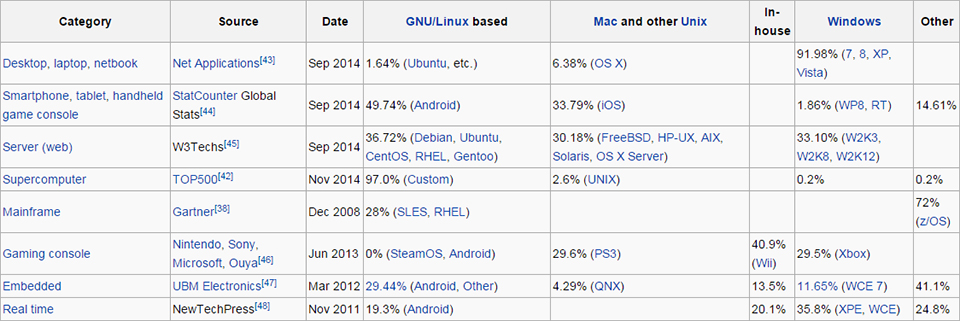
Computer platform operating system market share (from Wikipedia)

Today, the Linux operating system has been ported to more computer platforms—including the world’s largest supercomputers—than any other. Although Linux is used on less than 2% of desktop and notebook computers, it is the leading operating system on servers and the Linux kernel is the basis of Android, the most widely used OS on smartphones and tablets. There are many examples of open source software being used widely by the public every day, Mozilla’s Firefox browser and Wikipedia’s internal wiki technology among them.

While books on the history of computer technology tend to omit it, to his credit Walter Isaacson in The Innovators devotes a section of his chapter on software to Stallman and Torvalds and free and open source software. Isaacson quotes Eric Raymond, a leading open source software developer and advocate, “Who would have thought that a world-class operating system could coalesce as if by magic out of part-time hacking by several thousand developers scattered all over the planet, connected only by tenuous strands of the Internet?”