Surveys show preference for print media

Several recent surveys and reports substantiate the fact that print is both a highly successful choice for advertisers as well as a preferred marketing media for consumers. Interestingly, according to these studies, even among young people and the affluent—where one might expect a higher rate of loyalty to electronic and social media alternatives—print is still a favored source of offers, promotions, information and news.

Millennial shoppers

On September 11, Valassis—a leader in intelligent media delivery and printed coupon advertising—announced the results of its Sixth Annual RedPlum Purse String Survey of over 5,000 shoppers taken in June and July of this year. The results provided insights into the shopping behavior of millennials: the generation of young people born between 1982 and 2004.

The Purse String Survey showed that the millennial generation relies heavily on newspaper advertising print coupons and offers in the same way that all other age groups and income levels do. The top print sources for the millennials are:

  • 33 percent from the mail
  • 21 percent from retail circulars
  • 20 percent from coupon books

While the younger generation is, of course, very active with digital advertising, they are getting their promotions to a larger degree from these sources than the rest of the population. But according to Lisa Reynolds, Valassis VP of Consumer Engagement, “The RedPlum Purse String Survey results are somewhat counter intuitive from what you might expect based on what we know about millennials … While they are heavy digital users, this group also embraces tried and true methods for savings, as much as any other age group. Promotion sensitive, they are a true testament to the use of savings from both print and digital sources.”
Millennials Share Coupons

When it comes to sharing promotions and deals with others, millennials are the most active:

  • 90% of millennials share deals with others
  • 45% of millennials share deals through social media, compared to 29% among everyone
  • 30% of millennials share deals through text, compared to 19% among everyone
  • 71% of millennials share deals through word of mouth, compared to 56% among everyone
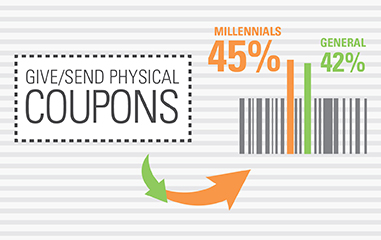
  • 45% of millennials share or send physical coupons compared with 42% among everyone

Affluent readers

On September 19, the 2013 Ipsos Affluent Survey USA reported that affluent adults (households with and annual income of $100,000 or more) “continue to be enthusiastic consumers of traditional media,” even as their use of digital media continues to grow sharply.

The study projected that there are 62.5 million affluent adults in the US, which is up more than 6% over the past two year and represents approximately 20% of the total US population.
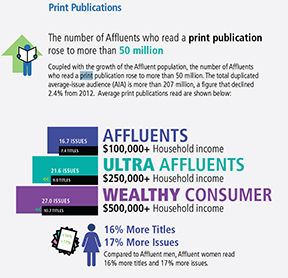
Affluent Adults Read Print MediaThe Ipsos survey found that 81% of affluent adults regularly read at least one of the 142 measured and reported print publications (135 magazines and 7 national newspapers).

The survey results on print readership is in contrast to the fact that affluent adults are also increasing the amount of time that they spend online each week. And they are increasing their use of smartphones, tablets and downloads of digital newspapers and magazines.

Direct mail vs. email marketing

An analysis of all Internet traffic in 2012 published by Pingdom reported that there were 144 billion email messages sent each day and that 68.8% of this was spam. Additionally, the data showed that 61% of all email was considered nonessential. Another report by HubSpot showed that three quarters of all email remains unopened and “click through” rates are below 5%.

This is in contrast to information published by the USPS in the Household Diary Study. This data from 2011 showed that the advertising mail represented 61% of all household mail or 85.1 billion pieces of print advertising entering homes in the US.

The survey showed that 78% of households either read or scan their advertising mail and only 21% say that they do not usually read their advertising mail. The USPS diary results also showed that 62% of households say they read or scan catalogs received in the home, with 13% setting them aside for later reading and only 17% discarding them without reading.

Additionally, the survey showed that households with Internet access receive more advertising mail than those without access.

Challenges to print

There continues to be a steady push by advertisers and marketers to move the behavior of the consumer away from print media to online alternatives, primarily because the cost of delivery is far lower.

A campaign recently launched by the CVS drugstore chain called “What’s your deal?” utilizes the integration of print, TV, mobile and social media channels to promote personalized offers based on previous consumer buying. The campaign offers customers who belong to the CVS ExtraCare loyalty program a personalized version of the weekly print circulars distributed through newspapers and in stores to an estimated 45 million people.

Users of the program will be able to build digital shopping lists that can be personalized based on the CVS location where they shop including the layout of the store and where they can find each product on the shelf.

According to a representative of the agency that developed the “What’s your deal?” program, “We’re trying to get people to change their behavior by going online for a much more personalized experience” rather than checking weekly circulars. “The print circular is going to be around for a while, but eventually it’s going to go away,” he added. “We have to prepare for the future.”

In the meantime, the above surveys on consumer and household behavior show that print media continues to be a preferred media for advertising, offers, information and news among the population. They also show that where print is integrated with digital and social media campaigns, its value in increased.

Herb Lubalin: 1918 – 1981

Avant Garde NameplateIn 1978, when I was a senior in high school, my art teacher gave me some graphic design magazines. Knowing I loved art and design, he told me “Hold on to these. They will be worth something one day.” What he gave me was a nearly complete set of Avant Garde, an innovative arts and culture magazine published between January 1968 and July 1971.

At the time, I could not have understood the significance of these magazines or what they were all about. So, I browsed through them a couple of times and then stuck them in a box. And there they sat for 35 years until a few months ago when I dug them out started looking through them again.

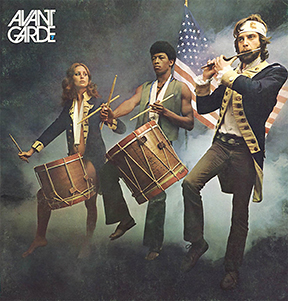
Avant Garde Number 7If you know something about the social and cultural climate in America during 1968-71, you can probably figure out what the magazine was about. For example, issue number 7 from March 1969 had a front cover photograph that is a parody of Archibald Willard’s famous patriotic painting “The Spirit of ’76”; Carl Fischer’s version of the image includes a white woman and a black man as two of the three Minutemen from the American Revolution.

You will have to look up Avant Garde magazine on the Internet for yourself to learn more about its editorial perspective. Suffice it to say that Ralph Ginzburg was the editor and Avant Garde “was extremely popular in certain circles, including New York’s advertising and editorial art directors.”

Most importantly, however, Avant Garde was a breakthrough publication creatively; during its four years of existence, it was the cutting edge of graphic design, especially typography. This is not hard to believe when you learn that the magazine’s art director was Herb Lubalin, one of the most important American graphic and type designers of the 1960s and 1970s.

*  *  *  *  *  *

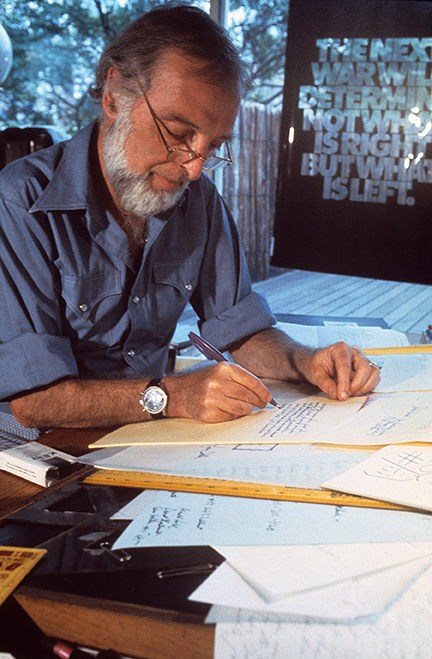
Herb Lubalin in his studio in 1975

Herbert F. Lubalin was born in New York City on March 17, 1918. As a high school student he did not show a particular interest in the graphic arts, although he liked to draw. He entered art school at Cooper Union at the age of 17 where his interest in typography was nurtured.

Herb graduated in 1939 and first worked as a freelance designer and typographer. It has been reported that he was fired from a position at a display company after he requested a two-dollar raise on his weekly eight-dollar salary.

Soon thereafter, and for the next twenty-five years, Lubalin worked as an art director for advertising agencies. The New York City firms he worked for included Deutsch & Shea, Fairchild Publications, Reiss Advertising and Sudler & Hennessey. During these years, Lubalin established himself as a genius of what would be later called “typographics” or “expressive typography,” i.e. words and letters as imagery with verbal and conceptual twists.

This was achieved through a meticulous creative approach to advertisements, trademarks and logos, posters, magazines and packaging design. In 1952, Herb won a New York Art Directors Club Gold Medal as creative director at Sudler & Hennessey, the first of hundreds of awards he would receive during his career.

After leaving Sudler in 1964, he established his own graphic design consultancy called Herb Lubalin, Inc. This was the first of multiple businesses and subsidiaries that Lubalin would found in both the US and Europe over the next two decades. In 1970, along with Aaron Burns and Edward Ronthaler, Lubalin created the International Typeface Corporation (ITC), one of the world’s first type foundries that had no history in hot metal type design.

Lubalin Smith Carnase
Lubalin established a partnership with Ernie Smith and Tom Carnase in 1967

Herb Lubalin achieved worldwide success as an art director and graphic designer during the “Mad Men” era (of the popular AMC TV series) of advertising. Lubalin became identified with graphic clarity and simplicity embodied in the following statement he made some years later, “Typography is a servant—the servant of thought and language to which it gives visible existence.”

In terms of the technology of type, this was the age of phototypesetting. The replacement of hot type with cold type meant that a new library of modern fonts could be developed. It also meant that type forms could be manipulated in ways that were extremely difficult, if not impossible, with the metal casting.

Although Lubalin’s ITC took up the task of preserving and reviving old classic faces such as ITC Bookman and ITC Garamond, the foundry also specialized in modern sans serif fonts such as ITC Franklin, ITC American Typewriter, ITC Kabel and ITC Bauhaus among many others.

ITC Fonts by Herb Lubalin and Others
Some of the fonts developed by Herb Lubalin and others at ITC in the 1960s and 1970s

Herb Lubalin’s relationship with Ralph Ginzburg—who was convicted in 1963 for violating US obscenity laws—was noteworthy. The two worked together on three of groundbreaking magazines: Eros (1962), Fact: (January 1964–August 1967) and the aforementioned Avant Garde.

Avant Garde magazine proved to be most significant for Lubalin, specifically for his design of the publication nameplate. The Avant Garde moniker became so popular that Lubalin, his partner Tom Carnase and the type designer Edward Benguiat developed an entire font set from it. What became the Avant Garde Gothic type design included a series of ligatures (combinations of two letters into one type element), an innovative development for a sans serif font.

Officially launched by ITC in 1970, Avant Garde Gothic became one of the most popular typefaces of the era. Although it came under criticism and was eschewed by the post-modernist graphic design community for its structural and grid-like consistency, Avant Garde Gothic was eventually included in the set of 35 base fonts on the Adobe PostScript print engine that was launched in the 1980s. For this reason, Avant Garde Gothic continues to be one of the most popular and often used alternatives to Helvetica.

Lubalin LogosHerb Lubalin designed some of the most memorable and lasting images of expressive typography that have ever been created. His publication nameplate for “Mother & Child,” logo for L’eggs and logo for the World Trade Center are part of iconic graphic design history.

Herb Lubalin had a near legendary reluctance to talk with anyone, especially the media and trade publications, about his work and some interpreted his reserved character as a lack of intellectual acumen. However, Lubalin was a very sharp advocate of his approach to his craft and he was not averse to sharing his knowledge with those who wanted to learn, particularly students.

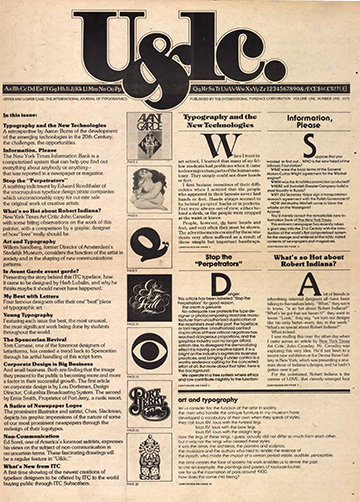
The first edition of U&lc, 1973

In 1973, Lubalin launched, became editor and art director of International Typeface Corporation’s quarterly in-house publication called U&lc (Upper and lower case). The journal became an instant force in the industry and rapidly built up a subscription circulation of 170,000 readers. It was in U&lc that some of Lubalin’s conceptions about graphic and type design can be studied and learned about.

The following statement—published in the introduction to Graphis Annual 65/66—shows that Herb Lubalin possessed a sharp, critical and iconoclastic attitude to the industry that he devoted his life to, “Advertising in the U.S.A. is a fairly stupid business. We have made it that way by underestimating the intelligence of the American people. The bulk of our output is devised to appeal to the sub-teen-age mentality of that great big consuming monster that we have created. Who’s responsible? Those of us that put absolute faith in antiquated, ineffective, stereotyped, outmoded, unreliable, unbelievable, valueless research methods such as copy testing. …  If recent statistics are any indication of the value of copy-testing, we would all be advised to spend our research money researching successful art-directors and copy-writers, knowledgeable creative people who have made their reputations not by fancy words and pretty designs, but by creating intelligent advertising that appeals to a surprisingly intelligent audience (the American people).”

Beginning in 1972, Lubalin began teaching graphic design at Cornell University and starting in 1976 he taught a course at Cooper Union where he remained until his death on May 24, 1981 at New York University Hospital.

*  *  *  *  *  *

I recently searched for copies of Avant Garde magazine on eBay and found that my high school art teacher was right about how they would be worth something. Although a full set of 14 editions is only going for several hundred dollars, I’m glad I still have my copies of an important piece of modern graphic and type design history.

The USPS and marketing mail

Postmaster General Patrick DonahoeOn August 8, Postmaster General Patrick Donahoe gave an interview to Bloomberg Businessweek concerning the budget crisis of the United States Postal Service. In response to the question, “What is the biggest problem facing the Post Office?” Donahoe said, “The Internet. The disruption with the Internet has been unrelenting. If we hadn’t lost the volume of bill payment to online, we wouldn’t have defaulted on our prefunding obligations. We wouldn’t have had to close the plants, and we’d be profitable with no debt.”

Like the rest of the offline and paper-based media industry, the USPS has been staggered by the impact of online communications and commerce. In the last ten years, the USPS has lost 60 percent of its annual first class mail volume, going from 51 billion pieces in 2003 down to a projected 21 billion pieces this year. That’s a lot of lost revenue. At 46¢ per piece, you are talking about $14 billion!

Printing Shipments and Postage Costs

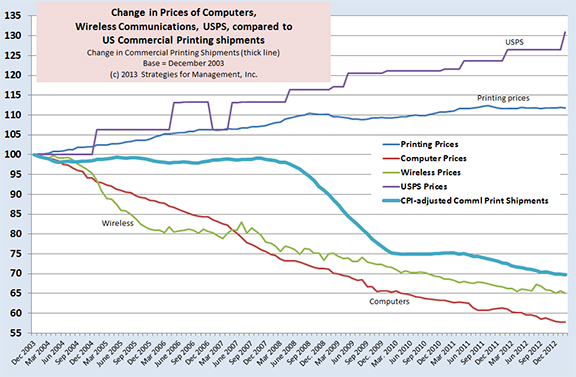
However, as important a factor as the Internet has been for the USPS, this is really one side of what has been happening. As the chart from Strategies for Management shows, over the same ten-year period, there have been multiple dynamic cost factors affecting the condition of the USPS as well as the rest of the print media business:

  • While quarterly volumes of printing shipments had already been declining for some years, the Great Recession of 2008-2009 accelerated this downward trend dramatically.
  • Although print prices appear to be increasing marginally, when factoring inflation, they are actually lower than they have ever been. Meanwhile, the fall in print prices has been achieved with increased operational and materials costs.
  • The cost of postage has increased exponentially relative to the dramatic decline in the costs associated with electronic alternatives to printed mail.

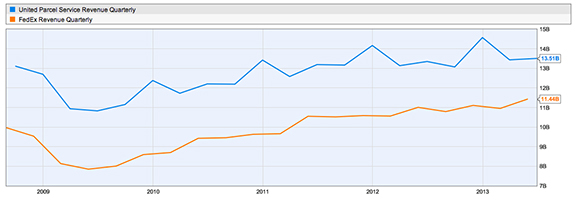
Another aspect of the problems facing the USPS, of course, relates to the growth of UPS and FedEx as alternatives. In the 80s and 90s, along with the growth of global economic integration, UPS and FedEx became dominant international package delivery solutions. For a host of complex reasons, the USPS reacted very slowly to this opportunity. Although it would have required infrastructure changes, had the USPS been able to offer a significant portion of the services now dominated by UPS and FedEx, it could have offset much of the losses stemming from the decline of first class mail.

UPS and FedEx RevenueThere has been widespread debate about what can or should be done to address the systemic crisis of the Postal Service. Most of the solutions focus on the massive budget deficit problems and include the following:

  • Elimination of the retiree’s health benefit prefunding requirement
  • Reductions in service such as elimination of Saturday delivery
  • Sale of real estate and facility assets
  • Privatization of the postal service

The conflicts over policy at the federal level regarding the USPS have resulted so far in an intensification of the crisis. It is the opinion of many experts that the current crisis of the Postal Service is the gravest in its 238-year history.

The Continental Congress created the American postal system on July 25, 1775 and Benjamin Franklin was named its first Postmaster General. Since that time, the post office has been through several critical transitions born of disruptive communications technologies such as radio, telegraph, telephone and television.

In its early days, the post office played a prominent role in the development of commerce as well as the westward expansion of the country. In 1788, Congress gave the postal service the authority to build roads and post offices and encouraged the use of stagecoaches to transport the mail, which now included newspapers.

In 1790 there were 75 post offices. By 1860 there were more than 24,000. Recognizing the powerful influence of the service and the Postmaster General, in 1872 Congress made the Post Office a cabinet department of the President.

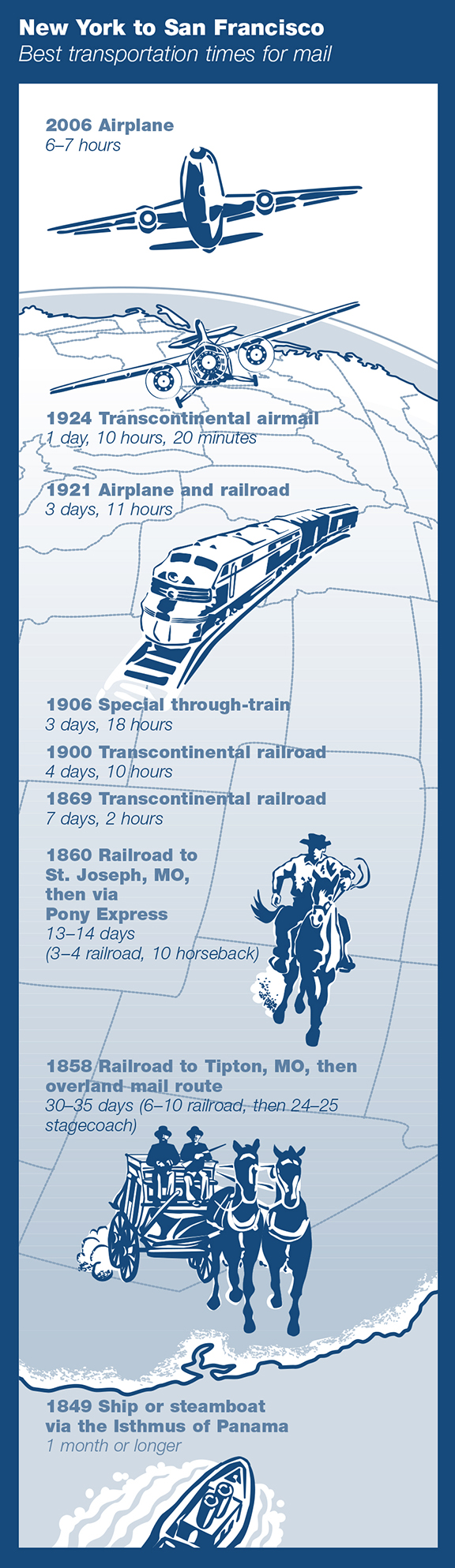
Transcontinental Postal Delivery SpeedsThroughout its history, the post office has benefited from innovations in transportation technology. Steamboats were introduced in 1811 and by 1820 there were 200 of these vessels delivering mail along US rivers. Initially, mail delivery from the east to the west coast went from New York by ship through Panama—using canoes and mules to the Pacific—and then from Panama to San Francisco. This service was offered at a rate of four weeks transit time.

An alternative method using stagecoach routes across the continent boasted 24-days delivery time but it often took months to get there due to the extreme weather conditions in the 2,000-mile stretch from Missouri to California. The overland transit time was cut in half with the start of the Pony Express in 1860. However, the Pony Express was ended within 18 months following the successful startup of the transcontinental telegraph on October 26, 1861.

Of course, the development of the railroads played an important part in moving the mail. By the time first transcontinental railroad was completed, there were Railway Post Offices that picked up the mail and sorted it en route in specially equipped rail cars. To this day, much of the US Mail is transported via train.

Experimental use of air transport for the mail began in 1911 and on May 15, 1918 the postal service began simultaneous flights from Washington and New York via Philadelphia. Shortly thereafter, Congress authorized “air-mail” postage at 24¢.

Following World War II, with the ubiquity of residential telephone communications, the content of the mail changed dramatically. By 1960, 80 percent of the mail was for business purposes instead of personal correspondence. The expansion of utility bills and payments, bank deposits and receipts, advertising, magazines, credit card transactions, mortgage bills and payments and Social Security checks meant that the post office had to find a better way to manage the mail.

Postmaster General J. Edward Day launched the ZIP (Zoning Improvement Plan) code system on July 1, 1963. It was based upon a postal zone system based on the major cities that had been set up in 1943. The five-digit codes made it possible for the post office to take advantage of computerized and automated systems for scanning, sorting, etc. to smooth and speed up the process of delivery.

In many ways the problems facing the USPS today stem from a crisis of the system that emerged in the 1960s. Unable to keep up with demand and the explosion of mail volume, the Chicago Post Office came to a dead stop in October 1966. The Postal Reorganization Act of 1970 transformed the Post Office Department into the United States Post Office and put into place the structural elements that exist today.  Now the USPS is facing the opposite problem of a decline in mail volume.

In March of this year, Mr. Donahoe gave remarks to the attendees of the National Postal Forum in San Francisco. Talking about the challenges facing the industry he said, “30 years ago, marketing mail claimed roughly 12 percent of the total marketing spend in the U.S. economy. Do you know what that number is today? It’s still 12 percent. With all of the changes in the way businesses can reach consumers, marketing mail has remained constant because of the tremendous value it delivers—for both the sender and the receiver. Marketing mail still remains the most effective way for companies to drive sales and it still delivers an exceptional return on investment.”

With this bit of optimism, Donahoe went on to outline four challenges before the mailing industry:

  • Make mail more personally relevant
  • Make mail more actionable
  • Make mail more functional
  • Make mail for creative

Clearly, these are challenges for both the printing firms that possess the technologies that manufacture the mail as well as the creatives who conceptualize and design the mail. With so much emphasis today on data driven and digitally personalized print, the future and viability of the USPS is a critical factor in being able to do what Donahoe is recommending.