Louis Moyroud: 1914 – 2010

WonderfulWorldofInsectsIt is likely you have not read the 1953 edition of “The Wonderful World of Insects” by Albro Tilton Gaul. That’s OK. To be honest, I haven’t read it either. However, I do have a copy and I know that it is a very important book … not so much because it is about insects. “The Wonderful World of Insects” is important because it is the first book ever produced with phototypesetting.

Prior to 1953, almost everything being printed used the casting method known as “hot type.” The mechanized production of molten metal type characters was first created by Gutenberg in the 1440s and his technique thrived for over 400 years. The system was revolutionized by Mergenthaler’s Linotype machine in the 1880s.

Beginning in the 1940s, with the invention of “cold type” by Louis Moyroud and his fellow inventor Rene Higonnet, the typographic process was again being revolutionized. Moyroud and Higonnet’s breakthrough was significant because type creation went from being a mechanical to an electronic process. But more fundamentally, the two French engineers had initiated technologies that would later lead to a transformation of the graphic arts from analog to digital technology. This evolution is not complete. It continues developing to this day.

Louis Marius Moyroud was born on February 16, 1914 in Moirains, Isère, France and was the only child of Marius and Ann Marie Vial Moyroud. Louis never knew his father, who died when he was an infant. His mother worked in a textile factory.
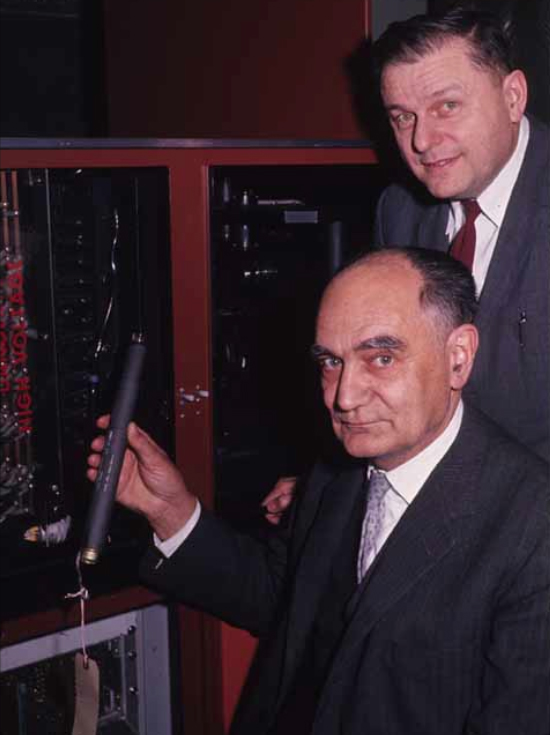
HigonnetandMoyroud
Higonnet and Moyroud with one of their devices at MIT in the 1960s.

As a student, Louis was outstanding. He received government support to study engineering at one of the best institutions in France, École Nationale Supérieure d’Arts et Métiers and he graduated in from there in 1936. Upon graduation, he served in the French army as a second lieutenant and was promoted to first lieutenant in 1939.

Louis’s work as an inventor began after 1941, when a subsidiary of ITT Corporation in Lyon called LMT Laboratories hired him. International Telephone and Telegraph was by this time a global corporation that owned both telephone services infrastructure and manufacturing operations that produced telephone equipment.

In the early 1940s, Louis was working with Rene Alphonse Higonnet when they observed the traditional process of hot metal typesetting in a French printing plant. Based upon some scientific breakthroughs associated with light, optics and photography, Moyroud and Higgonet believed that an alternative to the casting of molten metal typesetting could be developed.

As with many breakthrough technologies, there were many people trying to displace hot metal typesetting with a more advanced system. Moyroud and Higonnet were the first to build a functioning solution that was made into a commercial product. Much of the pressure to find a viable photographic typesetting system was being driven by the replacement of the letterpress printing method by offset lithography.

02moyroud_1-popup
Louis Moyroud in 1985.

According to Louis’s son Patrick, “My dad always said they thought it was insane [the Linotype process].  They saw the possibility of making the process electronic, replacing the metal with photography. So they started cobbling together typewriters, electronic relays, a photographic disc.”

Moyroud and Higonnet worked throughout the war years on their project and first demonstrated their invention in September 1946 in Lyon. Their first functioning photocomposing machine used a typewriter, a strobe light and a series of lenses to project characters from a spinning disk onto photographic paper. The typeset copy could then be used to make printing plates. Moyroud and Higonnet called their machine the Lumitype.

02moyroud_2-popup
The machine created in 1946 by Moyroud and Higonnet. They called it Lumitype.

With the post-World War II technology revolution underway, Louis and Rene moved to the United States to pursue the commercialization of their concept. They approached Vannevar Bush, president of MIT and President Roosevelt’s top technology adviser, with their prototype. Bush put them in touch with William Garth, President of Lithomat Corporation, a Cambridge, MA manufacturer of presensitized offset duplicator plates.

Garth was convinced that a successful phototypesetting system would stimulate the growth and expansion of offset printing and drive sales of his Lithomat plates. He formed the Graphic Arts Research Foundation to raise financial resources for the development and marketing of Moyroud and Higonnet’s invention. Encouraged by the possibility of dramatic cost reductions in the print production process, Garth attracted support from major newspaper publishers, book printers and traditional typesetting services.

MITBookAfter several years of development work, significant support for the project came in. Garth spent over $1 million to create a prototype phototypesetter. He also changed the name of his firm to Photon, Inc. The prototype device was called Petunia and it was used to set the type of the “Wonderful World of Insects” in 1953. In 1957, Moyroud and Higonnet were granted a patent for their invention and tens of thousands of phototypesetting machines were sold.

For more than 30 years, this method of producing type was dominant for printing, publishing and advertising copy. Mechanical artwork was produced by “paste up” artists around the world for reproduction on offset lithographic printing presses. Hot metal type and letterpress printing rapidly receded into the background, although some Linotype-generation systems remained in use for specialty work and that continues today.

In 1985 (two years after the death of Higonnet), Louis Moyroud and Rene Higonnet were inducted into the National Inventors Hall of Fame in Alexandria, Va. Ironically, 1985 is also the year of the advent of desktop publishing, a technology that would— within a few years—completely displace phototypesetting as a method of producing type for print. This fact shows that phototypesetting was a transitory development along the path of the digital transformation of the graphic arts.

Louis Moyroud continued his work on phototypesetting systems into the 1980s and his career as an inventor extended beyond the displacement of his most important contribution. He retired to Delray Beach, Florida where he later died in June 2010 at the age of 96.

Frank Romano, who worked with Moyroud as the advertising manager of Photon in 1969, wrote the following tribute to Louis, “He had a wonderful sense of humor and an unassuming demeanor. He had collected most of the early phototypesetters and donated them to the Museum of Printing in North Andover. Petunia is on display.

“John Crosfield, Rudolf Hell, Benny Landa, and Dan Gelbart are among the inventors who moved the printing industry to new levels, but the era of automation began with Louis and Rene. Louis is now gone and revolution he began is now ended. But other revolutions continue.”

2013: A big year for Big Data

The year 2013 will be important for a couple of reasons. Believe it or not, 2013 marks the twentieth anniversary of the World Wide Web. It is true that Tim Berners-Lee developed the essential technologies of the web at CERN laboratory in Switzerland in 1989-90. However, it was the first graphical browser called Mosaic—developed by a team at the National Center for Computer Applications at the University of Illinois-Urbana—in April 1993 that made the web enormously popular.

ncsa-mosaic

Marc Andreessen, developer of the first graphical web browser Mosaic in 1993.
Marc Andreessen, developer of Mosaic the first graphical web browser in 1993.

Without Mosaic, brainchild of UI-U NCSA team member Marc Andreessen, the explosive growth of the web in the 1990s could not have happened. Mosaic brought the web outside the walls of academia and transformed it into something that anyone could use. In June 1993 there were only 130 web sites; two years later there were 230,000 sites. In 2007 there were 121 million web sites; it is estimated that there are now 620 million web sites. Now that qualifies as exponential growth.

This brings me to the second reason why this year is important: worldwide digital information will likely surpass 4 zettabytes of data in 2013. This is up from 1.2 zettabytes in 2010. Most of us are familiar with terabytes; a zettabyte is 1 billion terabytes. In between these two are petabytes (1 thousand terabytes) and exabytes (1 million terabytes). 2013 is going to be a big year for Big Data.

Companies that grew up in the age of the World Wide Web are experts at Big Data. As of 2009, Google was processing 24 petabytes of data each day to provide contextual responses to web search requests. Wal-Mart records one million consumer transactions per hour and imports them into a database that contains 2.5 petabytes. Facebook stores, accesses and analyzes 30+ petabytes of user-generated data.

DataTerms

The expansion of worldwide Big Data and the metric terms to describe it (yottabytes or 1,000 zettabytes are coming next—beyond that is TBD) has become the subject of much discussion and debate. Big Data is most often discussed in terms of the four V’s: volume, velocity, variety and value.

Volume

The accumulation of Big Data volume is being driven by a number of important technologies. Smartphones and tablets and social media networks Facebook, YouTube and Twitter are important Big Data sources. There is another less visible, but nonetheless important, source of Big Data: it is called the “Internet of Things.” This is the collection of sensors, digital cameras and other data gathering systems (such as RFID tags) attached to a multitude of objects and devices all over the world. These systems are generating enormous amounts of data 24/7/365.

Velocity

The speed of Big Data generation is related to the expansion and increased performance of data networks both wired and wireless. It is also the result of improved capturing technologies. For example, one minute of high definition video generates between 100 and 200 MB of data. This is something that anyone with a smartphone can do and is doing all the time.

Variety

The Big Data conversation is more about the quality of the information than it is about the size and speed. Our world is full of information that lies outside structured datasets. Much of it cannot be captured, stored, managed or analyzed with traditional software tools. This poses many problems for IT professionals and business decision makers; what is the value of the information that is largely “exhaust data”?

Value

There are good internal as well as external business reasons for sharing Big Data. Internally, if exhaust data is missed in the analytical process, executives are making decisions based upon intuition rather than evidence. Big Data can also be used externally as a resource for customers that otherwise would be unable to gain real-time access to detailed information about the products and services they are buying. It is the richness and complexity of Big Data that makes it so valuable and useful for both the executive process and customer relationships.

Every organization today is gathering Big Data in the course of its daily activities. In most cases, the bulk of the information is collected in a central EMS or ERP system that connects the different units and functional departments of the organization. But more likely than not, these systems are insufficient and cannot support all data gathering activities within the organization. There are probably systems that have been created ad-hoc to serve various specialized needs and solve problems that the centralized system cannot address. The challenge of Big Data is to capture all ancillary data that is getting “dropped to the floor” and make it useful by integrating it with the primary sources.

Making Big Data available offers organizations the ability to establish a degree of transparency internally and externally that was previously impossible. Sharing enables organization members and customers to respond quickly to rapidly changing conditions and circumstances. Some might argue that sharing Big Data is bad policy because it allows too much of a view “behind the curtain.” But the challenge for managers is to securely collect, store, organize, analyze and share Big Data in a manner that makes it valuable to those who have access and can make use of it.

I remember—upon downloading the Mosaic browser in 1993 with my dial up connection on my desktop computer—how thrilling it was to browse the web freely for the first time. It seemed like Mosaic was the ultimate information-gathering tool. I also remember how excited I was to get my first 80 MB hard disk drive for data storage. The capacity seemed nearly limitless. As we look back and appreciate the achievements of twenty years ago, we now know that those were really the beginnings of something enormous that we could not have fully predicted at the time.

With the benefit of those experiences—and many more over the past two decades of the transition from analog to online and electronic media—it is important to comprehend as best one can the meaning of Big Data in 2013 and where it is going. Those organizations that recognize the implications and respond decisively to the challenges of the explosive growth of structured and unstructured data will be the ones to establish a competitive advantage in their markets.

Ira W. Rubel: 1860 – 1908

Illustrator and painter Robert Thom’s depiction of the invention of the offset printing press by Ira W. Rubel and his assistants in Nutley, NJ in 1903.
Ira Washington Rubel

Walter E. Soderstrom, the noted authority on print technology, wrote in the Photo-Lithographer’s Manual of 1937: “The origin of the offset press is one of the least discussed subjects in the literature of printing.”

In preparing this brief sketch of the life of Ira Rubel and his invention of the offset printing press—an extraordinarily important event in the history of modern print technology—it is evident that nothing much has changed since Soderstrom’s time. To this day, there is little accessible and authoritative information about Ira Washington Rubel: his work or his life. In fact, most of what is easily found either trivializes Rubel’s contribution—as bumbling or happenstance rather than the work of an earnest inventor—or glosses over its historic significance. There is currently no biographical Wikipedia entry on the man and his accomplishment; photos of Ira Rubel are very hard to find.

Ira Washington Rubel was born in Chicago on August 27, 1860. He attended Hayes and Division West High Schools in Chicago. He graduated from the University of Chicago in 1881. Rubel then attended Northwestern University in Evanston where he was a classmate of William Jennings Bryan and graduated with a Bachelor of Law in 1883. He litigated cases as a practicing attorney for a short time in Chicago.

The printing firm Rubel Brothers—which Ira founded along with his brother Charles in 1881—is listed in the Lakeside Annual Directory of the City of Chicago of 1887. During the 1880s, Ira became known for having been a pioneer in the manufacture of loose-leaf systems. Promoting the systems for the maintenance of business transactions records, the Rubel Loose Leaf Mfg. Co. was established on Superior Street in Chicago.

Advertising by the Rubel Company in a Chicago business publication.

By 1899, the Rubel brothers’ firm acquired both a six story building on Wabash Street in Chicago as well as a paper mill. At some point, Ira Rubel and his three brothers expanded to the east coast and established an office on Broadway in New York City. They also opened a lithographic printing and paper mill facility in Nutley, New Jersey.

By 1901, the Rubel Brothers Paper & Manufacturing Co. on Kingsland Street in Nutley, NJ experienced significant growth and expanded its facilities. It was at this plant that Ira would conduct his experiments, discover the offset printing method and build the first offset lithographic printing press.

Offset printing is also known as “indirect” printing, i.e. the printed image is not applied directly to paper from the printing plate or inked image carrier, but is first transferred to a rubber blanket and then to paper. Although indirect ink transfer had already proven its importance for at least 25 years in tinplate (canned goods) printing, the concept was not obvious in paper-based lithographic printing due to the dominance at the time of the letterpress technique especially in typographic reproduction.

Perhaps one of the reasons for the lack of literature on Rubel’s discovery is the fact that the offset method was the result of more than fifty years of seemingly disconnected technological developments in both typographic and pictorial reproduction. In 1875, Robert Barclay of Barclay & Fry obtained an English patent for the very first offset press that transferred the printed image from the lithographic stone to a cardboard surface and then to sheet metal (used in making biscuit tins). The discovery of halftone photographic and process color reproduction in the 1880s was also a factor that motivated the invention of offset.

In 1903 and 1904 Rubel experimented at the Nutley facility with photo reproductions transferred onto lithographic stone through a screen. Although the testing did not yield significant results, Rubel’s work on a stop cylinder press led inadvertently to an important breakthrough. When his assistant miss fed a sheet and the rubber impression roller came into contact with the lithographic stone, the reversed image was transferred this roller. When the next sheet was fed, it had an image on both sides: one that was product of the direct contact with the stone image carrier as intended and the other with a wrong-reading image from the “indirect” rubber roller.

Once the “indirect” image was found to be superior in quality to the direct one, Rubel and his collaborators expanded their testing along these lines and perfected the technique. This included a complete redesign of the press based upon the offset principle.

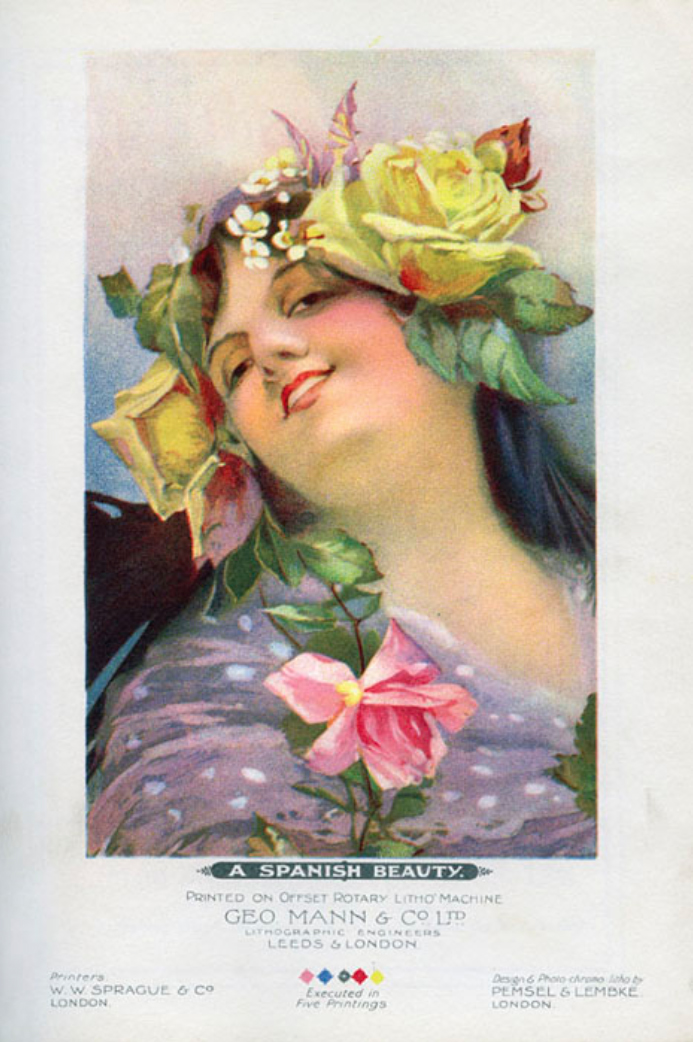
One of the first process color prints produced on an offset press. It appeared in Penrose’s Annual Pictorial in 1910.

As Ira was convinced of the importance of his discovery, he returned to Chicago to seek the technical assistance of lithographer Alexander B. Sherwood. The two also enlisted the financial support of Andrew Kellogg of New York as a venture partner. Although the arrangement did not last, three presses were built and each man took one of them as their share of the achievement.

Court rulings made it impossible for Rubel to obtain a US patent for his discovery because the pre-existing use of the offset method by tinplate printers was legally invoked. Therefore, each of the partners—Rubel, Sherwood and Kellogg— went their separate ways with the new invention. The Kellogg Offset Press was built in New Hampshire, Sherwood joined the Potter Printing Press Company of Plainfield, NJ and Ira Rubel took his idea to England where he thought he might obtain a patent for it. In 1906, Rubel met the New Zealander Frederick Sears and together they launched what became known as the Sears “Highlight” process.

Rubel and his family never realized any fortune from his invention. He died of a stroke at the age of 48 while at the Derby Hotel, Bury, Lancashire, according to relatives, from “the worry and work occasioned in seeking to protect his patents and marketing his inventions in Europe and America.”

An obituary published in the September 19, 1908 edition of The American Stationer reported, “Ira W. Rubel, pioneer manufacturer of loose leaf systems and inventor of the offset printing press which did much in the progress of lithographic development, died suddenly in London of apoplexy. Mr. Rubel was formerly connected with the Rubel Brothers’ Company, which was succeeded by the Rubel Manufacturing Company. Mr. Rubel left Chicago ten years ago, and took up his residence in New York. His remains will be buried in Chicago in Graceland cemetery, by the side of his wife.”

There is no doubt that Ira Rubel’s invention—and the independent and concurrent work of Charles and Alfred Harris of Niles, IL—came to transform the printing industry worldwide. The offset lithographic process was greeted initially within the industry with mixtures of enthusiasm, skepticism and opposition. As with many previous and future breakthroughs in the graphic arts, there were those who could see offset’s potential and those who were advocates of the dominant letterpress of the previous technology generation.

It would take fifty years before the superior quality, speed and economics of offset overtook letterpress as the dominant printing method internationally. By 1960, the majority of printed matter was being produced on offset equipment. Today, with digital printing systems advancing rapidly in recent decades, offset still represents more than half of the $800 billion of worldwide annual printing shipments. More than a century after Ira Rubel’s invention, the dominance of offset printing will continue for many years—some even say decades—to come.