Between papyrus & flexible e-paper displays: Two millennia of paper

We often take paper for granted. When searching for a dollar bill, filling up a fountain drink cup or moving a leaf bag to the curb, do we think about paper? Probably not. We are focused on the useful purpose of these daily items and don’t have time to stop and think about how they are made or what they are made of.

Christian religious text written on papyrus

Paper in all its different forms, qualities and applications has been around for a very long time. Most commonly, paper is thought of as a medium for the written or printed word. This is natural since paper—the word is derived from the Latin term papyrus—was developed as a writing surface 1,800 years ago by the Chinese to replace wood and bamboo scrolls.

The papermaking process—basically unchanged since Ts’ai Lun invented it in 105 AD—is a marvel of human ingenuity. Distinct from the papyrus of ancient Egypt, where thinly cut plant stalks were woven and laminated together, paper is the reduction of a raw material to individual fibers and their liquid suspension onto a mat or sheet.

With today’s instant global communications and world travel, it might seem strange that it took 500 years for papermaking to leave China and arrive in Japan and nearly 1,000 years for it to reach Europe. Nonetheless, paper’s global growth and development is an important chapter of world history.

  • In the seventh century, the Japanese were the first to recycle and repulp paper. In 750 AD, after a battle between the Chinese and the Muslims in what is now Uzbekistan, a group of Chinese prisoners revealed their secrets to their Middle Eastern captors. Once the Muslims began making paper, they went on to develop water powered stamping/hammer mills for the pulping process.
  • Papermaking entered Europe through the Muslim Moors of southern Spain in about 1100 AD. At that time, most European documents were recorded on parchment, a writing surface of sheepskin or vellum from calfskin. Since Europe was majority Christian and it was the time of the Crusades, the papermaking techniques of the Moors were not discovered by Europeans until after the military campaigns were concluded in the south. Once the Vatican was exposed to the wonders of papermaking, Italy emerged as the primary producer of paper in Europe.
  • In the thirteenth and fourteenth centuries the center of papermaking moved from Italy to France when the craft was encouraged by the monarchy. Just as demand for handwritten documents was on the rise, metallurgist Johann Gutenberg invented the mechanical methods of type setting and printing in Mainz, Germany in 1450. As the printing press spread throughout Europe, the volumes of paper being produced by the mills in France and Italy grew exponentially.
  • By the eighteenth century, papermaking had moved largely to Germany and Holland due to the social and political instability in France. Meanwhile, the technology of the paper industry was undergoing a transformation brought on by the emergence of manufacturing throughout Europe. These are the same industrial developments that impacted printing presses; iron in place of wood; steam in place of manpower or other natural forces such as wind and water.
The Fourdrinier paper machine and portrait of Nicholas-Louis Robert
  • In 1800, a Frenchman named Nicholas-Louis Robert patented an invention that converted papermaking into a mass production industry. Robert’s paper machine had a continuous wire screen upon which the slurry was poured so that the excess water would pass straight through it. The paper in formation was progressively dried by a series of felt rollers until it was solid enough to be wound onto a roll. Thus, paper no longer needed to made in individual sheets.
  • Several years later, Robert’s invention was sold to the Fourdrinier brothers of London where they constructed a much larger version of it. In 1812, the first Fourdrinier—the name associated with Robert’s invention and remains the primary method for papermaking to this day—machine was started up in a mill near Two Waters, England. Later, cylinders for pulp transport, drums for drying and techniques to prevent ink absorption into the fibers of the paper (sizing) would modify the Fourdrinier system.
  • By the mid nineteenth century, the center of papermaking moved to America and played an important role in the growth of newspaper publishing around the time of the Civil War. Up to this point, the fiber for papermaking—especially in Europe—came from the fabric in rags. But with the vast forests of North America, wood fiber quickly became the source of paper pulp and groundwood the essential raw material for the newsprint industry.
  • In the twentieth century, as printing technology moved from black and white letterpress to full color offset lithography, coated papers were developed. The papermaking process evolved from offline to inline coating systems. Today, the pulp and paper industries worldwide are going through a transformation born of the global economy and the shifting of paper consumption from west to east. According to industry data, paper consumption in the advanced world is falling rapidly—brought on by electronic media and recycling practices—while paper consumption in the developing world is rising even more rapidly. In 2009, for example, paper consumption in China surpassed that of the United States for the first time.
Text displayed on Gyricon e-paper and Nick Sheridon

While paper remains the number one media for publishing, electronic and online alternatives have been in development and grown rapidly over the last several decades. In the 1970s, Nick Sheridon at Xerox’s Palo Alto Research Center (PARC) developed the world’s first electronic paper, called Gyricon. It consisted of microscopic polyethylene spheres with black on one side and white on the other embedded in a silicon sheet. With the appropriate electronic charge this e-paper could be used over and over again to display an unlimited number of different images much like a computer monitor.
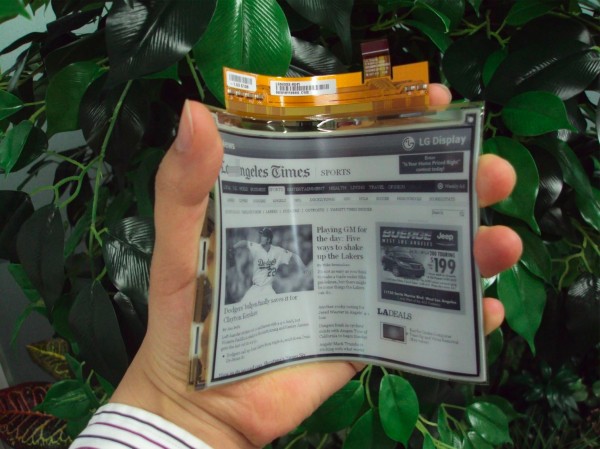
LG’s six inch flexible e-paper display

In 2007, Amazon began marketing the Kindle e-book reader based on a principle similar to Sheridon’s invention. The Kindle emulates the visual characteristics of book paper because it relies upon reflective light as opposed to the transmissive backlighting of computer displays. Although these technologies lack the surface flexibility of paper, there are developments underway that will soon bring that attribute to electronic publishing. For example, in March of this year, LG unveiled the world’s first commercially available six-inch e-paper display that can be bent at an angle of up to 40 degrees.

While good old-fashioned paper will be around for a long time—ensured by its utility, durability, recyclability and cost—the one sector where we can now visualize its decline and disappearance is in the publication of books, magazines and newspapers. Perhaps by that time we will better appreciate the miracle of paper and no longer take it for granted.

Digital trends: Where’s your camera?

In June 1994, I bought my first digital camera: an Apple QuickTake 100. It was the first consumer-level digital camera and cost about $695. Developed jointly by Apple and Kodak, it was a fascinating breakthrough device.

On the day I bought the camera, I connected it via serial cable to my Mac, installed the QuickTake 1.0 software (from a floppy disk) and downloaded the first digital photos I had ever taken. I brought the pictures into Photoshop and started editing them; these were images that did not come from film and did not require scanning. Wow, I thought, how much time am I going to save with this nifty little camera.

Well, not so fast. The images had a resolution of 640×480 pixels (about one third of a megapixel in today’s terms) and were not very useful for print reproduction. But they were perfect for standard definition video display and I could see how they could be used in presentations and slide shows.

Over the next few years, while I was fiddling around with the novelty of digital photography, I continued using my Canon 35mm SLR to shoot film negatives and transparencies. I’d shoot rolls of film and drop them off at the local camera store for processing and print making and continued to do this for many more years. It wasn’t until 2000 that I made the transition permanently to digital photography.

Fast forward to 2012 … Last weekend, for the first time I deposited a check into my bank account using the mobile banking app on my iPhone. I also shot a video and took photos of a family picnic in my back yard and posted the photos and video to my Facebook page immediately. I was even able to assemble and edit my video clips using the iMovie app on my iPhone.

And, on the same weekend, I saw someone using an iPad to shoot video of a football scrimmage … they were using the iPad screen as a viewfinder as they followed the players down the football field.

Needless to say, in the 18 years between these different experiences, camera technology has undergone a transformation. The last two decades have seen the replacement of conventional film photography with digital photos, but also more recently, the displacement of single purpose digital cameras (both video and still) by smartphones.

The pace and magnitude of these dual transformations are seen clearly in the answers to the following questions:

When did digital photography eclipse film photography?
In 1990 100% of photography was analog/film based. Ten years later, in 2000, just 99% of photography was still analog while 1% was digital. The big change took place over the past decade. By 2011, 99% of photography was digital and 1% film.

How many photos are being taken?
It has been estimated (by 1000memories blog) that since photography was first invented in 1838, there have been 3.5 trillion pictures taken. Today, every two minutes, we snap as many photos as were taken by all of humanity in the entire 19th century. In 1990 there were 57 billion photos taken, in 2000 there were 86 billion taken and in 2011 there were 380 billion taken.

Are mobile and smartphones replacing cameras and camcorders?
It has been estimated (by NPD Group) that in 2010 camera phones accounted for 17% of all images while point and shoot and camcorders accounted for 52%. In just one year, these numbers changed to 27% by camera phones and 44% by point and shoot and camcorders. The balance of the imagery is still dominated by higher end digital photographic and video equipment.

Where are all the digital photos being stored?
The biggest library of online photos is Facebook. It has been estimated (by pixable blog) that over 100 billion photos have been uploaded into Facebook its by users. The following is a list of the top photo sharing sites and their image volumes:

  • Photobucket: 10 billion photos
  • Picasa: 7 billion photos
  • Flickr: 6 billion photos
  • Instagram: 400 million

Instagram is the fastest growing online photo sharing technology and it was purchased by Facebook earlier this year for $1 billion.

The ubiquity and ease of use of cameras on smartphones—capable of shooting high quality color photos and video—combined with social networking and photo sharing have led to an explosion in digital photography. Almost anyone can capture a scene at any time and people are doing it, all the time.

As with other developments in our digital world, a transformation of one kind—the replacement of film by digital photography—is not fully completed when a transformation of another kind—the replacement of digital point-and-shoot cameras and camcorders by camera and smart phones—accelerates the entire process and evolves in an unanticipated direction.

It is these sudden and unexpected twists that make navigating the business environment such a complex task. The challenges facing Kodak, which filed for bankruptcy reorganization last January, is an expression of the way these rapid changes can impact companies and entire industries. Once the king of analog photographic equipment and supplies as well as an originator of the digital camera revolution, Kodak announced on August 23 that it was selling off its film division.

The ability to see and understand the convergence and successive waves of digital transformation, and the way these impact the behavior of our customers, is the only way to keep pace in our rapidly changing world and make plans for the future.

Beyond “tweets” and “friends”: the meaning of social media

I was not surprised when I learned that the term “retweet” was added to the 12th Edition of the Oxford English Dictionary. New words born of the social media revolution are everywhere. It’s an odd fact of our social media world that you can be “unfriended” on Facebook and not even know it. If you’re interested, you can read a discourse on the politics of unfriending here: http://www.facebook.com/topic.php?uid=4647588319&topic=4080

Treatises on the significance of social media are abundant. A search of Amazon’s book listings for “social media” turned up 102,071 paperback titles, 46,597 hardcover titles, 1,461 Kindle edition titles and 24 audio editions. The majority of these are how-to books for business: marketing and branding advice, tips on moneymaking and metrics for measuring success. Apparently, one can create a business out of social media by writing a book on the subject!

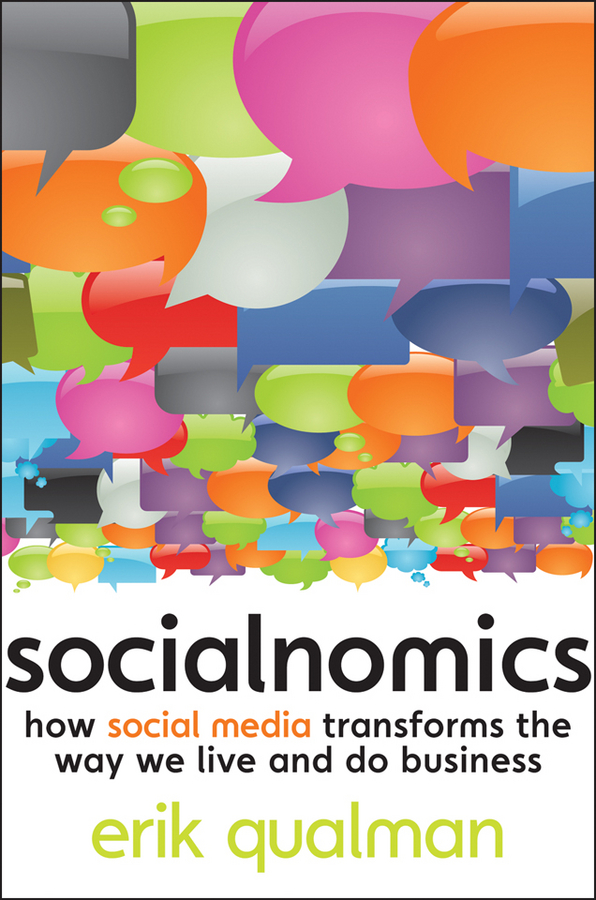
I won’t offer a how-to on the business opportunities present in social media; you should be pursuing this on your own already. What interests me is the broader implications of the social media; how is it different than previous media, how is it impacting our lives and where is it going? That’s what brought me to the book by Erik Qualman, “Socialnomics: how social media transforms the way we live and do business.”

Qualman, a marketing executive at EF Education and an MBA professor at Hult International Business School, sets himself a high bar with his title. However, I’m not sure he reaches his goal, even in the revised and updated edition.

Let me start with the positive. The core of Qualman’s theory of social media is found in the introduction where he states: “Socialnomics is the value created and shared via social media and its efficient influence on outcomes (economic, political and relational, etc.). Or more simply put, it’s Word of Mouth on digital steroids.”

I think his idea is basically correct, although the term “socialnomics” and the “value created” assertion should be debated. Social media transforms activities previously associated with word-of-mouth communications (exchanges between people that multiply) and accelerates them exponentially beyond anything previously possible. What we are living through is the evolution from simple verbal contact between individuals in one location to (potentially) a worldwide exchange between all individuals in all locations.

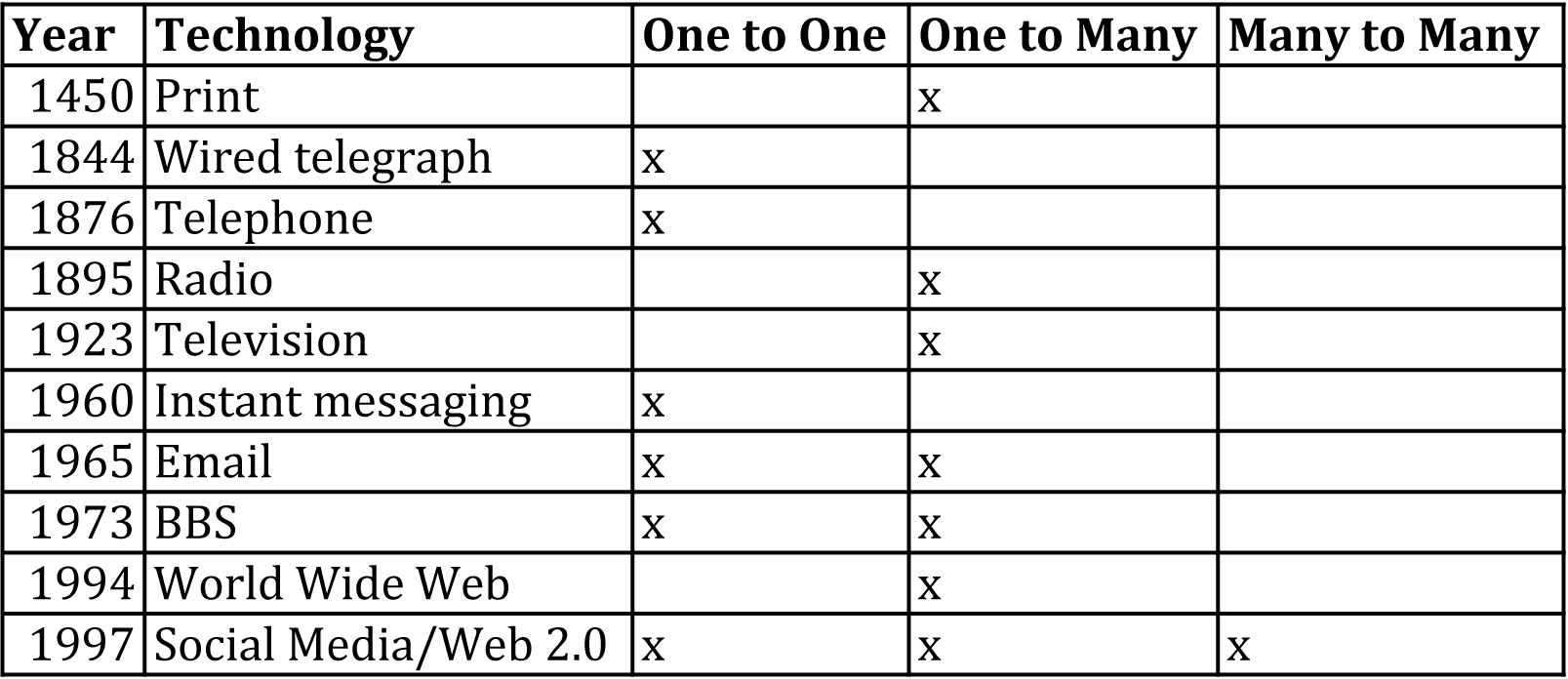
To illustrate this point, let us look at communications technology from the time of Gutenberg up to the present. When comparing the creator/recipient spectrum of social media to all previous technologies (dates subject to review), the transformation becomes apparent:

Social media, originating with what we know as Web 2.0 (online user-generated content, the Wiki phenomenon or web-as-participant-platform), has changed forever communications between people. We are no longer restricted to information from establishment sources or individual contact between our limited circle of friends and family; everyone can now simultaneously consume and create in the worldwide media-scape.

What Qualman does next is review, through case studies, the ways that this alteration in communications has been used, especially in business. He gives positive and negative examples. He examines the use of social media in the 2008 presidential campaign of Barack Obama. Many of these stories are interesting.

But this is also where the book falls down. His case studies are anecdotal and poorly researched. His conclusions are platitudinous and silly. Qualman has written an entire chapter called, “Social Media=Braggadocian Behavior” to explain that people use social media to compete for “who’s doing the coolest thing.” In my opinion, this only serves to reinforce negative perceptions of social media as a medium to post mundane daily activities. Of course, this is happening; much the same as it does with letter writing or telephone calls. This fact does little to reveal the underlying significance of what is happening.

YouTube, LinkedIn, Facebook and Twitter are the names of the services most associated with social media. In just a few short years, hundreds of millions (even billions in aggregate) worldwide are using these technologies to communicate in entirely new ways. We need to understand social media in the context of the breakthroughs and limitations of its predecessors in order to take advantage of the opportunities that it represents.