Aldus Manutius: 1449/1450 – 1515

The great cultural movement called the Renaissance (rebirth) spanned the fourteenth to the seventeenth centuries. This places Johannes Gutenberg’s 1450 invention of printing early in that era. As is widely acknowledged by historians, printing was not only the most important technological achievement of the Renaissance; it was also its greatest catalyst.
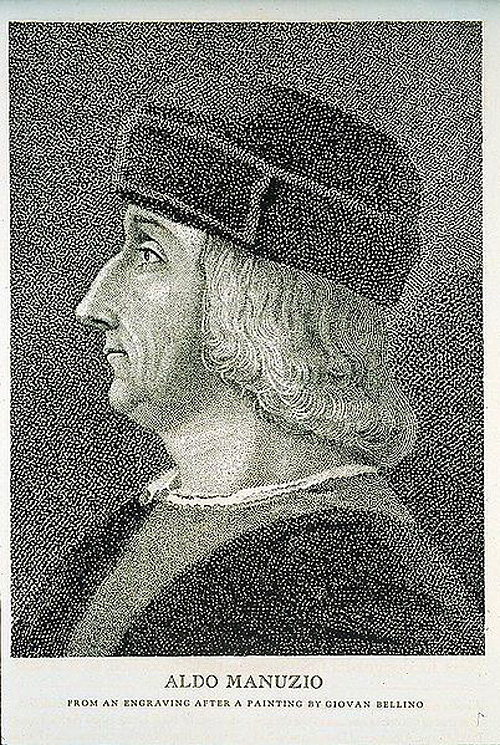
Aldus Manutius
Aldus Manutius: 1449/1450 – 1515

Along with the expansion of world trade and the circumnavigation of the globe—combined with enthusiasm for Gutenberg’s innovation—printing spread rapidly from Germany to destinations across Europe and elsewhere. And, as the business and products of “mechanical writing” proliferated, the knowledge that came along with it multiplied exponentially.

Eventually, like so many printing press pebbles tossed into the global pond, the ripple waves of literacy and democracy spread and connected with one another. By the eighteenth century, the achievements of the Renaissance led to the age of Enlightenment. And so, one of the most remarkable end results of this technical and cultural transformation was the American Revolution of 1776 … but that takes us a long way from the subject of this review.

The Renaissance, especially in Italy, was shaped by humanist teachings, i.e. the notion that citizens should be educated in the humanities (language, literature, philosophy, religion and the arts). Florence, Naples, Rome, Venice and Genoa were among the centers of Italian humanism. Great collections of antique hand written manuscripts and also printed books were assembled in libraries and made available for study primarily for those of wealth and means.

It was within this environment that Aldo Manuzio (Aldus Manutius is Latinized) was born in Bassiano, Italy about 100 kilometers south of Rome. The precise date of his birth is not known. It has been surmised that he was born in 1449 or 1450 from the preface to a book published by Aldus’ grandson, Aldus, The Younger, in 1597.

Very little is known about Aldus’ early life. In his The Rudiments of Latin Grammar published in 1501, Aldus mentions he was trained in Latin at a young age. This information—along with the fact that he had an ancestor that was a Bishop—indicates that his family was well off.

Aldus left Bassiano for Rome, perhaps as young as 15 years of age, to be educated as a humanist scholar. His classical studies in Latin continued in Rome for eight years at which time he moved to Ferrara to conduct studies in Greek. Sometime around 1479 or 1480, having established himself as a scholar of the highest quality, the King of Carpi hired Aldus to become the teacher of his nephews. It was during his time in Carpi that Aldus developed his interest in publishing and printing.

By the 1400s, Venice was a center of world commerce much like New York City might be considered today; everything important was happening there. And so, it was to this Italian center of so many things that Aldus, at the time in his late 30s, decided to relocate and start a publishing enterprise.

There is almost no information available about Aldus’ activity during his first five years in Venice. It has been deduced that he spent this time preparing and setting up a viable publishing business—learning the book market and printing technique—in a very competitive environment. Printing arrived in Venice by way of Germany twenty years earlier and there were well-known firms already operating by the time Aldus launched his enterprise.
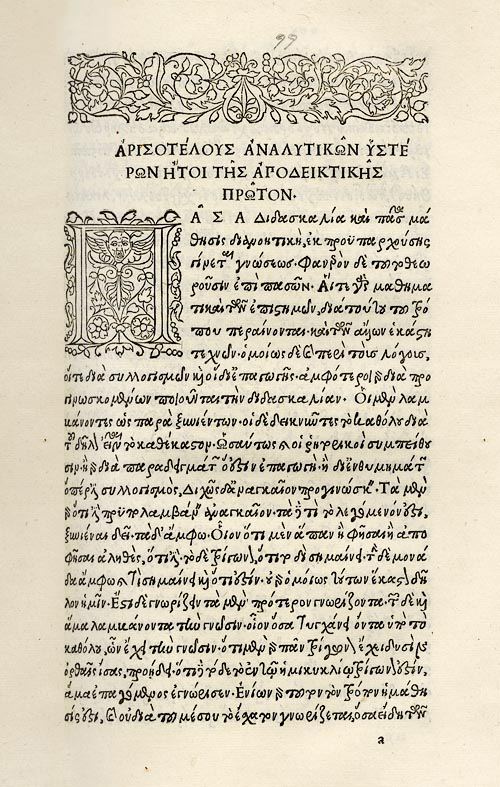
A page from Aldus printing of Aristotle
A page from one of the 5 volume set of “Aristotle” published by Aldus between 1495 and 1499

Aldus’ initial activity—and this would prove to be his most important accomplishment—was to edit and republish authoritative editions of the classics of literature. The initial project, a reissue of the Greek Grammar of Constantine Liscaris in 1495, was the first volume to be published under Aldus’ name although Andrea Torresani’s press likely did the printing.

A big breakthrough came in that same year with the publication in Greek of the first of a five-volume folio edition of the works of Aristotle. It would take four years to complete the project. This work has been referred to as the “greatest scholarly and printing achievement of the fifteenth century.” Aldus then went on to edit and publish Thucydides, Sophocles and Herodotus in 1502, Xenophon’s Hellenics and Euripides in 1503 and Demosthenes in 1504. In the decade before his death, Aldus also published editions of Latin and Italian classics. 

Aldine Press printers mark
The Aldine Press trademark symbolizing the adage “Festina lente” (Make haste slowly)

By 1496, had his own printing operation and began using various forms of “at Aldo’s” to signify the source of his publications as what later became known as the Aldine Press. In 1498, Aldus began using the Aldine Press trademark—the emblem of the dolphin wrapped around the anchor that symbolized the Latin phrase “Festina lente” (Make haste slowly)—on all of his works. At this point Aldus turned his attention to innovations in the forms of print, the first big contribution being in typography.

The typography of print as it arrived from Germany was in the Gothic form of heavy, “gross” lettering as seen in the Gutenberg bible. By 1470, Nicholas Jenson—who had come to Venice from France—had transformed the printed word and created the Renaissance book with his slender roman typeface and capital letters.
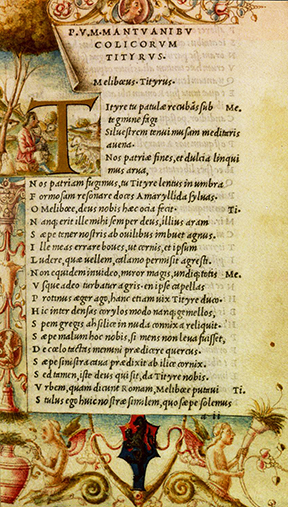
Title page from Virgil Opera with italics
Title page from Virgil’s Opera, the first book published in the Aldine italic typeface

Aldus began with Jenson’s typeface and reworked it into his own style for the Greek classics. His desire was to make the fonts look like the work of human handwriting. This effort would ultimately lead to the development of the “italics” that emulated cursive writing and also became known at times as the Aldino typeface. Francesco Griffo, to whom Aldus later paid tribute, performed the actual artistry of cutting the slanted italic. The first book that contained Aldus’ italic font was the 1501 Aldine Press edition of Virgil’s Opera.

The early period of printing—from 1450 to 1500—is often referred to as the “incunabula” or cradle of printing. At that time, most books were printed in folio format, i.e. page sizes of approximately 14.5” by 20” (the pages in the Gutenberg bible are approximately 17” x 24.5”). These were very large books that could be read wherever they were located; they were not portable.

This is when Aldus made another historic advancement. As explained by Helen Barolini in her Aldus and his Dream Book, “The real revolution, the moment of true divulgation of the printed word that impelled Western society … came when Aldus brought out his edition of Virgil’s Georgics in elegant, octavo format that was to become the staple of the Aldine press and Aldus’ trademark.”
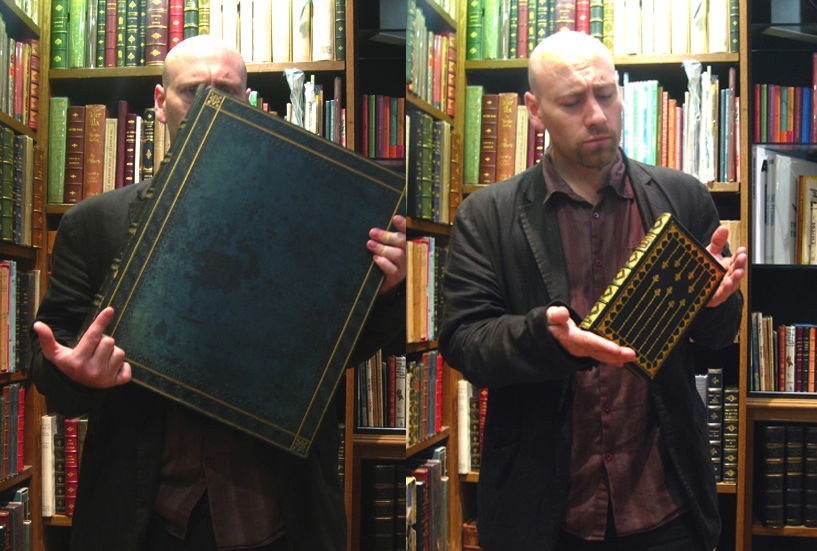
Comparison of folio to octavo book dimensions
A comparison of folio and octavo book dimensions, courtesy ILAB.
Aldus created the first octavo book.  

The octavo format is approximately 7.25” x 10,” something very close to what would be found today in a bookstore. Aldus produced the very first modern book that was small enough and inexpensive enough for someone to take with them almost anywhere.

Aldus’ other innovations included a unique method for bookbinding sometimes referred to as “binding in the Greek style” and advancements in punctuation such as the creation of the semicolon and the modern comma.

Aldus Manutius married Maria, the daughter of Andrea Torresani—the owner of a printing firm with whom he had worked early on in Venice—in 1505. Aldus died on February 6, 1515. His brothers-law took over the Aldine press and ran it until 1533 when Aldus’ third son Paulus Manutius assumed control of the business. It is believed that the Aldine Press published more than 1,000 titles in the hundred years that ended in 1595.

The scholar, humanist, publisher and printer Aldus Manutius was a monumental figure of the Renaissance. He was a force for the expansion of literacy and knowledge for everyone. Fortunately, his books have survived and there is a substantial record of his work including his own words that were often printed in the preface of Aldine Press books. In the Thesaurus Cornucopiae of 1496, Aldus wrote:

“My only consolation is the assurance that my labors are helpful to all … so that even the ‘book-buriers’ are now bringing their books out of their cellars and offering them for sale. This is just what I predicted years ago, when I was not able to get a single copy from anyone on loan, not even for one hour. Now I have got what I wanted: Greek volumes are made available to me from many sources … I do hope that, if there should be people of such spirit that they are against the sharing of literature as a common good, they may either burst of envy, become worn out in wretchedness, or hang themselves.”
The birth, life and afterlife of newspapers

The year 2014 marks twenty-five years of the World Wide Web. If you search online for “The birth of the web” you will find a link to the page from the website of CERN (European Organization for Nuclear Research) devoted to the Web’s invention.

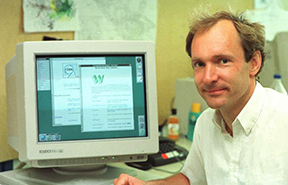
Tim Berners-Lee
Tim Berners-Lee at CERN in the 1990s

In March 1989, software engineer and networking specialist Tim Berners-Lee submitted a proposal at CERN for an online system of information sharing among 10,000 scientists in over 100 countries. His basic concept was to merge personal computers, networks and hypertext into a global information system. Originally calling the system “Mesh,” the proposal refers to a “web” of documents where a “hypertext browser” could be used to view data and information.

There are many important facts to be found on this page about the creation of the web by the 33-year old English-born Berners-Lee and how his idea produced the most important media technology innovation of our lifetime. If you are inclined, you can actually view Berners-Lee’s original draft proposal in HTML, text or as a PDF of the printed MacWord document that was distributed at CERN.

Although it is commonplace today, our ability to view and read these documents online from anywhere, at any time is a product of the very transformation that they brought about. But the web is not only the repository of viewable documents from the moment of the web’s invention forward; it is also becoming the online warehouse of documents that previously existed only in printed form.

Among the expanding digital library of printed archives is the vast universe of the world’s newspapers. Next to books, newspapers are the second most important paper-based knowledge and information source. And—due to their monthly, weekly or daily frequency—newspapers are the only existing chronological record of so many accomplishments, endeavors, hobbies, errors and catastrophes of people on a local, national and global scale.

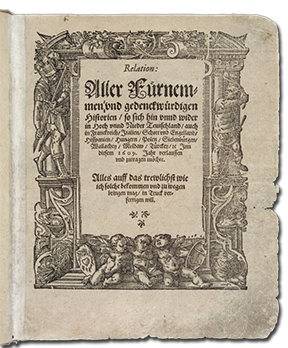
Title page of the “Strasbourg Relation” published by Johann Carolus in 1609

Newspapers as a form of print communications began in the early seventeenth century. The first newspapers were circulated in Germany and the expansion of the form is closely associated with the spread of the printing press (hence the term “press” to describe these publications). It is said that the Strasbourg Relation, printed by Johann Carolus beginning in 1609, was the first newspaper to appear because it had a publishing frequency and contained a variety of news items.

In the 1600s, newspapers spread rapidly throughout Europe (Holland, England, France, Portugal, Spain, Sweden and Poland) and also to the American colonies. In 1690 Benjamin Harris published the first American newspaper in Boston called “Publick Occurrences Both Forreign and Domestick.” It lasted for one issue before colonial authorities shut it down.

Alongside political pamphlets such as Thomas Paine’s spectacularly popular Common Sense, American newspapers played a critical role in the revolution of 1776. Benjamin Franklin was a leading publisher—having financed numerous printing establishments throughout the colonies—and worked on a plan for an inter-colonial network of newspapers.

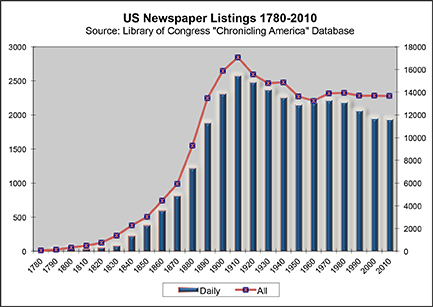
The era of the dramatic rise of newspapers began with the industrial revolution. As depicted in the graph of data from the Library of Congress project called “Chronicling America,” newspapers exploded across the United States throughout the 1800s. Paralleling the westward expansion and the rapid population increase across the country, the number of newspapers shot from 329 in 1800 up to 15,872 by 1900 and reached a peak at 17,083 in 1910. The number of daily newspapers in the US also reached an apex in the same time frame, with more than 2500 by the end of the first decade of the twentieth century.

US Newspaper Listings 1780-2010

While the communications technology advancements of the 1800s—innovations in printing, typesetting, photographic reproduction and distribution as well as the telegraph—accelerated the process and reduced the cost of print publishing, significant news media alternatives to newspapers emerged in the twentieth century. First commercial radio in the 1920s and then television in the 1960s augmented the newspaper business.

In our time, the Internet and the World Wide Web have had a similar, albeit more dramatic, impact on newspapers. However, newspapers continue to exist and, although daily papers have been falling steadily since 1980, the total number of newspaper in the US has been flat since 1990 and is greater today than it was in 1960.

The point here is that the majority of two hundred years’ worth of newspaper pages lie in physical archives, some well maintained while others are deteriorating by the hour. Efforts to preserve printed newspapers by converting them to searchable database of scanned images and OCR (optical character recognition) text have been mounted, although not without challenges and difficulties.

For example, Google launched with great fanfare, a news archive of the world’s newspapers on June 6, 2006. This initially turned out to be the database of PaperofRecord.com, a firm that had been acquired by Google. But later, on September 8, 2008, Google announced the expansion of the concept with the launch of an indexed database of scanned newspapers dating back to the 1800s. This project scanned some 2,000 archives.

But on August 14, 2011, without notice or explanation, Google cancelled its news archive service. Having previously gone through a lengthy and debilitating legal fight over the Google Books program, it appeared that the search giant had been bullied by the prospect of a long drawn out fight with newspaper publishers over copyright issues.

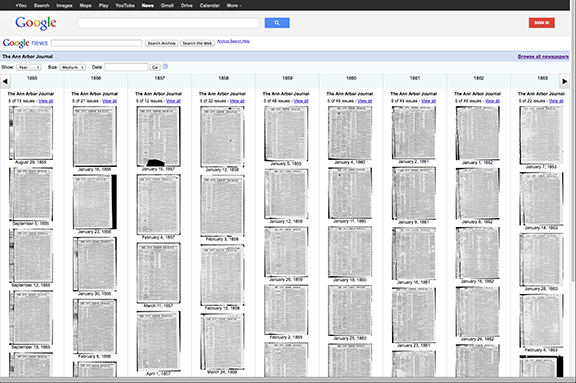
As of December 2013, the Google news archive of more than 2,000 of the world’s most important newspapers has become accessible and searchable at: http://news.google.com/newspapers

Google Newspaper Achive
Google news archive

One of the advantages of the Google archive is that it is open and freely searchable. However, initiatives to create free access newspaper archives—such as the Library of Congress at http://chroniclingamerica.loc.gov where 6.6 million newspaper pages from 1836 to 1922 have been made available to the public—are overwhelmed by subscription and fee-based online sources. Some systems offer sophisticated search tools combined with subscription and/or membership fees.

A comprehensive listing of both the “free and pay wall blocked” digital online newspaper archives has been published on Wikipedia: http://en.wikipedia.org/wiki/Wikipedia:List_of_online_newspaper_archives

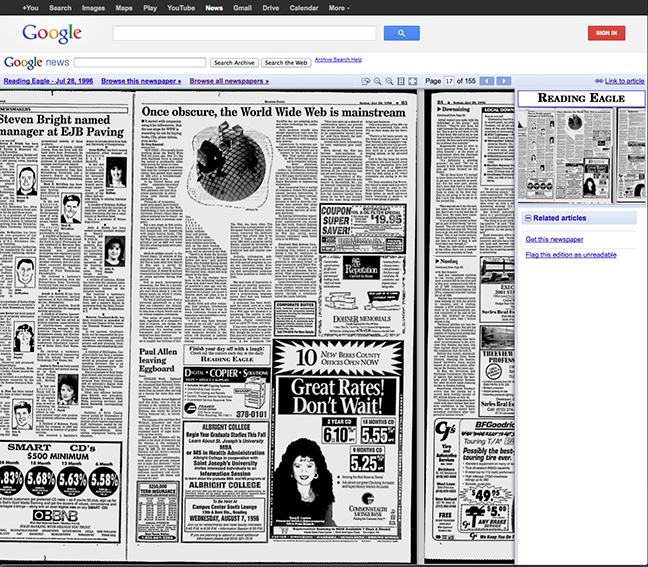
Page from the July 28, 1996 edition of the Reading Eagle as viewed in the Google news archive

Browsing the Google news archive, it is interesting to look back and read how the World Wide Web was viewed around the time that it was developed. An article “Once obscure, the World Wide Web is mainstream,” appeared on page 17 of the Reading Eagle of Reading, Pennsylvania on July 28, 1996. With 12 percent of the US population over age 16 at that time accessing the Web, Associated Press journalist Evan Ramstad noted, “the Web in a decade or so may be so common that people won’t think about it. Like the phone system on which it relies, the Web will just be there.”

http://news.google.com/newspapers?id=9lQlAAAAIBAJ&sjid=56UFAAAAIBAJ&pg=934%2C5597694

Fortunately, the newspaper archives hosted on the Web have also made it possible for us to find and read today what was being said and written about the Web while it was being created.

Karel Vaclav Klíč (Klietsch): 1841 – 1926

Everyone is familiar with National Geographic magazine. Published monthly and now celebrating its 125th year, National Geographic has a worldwide circulation of more than 8 million copies and appears in thirty-six languages. Widely known for the yellow rectangular border of its cover and the use of dramatic color photographs of world geography, history and culture, it is one the most popular magazines ever printed.

National Geographic

The name National Geographic is used occasionally as a printing industry euphemism. Someone might say, “It’s not National Geographic” when speaking of color reproduction expectations of other projects. What most are unaware of, however, is that National Geographic achieves such beautiful and spectacular color printing largely because of the gravure method used in the printing of its editorial pages.

The gravure printing process

Although less common in publication printing than offset lithography, gravure printing is typically associated with magazines that have very large circulation. According to Hans Wegner, VP of Production Services at National Geographic, gravure printing provides superior color saturation and consistency, a more photographic look as well as cost advantages.

The gravure process—a form of intaglio printing—involves engraving an image carrier, typically a metal cylinder, with recessed cells. The cylinder is immersed and rotates in fluid ink. As the cylinder turns, ink fills the imaging cells and, before making contact with the paper, a doctor blade scrapes the excess ink off the cylinder in the non-image area. The paper is brought into contact with the inked cylinder by an impression roller and the ink is drawn out of the cells onto the paper by capillary action.

The high quality reproduction of gravure printing is the result of the following attributes:

  1. Very fine halftone dot sizes that emulate the grain of continuous tone photography and can reproduce greater image detail than offset printing.
  2. A CMYK color gamut than that is often wider than that of offset printing because a greater amount of ink pigment is transferred the surface of the paper.

The history of gravure printing is complex and poorly documented. Dealing with the lack of reliable historical information in his History of Industrial Gravure Printing up to 1920, Otto M. Lilien wrote, “More and more of the technical development is described with only sketchy details and it is noticeable that the references are often missing. Frequently the information contradicts itself regarding the person credited with inventions and technical improvements.”

The manual gravure printing process was created and perfected in the nineteenth century and the earliest inventions are associated with photography. In 1826, Joseph-Niécephore Niépce developed the first photomechanically etched printing plate that was made of zinc and used to print portraits. In 1852, William Henry Fox Talbot developed a method for making gravure printing plates that could transform a continuous tone picture into a halftone.

According to Lilien, Paris publisher Auguste Godchaux took out the first patent for a gravure printing press that used cylinders and printed on a web of paper in France, in 1860. Godchaux built the press and it ran for 80 years in a printing facility in Paris on Boulevard Charonne until the Nazi’s occupied the city in 1940.

Karel Klíč
Karel Klíč (also known as Karl Klietsch), May 31, 1841 – November 16, 1926

Karel Klíč (Karl Klietsch) is the recognized inventor of modern gravure printing. Although it is sometime stated that Klíč developed all of the complex gravure processes without knowledge of the work of others, he was actually the first to bring all of them together. According to Lilien, Klíč brought together the crossline screen and the transfer of gelatine pictures to metal plates for cylinder production.

Karel Vaclav Klíč was born on May 31, 1841 in Hostinne, in the foothills of the Krkonose Mountains in the present-day Czech Republic and about 35 Kilometers from the border with Poland. The town has been known as a center of papermaking.

Klíč showed interest in the arts and at the age of fourteen was admitted to the Art Academy in Prague where he was expelled for nonconformance in 1855. He later returned to complete his studies. As a young man, Klíč worked as a draughtsman, a painter, illustrator and cartoonist. With his latter skills he worked at newspapers in Prague, Brno (Moravia) and Budapest before opening a photographic studio in Vienna, Austria in 1883.

While in Austria, Klíč joined the Photographic Society of Vienna and was exposed to many of the new developments in reproduction methods. His early attempts at photogravure techniques were exhibited with much acclaim at the annual society exhibitions in 1879 and 1880. During these years, Klíč did not reveal anything publicly about his methods. Recognizing the monetary value of the process he had perfected, Klíč sold the process to others in Vienna and London.

In 1880 and 1881, several of Klíč’s photos were published in an Austrian journal Photography Correspondence. In 1882 a heliogravure portrait of Mungo Ponton—a Scottish pioneer in photographic techniques and an amateur scientist—was reproduced as a special insert to the British The Yearbook of Photography and Photographic News Almanac.

Mungo Ponton
Klíč’s heliogravure photo of Mungo Ponton published as a special insert in the “Yearbook of Photography and Photographic News Almanac in 1882”

Writing about the significance of the image of Ponton, the editor of the almanac wrote, “We ought to say a word about our portrait of Mungo-Ponton, an Englishman who may well be termed the discoverer of permanent photographic printing, for he it was who proposed, in 1839, the employment of bichromate in photography. Klic’s is an etching process upon copper, an imprint from a carbon diapositive being secured upon that metal. The mode of preparing the copper is a secret, but we may mention that the process is so quick, that within four or five days an engraved plate may be produced of considerable dimensions. Of the quality of the printing our readers can judge for themselves. Suffice it to say, the process is an inexpensive one, and that during the past year alone, no less than three hundred photo-engravings were produced.”

Samuel Fawcett
Samuel Fawcett, a process worker at Storey Brothers, was co-inventor with Klíč of the industrial gravure printing method in 1895.

After one of his business associates by the name of Leonard published the details of his process in an Austrian technical journal in March 1886, Klíč left the country in frustration and traveled to England. It was during this trip that Klíč came into contact with Samuel Fawcett, a process worker at the Storey Brothers, a calico-printing firm located in Lancaster.

It is known that Klíč’s vision for gravure reproduction extended beyond single sheet photographic prints. Fawcett had been working independently in 1890 on a series of gravure experiments and his contact with Klíč was the catalyst for the development of entirely new industrial printing system.

Klíč and Fawcett, beginning in 1895 with formation of the Rembrandt Intaglio Printing Company, jointly developed the rotogravure process—modern gravure printing. The men experimented with screens of 150 and 175 lines per inch and printing on paper with machines owned by Storey Brothers and designed for printing on textiles.

The process developed by the Rembrandt Intaglio Printing Company remained secret for ten years, giving the firm lucrative monopoly on the process before any competitors emerged in the market. In 1897, while technical director of the company, Klíč left England and returned to Vienna to continue with further experimentation and invention. He came back for a short time in 1906 after he perfected a method for three-color gravure process with fine halftone screens. Karel Klíč died in Vienna on November 16, 1926.