What our doctors are telling us about the health of the printing industry

Two well-known Ph.D. economists recently published important reports on the condition of printing markets and printing businesses. Naturally, we should ask the question: what do our doctors have to say about the health of our industry?

Dr. Joe Webb, WhatTheyThink.com

Dr. Joe Webb, with a Ph.D. from the NYU Center for Graphic Communications Management, is director of WhatTheyThink.com’s Economic Research Center. Dr. Webb published a blog on February 4 on current quantitative indicators entitled, “2014 US Commercial Printing Rebounds from Poor First Half with Positive Third and Fourth Quarters.”

After a slow start in 2014, commercial printing shipments finished nearly even with 2013 and with most of the turnaround coming in December. “It was the first positive December since 2010. At that time, however, current shipments were more that $7 billion; December 2014 shipments were nearly $6.52 billion,” Webb wrote.

US Commercial Printing Shipments

He deduced that the strong December shipments were most likely the result of print that was generated by:

  1. The contentious mid-term local and regional election cycle
  2. A surge in local retail and holiday shopping promotions

However, Dr. Doom—as Joe Webb is sometimes called—had a warning against any false optimism that the December figures were part of a long-term growth trend. He wrote, “It is unlikely that this is a bottoming-out trend of industry shipments patterns, but a marked slowdown in the decline of real shipments. It is likely it is a sideways pause before another shift in media implementation.”

Media implementation refers to corporate marketing strategies that allocate budgets for the different communications channels, i.e. print, TV, radio, mobile, social, etc. There are contending opinions developing at the corporate marketing level regarding the effectiveness of digital approaches (computer, tablet and smartphone) versus tradition print such (direct mail, insert media, etc.).

Finally, Webb gave a warning, “Again, we remind readers that aggregate industry shipment data trends are not the certain destinies of all print businesses. Processes and product offerings are changing as market demands require. Getting ahead of those changes is essential.

“A slowdown in industry contraction, and even short-term increases, should be viewed as breathing room for thoughtful business re-configuration for the future.”

Dr. Ronnie H. Davis, Printing Industries of America

Dr. Ronnie H. Davis, Senior Vice President and Chief Economist at the Printing Industries of America Economic and Market Research Department published the second report called, “Industry Briefing: Competing in Print’s Dynamic Marketspace in 2015.” Dr. Davis’s report, although it also contains economic data, is a qualitative analysis of the major trends of the printing industry; it examines the overall economic environment, print sales volumes and profitability of the past decade. The report assesses the relative strengths and weaknesses of different forms of print media, different approaches to business strategy by printing companies and provides a forecast for each through the year 2021.

Recovery GapAfter explaining that the overall economy has still to “get out of second gear” following the recession of 2008-2009, Davis says that we should expect only “modest improvement” in the coming period. One of the impacts of the Great Recession is that the recovery is lagging behind previous recessionary cycles by about 4.8% or an average of about 1.2% growth per year. This “recovery gap” means that, at best, we will experience a leveling off or growth plateau that will remain between 2% and 3% into the near future.

GDP vs Nominal Print

In spite of this less than optimistic view of the economy as a whole, Dr. Davis makes an extremely important point about the relationship of print to GDP. For several years, industry analysts have been pointing to a divergence of printing industry annual growth numbers from the performance of the overall economy. But, according to the PIA report, “print still correlates with the economy.” This means that the impact of the Internet and digital alternatives may not have forced a detachment of print from general economic activity as had been previously thought. It may be the case that the responsiveness of print to GDP has lagged, but its ups and downs still correlate nonetheless.

As he has done in the past, Dr. Davis categorizes the functions of print into three groups:

  1. Inform and Communicate: Publications, Newspapers, Books, Legal Printing
  2. Product Logistics: Labels, Packaging Printing
  3. Market and Promote: Direct Mail, Signage

Print by Function

By far, the biggest drain on the printing industry is the first category; Inform and Communicate. The decline in magazine, newspaper and book printing—forms that are most susceptible to digital media alternatives and face dramatic declines in their revenue models—are pulling the rest of the industry down. According to Dr. Davis, this category—with a volume equal to one and a half times that of the other two categories combined—experienced a decline of 2% in 2014 and will see a drop of another 2.5% in 2015.

Meanwhile, Product Logistics—which represents somewhere around one tenth of the total volume of print—experienced an increase of 2.5% in 2014 and is expected to grow another 3% in 2015. According to Dr. Davis, the Market and Promote category is basically flat with a growth of 2% in 2014 and an expected growth of 1% in 2015.

The business trajectory of companies in the industry is another subject that PIA and Dr. Davis have been following for some years. Davis defines the product and service spectrum within the printing industry marketspace in the following four groups:

  1. Printed Products
  2. Ancillary and Adjacent Marketspace
  3. Communications Solutions
  4. Outsourced Print Management Services

As any given company moves from the top to the bottom of this list, they are migrating further and further away from the attributes of a “commercial printer” and into a more strategic partnership with their clients. Products and services that extend beyond and eliminate the competitive job-by-job bidding process make it possible for firms to develop relationships that add strategic value rather than low cost printing.

Additionally, Dr. Davis’s report contains information from a study of management approaches by printing industry companies that shows those that practice strategic planning have higher profit rates than those that do not.

PIA Long Term Print Forecast by Function

Finally, the PIA report considers a view of the industry six years out from now. Dr. Davis writes, “We project aggregate U.S. printing shipments to decline from $158.5 billion in 2015 to $143.6 billion in 2021—a reduction of around $15 billion or 9.4 percent. Although this is a fairly substantial decline, it is gradual (about 1.5 percent per year) and even at the end of the forecast period, print’s economic footprint remains large—over $143 billion, making it still one of the largest U.S. manufacturing industries. Additionally, two out of three print functions are expected to grow (print logistics and print marketing/promotion). Only print’s communication/inform function is projected to decline.”

It is clear from the reports published by both of our doctors that the health of the printing industry is improving, if only marginally. While much depends on the overall performance of the economy, print still remains a major manufacturing industry in the US with $155 billion in annual shipments, 45,000 establishments and nearly 1 million employees. As the industry continues to consolidate and shrink, business leaders must respond to the changes being made in customer markets, i.e. shifts in media implementation and segments that are most susceptible to digital alternatives.

Steve Jobs (1955 – 2011): Fonts and desktop publishing

Steven P. Jobs’ role in creating the first personal computer (along with his neighborhood friend Steve Wozniak), the founding of Apple Computer and his subsequent firing and return to the company have become part of tech industry lore. His later contributions to mobile, wireless and touch computing—embodied in the Apple iPod, iPhone and iPad—were no less transformative.

Steven P.  Jobs in 1984
Steven P. Jobs in 1984

Although Steve Jobs had extensive knowledge of computer hardware, operating systems and applications—he even worked for a short time in the early 1970s as a technician for Atari—his greatest skills were as technology visionary, marketer and salesman. Without the entrepreneurial drive, leadership charisma and design esthetic of Steve Jobs, Apple would never have emerged as the world’s largest publicly traded corporation; nor would it have the most loyal customers in the history of the consumer products industries.

Owing a great deal to the location and times of his upbringing, Steve Jobs expressed a broad cultural viewpoint and considered every project and product as an aspect of a larger creative purpose. Having developed an enthusiasm for the Bauhaus movement’s form and function philosophy, he identified design simplicity with products that were both beautiful and easy to use.

In his 2012 biography, Walter Isaacson quotes Steve Jobs from the early 1980s, “So that’s our approach. Very simple, and we’re really shooting for Museum of Modern Art quality. The way we’re running the company, the product design, the advertising, it all comes down to this: Let’s make it simple. Really simple.” Jobs rejected the boxy, bulky and dark industrial style of the earlier generation of computer design in favor of elegance and what he later called “taste.”

It was out of this unique blending of art with science and business that Steve Jobs made two significant contributions to typography and printing technology: the creation of computer fonts and the launching of desktop publishing. As with every innovation associated with his name, Jobs relied on the skills of others to realize his vision and then packaged and presented the accomplishments with great fanfare to investors and consumers alike.

Computer Fonts

Jobs’ esthetic sensibility had been formed a decade earlier while he was briefly a student at Reed College in Portland, Oregon in 1972. After dropping out of school, he enrolled in a calligraphy course at Reed taught by Father Robert Palladino. The course had a lasting impact on him.

As Jobs explained in a commencement address he delivered to Stanford University in 2005: “Reed College at that time offered perhaps the best calligraphy instruction in the country. … I learned about serif and san serif typefaces, about varying the amount of space between different letter combinations, about what makes great typography great. It was beautiful, historical, artistically subtle in a way that science can’t capture, and I found it fascinating.”

“None of this had even a hope of any practical application in my life. But ten years later, when we were designing the first Macintosh computer, it all came back to me. And we designed it all into the Mac. It was the first computer with beautiful typography.”

While working with the Macintosh design team, Jobs was involved in every detail of its size, shape and color as well as every icon, window and box of the graphical user interface. This involvement included the design of a group of fonts which he insisted be named for the great cities of the world: Cairo, Chicago, Geneva, London, Los Angeles, Monaco (monospaced system font), New York, San Francisco, Toronto and Venice.

Apple Macintosh font and desktop icon designer Susan Kare, developer Andy Hertzfeld and engineer Bill Atkinson

Prior to the work of Macintosh designer Susan Kare, developer Andy Hertzfeld and engineer Bill Atkinson on proportional fonts, computers were mostly limited to monospaced typefaces much like a typewriter with al alphanumeric characters and keystrokes the exact same width. Jobs could see that the bitmapped display of the Macintosh desktop was capable of rendering typefaces with a sophistication equal to that of letterpress hot metal type and cold phototypesetting.

Others at Apple Computer, due to their limited perspective on the utility of the personal computer, could not relate to Steve Jobs’ insistence on the font library; they considered it a distracting personal obsession. In his biography of Jobs, Walter Isaacson quotes Apple investor and partner Mark Markkula: “I kept saying, ‘Fonts?!? Don’t we have more important things to do?’ ”

The original Macintosh font library

When Steve Jobs launched the Macintosh on January 24, 1984 at the Flint Center in Cupertino, the font library was a critical part of the presentation of “the computer for the rest of us.” It was the first desktop system to offer not only the 9 city-named fonts listed above but also style choices—Plain, Bold, Italic, Bold Italic, Underline, Outline, Shadowed—for each.

While initially appearing somewhat primitive, bitmapped and lacking the finesse of professional typography, Jobs’ on-screen fonts were the beginning of a revolution in type technology. Firstly, fonts became something that everyone with a computer could use, not just professional graphic designers and printing specialists.

Secondly, the Macintosh font library encouraged professionals to push the limits of computer-generated typography and eventually transformed the field of typesetting altogether. Soon desktop fonts surpassed the quality and versatility of all previous type technologies and offered WYSIWYG (What You See Is What You Get) output; i.e. the image displayed on the computer screen is precisely what is printed onto a sheet of paper or other final output media.

Desktop Publishing

Steve Jobs understood the promise of WYSIWYG long before the phrase was widely used in the printing and publishing industries. Nearly one year to the day after unveiling the Macintosh, Jobs was back on stage in Cupertino at the annual Apple stockholders meeting on January 23, 1985 to launch the Apple LaserWriter and demonstrate the first ever desktop publishing system.

Desktop publishing signifies an integrated publishing system whereby pages containing both text and graphics are designed in layout software on a desktop computer and printed in individual or multiple copies on a desktop printer. Building on the accomplishments of the Macintosh, Steve Jobs worked throughout 1984 with partner companies and publishing industry experts to integrate the Apple Macintosh computer with other basic elements of desktop publishing: the Apple LaserWriter, Adobe PostScript and Aldus PageMaker.

The Apple LaserWriter, Apple project manager Bruce Blumberg and laser printer invertor Gary Starkweather
The Apple LaserWriter, Apple project manager Bruce Blumberg and laser printer invertor Gary Starkweather 

Apple LaserWriter: Gary Starkweather invented the core toner imaging technology of the laser printer at Xerox PARC in the early 1970s. Although Xerox never brought a desktop laser printer to market, HP and Canon developed systems independently of each other in the 1970s. The HP LaserJet, based on the Canon LBP-CX printing engine, was the first desktop laser printer and was released in 1984. The Apple LaserWriter, developed by a team led by project manager Bruce Blumberg, had two important differences with the HP device: it was networked (with AppleTalk) and could be shared and contained breakthrough PostScript software that enabled true WYSIWYG capability. The Apple LaserWriter was available for purchase in March 1985 and sold for $6,995.

PostScript Language Reference Manual. Steve Jobs talking with Chuck Geschke (left) and John Warnock of Adobe in January 1985.

Adobe Postscript: The software at the heart of the Apple LaserWriter was Adobe’s PostScript page description language. John Warnock and Chuck Geschke, who also came from Xerox PARC, founded Adobe Systems in 1982 with PostScript as their flagship product. Warnock and Geschke developed a state-of-the-art device independent print programming language that: 1.) captured all the elements—text, graphics, geometry, etc. —on the page of the desktop layout software during the “Print” function; 2.) interpreted the layout data as vector-based objects within the memory of the printer and; 3.) converted the PostScript objects into raster print data such that the page could to rendered onto a sheet of paper at a resolution of 300 dots per inch. The Adobe founders also signed a licensing agreement with Linotype that made 13 professional typefaces (four styles for each of the Helvetica, Times Roman and Courier families and a Symbol font) “resident” within the PostScript raster image processor (RIP) in the Apple LaserWriter.

Paul Brainerd and an early version of Aldus PageMaker on the Macintosh
Paul Brainerd and an early version of Aldus PageMaker on the Macintosh 

Aldus PageMaker: Paul Brainerd—the man who coined the phrase “desktop publishing”—founded Aldus Corporation in February 1984 in Seattle, WA. With a background in computerized newspaper publishing systems, Brainerd and a group of developers began working on layout software initially for newspapers. After getting some early peeks at the Apple Macintosh, Adobe PostScript and Apple LaserWriter, the Aldus team developed PageMaker as the first application capable of placing columns of text and images onto a virtual page and used a floating tool palette. The first commercially available version of PageMaker was released in July 1985 and sold for $495.

John W. Seybold
John W. Seybold

An important advisor to Steve Jobs throughout the process was John Seybold, a pioneer in computerized publishing systems and industry consultant. According to Paul Brainerd, “There were a couple of people that really were the glue that made all of this come together, and the most important was Jonathan Seybold. He was consulting to both Adobe and Apple. He and I knew each other for a long time going back … he told me some time during ’84, probably in the first quarter, that there was some confidential information that I needed to know. He got clearance from his clients to be able to share it with me.”

In an account published by Adobe in 2004, Jonathan Seybold reviewed the significance of the events that unfolded during the summer of 1984, “Steve wanted to see me urgently. He said they had a deal with Adobe, they were signing a deal with Linotype, they had real fonts. I went to Cupertino and walked into this tiny room, and there stood Jobs and Warnock with a Mac and a LaserWriter. He showed me what they were up to. I turned to Steve and said, ‘You’ve just turned publishing on its head. This is the watershed event.’ ”

Although they are less celebrated, Steve Jobs’ introduction of the Apple Macintosh font library and his pivotal role in launching the desktop publishing revolution in 1984-85 were watershed developments because they made designing and publishing accessible to anyone with a desktop computer and printer. The lasting impact of Jobs’ breakthrough continues to be felt today in the explosion of online and social media publishing by billions of people across the globe. Jobs’ death from cancer at age 56 on October 5, 2011 prematurely ended the life of one of the most important and unique figures of our times.

Albert Blake Dick: 1856 – 1934

An illustration of Albert Blake Dick with a rotary mimeograph machine

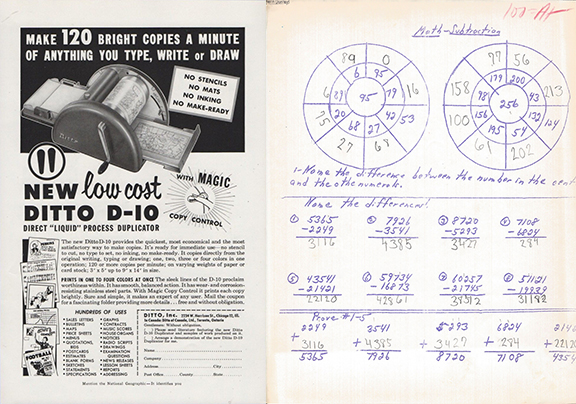
When I was in elementary school in the 1960s and into the early 1970s, teachers gave homework and classroom assignments, quizzes and tests on Ditto worksheets. We wrote on them so often that my classmates and I became intimately familiar with the aniline purple color of the Ditto—as well as the mesmerizing smell that emanated from the freshly printed sheets.

Making Dittos was a two-step process. The first step was to prepare the master, a two-ply form that had an easy-to-write-on paper sheet on top and a wax-coated sheet on the bottom. Our teachers would either hand write or typewrite the schoolwork onto one of these typically letter-size Ditto master forms. The pressure of the pen or the typewriter would transfer wax from the bottom sheet onto the back of the top sheet.

The second step—after discarding what was left of the bottom sheet—was to mount the master, bottom side up, onto the Ditto duplicating drum. The wrong-reading wax image contained the “ink” that was progressively broken down by the chemical spread across the drum as it was rotated—often by cranking the cylinder manually—and came into contact with the paper. Several dozen Ditto sheets could be easily produced within minutes.

A Ditto magazine ad from 1954 and a homework sheet from 1970

On occasion, some of us even got to help out by operating the Ditto machine in the main office or teacher prep room. With the potentially messy and smelly solvent involved, sometimes there were mishaps. I bet our teachers ruined their clothes more than once fiddling around with the Ditto chemistry.

* * * * *

The Ditto machine was the American variety of a duplicating system that became popular internationally—the Banda in the UK and the Roneo in France and Australia—in schools, churches, clubs and other small organizations. The Ditto is known generically as a spirit duplicator; the term “spirit” referring to its alcohol-based solvent.

The faintly pleasant odor of the Ditto came from the fact that the each sheet was essentially being coated with “10% of monofluoro tri-chloro methane and 90% of a mixture of 50% methyl alcohol, 40% ethyl alcohol, 5% water and 5% of ethylene glycol mono-ethyl ether.” This composition was developed in the 1930s as a less dangerous alternative to the original spirits of pure methyl/ethyl alcohol with a tendency to combust in confined spaces and air temperatures above 100˚ F.

Since spirit duplicators were limited to a maximum of about 300 copies per master and the quality of reproduction as well as the cost per copy were very low, they became a DIY alternative to more sophisticated printing equipment. The Ditto was perhaps the most successful small office copying system during the four decades prior to the ascension of xerographic toner-based photocopiers in the 1970s.

Spirit duplicators were one of several document reproduction technologies that were developed for the office rather than the printing plant. Office duplicators were first invented in the late 1800s in response to the demands of business for efficiency and economy in reproducing company documents in small numbers. Alongside the typewriter, office duplicators answered the problem of business forms and letters by replacing the tedium of copying each one by hand.

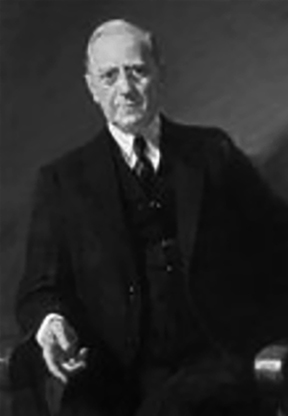
Portrait of Albert Blake Dick

Since commercially available printing machinery was very costly and too slow for these on-demand and short run copying needs, an alternative had to be found. In 1884, a Chicago lumber businessman devised a stencil-based method of document duplication that he would later call the “mimeograph.” From that point forward, the name “A.B. Dick” has been associated with the duplicating era of print technology.

Albert Blake Dick was born on April 16, 1856 in Galesburg, IL, a town about 175 miles southwest of Chicago and 50 miles northwest of Peoria. His parents, Adam Dick and Rebecca Wible, were from western Pennsylvania and decided to settle in Galesburg after helping to establish a church congregation in Quincy, IL.

Albert attended public school in Galesburg and then went to work for a farm equipment manufacturer in the area. After showing success as a manager, he became a partner in a lumber company. Just shy of his 28th birthday on April 11, 1884, the young Albert incorporated a lumber firm, the A.B. Dick Company, located at 740 Jackson Boulevard in Chicago.

It was during these early days that Albert preoccupied himself with the problem of business document reproduction. He rebelled against the effort wasted on a daily basis by hand copying price lists. Albert spent many hours experimenting with many unsuccessful ideas, most of them using the stencil principle.

The stencil method is distinct from other printing methods in which an inked image is mechanically transferred onto a substrate. Once a stencil sheet is prepared, it is mounted upon the ink-filled rotary duplicating drum. When a blank sheet of paper is brought into pressured contact with the rotating drum, ink is forced through the holes in the stencil onto the paper. Silk screening is also a form of stencil printing, but it utilizes a flatbed and squeegee process that is more wasteful than the process associated with A. B. Dick.

“My aim,” Albert would describe on the fiftieth anniversary of his company, “was to find a new means of duplicating letters other than by printing from moveable types, something more economical of both time and money.”

It did not take long. Sometime within the first year of his lumber firm, Albert sat down at his desk and across a piece of waxed paper he forced an awl (long pointed metal spike). After looking more carefully at what he had done, Albert noticed that the awl had left a series of tiny perforations on the wax paper. Developing this method, he perfected a sufficiently coated wax sheet as well as a stylus with which to write that could enable enough ink to be transferred to blank sheets of paper.

While his invention had achieved the immediate goal that he had set for himself, Albert returned his attention back to the development of his lumber company. For the next three years the stencil duplicating technique he pioneered remained an entirely internal matter at the A.B. Dick Company.

In 1887, following multiple inquiries by outsiders as to where a device such as his could be obtained, Albert decided to patent his invention with a plan to market and sell it to the broader business community. In a most peculiar and fortuitous coincidence it turned out that Thomas Alva Edison already held the patent for Albert’s stencil duplicating concept. In 1876, Edison had obtained a patent for his “Edison Electric Pen,” a more primitive implementation of the same principles that Albert had discovered independently, but nonetheless a very popular product.

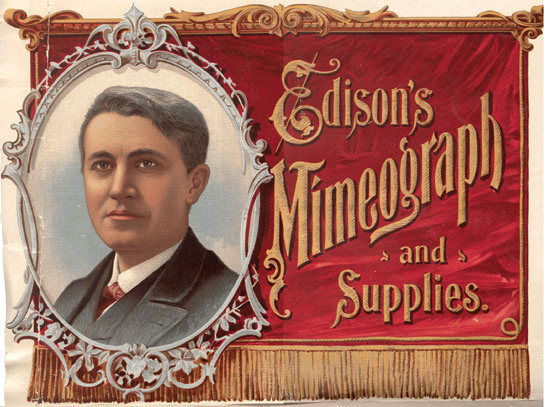
With the Edison name behind him, Albert Blake Dick set out to sell the stencil printing Mimeograph system across the country

Rather than walk away from the opportunity, the young Albert Blake Dick decided to approach Edison with his superior idea and see what arrangements could be made. Edison, ever the entrepreneur, readily accepted that Albert’s solution was simpler and more economical than his motorized pen technology. Furthermore, Edison agreed that his name would be associated with the product that Albert would develop and market.

In preparing to manufacture and sell the stencil system, Albert developed the trademark name. As he explained in 1934, “One day an old friend hit upon the combination of ‘mime’ and ‘graph.’ But it didn’t have the right swing. It wasn’t euphonious. Then the ‘o’ was added, to give it the swing—and the right euphony was acquired.”

The original Model 0 Flatbed Duplicator was sold as the Edison Mimeograph in 1887 and cost $12. A. B. Dick’s inventive genius did not stop there. By 1900, the company had developed the rotary Edison Diaphragm Mimeograph No. 61, the Edison Oscillating Mimeograph No. 71 and the A. B. Dick No.1 Folder, an automatic letter-folding machine.

A 1930 model of the A. B. Dick Mimeograph
A 1930 model of the A. B. Dick Mimeograph machine

By the 1910, there were 200,000 mimeograph machines in use and by 1940, nearly 500,000. In his Office Duplicating—which was printed in 1939 on an A.B. Dick Mimeograph machine—George H. Miller wrote, “There is little doubt that stencil duplicating in America owes its rapid and widespread growth to the Mimeograph machines and stencils as developed by the A.B. Dick Company.”

Albert Blake Dick died on August 15, 1934 and his son Albert Jr. took over the business at that time. In 1949, the company relocated to Niles, IL a suburb of Chicago. By the mid-1970s, while the Xerox machine was rapidly replacing the mimeograph, the A.B. Dick Company had annual sales of $300 million and employed more than 3,000 employees in the Chicago area.

As it declined, the firm was bought and sold by several concerns in the 1970s, 80s and 90s. In 2004, the A.B. Dick Company filed for bankruptcy and Presstek, a manufacturer of digital printing technologies, acquired the assets.