Albert Blake Dick: 1856 – 1934

An illustration of Albert Blake Dick with a rotary mimeograph machine

When I was in elementary school in the 1960s and into the early 1970s, teachers gave homework and classroom assignments, quizzes and tests on Ditto worksheets. We wrote on them so often that my classmates and I became intimately familiar with the aniline purple color of the Ditto—as well as the mesmerizing smell that emanated from the freshly printed sheets.

Making Dittos was a two-step process. The first step was to prepare the master, a two-ply form that had an easy-to-write-on paper sheet on top and a wax-coated sheet on the bottom. Our teachers would either hand write or typewrite the schoolwork onto one of these typically letter-size Ditto master forms. The pressure of the pen or the typewriter would transfer wax from the bottom sheet onto the back of the top sheet.

The second step—after discarding what was left of the bottom sheet—was to mount the master, bottom side up, onto the Ditto duplicating drum. The wrong-reading wax image contained the “ink” that was progressively broken down by the chemical spread across the drum as it was rotated—often by cranking the cylinder manually—and came into contact with the paper. Several dozen Ditto sheets could be easily produced within minutes.
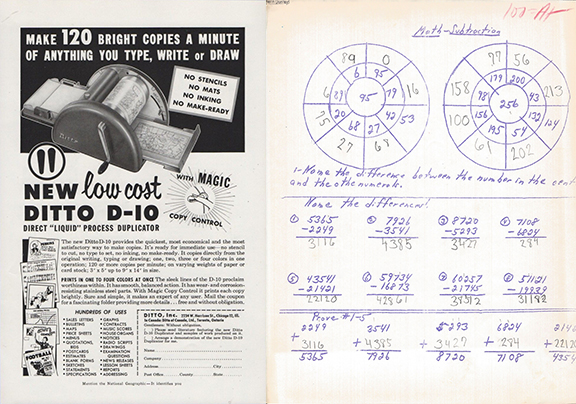
A Ditto magazine ad from 1954 and a homework sheet from 1970

On occasion, some of us even got to help out by operating the Ditto machine in the main office or teacher prep room. With the potentially messy and smelly solvent involved, sometimes there were mishaps. I bet our teachers ruined their clothes more than once fiddling around with the Ditto chemistry.

* * * * *

The Ditto machine was the American variety of a duplicating system that became popular internationally—the Banda in the UK and the Roneo in France and Australia—in schools, churches, clubs and other small organizations. The Ditto is known generically as a spirit duplicator; the term “spirit” referring to its alcohol-based solvent.

The faintly pleasant odor of the Ditto came from the fact that the each sheet was essentially being coated with “10% of monofluoro tri-chloro methane and 90% of a mixture of 50% methyl alcohol, 40% ethyl alcohol, 5% water and 5% of ethylene glycol mono-ethyl ether.” This composition was developed in the 1930s as a less dangerous alternative to the original spirits of pure methyl/ethyl alcohol with a tendency to combust in confined spaces and air temperatures above 100˚ F.

Since spirit duplicators were limited to a maximum of about 300 copies per master and the quality of reproduction as well as the cost per copy were very low, they became a DIY alternative to more sophisticated printing equipment. The Ditto was perhaps the most successful small office copying system during the four decades prior to the ascension of xerographic toner-based photocopiers in the 1970s.

Spirit duplicators were one of several document reproduction technologies that were developed for the office rather than the printing plant. Office duplicators were first invented in the late 1800s in response to the demands of business for efficiency and economy in reproducing company documents in small numbers. Alongside the typewriter, office duplicators answered the problem of business forms and letters by replacing the tedium of copying each one by hand.
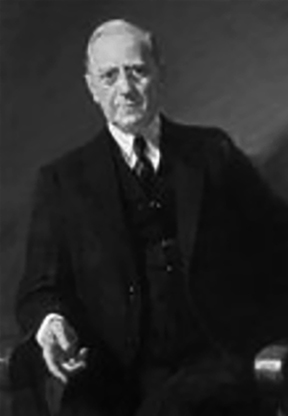
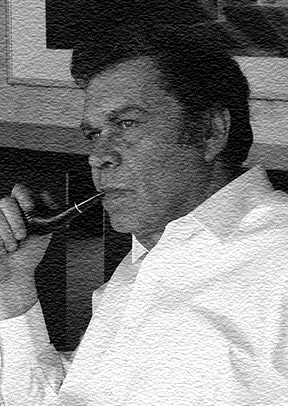
Portrait of Albert Blake Dick

Since commercially available printing machinery was very costly and too slow for these on-demand and short run copying needs, an alternative had to be found. In 1884, a Chicago lumber businessman devised a stencil-based method of document duplication that he would later call the “mimeograph.” From that point forward, the name “A.B. Dick” has been associated with the duplicating era of print technology.

Albert Blake Dick was born on April 16, 1856 in Galesburg, IL, a town about 175 miles southwest of Chicago and 50 miles northwest of Peoria. His parents, Adam Dick and Rebecca Wible, were from western Pennsylvania and decided to settle in Galesburg after helping to establish a church congregation in Quincy, IL.

Albert attended public school in Galesburg and then went to work for a farm equipment manufacturer in the area. After showing success as a manager, he became a partner in a lumber company. Just shy of his 28th birthday on April 11, 1884, the young Albert incorporated a lumber firm, the A.B. Dick Company, located at 740 Jackson Boulevard in Chicago.

It was during these early days that Albert preoccupied himself with the problem of business document reproduction. He rebelled against the effort wasted on a daily basis by hand copying price lists. Albert spent many hours experimenting with many unsuccessful ideas, most of them using the stencil principle.

The stencil method is distinct from other printing methods in which an inked image is mechanically transferred onto a substrate. Once a stencil sheet is prepared, it is mounted upon the ink-filled rotary duplicating drum. When a blank sheet of paper is brought into pressured contact with the rotating drum, ink is forced through the holes in the stencil onto the paper. Silk screening is also a form of stencil printing, but it utilizes a flatbed and squeegee process that is more wasteful than the process associated with A. B. Dick.

“My aim,” Albert would describe on the fiftieth anniversary of his company, “was to find a new means of duplicating letters other than by printing from moveable types, something more economical of both time and money.”

It did not take long. Sometime within the first year of his lumber firm, Albert sat down at his desk and across a piece of waxed paper he forced an awl (long pointed metal spike). After looking more carefully at what he had done, Albert noticed that the awl had left a series of tiny perforations on the wax paper. Developing this method, he perfected a sufficiently coated wax sheet as well as a stylus with which to write that could enable enough ink to be transferred to blank sheets of paper.

While his invention had achieved the immediate goal that he had set for himself, Albert returned his attention back to the development of his lumber company. For the next three years the stencil duplicating technique he pioneered remained an entirely internal matter at the A.B. Dick Company.

In 1887, following multiple inquiries by outsiders as to where a device such as his could be obtained, Albert decided to patent his invention with a plan to market and sell it to the broader business community. In a most peculiar and fortuitous coincidence it turned out that Thomas Alva Edison already held the patent for Albert’s stencil duplicating concept. In 1876, Edison had obtained a patent for his “Edison Electric Pen,” a more primitive implementation of the same principles that Albert had discovered independently, but nonetheless a very popular product.
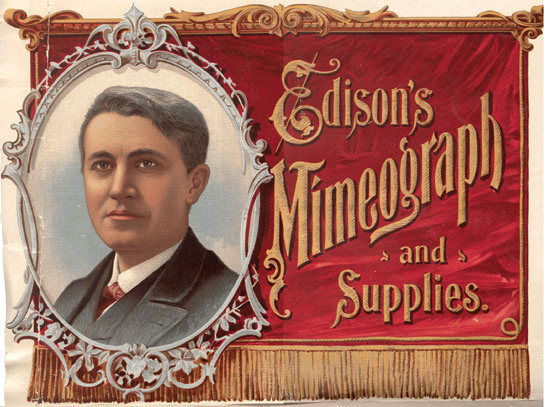
With the Edison name behind him, Albert Blake Dick set out to sell the stencil printing Mimeograph system across the country

Rather than walk away from the opportunity, the young Albert Blake Dick decided to approach Edison with his superior idea and see what arrangements could be made. Edison, ever the entrepreneur, readily accepted that Albert’s solution was simpler and more economical than his motorized pen technology. Furthermore, Edison agreed that his name would be associated with the product that Albert would develop and market.

In preparing to manufacture and sell the stencil system, Albert developed the trademark name. As he explained in 1934, “One day an old friend hit upon the combination of ‘mime’ and ‘graph.’ But it didn’t have the right swing. It wasn’t euphonious. Then the ‘o’ was added, to give it the swing—and the right euphony was acquired.”

The original Model 0 Flatbed Duplicator was sold as the Edison Mimeograph in 1887 and cost $12. A. B. Dick’s inventive genius did not stop there. By 1900, the company had developed the rotary Edison Diaphragm Mimeograph No. 61, the Edison Oscillating Mimeograph No. 71 and the A. B. Dick No.1 Folder, an automatic letter-folding machine.

A 1930 model of the A. B. Dick Mimeograph
A 1930 model of the A. B. Dick Mimeograph machine

By the 1910, there were 200,000 mimeograph machines in use and by 1940, nearly 500,000. In his Office Duplicating—which was printed in 1939 on an A.B. Dick Mimeograph machine—George H. Miller wrote, “There is little doubt that stencil duplicating in America owes its rapid and widespread growth to the Mimeograph machines and stencils as developed by the A.B. Dick Company.”

Albert Blake Dick died on August 15, 1934 and his son Albert Jr. took over the business at that time. In 1949, the company relocated to Niles, IL a suburb of Chicago. By the mid-1970s, while the Xerox machine was rapidly replacing the mimeograph, the A.B. Dick Company had annual sales of $300 million and employed more than 3,000 employees in the Chicago area.

As it declined, the firm was bought and sold by several concerns in the 1970s, 80s and 90s. In 2004, the A.B. Dick Company filed for bankruptcy and Presstek, a manufacturer of digital printing technologies, acquired the assets.

TGO & print media in the digital age

The latest book by Joseph W. Webb, Ph. D. and Richard M. Romano

In their latest book “This Point Forward: The New Start the Marketplace Demands,” Dr. Joseph W. Webb and Richard Romano offer the following blunt words for printing company representatives: “There is nothing worse than a bald or gray-haired guy standing in front of a bunch of young executives talking about how exciting print is. You’re not a wise elder statesman. You risk being perceived as an old relic who has no clue.”

Webb and Romano are inveighing against print media romanticism, i.e. nostalgic talk about the love of print, how it smells and feels, that it doesn’t require batteries or tech support and that it doesn’t crash or steal your identity, etc. They write “an increasing number of today’s communications and advertising managers do not expect to use print. Why should they? It doesn’t serve their purpose. … Today’s marketing communications managers are highly skilled digital media experts, who are both creative and innovative, and who are fluent in the statistical nature of digital media analytics.”

These are fundamental truths; cultural changes are shaking up the media business and the printing industry is not the only one facing problems. Digital streaming and on-demand have forever disrupted traditional radio and TV broadcast advertising. Any media business that tries to remain some kind of analog island amid the digital ocean is going to be swept under by the next technology or economic tidal wave.

For printing companies, this means morphing away from a print-centric to a digital-centric strategy. Understood as one of many choices that media buyers use to achieve their objectives, print can play a valuable and even critical role. For example, targeted and personalized direct mail­ can be central to a campaign as long it is integrated with a web, email and social media presence where the results are measureable. In short, the future of print depends on its integration into data driven analytics; print needs to be tracked, measured and cost justified or budgets for it will dry up and dollars will be spent on other more effective media forms.

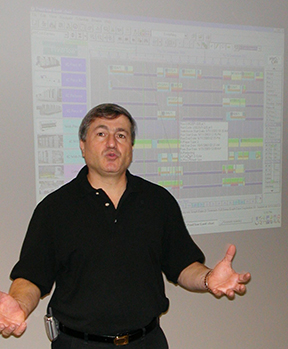
Udi Arieli presenting the Theory of Global Optimization

While Webb and Romano give an exhaustive review of the strategic reboot that printers require to be successful through 2020, they spend little time on the operational aspects of this transformation. Fortunately, there is someone in the printing industry that has developed a groundbreaking approach to production that makes print a competitive and attractive option for marketers and advertisers for decades to come. That person is Udi Arieli of EFI® and his approach is the Theory of Global Optimization (TGO).

What is the Theory of Global Optimization?

The Theory of Global Optimization is an approach to operational management that responds to all external and internal challenges facing the printing industry today. Its goals are to:

  • improve performance
  • increase throughput
  • accomplish more with diminishing resources
  • increase profitability

It does these things, not with automated and digital equipment although these are critical assets of the printing company of the future, but as a proactive management philosophy. TGO educates the entire organization against the reactive and narrow thinking that predominated in an era when companies could achieve success with limited or no business theory at all.

The two basic concepts of the Theory of Global Optimization are:

  1. Adopt the Global View
    Printing—as well as other custom or “pull” manufacturing businesses—is a chain of independent links. As the complexity of the production process increases and the company grows in size, the need for a global view of the business intensifies. A wider perspective beyond an individual project, client, cost center or machine must guide the decision making on a day-to-day and hour-by-hour basis. The profitability of the business is the result of the sum total of the performance of all jobs, customers, departments and equipment within the company; this is the global view.
  2. Optimize the System
    All areas of the establishment must be synchronized and optimized. The weakest links in the chain—the few constraints within the company that have the most impact on throughput, on-time delivery and costs—must be identified and managed. It is not possible for any individual no matter how talented to comprehend the complex interaction of these variables within the operation. Advanced computerized data collection and scheduling software are required to integrate and automate the critical decision making process.

Evolution of manufacturing theory

For years Udi Arieli has pointed to the relationship of his theory to previous generations of scientific management theory. That the Theory of Global Optimization contains the accomplishments of manufacturing theory going back to the beginning of the industrial revolution—and is also the modern day continuation of those achievements in the digital age—is proven by the following historical review:

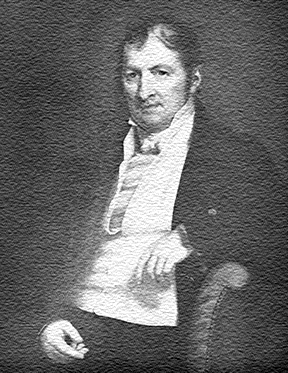
  • 1801: Eli Whitney / Interchangeable Parts
    Eli Whitney
    Eli Whitney

    Whitney is known for two related contributions to industrialization: the mechanized of farming (invention of the cotton gin in 1793) and, although he did not originate it, the promulgation of interchangeable parts. Whitney’s name is associated with the concept of interchangeable parts—the production of identical components made to specifications such that one part can freely and easily replace another—because he demonstrated the principle by assembling ten guns from a pile of mixed parts in front of Congress in July 1801. In the later 1800s this method became known as the “American system of manufacturing” as it increasingly utilized machine tools and semi-skilled labor to produce the parts to specified tolerances instead of the manual labor of skilled craftsmen.

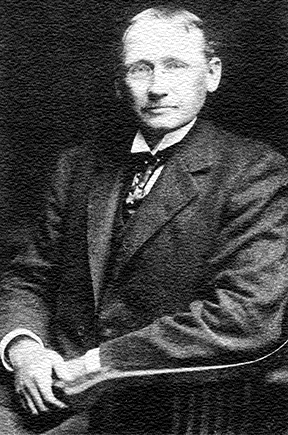
  • 1911: Frederick Taylor / Scientific Management
    Frederick W. Taylor
    Frederick W. Taylor

    At the turn of the twentieth century, Frederick Taylor extended the ideas and methods of the American system of manufacturing by studying labor productivity and introducing advanced planning into the production process. What is now known as “Taylorism” introduced ideas of scientific management and process management onto the production floor. Concepts such as “workflow” and “automation” emerged later from Taylor’s breakthrough stopwatch time and motion studies and his analysis of the functions and stages of the manufacturing process.

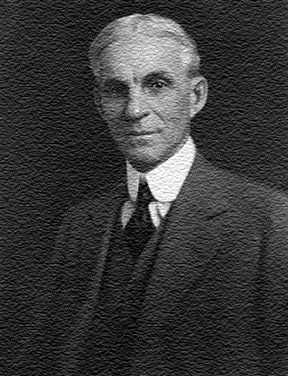
  • 1913: Henry Ford / Assembly Line
    Henry Ford in 1914
    Henry Ford in 1914

    Both interchangeable parts and scientific management methods were employed by Henry Ford in the startup of assembly line production of the Model T on December 1, 1913 in the Highland Park, Michigan. Also known as progressive assembly, the breakthrough of the assembly line was described by one of Ford’s top executives and engineers, Charles E. Sorenson, as “the practice of moving the work from one worker to another until it became a complete unit, then arranging the flow of these units at the right time and the right place to a moving final assembly line from which came a finished product.” Although this method had been pioneered by Ransom Olds in 1901, Henry Ford is credited with perfecting and sponsoring it by agreeing to the installation of a motorized conveyor belt that enabled a Model T to be assembled in 93 minutes.

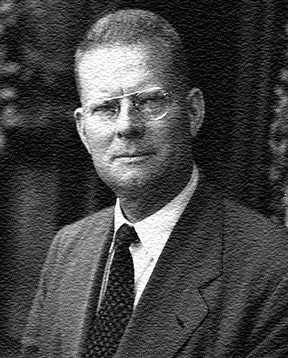
  • 1950: W. Edwards Deming / Process Control
    W. Edwards Deming in 1953
    W. Edwards Deming in 1953

    Following World War II, W. Edwards Deming further advanced scientific management theory by demonstrating that organizational cooperation and learning can improve manufactured product quality and reduce costs; that effective process control requires data gathering and measurement; that every process has a range and causes of variation in quality; that production workers should participate in continuous improvement initiatives. Deming gained worldwide notoriety for his pioneering work with the leaders of Japanese industry during what became known as the “Japanese post-war economic miracle” of 1950-1960. At first, Deming’s ideas were eschewed in the US for a host of cultural reasons. But by the 1980s, he was working directly with Ford Motor Company on a top to bottom quality manufacturing initiative and he would go on the become one of the most sought after experts on business management.

  • 1984: Eliyahu Goldratt / Theory of Constraints (TOC)
    Eliyahu Goldratt
    Eliyahu Goldratt

    In 1984, Eliyahu Goldratt wrote a novel called “The Goal,” which tells the story of Alex Rogo the manager of a production plant owned by UniCo Manufacturing. Rogo’s dilemma is that the plant is always running behind schedule and his job is on the line with upper management if he proves incapable of fixing the problems. The book was a clever method for Goldratt to explain his Theory of Constraints. TOC involves the successful management of constraints in the manufacturing process, i.e. focusing on those links in the chain—equipment, people and/or policies—that are preventing the organization from achieving its goal. Much of Goldratt’s TOC approach is derived from Deming’s notion that organizational cooperation and learning are keys to achieving agreed upon objectives; that measurement of indicators is required to gauge the impact of continuous improvement decisions.

  • 1984: Udi Arieli / Theory of Global Optimization (TGO)

    Udi Arieli
    Udi Arieli

    In the 1970s, as the third generation owner/operator of his family printing company in Israel, Udi Arieli realized that printing companies needed two things: a more advance business theory and smart software tools to manage the complex challenges they faced. In 1984, Arieli founded a company dedicated to developing intelligent production management solutions for the printing industry. While working on software, he established the elements of the Theory of Global Optimization. Arieli saw that the modern printing establishment (like many manufacturing businesses) had multiple interdependent processes—some were serial and some were parallel—that made manual- or analog-based decision making nearly impossible. Extending Goldratt’s theories, Arieli recognized that managing constraints in this dynamic environment required that production processes be replicated in a computerized scheduling model such that they could be globally synchronized and optimized. TGO is also derived from Deming’s teachings in that it educates and changes the thought process and culture of the entire business organization.

The future of print production management systems

Today TGO is more than a theory; it has become the foundation science on which EFI builds its management solutions. PrintFlow Dynamic Scheduling, for example, was the first software developed by Udi Arieli and his team based on the Theory of Global Optimization. PrintFlow acts as an operational umbrella for the business, gathering information about jobs, delivery commitments, production plans, resource availability and raw materials—generating run lists based on the best plan, not for an individual job, but for the business as a whole.

PrintFlow uses sequencing and optimization algorithms to maximize throughput while, at the same time, offering “what-if” and “weak-link” analytics to address real-world situations in real-time. PrintFlow is smart software that works with literally thousands of pieces of information to deliver a globally optimized plan that evolves with every new job and every new situation a printing business encounters.

TGO has evolved to become the foundation of EFI’s Automated Intelligent Workflow, bringing the printing industry to new levels of efficiency and savings. Recognizing the value of the Theory of Global Optimization, EFI continues to invest significant resources into its product suite—Digital StoreFront®, its MIS/ERP solutions, PrintFlow, Fiery®, VUTEk® and Jetrion®—so that they operate according to TGO principles.

It is not accidental that Udi Arieli developed the Theory of Global Optimization as a solution to the problems of the printing industry, one of the most complex and largest custom manufacturing sectors of the economy. The great value of Theory of Global Optimization is that it provides a framework for printing company executives to make their way out of the analog world of landline phone call status updates and into the digital world of client dashboard apps, automated text communications and email tracking information. By utilizing TGO, the printing firm of today can begin the practical transition of becoming the integrated media supplier of tomorrow.

By employing sophisticated digital operations management tools, print media suppliers can interact with the young advertising and marketing clients—that Webb and Romano write about—in a manner that fits their lifestyle and habits, i.e. more like their digital media suppliers. If print is going to survive in the digital age, it has to become easier to order, easier to produce, easier to track and easier to cost justify. Now that is the new start that the marketplace demands.

Linn Boyd Benton: 1844 – 1932

inland-printer-vol-089-n05-1932-08-linn-boyd-benton-obituary.pdf
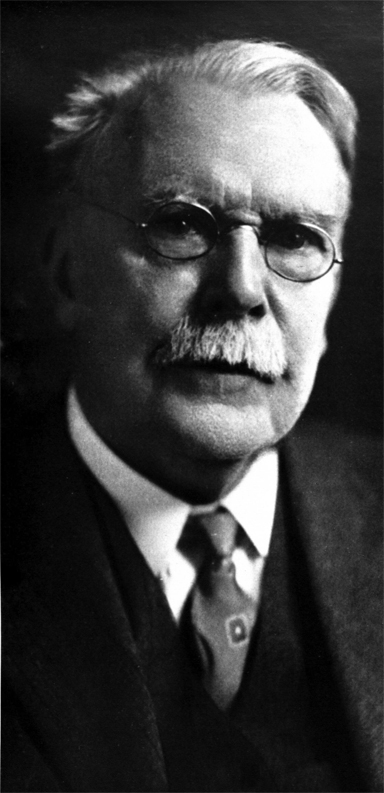
Linn Boyd Benton

Linn Boyd Benton is not a widely known figure in the history of printing. This is an odd fact given that he is responsible for one of the most important technical achievements of the late nineteenth century: the invention of the pantographic engraver of type punches. Without Benton’s contribution, the completion of the industrialization of the printing process—and the success of Mergenthaler’s Linotype casting machine—would not have been possible.

Linn Boyd Benton was born on May 13, 1844 in Little Falls, New York, a town about 75 miles east of Syracuse. His father, Charles Swan Benton, was a lawyer and the founder-editor of the Mohawk Courier & Little Falls Gazette. In 1840, the elder Benton was elected as US Representative of the 17th District of New York State.

It has been said that Linn Boyd was forced to rely upon himself at an early age because his mother, Emeline Fuller of Little Falls, died when he was just three years old. That his father moved the family frequently also contributed to Linn Boyd’s character development.

After Charles remarried, he relocated the family to Milwaukee, Wisconsin where he became part owner and editor of the Milwaukee Daily News. At age eleven, Linn Boyd had his first experience with typography in the composing room of his father’s newspaper.

Boyd—as he was called—attended Galesville College, in Galesville, Wisconsin and studied advanced subjects for two years with a private tutor in La Crosse, Wisconsin. He developed his mechanical aptitude while working summer jobs as a tombstone cutter and as a watch repairman for a jeweler in La Crosse.

At 22 years old, Boyd was hired by a friend of his father’s as a bookkeeper for a Milwaukee type foundry. When the company went bankrupt during the financial panic of 1873, Boyd bought the Northwestern Type Foundry along with a partner and ran the manufacturing operations of the business. This was the beginning of Linn Boyd Benton’s long career in typography.

After several name and partnership changes, Boyd remained operations director of Benton, Waldo & Company and, by the early 1880s, the firm was manufacturing and selling metal type in the highly competitive industry. It was during this time that Benton began developing his skills as an inventor and typographic innovator.

Self-spacing type

By the 1880s, the problem of standardized type size measurement had become the scourge of the printing industry. Most printing establishments were forced to maintain relationships with a single type foundry due to the fact that type sizes, widths, base alignment and even metal alloy composition were not common.

With the industrial development of printing machinery long established—the launching of daily newspapers and installation of large steam-powered rotary web presses taking place everywhere—the lack of advanced methods of type specification, manufacture and composition were holding the industry back.

benton-waldo-specimen-booklet-1886-sos-0600dpijpg.pdf
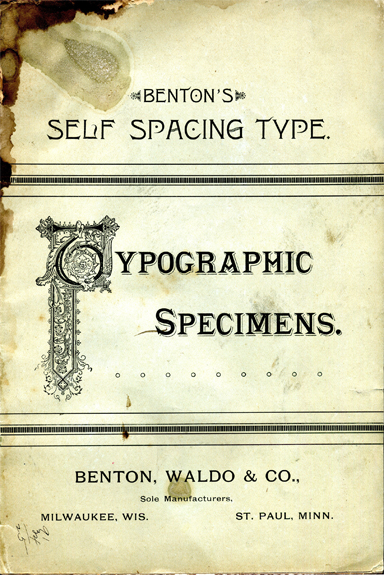
Cover of Benton’s Self Spacing Type Specimen Book

Since the early 1700s efforts had been mounted in Europe and America to come up with a standard for measuring type. The “pica and point” system finally emerged after a long conflict over proprietary interests. On September 17, 1886 the American System of Interchangeable Type Bodies was formally adopted at a meeting of the United States Type Founder’s Association in Niagara, New York.

Within this environment, Linn Boyd Benton began working on methods that would change the way type was specified and handled. The problem facing compositors was that justifying a line of type required the manual arrangement of individual characters and spacers with a “trial and error” working method. According to Benton and others, this antiquated process unnecessarily lengthened composition time and there had to be a means of automating it.

The measuring system of “12 points to a pica and 6 picas to an inch” that we use today was initially developed as a vertical system of type height. Benton’s innovation was that the width should also be measured such that the typography followed “the point system both ways.” In 1883, Benton received US Patent 290,201 for Self Spacing Type that, according to the promotional literature, could “increase composition speeds by 25%.”

The Benton, Waldo & Company’s Self Spacing Type styles were designed primarily for the newspaper industry where compositor speed was the most important issue. For some typographers, the horizontal distortion of characters and spaces required to make Benton’s system work meant that the visual appearance of the type was unacceptable; they argued it was hard to read.

Nonetheless, Benton’s work on self-spacing type was a breakthrough and the production and marketing of its typefaces brought him straight into a much more historically significant technological advancement for the industry.

Benton’s pantographic punch cutting machine

To grasp the significance of Benton’s invention of the pantographic engraver, it is important to understand the components and process of metal typesetting. Gutenberg’s accomplishment was the invention of the hand-held mold for typecasting. It created the mass production of individual metal characters that could be assembled into lines and pages of type, effectively displacing the handwriting by scribes.

There are two preliminary steps required in the production of the type mold into which the molten metal is poured: the punch and the matrix. The punch is a steel relief form of the letter that is driven by a hammer into a piece of copper that creates the cavity of the matrix. The matrix is then placed into the mold assembly where hot metal is poured forming the finished piece of type that will be inked and printed upon.

Punch, matrix and finished type character

Prior to Benton, punch cutting was a manual process that required a highly skilled craftsman to design and engrave the characters into a tapered piece of steel that was two to three inches long. Every character of every size had to be punch cut; these were the “masters” of the font from which many matrices could be produced. If a punch was damaged or broken, it would have to be remade by hand and it was likely that there would be slight differences from the one to the other.

Punch cutting was clearly the most difficult job in the production of type. It was not uncommon for a skilled punch cutter to take an entire day to make one punch; each punch required the continuous use of a magnifying glass, significant manual dexterity and an esthetic sensibility.

Benton’s Self Spacing Type required the cutting of more than 3,000 punches and skilled punch cutters were in short supply. In an effort to solve this problem, Linn Boyd Benton employed the pantograph—a mechanical device that uses parallelograms to trace an image on one surface and reproduce that image precisely on another surface—in the type production process.

Although Benton was not the first person to employ the pantographic principle in type making, he was the first to obtain a patent for the machine that would ultimately be used for cutting steel punches. The device went through several iterations and it has been established that the first machine did not cut punches but actually was used to engrave the metal letters themselves. However, Benton’s third pantographic engraver that was granted US Patent 332,990 was designed specifically for punch cutting.

Patent for Benton’s pantographic punch cutting machine

Coincidentally, while Benton was solving problems with self-spacing type manufacturing, Ottmar Mergenthaler was developing a solution for the mechanical composition of type, one complete line at a time. With the investment of powerful newspaper publishing interests behind him, Mergenthaler invented the Linotype machine in 1886 and by 1888 there were hundreds of these machines on order.

Mergenthaler’s Linotype breakthrough begged for a method of mass matrix production on a scale that had never before existed. As explained by Benton’s publicist Henry Lewis Bullen, “Here was a machine; but no adequate means of supplying it with matrices had been devised. The rapid production of matrices required the rapid production of punches. … In 1890 the Linotype company had six or seven punch cutters in its employ and these could do no more than keep up supply of matrices for about two hundred machines. Not in all the world could enough steel punch cutters be found to furnish an adequate supply of matrices, without which the machines were as useless and unsalable as a gun where powder is unprocurable.”

By chance, Benton’s partner R.V. Waldo was on a self-spacing type sales visit at New York Tribune where Mergenthaler’s machine was pioneered. Once the topic of Benton’s pantograph came up between Waldo and Mergenthaler’s representatives it was just a matter of time before the Linotype matrix production dilemma would be solved. On February 13, 1889, the first Benton punch-cutting machine was leased to the Mergenthaler Printing Company.

Thus, the combined accomplishments of Benton and Mergenthaler terminated the era of hand crafted type production and enabled this most important aspect of print technology to completely enter the industrial age.

Later years

Linn Boyd Benton would go on to make many other technical contributions to the printing and typographic industries: combination fractions (1895), a type dressing machine (1901), an automatic type-caster (1907), and a lining device for engraving matrices of shaded letters (1913). Benton also played an important role with Theodore Lowe De Vinne in the design of the Century Roman typeface, an innovation in type design at the beginning of the twentieth century.

In 1892, Benton, Waldo & Company merged with 23 other type houses and formed the American Type Founders Company with headquarters in Elizabeth, NJ. At the time it represented 85% of all type manufactured in the US and would dominate the industry into the 1940s.

Morris Fuller Benton, Linn Boyd’s only son who was born in Milwaukee in 1872, would join the ATF organization at age 24 after graduating from Cornell with an engineering degree. Morris would go on to be a major contributor to the type business and a force of his own in printing history completing 221 typeface designs—including Cheltenham, Hobo, Broadway and Franklin Gothic—during his career.

Linn Boyd Benton retired from ATF on July 1, 1932 and died two weeks later on July 15, 1932. Along with recognition of his many accomplishments, the company’s board of directors described Benton in a statement the following October: “As a Man Mr. Benton endeared himself to us by his modesty, his delightful humor and his probity in all matters, intellectual and material.”