The USPS and marketing mail

Postmaster General Patrick DonahoeOn August 8, Postmaster General Patrick Donahoe gave an interview to Bloomberg Businessweek concerning the budget crisis of the United States Postal Service. In response to the question, “What is the biggest problem facing the Post Office?” Donahoe said, “The Internet. The disruption with the Internet has been unrelenting. If we hadn’t lost the volume of bill payment to online, we wouldn’t have defaulted on our prefunding obligations. We wouldn’t have had to close the plants, and we’d be profitable with no debt.”

Like the rest of the offline and paper-based media industry, the USPS has been staggered by the impact of online communications and commerce. In the last ten years, the USPS has lost 60 percent of its annual first class mail volume, going from 51 billion pieces in 2003 down to a projected 21 billion pieces this year. That’s a lot of lost revenue. At 46¢ per piece, you are talking about $14 billion!
Printing Shipments and Postage Costs

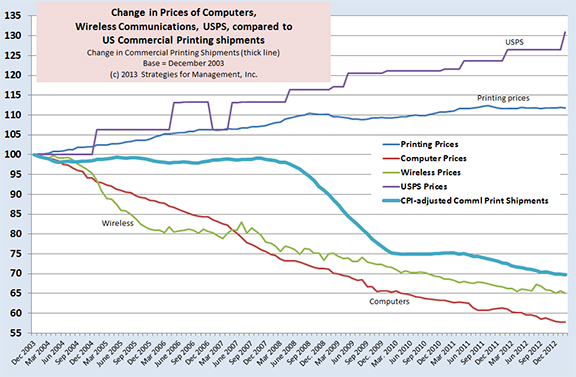
However, as important a factor as the Internet has been for the USPS, this is really one side of what has been happening. As the chart from Strategies for Management shows, over the same ten-year period, there have been multiple dynamic cost factors affecting the condition of the USPS as well as the rest of the print media business:

  • While quarterly volumes of printing shipments had already been declining for some years, the Great Recession of 2008-2009 accelerated this downward trend dramatically.
  • Although print prices appear to be increasing marginally, when factoring inflation, they are actually lower than they have ever been. Meanwhile, the fall in print prices has been achieved with increased operational and materials costs.
  • The cost of postage has increased exponentially relative to the dramatic decline in the costs associated with electronic alternatives to printed mail.

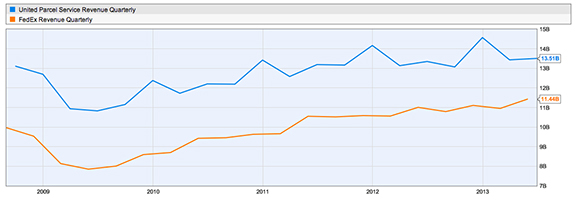
Another aspect of the problems facing the USPS, of course, relates to the growth of UPS and FedEx as alternatives. In the 80s and 90s, along with the growth of global economic integration, UPS and FedEx became dominant international package delivery solutions. For a host of complex reasons, the USPS reacted very slowly to this opportunity. Although it would have required infrastructure changes, had the USPS been able to offer a significant portion of the services now dominated by UPS and FedEx, it could have offset much of the losses stemming from the decline of first class mail.
UPS and FedEx RevenueThere has been widespread debate about what can or should be done to address the systemic crisis of the Postal Service. Most of the solutions focus on the massive budget deficit problems and include the following:

  • Elimination of the retiree’s health benefit prefunding requirement
  • Reductions in service such as elimination of Saturday delivery
  • Sale of real estate and facility assets
  • Privatization of the postal service

The conflicts over policy at the federal level regarding the USPS have resulted so far in an intensification of the crisis. It is the opinion of many experts that the current crisis of the Postal Service is the gravest in its 238-year history.

The Continental Congress created the American postal system on July 25, 1775 and Benjamin Franklin was named its first Postmaster General. Since that time, the post office has been through several critical transitions born of disruptive communications technologies such as radio, telegraph, telephone and television.

In its early days, the post office played a prominent role in the development of commerce as well as the westward expansion of the country. In 1788, Congress gave the postal service the authority to build roads and post offices and encouraged the use of stagecoaches to transport the mail, which now included newspapers.

In 1790 there were 75 post offices. By 1860 there were more than 24,000. Recognizing the powerful influence of the service and the Postmaster General, in 1872 Congress made the Post Office a cabinet department of the President.
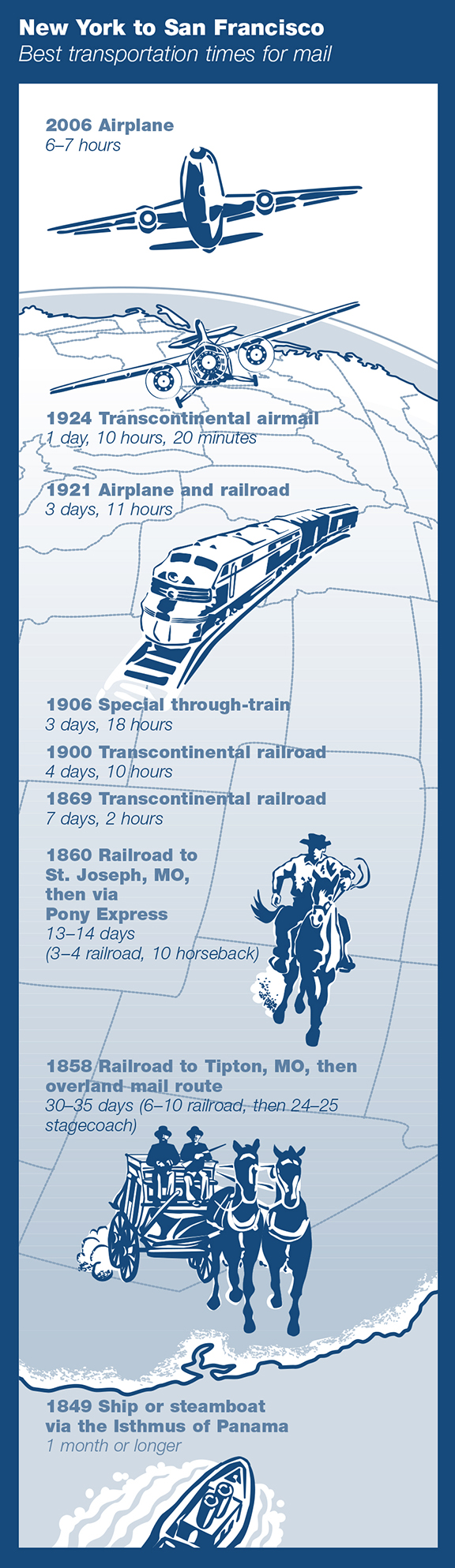
Transcontinental Postal Delivery SpeedsThroughout its history, the post office has benefited from innovations in transportation technology. Steamboats were introduced in 1811 and by 1820 there were 200 of these vessels delivering mail along US rivers. Initially, mail delivery from the east to the west coast went from New York by ship through Panama—using canoes and mules to the Pacific—and then from Panama to San Francisco. This service was offered at a rate of four weeks transit time.

An alternative method using stagecoach routes across the continent boasted 24-days delivery time but it often took months to get there due to the extreme weather conditions in the 2,000-mile stretch from Missouri to California. The overland transit time was cut in half with the start of the Pony Express in 1860. However, the Pony Express was ended within 18 months following the successful startup of the transcontinental telegraph on October 26, 1861.

Of course, the development of the railroads played an important part in moving the mail. By the time first transcontinental railroad was completed, there were Railway Post Offices that picked up the mail and sorted it en route in specially equipped rail cars. To this day, much of the US Mail is transported via train.

Experimental use of air transport for the mail began in 1911 and on May 15, 1918 the postal service began simultaneous flights from Washington and New York via Philadelphia. Shortly thereafter, Congress authorized “air-mail” postage at 24¢.

Following World War II, with the ubiquity of residential telephone communications, the content of the mail changed dramatically. By 1960, 80 percent of the mail was for business purposes instead of personal correspondence. The expansion of utility bills and payments, bank deposits and receipts, advertising, magazines, credit card transactions, mortgage bills and payments and Social Security checks meant that the post office had to find a better way to manage the mail.

Postmaster General J. Edward Day launched the ZIP (Zoning Improvement Plan) code system on July 1, 1963. It was based upon a postal zone system based on the major cities that had been set up in 1943. The five-digit codes made it possible for the post office to take advantage of computerized and automated systems for scanning, sorting, etc. to smooth and speed up the process of delivery.

In many ways the problems facing the USPS today stem from a crisis of the system that emerged in the 1960s. Unable to keep up with demand and the explosion of mail volume, the Chicago Post Office came to a dead stop in October 1966. The Postal Reorganization Act of 1970 transformed the Post Office Department into the United States Post Office and put into place the structural elements that exist today.  Now the USPS is facing the opposite problem of a decline in mail volume.

In March of this year, Mr. Donahoe gave remarks to the attendees of the National Postal Forum in San Francisco. Talking about the challenges facing the industry he said, “30 years ago, marketing mail claimed roughly 12 percent of the total marketing spend in the U.S. economy. Do you know what that number is today? It’s still 12 percent. With all of the changes in the way businesses can reach consumers, marketing mail has remained constant because of the tremendous value it delivers—for both the sender and the receiver. Marketing mail still remains the most effective way for companies to drive sales and it still delivers an exceptional return on investment.”

With this bit of optimism, Donahoe went on to outline four challenges before the mailing industry:

  • Make mail more personally relevant
  • Make mail more actionable
  • Make mail more functional
  • Make mail for creative

Clearly, these are challenges for both the printing firms that possess the technologies that manufacture the mail as well as the creatives who conceptualize and design the mail. With so much emphasis today on data driven and digitally personalized print, the future and viability of the USPS is a critical factor in being able to do what Donahoe is recommending.

Christopher Latham Sholes: 1819 – 1890

Christopher Latham Sholes Christopher Latham Sholes: February 14, 1819–February 17, 1890

I recently visited the location in Milwaukee where the typewriter was invented. At the corner of Fourth and State Streets a historical marker reads, “At 318 State Street, 300 feet northeast of here, C. Latham Sholes perfected the first practical typewriter in 1869. Here he worked with Carlos Glidden, Samuel W. Soulé and Matthias Schwalbach in the machine shop of C. F. Kleinsteuber.”

With Kleinsteuber’s work shop long gone, the marker stands on the property of US Cellular Arena, former home of the Milwaukee Bucks and several other professional sports teams. The 12,700-seat indoor arena was built in 1968. The Bucks and the other teams moved across State Street to the newer 18,000-seat BMO Harris Bradley Center … built a mere twenty-five years ago.

The modern surroundings of the typewriter’s birthplace are a reminder of how much time has passed since Sholes’ invention “freed the world from pen slavery.” Fortunately, a surviving photo of Kleinsteuber’s machine shop provides a glimpse into what life was like for Milwaukeeans between the Civil War and the automobile.

Kleinsteubers Machine Shop Photo of Kleinsteuber’s machine shop where Sholes, Glidden, Soulé and Shwalbach invented and perfected the first practical typewriter in 1869.

Christopher Latham Sholes was born February 14, 1819 in Mooresburg in Montour County, Pennsylvania, not far from the country seat of Danville. Sholes was born in a cellarless loghouse, eighteen feet square, a story and a half and with four windows.

After his family moved to Danville, Christopher’s mother Catherine Cook Sholes died in 1826 when he was seven. His father Orrin Sholes was a cabinetmaker and he had a workshop in town. While attending Henderson’s school in Danville, Christopher worked in his father’s cabinet shop. After graduation at age fourteen, he was apprenticed to the printing trade as a shop “devil” on the Danville Democratic Intelligencer.

By the time Sholes achieved master printer status at age eighteen, his family decided to move to Green Bay, Wisconsin. Encouraged to make the 750-mile trek by President Andrew Jackson’s proclamation of public land sales, the Sholes were among the frontline of settlers who relocated to the Territory of Wisconsin.

Christopher’s older brother Charles had established himself as a printer and political figure in the area. Prior to the arrival of the family, Charles had become the publisher and editor of the Green Bay Democrat. The elder Sholes would go on, following Wisconsin statehood in 1848, to serve in both houses of the state legislature and as well as mayor of Kenosha.

With a combination of his brother’s influence and his own exceptional talents, Christopher was appointed official printer and took charge of the House Journal of the Wisconsin Territorial Legislature. At age twenty, he became editor of the Wisconsin Enquirer, a Madison publication owned by his brother.

In 1840, Christopher moved to Southport (later Kenosha). He launched and became editor of the Southport Telegraph. The paper took its name from the invention of Samuel Morse. Sholes recognized the telegraph as a breakthrough communications technology that would improve the speed of news distribution. In 1844, he also became town postmaster.

Inevitably, like his brother, Christopher entered politics. He served two terms (1848-49 and 1956-57) in the state senate and one term in the assembly (1852-53).  In 1860, Sholes moved to Milwaukee where he became postmaster and commissioner of public works. He was also at different times editor of the Milwaukee Daily Sentinel and the Milwaukee News.

Sholes’ inventive genius was sparked by business needs. His first invention was for printing the address of subscribers into the margin of newspapers, an early form of what we now call “variable data printing.” He also worked with fellow inventors Samuel W. Soulé (machinist) and Carlos S. Glidden (attorney) on a machine for automatically numbering the pages of blank books and for sequentially numbering checks. Sholes obtained US Patents in 1864 for these inventions as well as one for a combination shoe brush-shoe scraper he invented along with C. F. J. Moller in 1866.

By the 1860s, many people were interested in developing, investing in or inventing a “Machine for Writing with Type or Printing on Paper or Other Substance” as one such system was called. The race was on to see who could come up with a viable, personal and portable alternative to the four hundred year old relief-printing process associated with Johannes Gutenberg.

Attempts had been made to conceptualize and even produce a typewriter going back to the 1700s. Englishman Henry Mill received a patent from Queen Anne in 1714 that called for “impressing or transcribing letters singly or progressively one after another, as in writing, where all writing whatsoever may be engrossed in paper or parchment so neat and exact as not to be distinguished from print; …” However, as promising as it sounded, Mill left behind no drawings or record of any existing machine to go along with what was a breakthrough idea.

Sholes Proof of Concept Sholes proof of concept device (this model is a reconstruction, the original has been lost).

Sholes was inspired to solve the technical riddle of the typewriter after he saw the July 6, 1867 issue of Scientific American. The SA article reported an invention that had been exhibited at the London Society of Arts by John Pratt (later known as the Pterotype or “winged type”) of Centre, Alabama.

The SA editors captured the implications of what would become later Sholes’ invention: “Legal copying and writing and delivery of sermons and lectures, not to speak of letters and editorials, will undergo a revolution as remarkable as that effected in books by the invention of printing, and the weary process of learning penmanship in schools will be reduced to the acquirement of the art of writing one’s own signature and playing on the literary piano above described, or rather on its improved successors.”

Sholes vision for the typewriter was a natural extension of his numbering machine inventions of 1864. The proof of concept was a primitive system of wood frame, glass platen and brass bar attached to a Morse telegraph “key.” It produced the letter “w” over and over again by striking through a piece of carbon onto a sheet of paper against the glass.

After receiving an enthusiastic response from those who saw the concept, Sholes worked with Soulé, Glidden and the engineer Matthias Schwalbach throughout the summer and fall of 1867 to develop the first working typewriter. This machine used a keyboard that looked similar to that of a piano and it had a typewriter ribbon to transfer the image to paper. On June 23, 1868, Sholes, Glidden and Soulé received a patent for the design and it is recognized as the first practical typewriter.

07253_2003_001.tif Typewriter Patent drawing 6/23/1868 The front page of the October 1867 Sholes, Glidden and Soulé patent submission for “Improvements in Typewriting Machines”

The innovations represented by this invention are too numerous to explain in detail here. As the patent—filed on October 11, 1867—explains, “Its features are a better way of working the type-bars, of holding the paper on the carriage, of moving and regulating the movement of the carriage, of holding, applying and moving the inking ribbon, a self adjusting platen, and a rest or cushion for the type-bars to follow.” However, the inventors acknowledged the advances of others before them and filed the patent for “improvement in type-writing machines,” not the invention of the typewriter itself.

Mention should be made here of the QWERTY keyboard about which much has been written. The record shows that the keyboard design underwent an evolution beginning with a straightforward listing of numbers and letters of the alphabet. Upon testing and subsequent design improvements—coinciding with the collaboration of the inventors with investor James Densmore—it was seen that frequent jamming of the type bars was a barrier to practical use of the machine.

US207559.pdf The QWERTY keyboard as it was first presented in the Sholes patent of 1878

Sholes worked with the Densmore’s brother Amos, an educator, to make a statistical analysis of the most frequently used letter combinations. From there Sholes changed the keyboard design such that common letter pairs were separated by a “lag time” and the instance of type bar jams was reduced. The resultant QWERTY keyboard remains in use today even though these mechanical considerations are no longer present.

Something must also be said of Sholes’ character. While he was a man of significant talents and influence—Sholes left his position as editor of the Milwaukee Sentinel to accept an appointment by President Abraham Lincoln as Collector of the Port of Milwaukee—he was also a man of great principles and humility. An active opponent of slavery, Sholes was an abolitionist and founding member of Lincoln’s Republican Party. He supported the case of Joshua Glover that challenged the Fugitive Slave Act.

Historians universally recognize the magnanimity of Sholes and his preoccupation with progress over personal gain and recognition. It is a fact that he sold his invention to Remington (the Civil War gun manufacturer) for mass production and gladly accepted a one-time payment of $12,000 instead of a royalty contract.

Christopher Latham Sholes suffered throughout his life from persistent health issues that were likely the product of the harsh conditions of his upbringing. He died on February 17, 1890, after a long bout with tuberculosis, and was buried in an unmarked grave in Milwaukee’s Forest Home Cemetery. An effort was mounted in the early twentieth century to appropriately recognize Sholes and his grave was marked with a monument. It says “Dedicated by the young men and women of America in grateful memory of one who materially aided in the world’s progress.”

3-D printing: The next desktop revolution

I suspect there are more than a few readers who remember how printing and publishing changed dramatically in the 1980s as desktop computers and print-ready files displaced phototypesetters and camera-ready artwork. Many of us went from the hazards of darkroom chemistry to that of workstation ergonomics; I remember being unceremoniously lifted from the comfort of my paste-up boards, horizontal camera and film processor and dropped into the world of SyQuest disks, Apple system “bombs” and PostScript (infinite-loop) errors.

Steve Jobs Press Conference January 23 1985
Steve Jobs at the press conference where the first desktop publishing system was announced on January 23, 1985.

Actually, the birth of desktop publishing (a term coined by Paul Brainerd of Aldus Corporation) and its disruptive impact can be traced to a specific date. On January 23, 1985, at a press conference following an annual stockholder’s meeting of Apple Computer, Steve Jobs announced the first desktop publishing system. It consisted of the following component technologies:

  • Personal computer (Apple Macintosh)
  • Page layout software (Aldus PageMaker)
  • Laser printer (Canon/Apple LaserWriter)
  • Page description language (Adobe PostScript)

It is safe to say that few understood the meaning of what happened that day. For the first time, text and graphics were placed on a page simultaneously and imaged on paper as reproduction “copy” or as a final printed sheet. The breakthrough of desktop publishing was that it was possible for just about anyone—with a modest investment—to become a publisher. The full impact of desktop publishing would be realized over the next decade as it transformed several industries and was a significant element in the evolution of the World Wide Web.

Chris Anderson MakersWith the benefit of hindsight, Chris Anderson (author of The Long Tail and former editor of Wired magazine) discusses the long-term implications of the desktop phenomenon in his book Makers: The New Industrial Revolution. “Remember, at that time publishing used to mean manufacturing in every sense of the word, from the railways that brought huge rolls of paper and barrels of ink to the printing plant … Taking publishing out of the factories liberated it. But the real impact of this was not in paper, but in the idea of ‘publishing’ online. Once people were given the power of the press, they wanted to do more than print out newsletters. So, when the web arrived, ‘publishing’ became ‘posting’ and they could reach the world.”

Today Anderson believes that we are living through a similar paradigm shift. But this time it is in the world of physical objects and the making of things. Today’s Maker Movement—the design and manufacture of things by individuals instead of industrial corporations—is with personal computers, CAD software and desktop 3-D printers and other equipment like laser cutters and CNC machines.

Form 1 desktop 3-D printer
Desktop 3-D printers take geometric data from CAD software and fabricate objects out of liquid plastic or resin

Distinct from the desktop printers that produce 2-D black and white or full color images on sheets of paper, a 3-D printer uses electronic geometries and turns them into objects that you can pick up and hold in your hand. Desktop 3-D printers usually extrude molten plastic in layers of liquid or powder resin. They can typically put down plastic material in thin layers (.33 of a millimeter) in processes like fusion deposition modeling (FDM), stereo lithography (SLA) or selective laser sintering (SLS).

3-D printers are an “additive” manufacturing technology; they build up objects from nothing, layer by layer. This is distinct from older industrial techniques—like “subtractive” routers and mills—in which spinning raw material is cut or ground away to reveal the object. Although they are newer and undergoing rapid development, additive 3-D printers have the advantage of producing little or no waste in the production process.

3D Print Sales Chart
Market size by 3-D printing sector application in US$ million

According to a recent report by IDTechEx, large-scale 3-D printing surpassed revenues of $1 billion in 2012 and growth is expected to quadruple by 2025. Industries that are heavy users of 3-D printing technologies are medical and dental, automotive and aerospace. The promise of the 3-D print is that it opens up inexpensive variability and complexity to the mass manufacturing process. For example, 3-D print used in the manufacture of prosthetics and orthopedic implants makes possible mass customization based on patient CT or MRI scan data.

Some believe—including Chris Anderson—that the digital Do-It-Yourself (DIY) and Maker Movement are generating a much bigger market than that of the large-scale commercial applications. The aggregate value of the design and manufacture of entirely custom products in medium to small (or even single) quantities is potentially greater than the manufacture of mass consumer products where each item is identical.

This is a business concept that everyone in the printing industry is very familiar with. We have been dealing with the economics of the digital print for two decades and understand very well that the cost per unit of a digital print product (custom) versus conventional offset printing (mass production). The cost per unit in digital print is “flat,” i.e. it do not rise or fall based upon a decrease or increase in quantity or a change in complexity, whereas the cost of the setup (make-ready) of a traditional offset print project is amortized across the entire print run.

chrischarts.indd
The relationship between the cost per unit and the quantity of mass manufacturing (injection molding) versus digital fabrication (3-D printing).

Anderson explains it this way, “Digital fabrication inverts the economics of traditional manufacturing. In mass production, most of the costs are in up-front tooling, and the more complicated the product is and the more changes you make, the more it costs. But with digital fabrication, it’s the reverse: the things that are expensive in traditional manufacturing become free.”

We can rightfully question Chris Anderson’s assertion that digital desktop fabrication heralds the beginning of new industrial revolution on the magnitude of that which occurred in the nineteenth century. However, there is no doubting his commitment. Anderson recently left his position after more than ten years as editor of Wired magazine to become full-time CEO of the firm he founded called 3D Robotics that manufactures unmanned aerial vehicles (UAVs).

As we think about the meaning of 3-D printing technology today, it is important to reflect back upon the desktop revolution of the 1980s. We should recall that many in the publishing industry viewed the nascent desktop system—inspired by Steve Jobs of Apple, Paul Brainerd of Aldus and Chuck Geschke and John Warnock of Adobe—as not measuring up to the professional requirements of the day. Many who initially dismissed desktop publishing as a fad and resisted the transition away from mechanical graphic arts technologies would later live to regret that perception.

The promise of 3-D printing is significant. Perhaps Chris Anderson will not be alone in the migration from the printing and publishing industries to that of digital fabrication, DIY manufacturing and the Maker Movement.