Debating the tipping point: When will digital printing transcend offset?

When I attended GraphExpo2010 in Chicago last fall, I noticed something had changed. For the first time, the largest exhibit spaces—in previous years occupied by offset lithographic presses—had been taken over by the latest digital printing systems.

This seemed to happen suddenly and I wondered: have we reached the tipping point already?

Since the digital printing revolution began in the early 1990s, much has been written and said about its impact on our industry and markets. Books and research studies have been published and conferences and surveys have been held, all to illustrate the transformative effect of the new technology. The opportunities and threats of the disruptive innovation brought by digital printing—personalized, variable, on-demand, data-driven and zero makeready—have been thoroughly discussed.

More recently, the commentary has turned to a debate over the transition point at which digital will displace offset. I have collected examples of this dialogue and focused on those who have been so bold as to prognosticate on the subject.
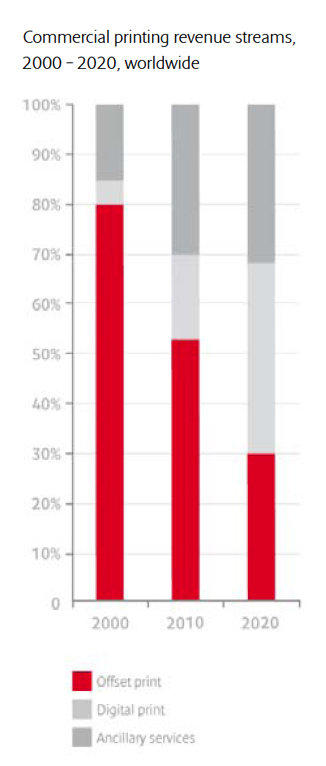
• In June 2008, Canon Europe published a report called “Digital Printing Directions.” Based on a survey of 619 industry representatives worldwide, the report says: “The global printing industry is at a crossroads. … Digital printing in 2008 is at the point where offset was in 1968.” Next to a graph the report says, “Through 2020, offset will remain a viable process, even as digital printing grows, but after 2020, new digital technology may affect offset the way that offset affected letterpress.”

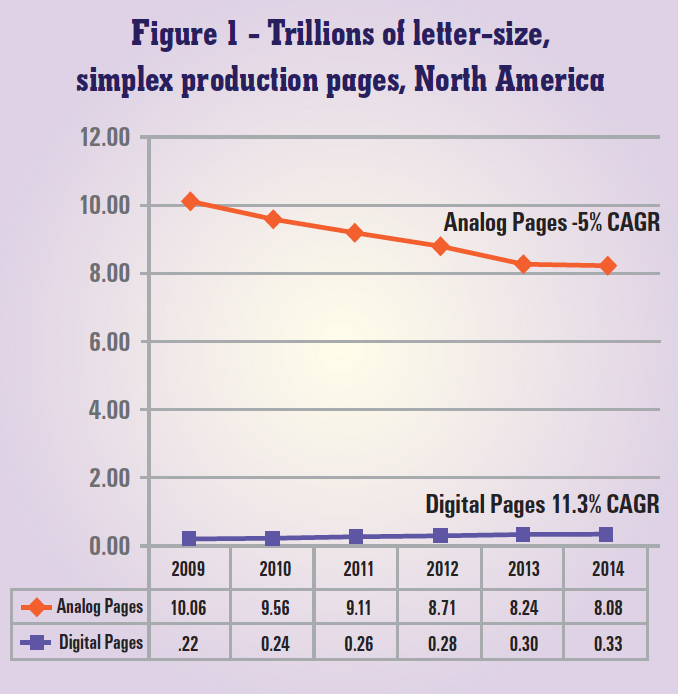
• In September 2010, NPES (the association for printing, publishing and converting technologies) published details of a study called “Megatrends in Digital Printing Applications.” The study surveyed 900 industry representatives and covered 12 applications: books, catalogs, direct mail, labels, magazines, manuals, marketing collateral, newspapers, packaging and specialty printing. The findings showed that few if any of the 12 applications will tip by 2020 but “the tipping point for most of the applications is decades away, if at all.” The NPES article contains a graph (Chart 2) showing how digital printing, while experiencing 11.3% growth from 2010 to 2014, remains a tiny fraction of total print volume.
• On November 10, 2010, whattheythink.com’s Frank Romano made the following remark in a video entitled “Frank takes a look at when the tipping point for digital may be”: “Offset lithography dragged along for a hundred years and then all of a sudden it found a marketplace and within a decade letterpress was gone.  Now according to the (NPES) research, they say the tipping point for digital printing is decades away … I disagree with that … Now, I don’t think it’s going to take a decade for those two worlds to come very close together.”


Frank Romano
Andy Tribute

• On January 18, 2011, whattheythink.com’s Andy Tribute published a commentary entitled, “When Will Digital Printing Take Over from Offset Printing?” Tribute wrote, “Overall I find that many projections I see for digital printing growth are pretty wild … it will take a long time before the ‘tipping point’ is reached where digital becomes larger than analog printing.”

These are differing predictions on the tempo and scope of the replacement of offset by digital printing. Some say in a decade (or less) and others say it will take longer (two decades or more). Some say total eclipse and others say partial and only in some categories. However, they all agree that the transition is coming.

As we reflect upon the present and the letterpress-to-offset and phototypesetting-to-desktop experiences of our past, keep in mind these key attributes of disruptive innovation: 1.) likelihood of dominant players to fail; 2.) requirement of a new value proposition; 3.) short-term increase in cost per unit, 4.) short-term decrease in quality, and; 5.) long-term tendency toward complete replacement.

For printing companies, these are strategic problems. The relative weight and pace of offset-to-digital within the print markets is not uniform. Therefore, digital adoption rates must be calibrated to meet increasing customer demand while maintaining competitive in offset long enough to exhaust its potential. In other words, companies must plan their own offset-to-digital tipping point to avoid having it foisted upon them the way that offset printing and desktop publishing were adopted.

Ottmar Mergenthaler: 1854 – 1899

Ottmar Mergenthaler, the inventor of the Linotype machine, was born on May 11, 1854. While it may be difficult to appreciate in our era of digital innovation, Mergenthaler’s invention was a momentous achievement that transformed our industry 125 years ago.

Called the “eighth wonder of the world” by Thomas Edison, Mergenthaler’s machine automated and integrated the casting and assembly of type forms; the invention completed the advancement of printing from handcraft to industrial manufacturing.

In the early 19th century, industrial printing came into shape as iron replaced wood in press construction. Cylinders were developed and, with steam power, the rotary press was invented. Meanwhile, the 1800s saw papermaking industrialize and bookbinding convert from handiwork to mass production.

The industrial revolution increased the volume of printing and its output per hour. However, in contrast, there was one critical step that remained primitive, costly and in need of revolutionary change: typesetting.

For centuries, type composition methods remained static. Standing in front of the type case, the compositor manually picked up individually cast metal characters and placed them in sequence—including justification—onto an eight-inch composing stick. Manual typesetting required The New York Times, for example, to maintain a staff 100 compositors … to produce eight-page weekday editions and a twelve-pager on Sundays!

The search to replace the old process—which remained unchanged since Gutenberg’s time—spanned a century and went through more than 100 unsuccessful inventions. As one author wrote, “The story of the many inventors who failed, died broke or took to drink … only serves to dramatize this persistent urge of the human spirit” to leap over an important technological hurdle.

With expectations of a solution on the horizon, investors put up an estimated $10 million between 1865 and 1885 for various schemes. Among them was Mark Twain who sank $190,000 ($7 million in today’s money) into a failed contraption that had 18,000 moving parts.

It took the genius, clarity of vision and persistence of a young German emigrant to America to solve the riddle of mechanical typesetting. Arriving in Baltimore at the age of 18, Ottmar Mergenthaler was looking for an opportunity to pursue his interest in engineering.

In 1876, the young Mergenthaler—who was trained as a watchmaker— was asked to review the apparatus of another inventor. He said, “Even though I know almost nothing about printing, I have little faith that this is the machine to revolutionize an industry.” And with that, he embarked upon the project of his life. After ten years of work and at age 32, Mergenthaler demonstrated his machine publicly for the first time in the offices of The New York Tribune on July 3, 1886.

With his unique arrangement of keyboard, gears, wheels, belts, pulleys, tubes, cables, hoses, trays etc., Mergenthaler integrated a mind-boggling array of functions. At the core of his invention were: 1.) the casting of individual type forms from hot metal; 2.) the assembly of the characters into lines-of-type and; 3.) everything was done by a single operator. You can watch a Model 8 Linotype machine in action by visiting this YouTube link: http://www.youtube.com/watch?v=nf0hDWOrnWA

By 1895, there were 3,000 machines in use by publishers and printers worldwide. The fast, low cost typesetting led to an expansion of the printed word. In the US, newspapers increased pages, magazines grew in size and frequency, books were printed in greater quantities, libraries multiplied and the illiteracy rate was reduced.

Predictably, Mergenthaler—a technician, not a moneyman—was treated badly by the “publishers syndicate” that financed the development of the Linotype. Expecting rapid and large returns, they forced Ottmar to bring his invention to market before it was ready and manipulated the patent system for their own gain.

Along with other inventors of his generation, Ottmar Mergenthaler exhibited little interest in riches or personal glory. After twenty years of work and following a serious illness, he and his family took their first vacation. Traveling to his hometown in Wurttemberg, Ottmar was greeted with a hero’s welcome. Upon their return to America, however, Ottmar Mergenthaler was diagnosed with TB and, at the age of 45, he died on October 28, 1899.

Print, the sustainable media

Benjamin Franklin was the first to suggest the idea of Daylight Savings Time.

I am writing this on March 13, 2011, the day we “spring forward” into Daylight Savings Time (DST). With spring arriving presently, it is a good time to consider the ways that print media is contributing to environmental sustainability.

It is none other than American printer, inventor and statesmen Benjamin Franklin who is credited with the idea of saving daylight. It is believed that Franklin was first to suggest moving daylight hours to the end of the day between the vernal and autumnal equinoxes as a means of conserving resources. In a 1784 letter to the editor of the Journal of Paris, Franklin joked that if Parisians would break their habit of sleeping late and not seeing “any signs of sunshine before noon,” then the six hours of missed daylight in the morning could be used to replace six hours of candlelight in the evening.

As Franklin wrote, “I say it is impossible that so sensible a people, under such circumstances, should have lived so long by the smoky, unwholesome, and enormously expensive light of candles, if they had really known, that they might have had as much pure light of the sun for nothing.”

You can read the complete text of Franklin’s letter here: http://www.webexhibits.org/daylightsaving/franklin3.html.

The modern concept of sustainability is very similar to Franklin’s simple idea: it addresses the complex and long-term problems of environmental, economical and social well-being; it teaches that satisfying needs and managing resources in the present is also about ensuring the same for future generations.

In this respect, the paper and printing industries—as well as the consuming public—have made significant progress. Although we still have much work to do, we should use this occasion to celebrate print media as among the most sustainable communications, marketing and publishing choices of the day.

The following are some of our important green accomplishments:

  • Print helps to grow trees
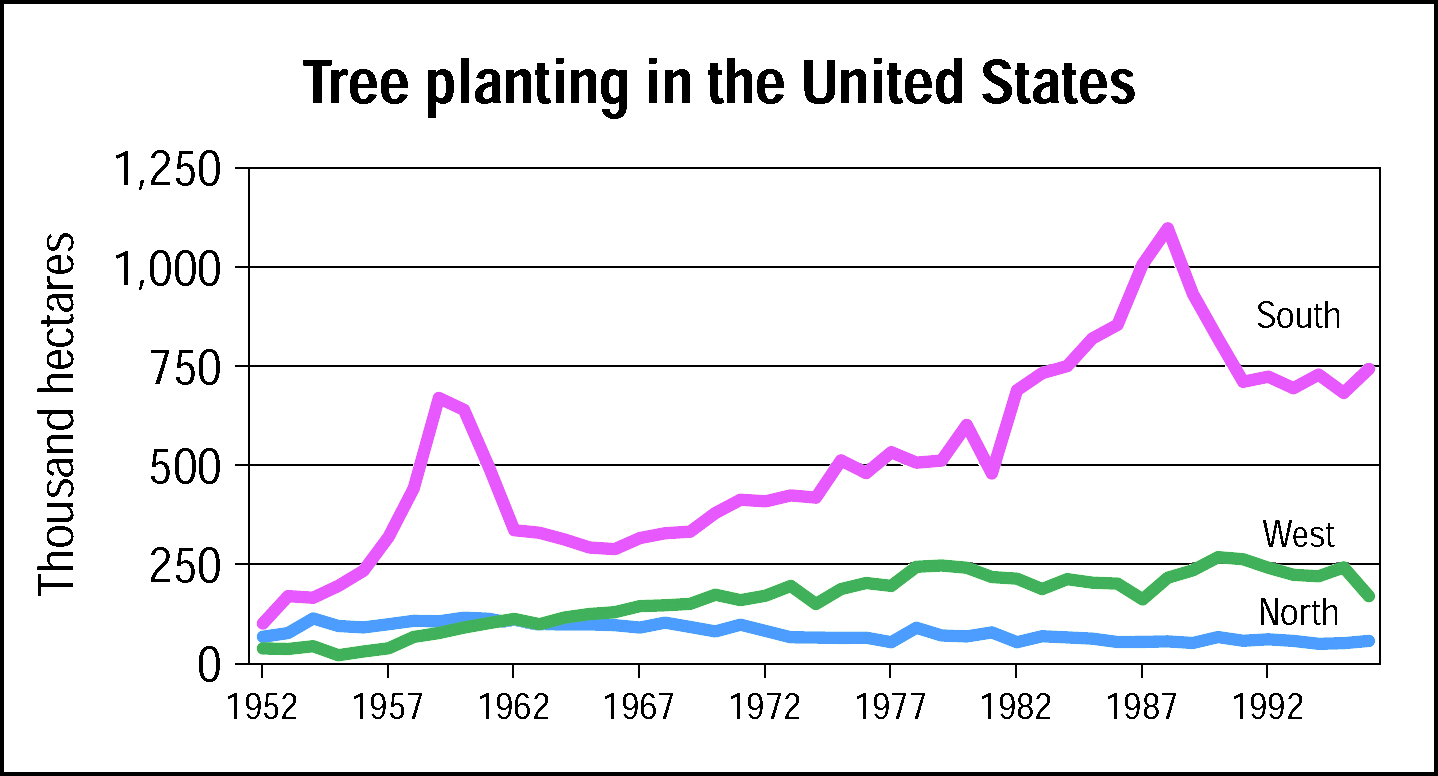
    According to the USDA Forest Service, about 4 million trees are planted daily in the US, 1.7 million of that total by the wood and paper industries. Most paper now comes from sustainable forests. These forests are essentially “tree farms,” where trees are grown as a crop, just like broccoli or wheat. When these trees are harvested, new stocks are planted. Print on paper gives landowners a financial incentive to renew forests rather than convert them for other uses, such as agriculture or development.
  • Paper is a renewable resource
    One-third of the fiber used to make paper comes from wood chips and sawmill scraps; another third comes from recycled paper. Overall, in the United States nearly 80 percent of the almost 400 paper mills use recovered fiber to make some or all of their paper products, and of these, approximately 200 mills use recovered paper exclusively.

  • Post-consumer paper recycling is at record levels
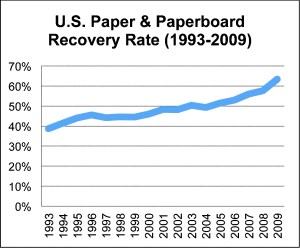
    The American Forest & Paper Association (AF&PA) reported that a record-high 63.4% of the paper consumed in the US was recovered for recycling in 2009. This exceeds the industry’s 60 percent recovery goal three years ahead of schedule. This is a tremendous achievement by the both the public and the paper recycling industries.
  • Print is often greener than electronic media
    All communications media leave a carbon footprint. Making a CD or DVD, both of which are difficult to recycle at best, generates around 300 to 350 grams of CO2 per copy, while printing a 100-page four-color annual report releases about 80 grams. Even Web-based communications have a carbon impact—both in terms of the electricity needed to power the computers involved and the metals, plastics and other materials that go into their construction.

It took about 135 years for Benjamin Franklin’s brilliant idea to be realized (DST was officially implemented in 1918 when Congress adopted “An Act to preserve daylight and provide standard time for the United States”). Obviously Congress did not heed Poor Richard’s dictum: “You may delay, but time will not.” We need not delay in promoting the uniquely sustainable qualities of print and paper-based media. Let’s start today!