I am not an economics expert. When I sit down to read the business news I usually go straight for the tech stuff like you probably do. However, now and again I take the time to read economic assessments and forecasts. It is important for all of us—regardless of where we are in the value chain of graphic communications—to try to understand the business climate and how it impacts our professional and personal lives.
Without getting lost in so many facts and figures, it goes without saying that you need an idea of which way the wind is blowing in the overall economy even if you are planning to buy the latest Internet-enabled 3D HDTV much less than make a capital improvement or hire new staff. This is especially true now with what appears to be the aftermath of the greatest economic downturn since the Great Depression of the 1930s.
 For these reasons, I welcomed the opportunity to read and comment on the recently published report from the Printing Industries of America “Moving Past the Great Recession: Print’s Recovery Path for 2011-2012 and Beyond.” The PIA’ s Economic and Market Research Department has done our community a huge service in providing a comprehensive outlook on the printing industry, its markets and technology segments.
The PIA document is broken up into four sections with each containing much that is valuable. I will highlight what I consider to be the most important aspects of each section and then finish with a summary and some conclusions of my own. You might want to go for that cup of coffee now before you read on, or you can just skip to the end.
The Economy: Recession and Recovery
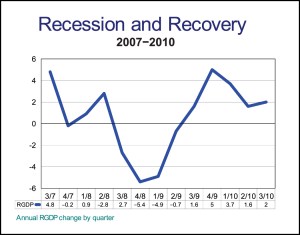 The essential question here is: are we on our way up or down? Well, according to PIA, we’re actually moving sideways. The Great Recession was significant in terms of damage to the economy in comparison to the previous four recessions (1974-75, 1981-82, 1990-91 and 2000-2001). However, in contrast to these events—where the principle of “the steeper the decline, the stronger the recovery” prevailed—this recovery stalled following the fourth quarter of 2009 and not long after the recession was declared officially over (June 2009).
What this means is that much uncertainty continues. However, according to the report, “At this time, the most likely trajectory of the economy over the next two years is a somewhat stronger rebound with inflation-adjusted growth of 3.3 percent in 2011 and 3.5 percent in 2012. While this is not a robust recovery, at least it is improved from just a few months ago.”
Assessing the Damage: Print and the Great Recession
 The printing industry took a significant hit during the crisis of 2007-2009. According to the PIA report, the Great Recession “shrunk print’s economic footprint by historic proportions last year” with 8 percent (2,943) of total printing plants closing and 15.6 percent ($25.9 billion) of total volume of printing falling between 2008 and 2009. The PIA’s caveat is that print remains a major part of the economy in spite of these declines.
In this section, the report makes some important observations about the different segments and technologies of the industry and the overall impact of the downturn on printing businesses:
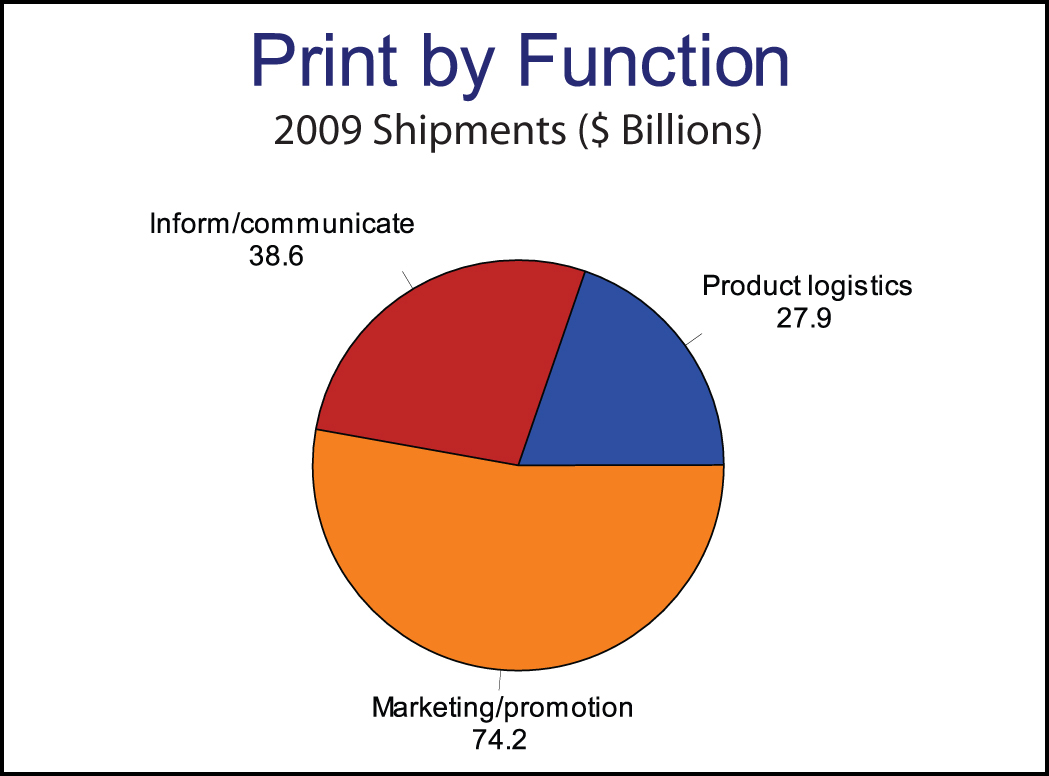
- Marketing and promotional printing is by far the largest component of our industry with 52.8 percent ($74.2 billion) of all shipments compared to informational and communications printing at 27.4 percent ($38.8 billion) and product logistics at 19.8 percent ($27.9 billion).
- The category of “product logistics,” i.e. packaging, labels and product manuals, is the one print function that does not compete against other media (with the exception of manuals) and has a protected competitive position.
- Digital printing grew throughout the downturn and projected to grow ahead of overall GDP, but this will come at the expense of the other categories of printing technology.
- Profits for printing companies on average were -1.7 percent of sales in 2010 which was a decline from 2009 where profits were +1. 6 on average.
Print Market Outlook for 2011-2012
 PIA projects that print markets will grow by 3 percent in the next two years based on the likely trajectory mentioned in the first section of the report. The report also predicts that the “shake out” of unviable enterprises and industry restructuring will continue. While this undoubtedly means more unemployed print company workers, the good news is that those firms that remain should see an increase in business volume.
The report refers to “survivors” as those companies that have made it through the storm and it predicts that we will see an overall growth of 12% for these firms. This is further broken down into 4% growth in conventional print, 16% growth in digital print and 16% growth in ancillary services. With printers’ profits generally lagging sales growth and the overall economy, PIA predicts that average profits will be 2 percent of sales during the next two years.
Different Paths: Printers Race for the Future
 Here we get into the more challenging problems of the industry and our prospects for future success. Much of the material in this section is derived from a previously published PIA report called “Beyond the Horizon” (2009) and an upcoming book entitled “Competing for Print’s Thriving Future.” The main question here is this: how do move into the future and not just survive but thrive.
PIA puts printing companies into four broad categories each representing one quarter of the industry for the purposes of their analysis. Each group is defined by the combination of financial success and the perceived-value of the mix of product and service offerings:
- Super Printers: 9 percent profitability
- Survivors: 5 percent profitability
- At Risk: 2 percent profitability
- Expendables: -2 percent profitability
The key to movement up the scale from one category to the other is the ability to navigate from being a provider of printer products, to a provider of ancillary services, to a provider of business solutions to a provider of outsourced print management.
The report ends with the observation that when asked in a survey to select a strategy that best describes their firm, a majority of printers still select “general commercial printer.” This is one among many challenges that printers will face in the next year or two: how to address the transition from traditional print markets to the new world of communications and product and vertical niche services providers.
Summary and thoughts
These are the key points from the PIA report:
- The recovery is going to be very slow at best
- The entire printing industry was hit very hard by the crisis
- There will be a further “shakeout” in the printing industry
- Those who survive can expect a modest increase in sales
- Industry profitability will also be modest and depend on where companies fall in the customer-perceived value spectrum.
The one area that the report does not discuss is the outlook on pricing. Although no figures are provided by PIA, I would submit that the softening demand and overcapacity problems of our industry have had, and will continue to have for some time, a downward impact on pricing. This undoubtedly is an element of the slow return to profitability that is predicted.
Over the past two years, we have been hit simultaneously by very difficult economic conditions and dramatic shifts in the media landscape. Budgets have been cut and the dollars that were previously spent on print media are migrating in ever-greater amounts to alternative technologies such as social media, eBooks, online portals, tablets and smartphones.
As an industry, we cannot run-and-hide from these changes; we must embrace them and find the appropriate role for print within the range of media options. We have to answer the question: what is it that only print can do that is both unique and plays a supporting role with the online world.
With the small signs of recovery in the business climate, although tentative and uncertain, we have cause for some optimism and can begin to once again to focus on those things that make print a cost effective, reliable and indispensable component of all publishing, marketing and communications programs. Along these lines, I would recommend the information contained in the PIA campaign called “The Value of Print” which specifically highlights many of these features: http://www.printing.org/valueofprint