NAPL report: What is happening to the printing industry?

State of the IndustryLast September, NAPL (National Association for Printing Leadership) published a valuable eleventh edition of a report called “State of the Industry.” The report provides a multi-faceted and insightful look into the condition of the printing industry—the changes, challenges and opportunities faced by printing firms today—based upon a survey of executives and owners from more than 300 companies.

The report is the work of Andrew Paparozzi, NAPL Chief Economist, and Joseph Vincenzino, NAPL Senior Economist. The NAPL economists overlay the survey results upon other general information to develop a depth of understanding about the dynamic forces impacting the industry. A copy of the report is available for NAPL members at no charge and non-members can purchase it on the NAPL web site for $149.95. http://members.napl.org/store_product.asp?prodid=369

A central theme of the survey results and analysis—both quantitative and qualitative—is that print is undergoing a transformation of historic magnitude. The difficulties created by the Great Recession of 2008-2009 that caused business volumes to fall dramatically—and they still remain today some 21% below pre-recession highs—are but one side of the problems created by rapidly evolving print markets.

The report begins with the following: “Business remains a tough grind, with little opportunity for organic growth.” This means that firms competing for “new” business are struggling over a traditional print market pie that is getting smaller; and yet market redistribution is also underway because of the second side of the changing business climate: the fundamental adjustments brought on by digital communications technologies and methods.

As Paparozzi and Vincenzino explain in the Executive Summary, “Getting and staying on the right side of market redistribution is the most significant challenge for everyone in our industry. Market redistribution is structural, not just cyclical. So much of what’s happening in our industry is the result of digitization, the Internet, and profound change in how people communicate, not GDP. Consequently, we have fewer printers but more competition—we’re in a constant battle for market share.”

The NAPL analysis is more than a review and commentary on the condition of the industry (Chapters: “Where We Are” and “Where We Are Headed”); the report also contains an assessment of those firms that are doing well in the current environment. It brings together generalizations (Chapters: “What We Have to Do” and “We May Need to Look Elsewhere”) about the correct way to approach the printing business today (Chapters: “Leaders: A Diverse Group” and “Ideas for Action”). At the same time, the report cautions against any kind of formulaic or “cookie-cutter” solution for every company or situation.

As the Executive Summary concludes: “It isn’t enough to know what’s happening and what’s ahead. We have to act on what we know—a game plan for action—taking steps to make the upheaval redefining our industry an opportunity rather than a threat. This report provides several ‘ideas for action’ to do just that.” These actions are summarized as “Hear the voice of our clients more clearly; execute more efficiently and successfully; communicate company direction to employees more effectively; and cultivate new skills across our organization.”

Macro trends

One interesting point that is made deals with the contraction of the industry. It is well know that the number of printing establishments has been declining for the last two decades; since 1992 there were 16,000 fewer companies in the industry (41,012 down to 25,242) by 2012. However, as the report analyses, not only are companies dying off, but there are also new firms being born each year.

Printing Company Births and Deaths

What kind of companies are these businesses? NAPL answers thus: “These companies are coming in with a clean slate—i.e. without legacy equipment, work habits and mindsets that limit flexibility or the troublesome issue of long-term, loyal employees whose skills don’t match the direction in which the company is embarking. Rather they are hiring the skills they at the start, creating a workforce with talents more relevant to our new industry. That they tend to be smaller companies shouldn’t create a false sense of security: Smaller companies grow—and the good ones grow rapidly.”

Another important point the report makes about the overall situation is that a boost in overall economic activity as reflected in GDP is not going to produce a “recovery” in printing. In any event, the very modest economic growth remains lackluster because of “headwinds” such as government cutbacks and the implications of the Affordable Care Act.

NAPL predicts that US printing industry sales will rise .5%-1.5% in 2013 and as much as 1.0%-3.0% in 2014 following an increase of .6% in 2012. While these figures are very modest, the report shows that these results are not projected to be even across all regions of the country. While some regions, such as South Central, have experienced double-digit growth since 2007, others like the Southeast and North Central have seen an overall decline of -.5%.

Print business priorities

The NAPL survey results reveal what company owners and executives consider the most important areas of focus and how they approach them. The following are the business topics and the top responses to the survey:

  • Hearing the Voice of the Customer
    Meeting more frequently on an owner-to-owner/executive-to-executive basis (64%)
  • Client Education
    We offer client education programs and materials (56.4%)
  • Employee Communications
    One-on-one or small group meetings (77%)
  • Execution issues
    Poor follow through. Start off well, but lose focus (39.8%)
  • Strategic Shifts
    We will no longer carry unproductive employees (48.3%)
  • Critical Skills
    Sales (71.3%)
  • What We’d Most Like to Upgrade
    Web-to-print, web storefront, ecommerce (51%)
Sales Industry Leaders

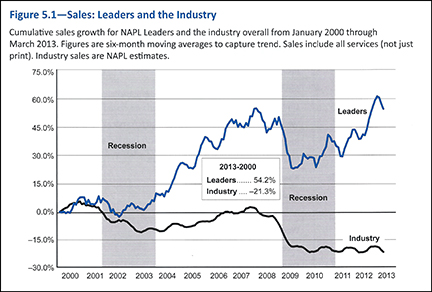
One of the striking results of the survey is that there is an expanding divergence between industry leaders and the rest of the industry. This comes out most obviously on the sales front. It is clear from the foregoing data that understanding customer needs, business development and sales are a top priorities for printing company owners and executives.

In an environment of intense competition, differentiation is key to winning and retaining clients. In order to survive and grow, those companies that have been most successful have absorbed the meaning of the fundamental changes taking place and are offering a complex array of products and services beyond ink on paper. As summed up in the comment of one survey participant, “Successful printers recognize they are part of the communications industry, not the printing industry.”

Where does offset lithography fit?

An important aspect of the NAPL report deals with the state of traditional offset printing. In fact, the report contains a page following the executive summary called, “What About Lithography?” which makes some highly valuable comments about the relationship between the old and the new of the industry.

Offset lithography is still the single biggest source of revenue in the printing industry. At between $40 and $45 billion, this market breaks down as follows:

  • Advertising print: $10.2 billion
  • Magazine/periodical print: $4.9 billion
  • Catalog/directory print: $3.2 billion
  • Miscellaneous other print: $20 billion
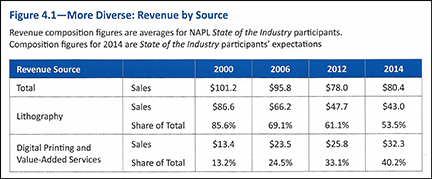
Printing Company Revenue Sources

Eighty-eight percent of NAPL survey respondents reported that they get one quarter of their revenue from offset lithography and 70% report that it accounts for at least half. Printing companies cannot afford to “walk away” from this dominant yet traditional source of revenue. “Put simply, once we won by being the best lithographer. Now we win by being the best at putting lithography and every other service that we offer—it’s print-and, not print-or—to work for our clients.” This is a very good summary of where we are as an industry: one foot in the old and one foot in the new era of communications.

Aldus Manutius: 1449/1450 – 1515

The great cultural movement called the Renaissance (rebirth) spanned the fourteenth to the seventeenth centuries. This places Johannes Gutenberg’s 1450 invention of printing early in that era. As is widely acknowledged by historians, printing was not only the most important technological achievement of the Renaissance; it was also its greatest catalyst.

Aldus Manutius
Aldus Manutius: 1449/1450 – 1515

Along with the expansion of world trade and the circumnavigation of the globe—combined with enthusiasm for Gutenberg’s innovation—printing spread rapidly from Germany to destinations across Europe and elsewhere. And, as the business and products of “mechanical writing” proliferated, the knowledge that came along with it multiplied exponentially.

Eventually, like so many printing press pebbles tossed into the global pond, the ripple waves of literacy and democracy spread and connected with one another. By the eighteenth century, the achievements of the Renaissance led to the age of Enlightenment. And so, one of the most remarkable end results of this technical and cultural transformation was the American Revolution of 1776 … but that takes us a long way from the subject of this review.

The Renaissance, especially in Italy, was shaped by humanist teachings, i.e. the notion that citizens should be educated in the humanities (language, literature, philosophy, religion and the arts). Florence, Naples, Rome, Venice and Genoa were among the centers of Italian humanism. Great collections of antique hand written manuscripts and also printed books were assembled in libraries and made available for study primarily for those of wealth and means.

It was within this environment that Aldo Manuzio (Aldus Manutius is Latinized) was born in Bassiano, Italy about 100 kilometers south of Rome. The precise date of his birth is not known. It has been surmised that he was born in 1449 or 1450 from the preface to a book published by Aldus’ grandson, Aldus, The Younger, in 1597.

Very little is known about Aldus’ early life. In his The Rudiments of Latin Grammar published in 1501, Aldus mentions he was trained in Latin at a young age. This information—along with the fact that he had an ancestor that was a Bishop—indicates that his family was well off.

Aldus left Bassiano for Rome, perhaps as young as 15 years of age, to be educated as a humanist scholar. His classical studies in Latin continued in Rome for eight years at which time he moved to Ferrara to conduct studies in Greek. Sometime around 1479 or 1480, having established himself as a scholar of the highest quality, the King of Carpi hired Aldus to become the teacher of his nephews. It was during his time in Carpi that Aldus developed his interest in publishing and printing.

By the 1400s, Venice was a center of world commerce much like New York City might be considered today; everything important was happening there. And so, it was to this Italian center of so many things that Aldus, at the time in his late 30s, decided to relocate and start a publishing enterprise.

There is almost no information available about Aldus’ activity during his first five years in Venice. It has been deduced that he spent this time preparing and setting up a viable publishing business—learning the book market and printing technique—in a very competitive environment. Printing arrived in Venice by way of Germany twenty years earlier and there were well-known firms already operating by the time Aldus launched his enterprise.

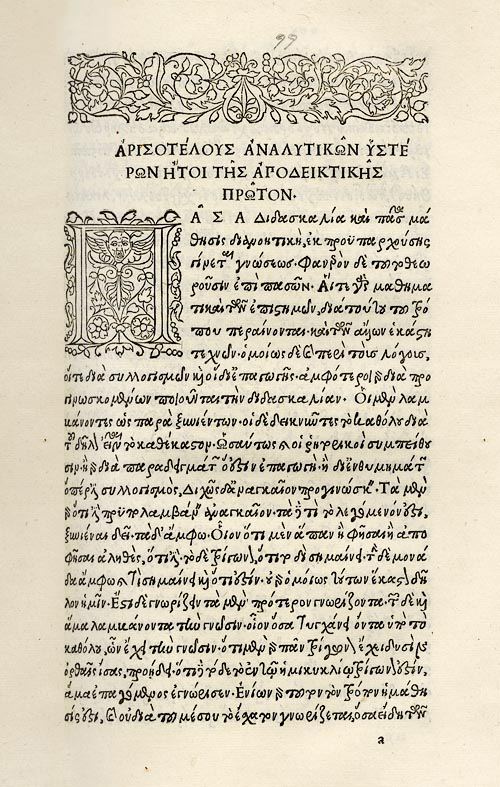
A page from Aldus printing of Aristotle
A page from one of the 5 volume set of “Aristotle” published by Aldus between 1495 and 1499

Aldus’ initial activity—and this would prove to be his most important accomplishment—was to edit and republish authoritative editions of the classics of literature. The initial project, a reissue of the Greek Grammar of Constantine Liscaris in 1495, was the first volume to be published under Aldus’ name although Andrea Torresani’s press likely did the printing.

A big breakthrough came in that same year with the publication in Greek of the first of a five-volume folio edition of the works of Aristotle. It would take four years to complete the project. This work has been referred to as the “greatest scholarly and printing achievement of the fifteenth century.” Aldus then went on to edit and publish Thucydides, Sophocles and Herodotus in 1502, Xenophon’s Hellenics and Euripides in 1503 and Demosthenes in 1504. In the decade before his death, Aldus also published editions of Latin and Italian classics. 

Aldine Press printers mark
The Aldine Press trademark symbolizing the adage “Festina lente” (Make haste slowly)

By 1496, had his own printing operation and began using various forms of “at Aldo’s” to signify the source of his publications as what later became known as the Aldine Press. In 1498, Aldus began using the Aldine Press trademark—the emblem of the dolphin wrapped around the anchor that symbolized the Latin phrase “Festina lente” (Make haste slowly)—on all of his works. At this point Aldus turned his attention to innovations in the forms of print, the first big contribution being in typography.

The typography of print as it arrived from Germany was in the Gothic form of heavy, “gross” lettering as seen in the Gutenberg bible. By 1470, Nicholas Jenson—who had come to Venice from France—had transformed the printed word and created the Renaissance book with his slender roman typeface and capital letters.

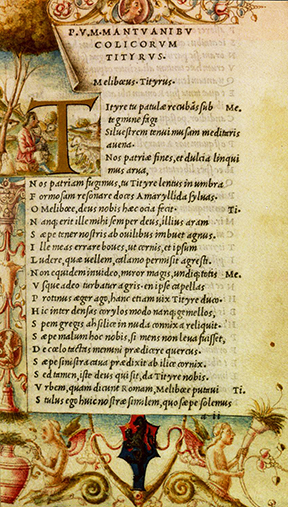
Title page from Virgil Opera with italics
Title page from Virgil’s Opera, the first book published in the Aldine italic typeface

Aldus began with Jenson’s typeface and reworked it into his own style for the Greek classics. His desire was to make the fonts look like the work of human handwriting. This effort would ultimately lead to the development of the “italics” that emulated cursive writing and also became known at times as the Aldino typeface. Francesco Griffo, to whom Aldus later paid tribute, performed the actual artistry of cutting the slanted italic. The first book that contained Aldus’ italic font was the 1501 Aldine Press edition of Virgil’s Opera.

The early period of printing—from 1450 to 1500—is often referred to as the “incunabula” or cradle of printing. At that time, most books were printed in folio format, i.e. page sizes of approximately 14.5” by 20” (the pages in the Gutenberg bible are approximately 17” x 24.5”). These were very large books that could be read wherever they were located; they were not portable.

This is when Aldus made another historic advancement. As explained by Helen Barolini in her Aldus and his Dream Book, “The real revolution, the moment of true divulgation of the printed word that impelled Western society … came when Aldus brought out his edition of Virgil’s Georgics in elegant, octavo format that was to become the staple of the Aldine press and Aldus’ trademark.”

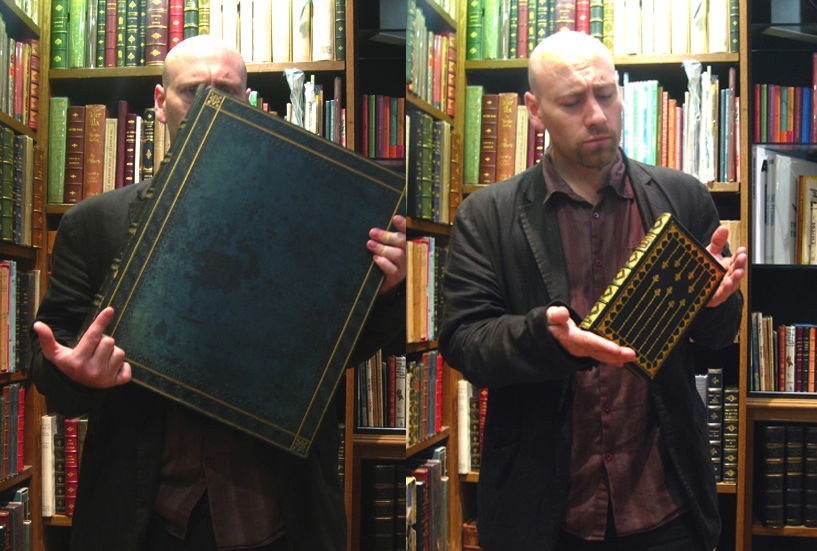
Comparison of folio to octavo book dimensions
A comparison of folio and octavo book dimensions, courtesy ILAB.
Aldus created the first octavo book.  

The octavo format is approximately 7.25” x 10,” something very close to what would be found today in a bookstore. Aldus produced the very first modern book that was small enough and inexpensive enough for someone to take with them almost anywhere.

Aldus’ other innovations included a unique method for bookbinding sometimes referred to as “binding in the Greek style” and advancements in punctuation such as the creation of the semicolon and the modern comma.

Aldus Manutius married Maria, the daughter of Andrea Torresani—the owner of a printing firm with whom he had worked early on in Venice—in 1505. Aldus died on February 6, 1515. His brothers-law took over the Aldine press and ran it until 1533 when Aldus’ third son Paulus Manutius assumed control of the business. It is believed that the Aldine Press published more than 1,000 titles in the hundred years that ended in 1595.

The scholar, humanist, publisher and printer Aldus Manutius was a monumental figure of the Renaissance. He was a force for the expansion of literacy and knowledge for everyone. Fortunately, his books have survived and there is a substantial record of his work including his own words that were often printed in the preface of Aldine Press books. In the Thesaurus Cornucopiae of 1496, Aldus wrote:

“My only consolation is the assurance that my labors are helpful to all … so that even the ‘book-buriers’ are now bringing their books out of their cellars and offering them for sale. This is just what I predicted years ago, when I was not able to get a single copy from anyone on loan, not even for one hour. Now I have got what I wanted: Greek volumes are made available to me from many sources … I do hope that, if there should be people of such spirit that they are against the sharing of literature as a common good, they may either burst of envy, become worn out in wretchedness, or hang themselves.”

The birth, life and afterlife of newspapers

The year 2014 marks twenty-five years of the World Wide Web. If you search online for “The birth of the web” you will find a link to the page from the website of CERN (European Organization for Nuclear Research) devoted to the Web’s invention.

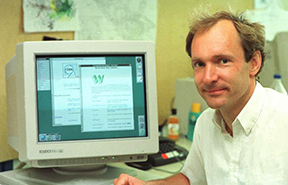
Tim Berners-Lee
Tim Berners-Lee at CERN in the 1990s

In March 1989, software engineer and networking specialist Tim Berners-Lee submitted a proposal at CERN for an online system of information sharing among 10,000 scientists in over 100 countries. His basic concept was to merge personal computers, networks and hypertext into a global information system. Originally calling the system “Mesh,” the proposal refers to a “web” of documents where a “hypertext browser” could be used to view data and information.

There are many important facts to be found on this page about the creation of the web by the 33-year old English-born Berners-Lee and how his idea produced the most important media technology innovation of our lifetime. If you are inclined, you can actually view Berners-Lee’s original draft proposal in HTML, text or as a PDF of the printed MacWord document that was distributed at CERN.

Although it is commonplace today, our ability to view and read these documents online from anywhere, at any time is a product of the very transformation that they brought about. But the web is not only the repository of viewable documents from the moment of the web’s invention forward; it is also becoming the online warehouse of documents that previously existed only in printed form.

Among the expanding digital library of printed archives is the vast universe of the world’s newspapers. Next to books, newspapers are the second most important paper-based knowledge and information source. And—due to their monthly, weekly or daily frequency—newspapers are the only existing chronological record of so many accomplishments, endeavors, hobbies, errors and catastrophes of people on a local, national and global scale.

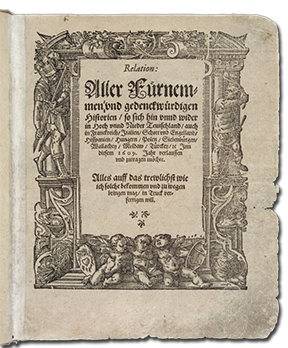
Title page of the “Strasbourg Relation” published by Johann Carolus in 1609

Newspapers as a form of print communications began in the early seventeenth century. The first newspapers were circulated in Germany and the expansion of the form is closely associated with the spread of the printing press (hence the term “press” to describe these publications). It is said that the Strasbourg Relation, printed by Johann Carolus beginning in 1609, was the first newspaper to appear because it had a publishing frequency and contained a variety of news items.

In the 1600s, newspapers spread rapidly throughout Europe (Holland, England, France, Portugal, Spain, Sweden and Poland) and also to the American colonies. In 1690 Benjamin Harris published the first American newspaper in Boston called “Publick Occurrences Both Forreign and Domestick.” It lasted for one issue before colonial authorities shut it down.

Alongside political pamphlets such as Thomas Paine’s spectacularly popular Common Sense, American newspapers played a critical role in the revolution of 1776. Benjamin Franklin was a leading publisher—having financed numerous printing establishments throughout the colonies—and worked on a plan for an inter-colonial network of newspapers.

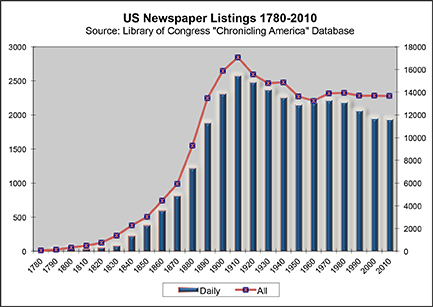
The era of the dramatic rise of newspapers began with the industrial revolution. As depicted in the graph of data from the Library of Congress project called “Chronicling America,” newspapers exploded across the United States throughout the 1800s. Paralleling the westward expansion and the rapid population increase across the country, the number of newspapers shot from 329 in 1800 up to 15,872 by 1900 and reached a peak at 17,083 in 1910. The number of daily newspapers in the US also reached an apex in the same time frame, with more than 2500 by the end of the first decade of the twentieth century.

US Newspaper Listings 1780-2010

While the communications technology advancements of the 1800s—innovations in printing, typesetting, photographic reproduction and distribution as well as the telegraph—accelerated the process and reduced the cost of print publishing, significant news media alternatives to newspapers emerged in the twentieth century. First commercial radio in the 1920s and then television in the 1960s augmented the newspaper business.

In our time, the Internet and the World Wide Web have had a similar, albeit more dramatic, impact on newspapers. However, newspapers continue to exist and, although daily papers have been falling steadily since 1980, the total number of newspaper in the US has been flat since 1990 and is greater today than it was in 1960.

The point here is that the majority of two hundred years’ worth of newspaper pages lie in physical archives, some well maintained while others are deteriorating by the hour. Efforts to preserve printed newspapers by converting them to searchable database of scanned images and OCR (optical character recognition) text have been mounted, although not without challenges and difficulties.

For example, Google launched with great fanfare, a news archive of the world’s newspapers on June 6, 2006. This initially turned out to be the database of PaperofRecord.com, a firm that had been acquired by Google. But later, on September 8, 2008, Google announced the expansion of the concept with the launch of an indexed database of scanned newspapers dating back to the 1800s. This project scanned some 2,000 archives.

But on August 14, 2011, without notice or explanation, Google cancelled its news archive service. Having previously gone through a lengthy and debilitating legal fight over the Google Books program, it appeared that the search giant had been bullied by the prospect of a long drawn out fight with newspaper publishers over copyright issues.

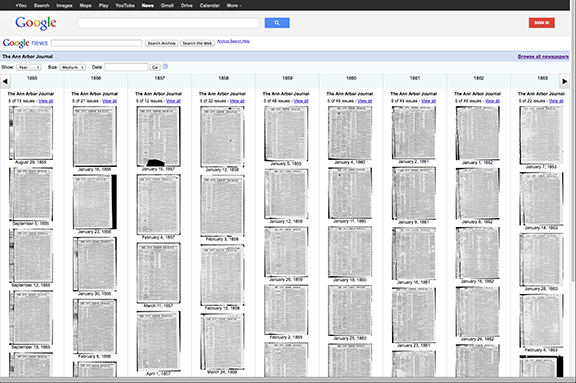
As of December 2013, the Google news archive of more than 2,000 of the world’s most important newspapers has become accessible and searchable at: http://news.google.com/newspapers

Google Newspaper Achive
Google news archive

One of the advantages of the Google archive is that it is open and freely searchable. However, initiatives to create free access newspaper archives—such as the Library of Congress at http://chroniclingamerica.loc.gov where 6.6 million newspaper pages from 1836 to 1922 have been made available to the public—are overwhelmed by subscription and fee-based online sources. Some systems offer sophisticated search tools combined with subscription and/or membership fees.

A comprehensive listing of both the “free and pay wall blocked” digital online newspaper archives has been published on Wikipedia: http://en.wikipedia.org/wiki/Wikipedia:List_of_online_newspaper_archives

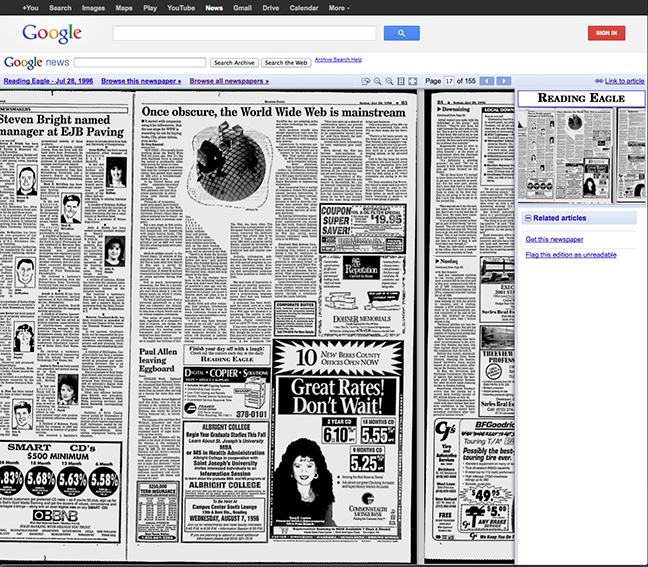
Page from the July 28, 1996 edition of the Reading Eagle as viewed in the Google news archive

Browsing the Google news archive, it is interesting to look back and read how the World Wide Web was viewed around the time that it was developed. An article “Once obscure, the World Wide Web is mainstream,” appeared on page 17 of the Reading Eagle of Reading, Pennsylvania on July 28, 1996. With 12 percent of the US population over age 16 at that time accessing the Web, Associated Press journalist Evan Ramstad noted, “the Web in a decade or so may be so common that people won’t think about it. Like the phone system on which it relies, the Web will just be there.”

http://news.google.com/newspapers?id=9lQlAAAAIBAJ&sjid=56UFAAAAIBAJ&pg=934%2C5597694

Fortunately, the newspaper archives hosted on the Web have also made it possible for us to find and read today what was being said and written about the Web while it was being created.