Eduard Hoffmann: 1892 – 1980

Eduard Hoffmann
Eduard Hoffmann

It is a fact of typographic history that the font Helvetica exists today because of Hamburgers … but not the food “Hamburgers.” Eduard Hoffmann, the creator of the ubiquitous typeface, knew the word “Hamburgers” contained the complete range of character attributes in the alphabet; he knew that from this one word the quality of a typeface design could be evaluated, that the features of its anatomy could be examined.

And so, early on in the design of the precursor to Helvetica—called Neue Haas Grotesk—Eduard Hoffmann of the Swiss-based Haas Type Foundry wrote to his designer and confident Max Miedinger, “But our first priority is the word ‘Hamburgers.’ It is the universal type founders’ word that contains all the varieties of letters.”

Helvetica is probably the most successful typeface in all of history. It is everywhere, all the time and there are reasons for this: Helvetica is neutral and easy to read; its different weights and styles effectively embody almost any meaning or message. Helvetica is plain but it is also modern and timeless.

Helvetica came about when typography and printing technology were moving from the metal casting, mechanical and letterpress era to the electronic phototypesetting, word processing, laser imaging and computer age. It rode atop this transformation and became the first truly international typeface. By the mid-1960s, Helvetica emerged as a global standard for public signage, corporate identity and communications.

Sampling of Helvetica Logos
A sampling of corporate identities that use Helvetica.

Regardless of one’s personal opinion of the esthetics and usefulness of Helvetica today, its creation and development—the people who developed it and how they developed it—is one of the most important accomplishments of twentieth century graphic arts.

Eduard Hoffmann was born on May 26, 1892 in Zurich, Switzerland. As a student, he studied technology and engineering in Zurich, Berlin and Munich with a specific interest in aviation. In 1917, the 25-year-old Hoffmann took a position under the direction of his uncle Max Krayer at Haas’sche Schriftgiesserei (Haas Type Foundry) in Münchenstein, Switzerland and made a commitment to the profession of typography. In 1937, Eduard became co-manager of the company with Krayer, and after his uncle’s death in 1944, became sole manager where he remained until his retirement in 1965.

As early as 1950, Hoffmann made a decision to introduce a new sans serif typeface into the Swiss market that could compete with those coming from the other European countries. The origins of san serif typefaces date back to the late eighteenth century where it was used with an embossing technique to enable the blind to read. The first fully developed sans serif (also known as grotesque or grotesk) made its appearance in Germany around 1825 and a French type founder first used the term sans serif (without decorative extensions) in 1830.

The sans serif types that Hoffmann wanted to compete with originally became popular and successful in the late nineteenth century. This was true of Akzidenz Grotesk of the Berlin-based H. Berthold AG type foundry, for example, which was originally designed in 1896. But there were neo-grotesk faces that had since entered the market, Bauer’s Folio and Frutiger’s Univers for example, that threatened to eclipse Hoffmann’s venture.

In 1956, as grotesk font use was surging in Europe, Hoffmann thought the timing was right to attempt a specifically Swiss variety. He contacted Max Miedinger, who had been a salesman and type designer at the Haas Type Foundry for the previous ten years, and wrote “he was the only man to design a new typeface for Haas.”

Max Miedinger
Max Miedinger

Miedinger’s role in the process was decisive and many credit him more than Hoffmann for the creation of Helvetica. It is true that Miedinger made the original hand-drawn letters of the alphabet. But the esthetic component was only one side of the value that Miedinger brought to Haas. It was his in-depth knowledge and relationship with the customers of the type foundry that made Miedinger indispensible to the success of Neue Haas Grotesk and later Helvetica.

Miedinger had access to some of the most brilliant Swiss graphic artists as well as advertising representatives from major Swiss corporations—the chemical firm J.R. Geigy AG among them—and through a painstaking and collaborative development process headed up by Hoffmann, Neue Haas Grotesk took shape.

Throughout 1957 and 1958, the two men collaborated back and forth, fine-tuning each character. The record of the exchange between Hoffmann and Miedinger has been preserved and can be followed in detail in the book, Story of a Typeface: Helvetica forever. The book includes photographic reproductions of the letters the men wrote to each other as well as Hoffmann’s project notebook.

Eduard Hoffmanns Helvetica Notebook
A page from Eduard Hoffmann’s Helvetica notebook dated November 27, 1957.

Hoffmann knew that designing a great typeface was not only about the beauty and logical construction of each individual character, even though this was an important aspect. Each character had to fit together with all the other characters in the various combinations that make letters into words. There was also the technical question of how the typeface would look at different sizes and once it was printed with ink on paper.

As Hoffmann explained in 1957, “praxis has shown that a new typeface cannot be correctly and objectively evaluated until it is in printed form. But even then, it is quite curious to find that a letter might be very satisfactory in a word, while seemingly quite out of place in another context. This makes it necessary to consider its design anew, which usually leads to unavoidable compromises.”

Once they were satisfied with the basic letterforms and had designed enough weights and sizes—at that time, the Haas Type Foundry was punch cutting, engraving and typecasting by hand thousands upon thousands of individual characters in metal—the men took their product to market. With the help of some well-designed promotional brochures and an initial buzz at the Graphic 57 trade fair in Lausanne, Neue Haas Grotesk became a hit. By 1959, about ten percent of the printers in Switzerland were carrying it.

Haas Type Foundry Engraving
The engraving room at the Haas Type Foundry. Lintoype ceased the type casting operations at Haas in 1989.

The Haas Type Foundry was majority-owned by the German firm D. Stempel AG. In turn, Stempel was in a contract with the multinational Linotype Corporation for the production of machine manufactured metal type forms. In order to expand the appeal of Hoffmann and Miedinger’s typeface and to bring it to the world of mass production typography, especially in the US, Linotype’s marketing department pushed for Neue Haas Grotesk to be renamed.

Linotype initially suggested that it simply be named Helvetia (Latin for Switzerland). Hoffmann felt that, although it was distinctly a Swiss product, the typeface could not have the exact same name as the country. He came up with Helvetica, which means “The Swiss Typeface,” and all involved accepted the new name developed by its creator.

Into the 1960s, Helvetica gained spectacular popularity and was adopted as the “in-house typeface” of various international corporations, many of which still use it to this day. Commentary on the significance and social driving force behind the success of Helvetica has often referred to post-war economic expansion. There was a thirst in the 1950s within the creative community for visual clues that conveyed optimism about the future. Designers wanted an excessively modern look that helped to put the bad memories of the first half the twentieth century far behind. For many, Helvetica accomplished this goal.

In 1971, Eduard established a foundation with the aim of creating a museum dedicated to the printing industry. In 1980, in the former Gallician paper mill on the Rhine, the museum opened with Hoffmann’s collection of papers on the history of the Haas Type Foundry as one of its main attractions. Eduard Hoffmann died in Basel, Switzerland on September 17, 1980.

PIA forecast for printers: Industry transition in a slow-growth economy

ChartingAPath

On February 15, I received an email from Printing Industries of America President and CEO Michael Makin announcing a special report. Mr. Makin said the report “is designed to help you assess the key trends impacting the economy and print markets over the next 12–24 months.” He added that the special report assists companies “design strategies and tactics to help your firm take advantage of coming opportunities and address potential challenges.”

I downloaded “Charting a Path for 2013-2014: A Special Report”—written by PIA Senior Vice President and Chief Economist Dr. Ron Davis—and read it over carefully. Below is a summary of the report followed by a few of my own thoughts and observations.

Economic environment

In the introduction, Dr. Davis points out that the report had to be delayed pending the outcome of the government’s “fiscal cliff” discussion at the beginning of the year. Davis says the debate resulted in a “question mark” on fiscal policy. Therefore the PIA forecast on the economy as a whole is for “restrained expansion as the economy’s natural bias for growth trumps unresolved fiscal policy choices.”

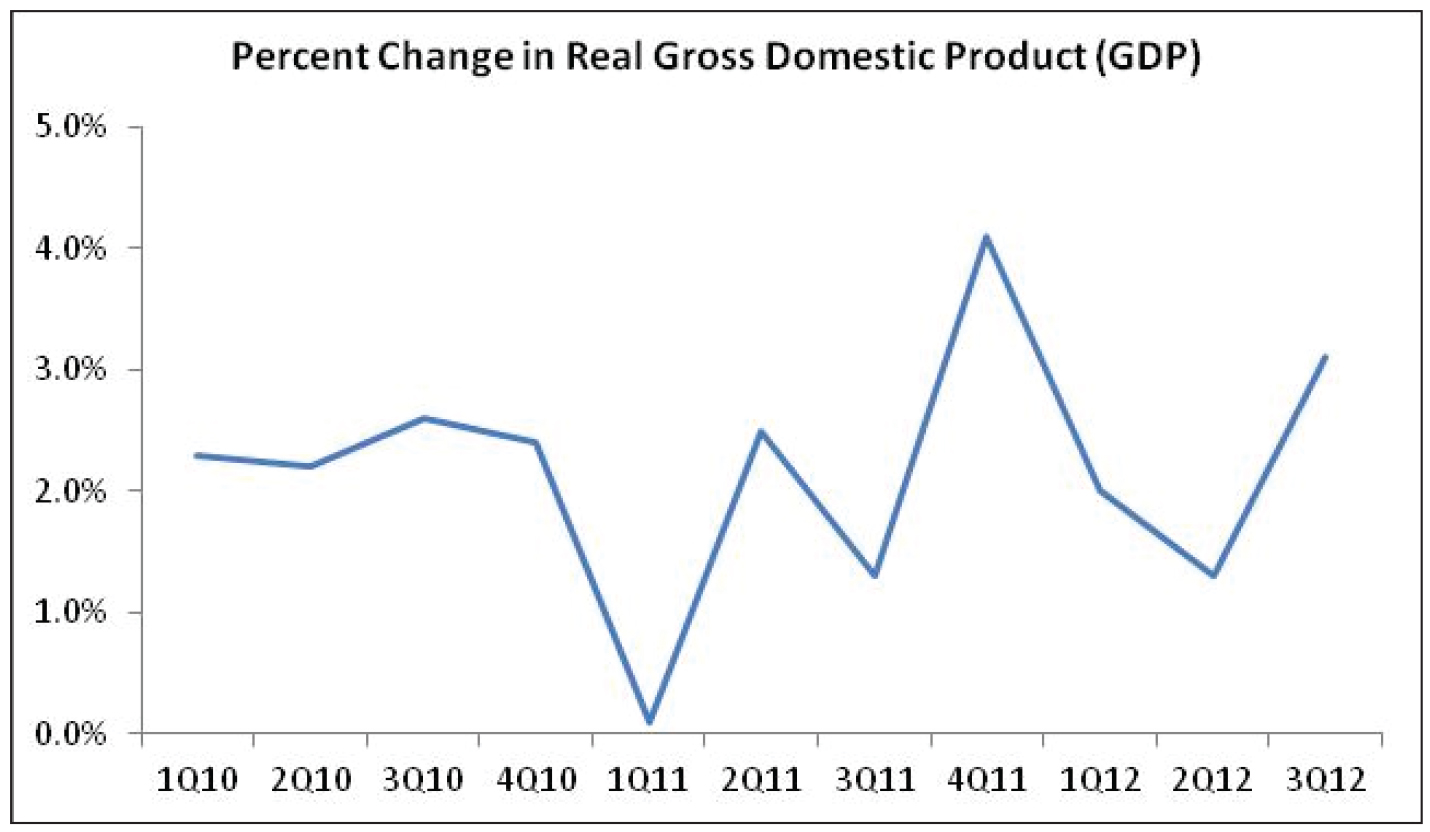
PercentChangeinGDPThe first section of the report reviews the recent economic past. A chart of “Percent Change in Real GDP” shows a marginally upward trend since the first quarter of 2010, with growth hovering around 2%. Dr. Davis says, “The economy continues to improve, but at a very modest pace … a rate just above stall speed, making the return to recession a distinct possibility.”

Turning to the printing markets, according to the current PIA definition of the industry, it includes “printing and related support activities (Economic Census code 323) plus printing related media (Economic Census code 511).” Based on this, the printing industry represented $158 billion in annual shipments in 2011, there are approximately 48,000 establishments employing over 1 million people. The printing industry is the most geographically dispersed industry in the US with a significant presence in all 50 states. The bad news is that even with this expanded definition of the industry, “establishments and employment have declined for both categories.”

The negative pressures on the printing industry are a combination of a weak economic climate and what PIA calls, “significant challenges from a very competitive environment—both among printers and between print and other media.” At the conclusion of the section on the economy, the report notes a very important transition point, “For the first time ever, marketers spent more on digital advertising than print advertising in 2012.”

Printing firm performance

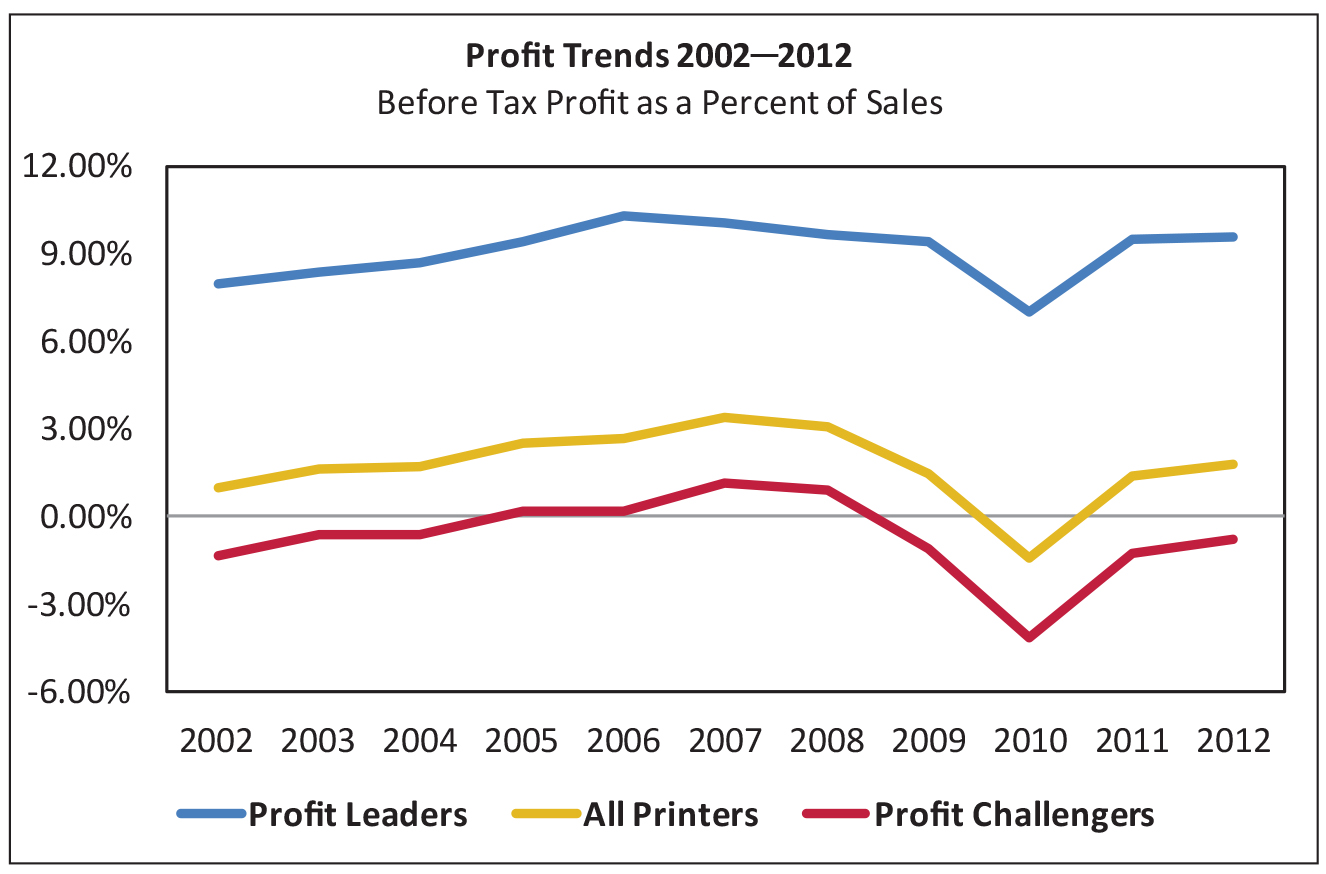
The second section of the document deals with financial performance during and since the Great Recession of 2007-2009. PIA printing firm data known as the Ratios shows that the industry as a whole exited the recession in 2010 and that trend continued in 2011. The report says, “These results put a hard end to the economic downturn, dispelling fears of the return to recession.”

ProfitTrendsStill, the picture of the past two years is not same for all firms. In 2011, profitability was lowest on average for all small to medium firms (under $10 million in annual sales) and better for larger firms ($10 million and up), but none of the categories were greater than 2.9% profitability. The entire industry has yet to return to pre-recession profitability numbers, even the most successful companies.

Other elements of financial performance focused on changes in major cost items, productivity trends and profitability by product specialty. According to the PIA ratios, industry profit leaders in 2012 “did not experience an increase in productivity … This unexpected result may have occurred due to the Profit Leaders’ slight reduction in the wages paid per employee either dropping slightly or staying the same, which might correlate to more production employees with fewer overtime hours.”

Sales vs. profitability

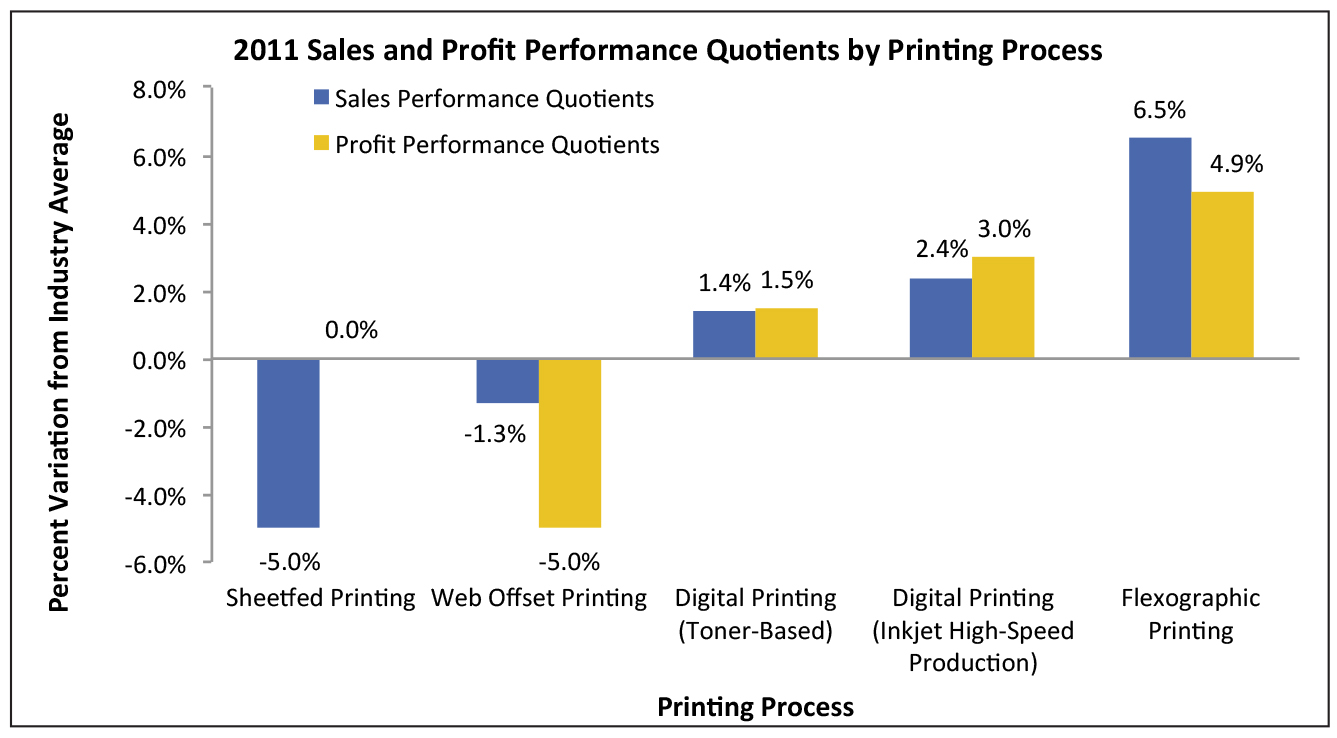
The third section of the report draws a correlation between sales and profitability. Dr. Davis uses something called a “profile performance quotient” to characterize firms based on demographic and geographic criteria. The quotient is a comparison of the overall industry averages to the particular category average.

SalesandProfitPQbyProcessThis section shows a clear indication of the sales and profit potential of digital printing (both toner and ink jet based) as well as flexographic printing. It also reveals that the sales and profit performance quotients for both sheetfed offset and web offset were particularly low.

An important finding in the PIA analysis is that “sales and profit performance often track in opposite directions—at least for the demographic characteristics examined. As many printers have discovered, chasing sales may have a negative impact on profit if you don’t keep an eye on other factors that provide a competitive advantage.”

Looking ahead

The last three sections of the report are devoted to: a.) What to expect over the next two years (2013-2014), and b.) What printing firms should be doing now to align themselves strategically with these trends.

The report says that over the next two years the PIA’s forecast “calls for a continuation of the slow economic growth that we have experienced over the past year—around 2 percent adjusted for inflation.” Print related media will continue its steady decline but at a slower rate of 2 percent each year instead of the 4 percent more recently.

According to the PIA the keys to success in the environment over the next two years is the same as it has been over the past few years:

  • Know the place of print within the economic cycle
  • Know your print segment’s life cycle and competitive environment
  • Keep in tune with changes in prices, sales volumes and costs
  • Check your strategy against the development of print product function
  • Develop your staff and stay focused on “attitude”

The next decade

The concluding section of the PIA forecast goes into a projection for the industry through the year 2021. There are two scenarios presented. Depending on how the industry is defined (either as just “Commercial Printing & Related Support Activities” or this plus “Print-related Media”), the industry is project to either grow in size from $82.8 billion to $89.8 billion or contract from $158.6 billion to $143.6 billion over the next 8 years.

“The reason why adding print-related media into the model causes overall sales to decline is that this sector accounts for 49% of total industry sales and 95% of ‘print-related media’ services the function of print intended to inform and communicate, which is forecasted to decline by 4% per year over the next ten years.”

The bright spots in the decade ahead forecast are in packaging (product logistics print) and print intended to market, promote and sell. In these categories, both economic forecast scenarios show similar growth rates by 2021.

Thinking it through

In my opinion, the PIA’s economic forecast is ambivalent. Perhaps this reflects the contradictory nature of the environment: on the one hand, the recession has reached a “hard end,” but, on the other hand, economic growth will be very slow and uncertain due to the federal budget deficit and the government’s response to these problems. This outlook does not instill a sense of confidence for business owners to take risks when industry profits—even though they are rising—are still below prerecession levels.

Meanwhile, the PIA report shows that opportunities for digital print and media offerings bring promise for printers. Customers are rapidly adding more data driven, mobile and online marketing and communications at the expense of their traditional offset print programs. Printing companies that have found the means to move into these product and service areas and, at the same time, have managed to keep the fixed costs of their offset business under control are well positioned today.

The business environment remains complex: printing firms must continue to navigate the combined impact of slow or stalling overall economic growth and the transition of the industry from traditional to digital systems, products and services. The PIA report provides important insights into this process.

Stanley Morison: 1889 – 1967

stanley-morison
Stanley Morison, May 6, 1889 – October 11, 1967

In 1930 Stanley Morison wrote, “Typography is the efficient means to an essentially utilitarian and only accidentally aesthetic end, for the enjoyment of patterns is rarely the reader’s chief aim. Therefore, any disposition of printing material which, whatever the intention, has the effect of coming between the author and the reader is wrong.”

This is taken from Morison’s essay First Principles of Typography, which became in the decades that followed an industry manual of book typesetting standards, especially in America. By the 1930s, Stanley Morison had acquired a remarkable depth of knowledge and experience in printing. He understood better than most the importance of the “invisible” beauty and subordination of form to function in typography.

First Principles of Typography (small)Morison’s first principle still applies today: when it comes to typographic design and style—especially in books—easing the comprehension of the text is the primary objective. “Dullness and monotony” and “obedience to convention” are preferred over “eccentricity or pleasantry” and “typographical experiment.” A text is useless if it is hard to read because it is “different” or “jolly.”

One might conclude from the above that Stanley Morison was opposed to typographic innovation, but nothing is further from the truth. Within a year of writing his tribute to typographical tradition, Morison would develop and design—in collaboration with the graphic artist Victor Lardent—one of the most widely used typefaces in history: Times New Roman.

Stanley Arthur Morison was born May 6, 1889 in Wanstead in Essex between London and Epping Forest. As a child of seven or eight, the family moved to north London. Stanley lived at this location on Fairfax Road, Harringay until he was 23 years old.

Stanley was largely self-taught. He left school at age 14 to find work after his father—who was a traveling salesman—abandoned the family. His mother was strong-willed and inspired Stanley to serious and independent study. He was influenced by her to take up philosophy and a study of ancient manuscripts (palaeography), spending his spare time at King’s Library at the British Museum.

The Imprint (small)
Stanley Morison was an editorial assistant for the “The Imprint” magazine in 1913.

At age 23, while working unhappily as a bank clerk, Stanley read a supplement published by The Times that carried an ad about the start of a new magazine on printing called The Imprint. After the first issue appeared in January 1913, he applied for and was hired as an editorial assistant. This job would prove to be the beginning of the extraordinary graphic arts career of Stanley Morison.

During World War I, Morison was imprisoned for being a conscientious objector. Following the war, Stanley underwent a conversion to Catholicism and began a study of liturgical writings, hymnals and other early church publications. In 1919, he became design supervisor for Pelican Press and in 1921 published his first typographical study: “The Craft of Printing: Notes on the History of Type Forms.”

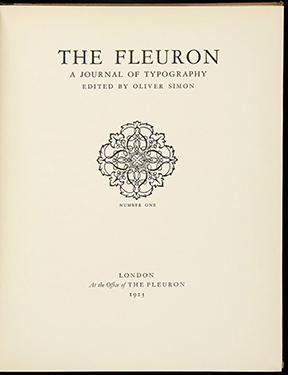
In 1922—along with Francis Meynell, Holbrook Jackson, Bernard Newdigate and Oliver Simon—Stanley became a founding member of the type-centric Fleuron Society (a fleuron is a typographer’s floral ornament). Seven volumes of their journal called The Fleuron appeared between 1923 and 1930. Each lavish edition contained papers, illustrations, specimens and essays by contemporary authorities on typography and book design.

The Fleuron (small)
The first issue of “The Fleuron,” journal of the Fleuron Society of which Stanley Morison was a founding member.

The scholarly works contained in The Fleuron remain relevant today as the material spans all publishing forms (print and electronic) and technologies (conventional and digital). It was in this publication that Morison’s “First Principles of Typography” originally appeared.

In 1923 Stanley Morison became a typographic consultant for the Monotype Corporation. Monotype was a manufacturer of hot metal casting machines that industrialized and revolutionized in the 1880s—along with Linotype Corporation—the process of making type for print. While the Linotype machine cast complete lines of type primarily for newspaper publishing, the Monotype machine cast individual characters and was often used in book and other “fine” printing.

During the remainder of the 1920s, Morison became involved in Monotype’s program of old style type revival. Sparked by technological innovation, the first few decades of the twentieth century witnessed a typographic renaissance. At Monotype fonts such as Bodoni, Baskerville, Bembo, Centaur, Perpetua and others were reinterpreted and recut under Morison’s direction.

In 1929 Stanley Morison publicly criticized The Times for being poorly printed and typographically antiquated. Following discussions with the publisher, Morison was hired as a consultant and commissioned in 1931 to develop a new, easy-to-read typeface for the newspaper. His task was to design a font that was economical—capable of fitting more copy in a column than previous typefaces—as well as technically compatible with the printing machinery of the time.

Morison began his work with an authoritative historical survey called The typography of The Times that showed the evolution of its type. Morison presented to the publisher a folio with 42 full-size reproductions from the earliest days in the eighteenth century into the 1920s to make the case for his solution.

Tally of Types (small)
Morison’s description of the development of Times New Roman in “A Tally of Types.”

In “A Tally of Types” in 1953, Morison wrote that he “penciled the original set of drawings, and handed them to Victor Lardent, a draughtsman in the publicity department of Printing House Square,” who Stanley “considered capable of producing an unusually firm and lean line.” The drawings were then used by Monotype to cut the punches for the first set of Times New Roman types. The first issue of The Times to use the new typeface appeared on October 3, 1932.

As a historian, Morison was appreciative of the accomplishments of others before him that made his work possible. In summing up the experience with the typography of The Times, Morison explained, “Above 14,750 punches, including those corrected (a large number), were cut by Monotype Corporation for the installation at Printing House Square. … Their cutting was a triumph for the mechanism invented by Linn Boyd Benton of Milwaukee. In 1885 he adapted the pantograph principle to the mechanical cutting of the punches used for striking the matrices from which the type is cast. This invention lies at the basis of all mechanical composition, which requires at some stage the pouring of metal into a single matrix or line of matrices.”

Following the achievement of Times New Roman, Stanley Morison continued his design consulting work with Monotype and The Times for three decades. He became editor of the History of the Times from 1935 to 1952 and he was also editor of The Times Literary Supplement between 1945 and 1948. He spent his later years on typographical research. Although he was offered a knighthood in 1953 and the CBE in 1962, he declined both. He was elected a Royal Designer for Industry in 1960. He died on October 11, 1967 at the age of 78.

It is difficult to appropriately summarize the work of a figure such as Stanley Morison in this small space. Although his writings have never been brought together into a single collection or set of volumes, Morison was a prolific scholar and practitioner of the graphic arts. He was perhaps the most important theoretician, designer and historian of print in the twentieth century.

Postscript

In 1994, printing historian Mike Parker published findings that showed Times New Roman was based upon a design originally made by William Starling Burgess in 1904. A complete review of Parker’s story can be found in an article titled “The history of the Times New Roman typeface” on the FT Magazine web site (http://on.ft.com/M7kYD3). Although still controversial, The Times began in 2007 accepting the possibility of an alternative history to the one provided by Morison about the origin of the famous font. According The Times web site, Times New Roman was designed by Morison, Lardent “and possibly Starling Burgess.” In 2009, Mike Parker worked with The Font Bureau, Inc. and published a font series called Starling based upon Burgess’s original conception.