
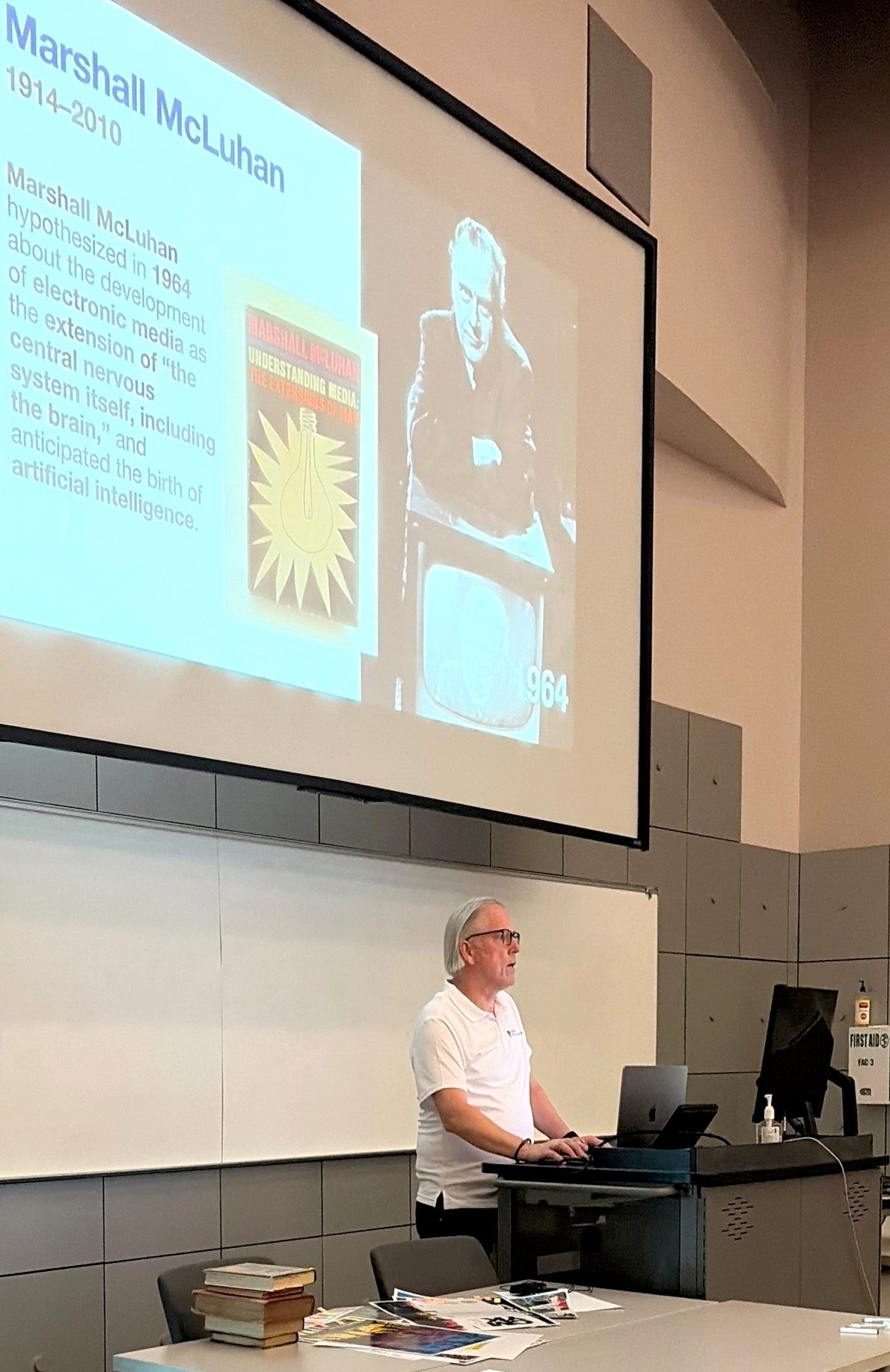
On July 19-22, I attended the 2026 Conference of the Graphic Communications Education (GCEA) Association at Pittsburg State University (PSU) in Pittsburg, Kansas. I was one of the speakers at the conference and delivered a short presentation to the attendees on my book, “As If By Chance: Sketches of Disruptive Continuity in the Age of Print from Johannes Gutenberg to Steve Jobs.”
This was the 101st conference of GCEA. The membership of the organization consists of high school, technical school and college and university educators who teach classes in numerous disciplines within the printing and graphic communications industries.
This was the first time I attended the GCEA conference. It was originally introduced to me two years ago by my friend, Mike Stinnett, who is a retired high school graphic arts teacher from Royal Oak, Michigan.
The conference program was exceptional from the opening keynote, which was delivered by Bill Gardner, the owner and creative director of the design agency Garder Design, from Wichita, Kansas. Bill’s presentation, which focused on the changing conception of corporate identity in our multimedia world, was outstanding.
I attended the conference sessions between, many of which were given by members of GCEA. The conference theme was built around “Enduring | Embracing | Empowering” with an emphasis on artificial intelligence (AI) and its impact on teaching in the graphic communications. I learned many important things about how AI is being implemented in schools and some of the challenges that it poses to both educators and students.
I am pleased to report that the overall sense of those in attendance was to embrace the powerful new technology while also establishing guidelines for its use in a school environment.
Presentation of my book
On the final day of the conference, I gave my presentation, which focused on the basic ideas contained in “As If By Chance” and why it is of critical importance to students that they be provided with a historical understanding of the origins and development of our industry.
For one, printing and graphic arts have been around for nearly 600 years. Having knowledge of how printing started and the transitions it has gone through over the generations gives students both an understanding of the technological changes over the centuries as well as a view of world history going back to the Middle Ages.
Additionally, learning about the inventors and their innovations teaches students that they too can participate in our own time in technologically disruptive continuity, i.e., the way that breakaway technologies emerge as something entirely new out of the things that have previously existed.
The GCEA members that attended my presentation participated actively by answering my questions—some received a copy of my book—making comments and asking their own questions. I also distributed a copy of a Teachers’ Guide to teaching the content of “As If By Chance.”
An important part of the conference was a road trip to visit two print businesses in the Pittsburg, Kansas area. We toured Miller’s Professional Imaging, a printing company that produces photographic prints, photo cards, photo albums and books, wall art and fine art prints. The second printing firm we visited was Kendall Packaging Company, a producer of flexible packaging for food and retail products.
Pittsburg State University
The highlight of the conference was meeting and getting to know our hosts at Pittsburg State University (PSU). We not only learned that the university mascot is the Gorillas of Pittsburg State but that there is an exceptional printing and graphics arts program at the school.
With a faculty of eight professors covering various disciplines, Pittsburg State offers a Bachelor of Science in Technology degree in Graphic Communications. Among the areas of focus for students are graphic design, UI/UX (User Interface/User Experience) and web design, print media and packaging design and photography and videography.
The graphic communications facilities at the Crossland Technology Center are impressive. Among the most significant and unique is the consumer products and packaging production studio. In this area, students use the latest in folding carton and corrugated box design and production. I saw many examples on display of structural prototypes that involved physically cutting printed substrates designed for retail products and exploration of product shelf-appeal, durability, and brand alignment.
The students are also learning about more traditional forms of print media such as prepress, magazine and book production as well as screen printing, wide format and vinyl and adhesive printing for commercial signage.
I have visited multiple college campuses during my career where graphic communications and printing is being taught. The offerings from PSU is state-of-the-art and unique. Plus, as I learned from Professor Emeritus and former Department Chair Dr. Jesús J. Rodriguez, Pittsburg State offers in-state tuition to 34 other states in the US. You can review this program, called the Gorilla Advantage, here. The current cost of in-state tuition plus on-campus room and board at PSU is approximately $10,259 per semester or $20,518 per year.
Pittsburg, is located in the southeast corner of Kansas near the border with Missouri to the east and Oklahoma to the south. Started as a coal mining camp, the town was named by its founders in 1876 after Pittsburgh, Pennsylvania. The name was later changed to Pittsburg with the “h” dropped at the request of the US Board on Geographic Names.
Pittsburg, Kansas was named without the “h,” in the late 1800s a project to standardize spellings across the country. The US Board of Geographical Names, after some feedback, allowed cities impacted by the change to petition to restore the “h.” Pittsburgh, Pennsylvania did this. There are now 19 cities or towns across the US named Pittsburg and only one named Pittsburgh.
While the identity of the town has changed over the decades and the university has come to define the identity of Pittsburg. I made a few trips into town and spoke with residents and found them to be very friendly to a visitor all the way from Michigan. The community is ideal for college students seeking to attend a small-to-medium size university and study graphic communications.

